
Collagen Peptides Benefits: What Does the Evidence Show?
Collagen peptides are widely promoted for skin, joints, bones, muscle and healthy aging. But do collagen peptides actually work?
The answer is more nuanced than most supplement marketing suggests.
Clinical research has reported potential benefits in several areas, particularly skin and musculoskeletal health, but the strength of evidence varies by outcome, product, dose, population and study quality. Some research is encouraging, while other high-quality analyses have challenged widely repeated claims.
The most useful way to understand collagen peptides benefits is therefore not to ask whether collagen is simply “good” or “bad,” but to examine what has actually been studied — and how strong that evidence is.
If you are new to the ingredient, start with our guide to what collagen peptides are.
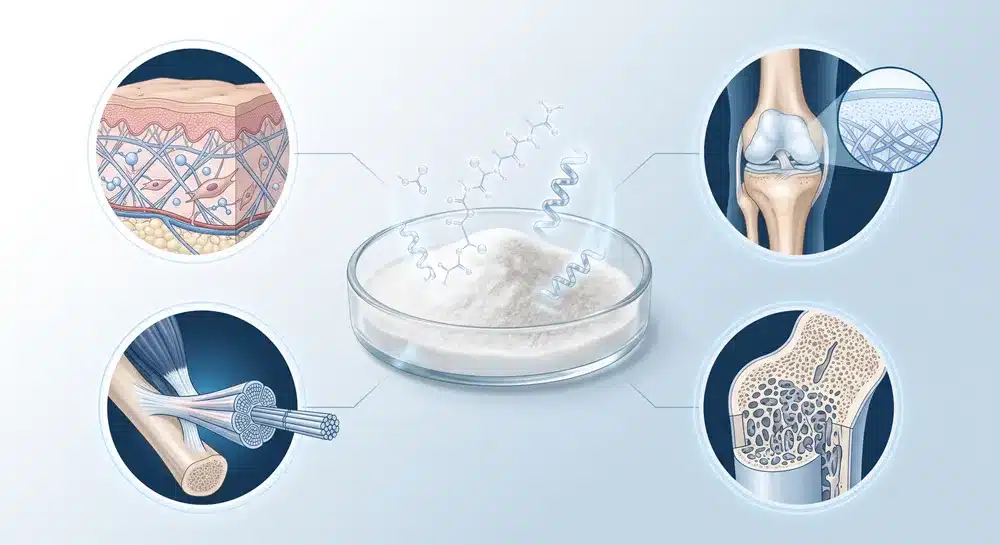
Collagen Peptides Benefits at a Glance
| Potential Benefit | Evidence Direction | What the Research Suggests |
|---|---|---|
| 피부 수분 공급과 탄력 | Mixed | Some trials and reviews report improvements, while higher-quality analyses have questioned the strength of the effect |
| Joint comfort and function | Moderate, condition-specific | Several controlled trials and meta-analyses report improvements, particularly in osteoarthritis populations |
| 뼈 건강 | Promising, population-specific | Specific collagen peptide studies in postmenopausal women have reported improvements in bone-related outcomes |
| Muscle and body composition | Emerging / promising with training | Some studies report benefits when collagen peptides are combined with resistance exercise |
| Tendon and connective tissue | 신흥 | Exercise-based studies suggest possible effects on collagen-rich tissue adaptation |
| 헤어 및 네일 | 제한적 | Popular claim, but high-quality clinical evidence remains limited |
| 장 건강 | Insufficient | Frequently marketed but not supported by strong clinical evidence |
| 체중 관리 | Insufficient | Not an established benefit of collagen peptides |
| Cardiometabolic health | Mixed | Some outcomes have been studied, but results are inconsistent |

The key point is that not every claimed benefit of collagen peptides has the same level of scientific support.
Do Collagen Peptides Work?
Collagen peptides may produce measurable effects in certain circumstances, but there is no single answer that applies to every person, product or health outcome.
Recent research illustrates why.
A 2026 umbrella review combining 16 systematic reviews, 113 randomized controlled trials and 7,983 participants found generally favorable results across several skin and musculoskeletal outcomes. However, cardiometabolic results were mixed.
At the same time, a 2025 systematic review and meta-analysis focused specifically on skin aging analyzed 23 randomized controlled trials involving 1,474 participants. When all studies were pooled, collagen supplementation appeared to improve skin hydration, elasticity and wrinkles.
But when the researchers looked only at higher-quality trials or studies without pharmaceutical-company funding, those significant skin effects were no longer observed.
These findings do not mean collagen peptides “never work.”
They show something more important:
The result can depend heavily on study quality, the exact collagen preparation, the population being studied and the outcome being measured.
That is why this page separates promising evidence 에서 established fact.
What Do Collagen Peptides Do in the Body?
Collagen peptides are produced by hydrolyzing larger collagen proteins into shorter peptide chains.
After they are consumed, they continue to undergo digestion. The body absorbs collagen-derived amino acids, including glycine and proline, as well as some small hydroxyproline-containing peptides.
Those nutrients and metabolites then enter normal circulation and metabolism.
This is different from the common marketing explanation that collagen powder travels directly from the digestive system to the skin or joints.
It does not.
Researchers have investigated several possible mechanisms, including the nutritional availability of collagen-associated amino acids and the potential biological activity of certain collagen-derived peptides. However, mechanisms observed in laboratory experiments should not automatically be treated as proof of a clinical benefit in humans.

If you want to understand the processing distinction first, read Hydrolyzed Collagen vs Collagen Peptides.
1. Collagen Peptides and Skin Health
Skin health is probably the best-known reason consumers take collagen peptides — and also one of the most debated areas of collagen research.
Clinical trials have investigated outcomes such as:
- skin hydration,
- elasticity,
- wrinkle appearance,
- dermal density,
- and transepidermal water loss.
Several earlier randomized trials and meta-analyses have reported improvements in hydration or elasticity after oral hydrolyzed collagen supplementation.
For example, a 2023 systematic review and meta-analysis of 26 randomized controlled trials reported statistically significant improvements in skin hydration and elasticity.
However, that is not the end of the story.
A 2025 meta-analysis published in The American Journal of Medicine examined 23 randomized trials. While the pooled results were positive, the researchers found no significant improvement in hydration, elasticity or wrinkles when they restricted the analysis to higher-quality studies or studies without pharmaceutical-company funding.

So what should we conclude?
A reasonable evidence-based position is:
Oral collagen peptides may support certain skin outcomes, but the magnitude and reliability of those benefits remain uncertain, and results should not be presented as guaranteed.
That is very different from saying collagen peptides “reverse aging” or rebuild lost collagen within a few weeks.
Product-specific dose, study duration and the exact collagen preparation matter.
2. Collagen Peptides for Joint Health and Mobility
Joint health has a different evidence profile.
Studies have evaluated collagen-based supplements in people with joint discomfort, active populations and individuals with osteoarthritis.
An updated systematic review and meta-analysis included 11 randomized controlled trials involving 870 participants with knee osteoarthritis.
The pooled results favored collagen supplementation for both pain and physical function.
However, the studies were highly heterogeneous, meaning there were meaningful differences between trials in ingredients, protocols, populations and outcomes.
This matters.
The evidence supports saying that:
some collagen-based supplements may help support joint comfort and function in specific populations.
It does not support saying that generic collagen peptides:
- rebuild damaged cartilage,
- cure osteoarthritis,
- or replace medical treatment.
Another important distinction is the form of collagen being studied.
Hydrolyzed Type I and III collagen peptides should not automatically be treated as equivalent to native or 변성되지 않은 II형 콜라겐. These are different ingredient categories with different mechanisms, serving sizes and evidence bases.
For supplement formulation, that distinction is critical when developing joint-health products.
3. Collagen Peptides for Bone Health
Bone is not composed only of minerals.
Its organic matrix contains a substantial collagen component, which is one reason collagen peptides have been investigated in bone-health research.
One frequently cited randomized controlled trial enrolled 131 postmenopausal women with age-related reductions in bone mineral density.
Participants received either 5 grams of specific collagen peptides per day or placebo for 12 months.
The collagen-peptide group showed significantly better changes in bone mineral density at the spine and femoral neck than the control group, together with differences in markers of bone turnover.
This is promising research.
But it should be interpreted within its actual context:
- the population was postmenopausal women,
- a specific collagen peptide preparation was tested,
- the serving was 5 g/day,
- and the intervention lasted 12 months.
It would therefore be inappropriate to conclude that every collagen peptide powder at every dose will produce the same result.
For a deeper discussion of this research and the role of collagen in the bone matrix, read our guide to 뼈 건강을 위한 콜라겐 펩타이드.
4. Collagen Peptides for Muscle, Body Composition and Recovery
Collagen peptides are also increasingly studied in sports nutrition and healthy-aging research.
Several randomized trials have combined collagen peptide supplementation with resistance training.
For example, studies using approximately 15 g/day of specific collagen peptides over 12 weeks have reported improvements in outcomes such as fat-free mass, body composition or strength in certain groups, including premenopausal women, middle-aged men and older men with sarcopenia.
More recent research has also investigated how collagen supplementation may affect collagen structures within skeletal muscle during high-load resistance training.
However, there is an important nutritional distinction:
collagen is not nutritionally equivalent to whey or another high-quality complete protein.
Collagen has a distinctive amino-acid profile rich in glycine, proline and hydroxyproline but lacks tryptophan and contains relatively low amounts of some essential amino acids important for muscle protein synthesis.
So collagen peptides should not automatically replace complete dietary protein in a muscle-building program.
A more defensible position is:
Collagen may have a complementary role in exercise and connective-tissue nutrition, particularly when combined with resistance training, but it should not be positioned as a superior replacement for complete protein.
Read more in Do Collagen Peptides Work for Muscle Recovery? 그리고 콜라겐 펩타이드도 단백질로 간주되나요?.
5. Collagen Peptides for Tendons and Connective Tissue
Tendons are collagen-rich connective tissues, making them another logical target for collagen nutrition research.
The most interesting evidence in this area usually combines nutritional supplementation with mechanical loading or resistance exercise.
For example, recent research in middle-aged men found that hydrolyzed collagen combined with 12 weeks of resistance exercise produced greater changes in several patellar-tendon structural and mechanical measurements than exercise with placebo.
That does not mean collagen peptides can “heal a torn tendon.”
Exercise stimulus, injury status, total diet and rehabilitation all matter.
The more evidence-aligned interpretation is that collagen nutrition may support connective-tissue adaptation when used in an appropriate exercise context.
For a detailed look at dosage, exercise context and formulation considerations, read 힘줄용 콜라겐 펩타이드.
What Collagen Peptide Benefits Are Not Well Supported?
Some of the most popular collagen claims have far less clinical support than skin or musculoskeletal outcomes.
Hair Growth
Collagen provides amino acids found in connective tissues, but direct clinical evidence showing that oral collagen peptides reliably increase hair growth or treat hair loss remains limited.
Hair loss also has many possible causes, including genetics, hormonal changes, nutrient deficiency, medication and medical conditions.
Collagen should therefore not be marketed as a hair-loss treatment.
손톱 강도
Small studies have explored collagen supplementation in brittle nails, but larger well-controlled trials are still needed.
This should be described as an emerging area rather than an established benefit.
장 건강
Collagen is frequently promoted for “healing the gut,” improving intestinal permeability or treating digestive disorders.
At present, these claims are not supported by strong clinical evidence.
That does not mean collagen has no nutritional role in the diet. It means the specific gut-health claims have not been established to the same standard as stronger areas of research.
체중 감량
Collagen is a protein ingredient and protein can contribute to satiety, but collagen peptides are not a clinically established weight-loss treatment.
A few individual trials have investigated body composition, but they are not enough to conclude that taking collagen peptides by itself causes meaningful weight loss.
두뇌 건강
Claims that collagen peptides improve memory, anxiety, sleep or general brain function are currently supported by much less evidence than the established structural-health research areas.
These claims should not be grouped together with better-studied outcomes as if they have equal scientific support.
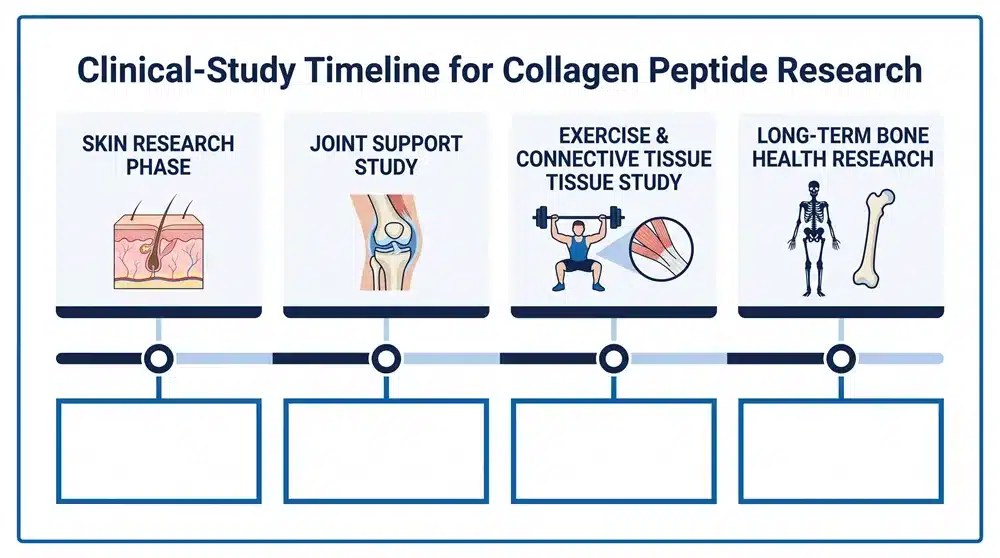
How Long Do Collagen Peptides Take to Work?
There is no universal timeline 콜라겐 펩타이드를 위해.
This is important because several searches — such as “how long does it take collagen peptides to work” — imply that there should be one predictable answer.
Research does not support that assumption.
Different outcomes are measured over very different periods.
| 결과 | Common Study Time Frame | What That Means |
|---|---|---|
| Skin hydration / elasticity | Often around 8–12 weeks | This is when many trials measure outcomes, not a guaranteed time to visible results |
| Joint symptoms | Often several months | Effects, when observed, generally require consistent use rather than a few days |
| Exercise / body composition | Commonly around 12 weeks | Usually studied together with structured resistance training |
| Tendon adaptation | Around 12 weeks or longer in training studies | Mechanical loading is a key part of the intervention |
| Bone mineral density | Often many months | A key postmenopausal trial lasted 12 months |
A study lasting 12 weeks does not mean everyone will notice a benefit precisely at week 12.
Study duration is the period researchers chose to evaluate an endpoint.
Individual response can vary based on:
- the collagen ingredient,
- dose,
- consistency,
- age,
- baseline status,
- diet,
- physical activity,
- and the outcome being measured.
For this reason, “collagen works in seven days” or “everyone needs exactly eight weeks” is not an evidence-based promise.
Are Collagen Peptides Good for You?
For many healthy adults, collagen peptides can simply be viewed as a specialized protein-derived food or supplement ingredient.
Whether they are useful depends on the goal.
Someone who already consumes adequate protein and has no specific interest in collagen-rich connective-tissue nutrition may not need a collagen supplement.
Someone choosing collagen for a studied application should look beyond the front-label marketing claim and consider:
- whether the exact outcome has human evidence,
- whether the serving size resembles the studied dose,
- whether the product source is appropriate,
- and whether the ingredient is supported by credible quality documentation.
People with allergies should also confirm the collagen source. Marine collagen, for example, may be relevant to fish-allergy considerations.
Individuals who are pregnant, breastfeeding, managing a medical condition or using medication should discuss supplement use with an appropriate healthcare professional.
Do Marine, Bovine and Hydrolyzed Collagen Have Different Benefits?
The source of collagen can affect collagen type, amino-acid profile, sensory characteristics, allergen considerations and product positioning.
But source alone does not prove that one collagen has universally better health benefits.
예를 들어
마린 콜라겐 is commonly associated with Type I collagen and beauty-focused positioning.
소 콜라겐 commonly provides Type I and III collagen and is widely used in general collagen, beauty, sports and healthy-aging products.
하이드롤라이즈드 콜라겐 describes collagen that has been broken into smaller peptide fractions; it is not a separate animal source.
Multi-collagen products combine multiple sources or collagen types, but a longer list of types does not automatically mean stronger clinical efficacy.
For evidence-based product development, the more useful questions are:
What exact ingredient was clinically studied?
At what dose?
In which population?
For how long?
What outcome changed?
Was that study conducted on the same ingredient being used in the finished product?
For a detailed sourcing comparison, see Compare Collagen Peptides by Source and Type.
Are Collagen Peptide Powder Benefits Different From Other Forms?
꼭 그렇지는 않습니다.
Powder, capsules, gummies and liquids are delivery formats.
The health effect depends much more on the collagen ingredient, effective serving size, formulation and evidence than on whether the consumer takes it from a scoop or a capsule.
Powder does, however, have one important practical advantage:
many collagen studies use gram-level daily servings.
Delivering several grams of collagen in powder or a stick pack is generally more practical than delivering the same amount in a small number of capsules or gummies.
So the format can influence whether a product can realistically deliver a research-aligned serving.
It does not automatically create a different biological benefit.
Are Collagen Peptide Benefits Different for Women and Men?
There is no good evidence that collagen peptides provide an entirely different universal set of benefits for men versus women.
What does differ is the population studied.
For example, some important bone-health studies have been conducted specifically in postmenopausal women.
Several resistance-training studies have included men, while other trials have been conducted in premenopausal women.
These results should be interpreted for the populations actually studied rather than generalized into claims such as:
“collagen works only for women”
또는
“men need a completely different collagen peptide.”
Sex, age, exercise status and health condition are research variables — not proof that collagen is fundamentally a different ingredient for each group.
For Supplement Brands: Turn Evidence Into Responsible Product Positioning
For a supplement brand, knowing that “collagen has research” is not enough.
Clinical substantiation should be connected to the exact ingredient, serving size and claim.
Consider a skin study that used a branded collagen peptide at a specific daily dose for 12 weeks.
That study does not automatically prove that:
- every bovine collagen powder produces the same outcome,
- a 500 mg gummy will reproduce the result,
- a marine collagen ingredient works identically,
- or a finished product can use stronger claims than the study actually measured.
A more responsible product-development process is:
1. Define the desired consumer outcome.
Skin hydration, joint comfort, bone health and exercise recovery require different evidence stories.
2. Review the human evidence.
Prioritize randomized controlled trials, systematic reviews and meta-analyses over ingredient marketing summaries.
3. Match the ingredient to the evidence.
Confirm source, collagen type, peptide specification and whether the evidence is generic or ingredient-specific.
4. Match the serving size.
A clinical result obtained with gram-level dosing should not be casually transferred to a formula containing a much smaller amount.
5. Review claims separately from science.
Evidence that an ingredient affects a measured outcome does not automatically mean every marketing statement is legally appropriate in every market.
6. Confirm quality and batch documentation.
Specification, protein content, molecular-weight profile, microbiology, contaminants, allergen status and batch COA remain important even when an ingredient has a strong scientific story.
If you are developing a collagen supplement or sourcing raw material, explore Gensei’s 대량 콜라겐 펩타이드 portfolio for marine, bovine and specialty collagen options.
Frequently Asked Questions About Collagen Peptides Benefits
What are the main benefits of collagen peptides?
The most studied areas include skin, joint and broader musculoskeletal health. Some studies also report effects on bone outcomes and body composition when collagen peptides are combined with exercise. The evidence is not equally strong for every outcome.
Do collagen peptides really work?
Some randomized trials and systematic reviews report measurable effects, but results depend on the outcome, ingredient, dose and study quality. It is more accurate to say collagen peptides may be useful for certain applications than to claim they work universally.
What do collagen peptides do for your body?
After digestion, collagen peptides provide collagen-associated amino acids and some small peptide metabolites. Research has investigated how these nutrients may relate to skin and musculoskeletal outcomes, but they are not delivered directly to one specific body part.
What are collagen peptides good for?
Research is most commonly focused on skin hydration and elasticity, joint comfort and function, bone health, connective tissue and exercise-related outcomes. Evidence for gut health, weight loss, hair growth and several other popular claims is much weaker.
How long does it take collagen peptides to work?
There is no single timeline. Skin studies often measure outcomes after roughly 8–12 weeks, resistance-training studies commonly last around 12 weeks, joint studies may last several months, and bone studies may continue for 12 months. These are study durations, not guaranteed onset times.
Are collagen peptides good for you?
They can be a useful nutritional ingredient for some people, but they are not necessary for everyone and should not replace a balanced diet. Suitability also depends on source, allergies, health status and individual goals.
Do collagen peptide powders have more benefits than capsules or gummies?
Not inherently. Powder can make gram-level servings easier to deliver, but health outcomes depend on the ingredient and dose rather than the physical format alone.
Are marine collagen peptides better than bovine collagen peptides?
There is no strong basis for saying one source is universally superior. Source affects collagen type, allergen considerations, sensory profile and product positioning, while clinical benefits depend on the exact ingredient and supporting evidence.
Should collagen replace my regular protein supplement?
Not if the goal is complete dietary protein or maximizing muscle protein synthesis. Collagen has a distinctive incomplete amino-acid profile and is better viewed as complementary to high-quality complete protein rather than a universal replacement.
결론
Collagen peptides have legitimate scientific interest, but their benefits should be discussed with more precision than most supplement marketing allows.
Research is most developed around skin and musculoskeletal health, with encouraging findings in areas such as joint function, selected bone outcomes and exercise-related connective-tissue research.
At the same time:
- skin research remains disputed,
- many studies use specific collagen preparations,
- doses vary,
- populations vary,
- and several popular claims have little high-quality clinical support.
So the best answer to “Do collagen peptides work?” is:
They may support certain outcomes, but the evidence depends on what benefit, which collagen ingredient, what dose and which population you are talking about.
For consumers, that means looking beyond exaggerated promises.
For formulators and supplement brands, it means building products around specific evidence, realistic serving sizes and responsible claims.
과학적 참고문헌
- Ravindran R, et al. Collagen Supplementation for Skin and Musculoskeletal Health: An Umbrella Review of Meta-Analyses on Elasticity, Hydration, and Structural Outcomes. Aesthetic Surgery Journal Open Forum. 2026.
- Myung S-K, Park Y. Effects of Collagen Supplements on Skin Aging: A Systematic Review and Meta-Analysis of Randomized Controlled Trials. The American Journal of Medicine. 2025.
- García-Coronado JM, et al. Effect of collagen supplementation on knee osteoarthritis: an updated systematic review and meta-analysis of randomised controlled trials.
- König D, et al. Specific Collagen Peptides Improve Bone Mineral Density and Bone Markers in Postmenopausal Women — A Randomized Controlled Study. Nutrients. 2018.
- Zdzieblik D, et al. Collagen Peptide Supplementation in Combination With Resistance Training Improves Body Composition and Increases Muscle Strength in Elderly Sarcopenic Men.
- Kirmse M, et al. Specific Collagen Peptides in Combination With Resistance Training Improve Body Composition and Regional Muscle Strength in Premenopausal Women.
- Jerger S, et al. Hydrolysed Collagen Supplementation Enhances Patellar Tendon Adaptations to 12 Weeks’ Resistance Training in Middle-Aged Men.
- de Miranda RB, et al. Effects of Hydrolyzed Collagen Supplementation on Skin Aging: A Systematic Review and Meta-Analysis.

워렌 완은 식이 보충제 공급망 분야에서 폭넓은 경험을 갖춘 노련한 전문가로, 콜라겐 펩타이드, 뼈 육수 단백질, 케라틴과 같은 핵심 원료의 연구, 개발, 공정 관리 및 글로벌 조달에 풍부한 실무 경험을 보유하고 있습니다. 이 칼럼의 필자로서 그는 마케팅적 포장만을 벗겨내고, 난해한 원료 과학 및 생산 품질 관리 기준을 누구나 쉽게 이해할 수 있는 심도 있는 과학 대중화 콘텐츠로 재구성함으로써, 독자들이 라벨 뒤에 숨겨진 진실을 파악하고 보다 합리적인 건강 선택을 할 수 있도록 돕는 데 전념하고 있습니다.