Consumers often compare pea protein and collagen because both are sold as protein powders. However, they provide different amino acid patterns and are normally used for different product goals. This guide explains the practical differences for consumers, formulators, ingredient buyers, and supplement brands.
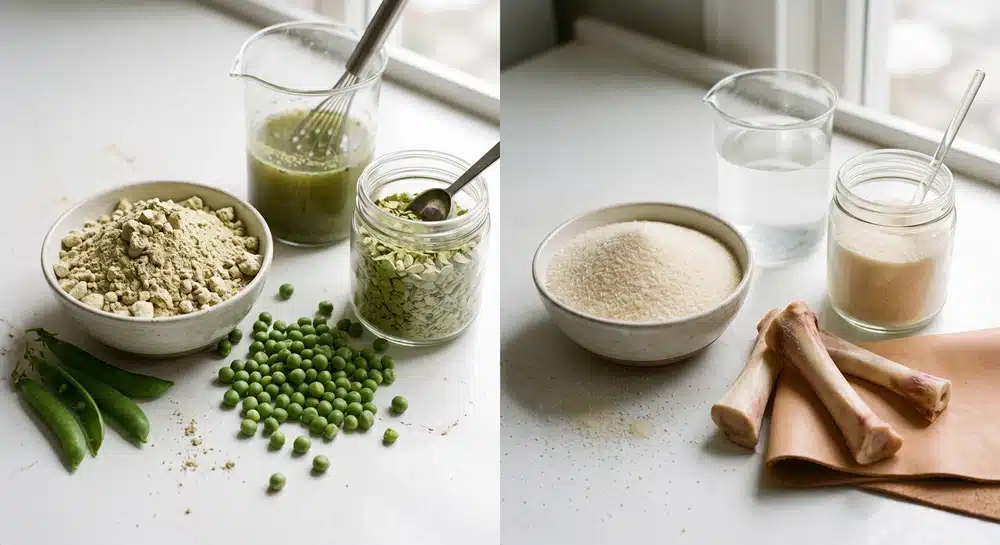
Pea Protein vs Bovine Collagen at a Glance
| Фактор | Гороховый протеин | Бычий коллаген | Practical Takeaway |
|---|---|---|---|
| Источник | Usually produced from yellow peas (Pisum sativum) | Produced from bovine hides, bones, or other connective tissues | Pea protein fits plant-based positioning; bovine collagen is animal-derived. |
| Primary nutrition role | General protein intake and essential amino acid contribution | Collagen-derived peptides rich in glycine, proline, and hydroxyproline | Choose based on whether the formula is a general protein product or a collagen product. |
| Essential amino acids | Contains all nine essential amino acids but is relatively low in methionine | Incomplete protein and typically low in tryptophan and some other essential amino acids | Collagen should not be treated as the sole protein source for meeting essential amino acid needs. |
| Типичное расположение | Vegan protein, sports nutrition, meal replacement, daily nutrition | Beauty-from-within, joint support, connective tissue, active aging | The positioning and substantiation should match the ingredient’s actual profile. |
| Dietary fit | Vegan and vegetarian; often dairy-free and soy-free | Not vegan or vegetarian; may require bovine-source and religious-status documentation | Confirm allergen, vegan, halal, kosher, and origin documents rather than relying on assumptions. |
| Вкус и текстура | May have earthy, beany, chalky, or gritty notes | Often neutral in hydrolyzed form, but source and hydrolysis can affect odor and bitterness | Both require sensory and solubility testing in the finished formula. |
| Common serving logic | Often used at higher gram amounts to deliver meaningful protein per serving | Often used at lower, study- or concept-specific gram amounts | Serving size must be based on the product objective, evidence, and label space. |
| Best B2B use | Plant protein powders, shakes, bars, meal replacements, blended proteins | Collagen powders, sachets, gummies, capsules, beauty and joint formulas | Form, packaging, flavor system, and claims should be planned together. |
Что такое гороховый протеин?
Pea protein is a plant-derived protein ingredient, most commonly made from yellow peas. Commercial forms include pea protein concentrate, pea protein isolate, hydrolyzed pea protein, organic grades, and instantized grades. Protein content, taste, color, solubility, particle size, and amino acid composition can vary by supplier and processing method.
Pea protein is widely used in vegan protein powders, dairy-free shakes, meal replacements, nutrition bars, drink powders, and blended plant-protein systems. Brands evaluating the ingredient should request current bulk pea protein specifications, including the protein test method, amino acid profile, allergen statement, heavy metals, microbiology, and sensory information.
Is Pea Protein a Complete Protein?
Pea protein contains all nine essential amino acids, but it is relatively low in sulfur-containing amino acids such as methionine. Whether a finished product is appropriate for muscle-focused positioning depends on the total protein dose, digestibility, leucine and essential amino acids per serving, the consumer’s overall diet, and whether complementary proteins are included.
For formulators, a pea-and-rice or other complementary protein blend may improve the overall amino acid balance. Any “complete protein,” “high protein,” or performance-related statement should be checked against the actual formula, analytical data, serving size, and destination-market rules.
What Is Bovine Collagen?
Bovine collagen is an animal-derived protein sourced from cattle tissues such as hides or bones. In dietary supplements, it is commonly hydrolyzed into collagen peptides to improve dispersibility and make it easier to use in powders, beverages, sachets, capsules, tablets, and gummies.
Collagen has a distinctive amino acid pattern rich in glycine, proline, and hydroxyproline. It is not a complete protein and should not be presented as nutritionally equivalent to pea protein, whey protein, egg protein, or a balanced dietary protein. Brands can review a bovine collagen sourcing and technical overview before deciding which source, molecular-weight range, purity target, and documentation package fit the product.
Does Bovine Collagen Count as Protein?
Yes. Collagen contributes protein and amino acids, but its amino acid profile is specialized and incomplete. It may be appropriate for collagen-specific product concepts, but it should not be used as the only protein source when the product promise depends on a balanced essential amino acid profile.
Protein Quality and Amino Acid Differences
The most important difference is not simply plant versus animal. It is the amino acid pattern and intended biological role of the ingredient.
- Pea protein: provides essential amino acids and is commonly used to support total dietary protein intake. Its methionine level is relatively low, so complementary protein blending can be useful.
- Bovine collagen: provides collagen-characteristic amino acids but is low in several essential amino acids. It is normally selected for collagen-specific positioning rather than as a primary muscle-building protein.
A 2024 randomized trial comparing whey, pea, and collagen supplementation found different amino acid responses among the protein sources, reinforcing the need to match the protein to the intended use rather than treating all protein powders as equivalent. Results from a single trial should not be generalized to every product, dose, age group, or training program.
Which Is Better for Muscle and Daily Protein Intake?
Pea protein is generally the better choice when the main goal is daily protein intake or a plant-based sports nutrition formula. Human trials have reported improvements in strength or muscle outcomes when pea protein is consumed alongside resistance training, although outcomes depend on dose, training, total diet, participant characteristics, and study design.
Collagen may be included in active-aging or sports formulas when connective-tissue positioning is relevant, but it should not replace a higher-quality essential-amino-acid source in a product designed primarily for muscle protein synthesis. Brands should verify grams of protein, leucine, and total essential amino acids per serving before using muscle-focused messaging.
Which Is Better for Skin, Joints, and Connective Tissue?
Bovine collagen is the more directly relevant ingredient for collagen-specific skin, joint, and connective-tissue concepts. Systematic reviews and randomized trials have reported potential benefits from specific hydrolyzed collagen products for outcomes such as skin hydration, elasticity, wrinkles, joint comfort, or function. However, evidence varies by collagen type, dose, duration, population, and branded ingredient.
Pea protein can contribute amino acids to the overall diet, but it does not contain collagen and should not be described as a direct substitute for hydrolyzed bovine collagen. Plant-based products may instead be positioned as vegan protein, collagen-support, or collagen-builder concepts when the formula and evidence support that wording.
For a broader sourcing comparison, see how to сравнение пептидов коллагена по источникам и типам.
Digestibility, Tolerance, and Allergy Considerations
Гороховый протеин
Pea protein is often selected by consumers avoiding dairy or soy, but it should not be described as universally hypoallergenic. Pea allergy can occur, and some people may experience bloating, fullness, or digestive discomfort. Tolerance also depends on serving size, residual carbohydrates, flavor systems, sweeteners, gums, and other ingredients in the finished product.
Бычий коллаген
Hydrolyzed collagen peptides are generally formulated for easy dispersion and digestion, but tolerance is still product-specific. Animal-source preferences, religious requirements, source traceability, flavor, and potential sensitivities should be considered. Products should clearly identify the bovine source and any relevant allergen or facility statements.
Taste, Solubility, and Formulation Performance
Pea protein and bovine collagen behave differently in a formula.
| Formulation Issue | Гороховый протеин | Бычий коллаген |
|---|---|---|
| Аромат | Earthy, beany, bitter, or grassy notes may require masking. | Often mild, but odor or bitterness can vary with source and hydrolysis. |
| Mouthfeel | Can be chalky, gritty, thick, or drying at high use levels. | Often smoother at typical use levels, depending on molecular weight and formula. |
| Растворимость | Dispersibility and foaming can be challenges; instantized grades may help. | Hydrolyzed grades are often highly soluble, but clarity and taste should be tested. |
| Размер порции | Higher bulk can affect tub size, scoop size, viscosity, and cost per serving. | Lower use levels may fit sachets, drinks, capsules, or gummies, depending on the target dose. |
| Лучшие форматы | Protein powder, meal replacement, bar, high-protein drink mix. | Collagen powder, stick pack, beauty drink, gummy, capsule, active-aging formula. |
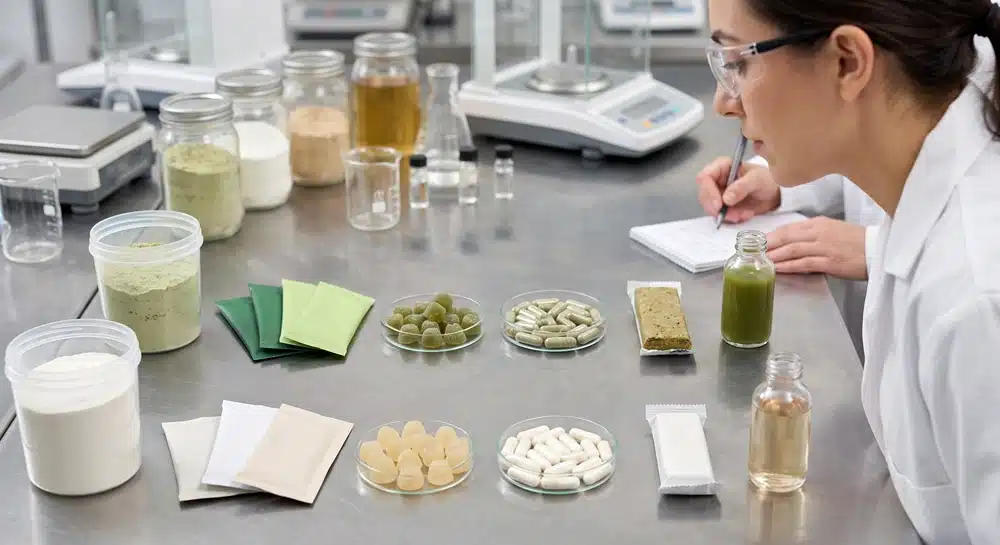
Brands developing either ingredient should conduct bench samples and pilot testing. A qualified производство белковых добавок partner can help evaluate flavor masking, sweeteners, dispersibility, scoop size, packaging, stability, and finished product testing.
Как брендам пищевых добавок следует выбирать
Use the decision framework below instead of asking which ingredient is universally “better.”
- Define the main product promise. Choose pea protein for plant-based protein intake, meal replacement, or sports nutrition. Choose bovine collagen for collagen-specific beauty, joint, or connective-tissue concepts.
- Define the target consumer. Confirm vegan, vegetarian, dairy-free, soy-free, bovine-source, halal, kosher, and sustainability requirements.
- Set the evidence-based serving target. Review the specific ingredient, clinical evidence, protein contribution, amino acid data, and destination-market rules.
- Choose the dosage form. Powder, sachet, capsule, tablet, gummy, and ready-to-mix drink formats have different dose and sensory limitations.
- Review analytical documents. Request COA, specification, amino acid profile, protein test method, heavy metals, microbiology, allergens, identity, origin, and shelf-life documents.
- Test the finished product. Confirm flavor, texture, solubility, stability, packaging compatibility, and label accuracy before scale-up.
Требования к качеству, которые необходимо указать в запросе
| Document or Test | Почему это важно | Pea Protein Focus | Bovine Collagen Focus |
|---|---|---|---|
| Certificate of Analysis | Confirms batch results against specification | Protein, moisture, ash, microbiology, heavy metals | Protein, moisture, ash, microbiology, heavy metals |
| Protein test method | Different methods and conversion factors can affect reported protein | Confirm method and nitrogen conversion factor | Confirm method and whether results reflect collagen protein |
| Аминокислотный профиль | Supports protein-quality and formulation decisions | Review methionine, leucine, lysine, and total EAAs | Review glycine, proline, hydroxyproline, tryptophan, and total EAAs |
| Source and process declaration | Supports traceability and label positioning | Botanical source, isolate/concentrate/hydrolyzed process | Hide/bone source, bovine origin, hydrolysis process |
| Allergen and dietary statements | Supports label and consumer suitability review | Pea, facility cross-contact, vegan, dairy/soy statements | Bovine source, facility allergens, halal/kosher status |
| Sensory and functional data | Reduces formula failure risk | Taste, color, particle size, dispersibility, viscosity | Odor, taste, solubility, clarity, molecular-weight distribution |
Brands that need ingredient screening, sample development, dosage-form planning, and scale-up can use formulation and R&D support to connect the ingredient choice with a manufacturable finished product.
Вопросы безопасности и указания на этикетках
- Do not imply that pea protein or collagen diagnoses, treats, cures, or prevents disease.
- Do not call a dietary supplement “FDA approved.” Dietary supplements are not approved by FDA for safety and effectiveness before marketing.
- Qualify health statements according to the strength and relevance of the evidence.
- Do not generalize results from one branded collagen peptide, dose, study population, or duration to every bovine collagen ingredient.
- Do not describe pea protein as universally hypoallergenic.
- Do not claim that collagen “heals and seals the gut” or treats “leaky gut.” Evidence is not sufficient for that broad consumer claim.
- People who are pregnant, breastfeeding, managing a medical condition, using medication, or dealing with food allergies should consult a qualified healthcare professional before using supplements.
Часто задаваемые вопросы
Does pea protein contain collagen?
No. Pea protein is derived from peas and does not contain animal collagen. It can provide amino acids and general dietary protein, but it is not hydrolyzed collagen.
Is bovine collagen a complete protein?
No. Bovine collagen is an incomplete protein with a specialized amino acid profile. It should not be the only protein source in a formula intended to provide a balanced essential amino acid profile.
Is pea protein better than collagen for muscle?
Pea protein is generally the more appropriate choice for a plant-based muscle or daily-protein product because it contributes essential amino acids. Results still depend on total protein intake, leucine, training, diet, and serving size.
Is collagen better than pea protein for skin and joints?
Collagen is more directly relevant to collagen-specific skin and joint formulations. Research findings are ingredient-, dose-, duration-, and population-specific, so claims should be carefully qualified.
Can pea protein and bovine collagen be used together?
Yes, they can be combined when the product concept needs both general protein and collagen-derived peptides. The formula should clearly communicate the role and amount of each protein and should be tested for taste, texture, solubility, stability, and label compliance.
Which ingredient is better for a vegan product?
Pea protein. Bovine collagen is animal-derived and is not suitable for vegan or vegetarian positioning.
Заключение
Pea protein and bovine collagen solve different nutrition and formulation problems. Pea protein is usually the better fit for plant-based protein powders, daily nutrition, and sports products that need essential amino acids. Bovine collagen is usually the better fit for collagen-specific beauty, joint, connective-tissue, and active-aging concepts. The strongest product decision comes from matching the ingredient to the consumer, evidence, serving size, specification, sensory target, dosage form, and compliant claim strategy.
Ссылки
- The effects of whey, pea, and collagen protein supplementation on integrated myofibrillar protein synthesis in older adults
- Pea proteins oral supplementation promotes muscle thickness gains during resistance training
- The effects of collagen peptide supplementation on body composition, collagen synthesis, and recovery
- Effects of hydrolyzed collagen supplementation on skin aging: a systematic review and meta-analysis
- FDA: Заявления о связи «структура-функция»
- Федеральная торговая комиссия (FTC): Руководство по соблюдению требований к товарам для здоровья
Disclaimer: This article is for educational and B2B formulation reference only. It is not medical advice and is not intended to diagnose, treat, cure, or prevent any disease.

Уоррен Ван — опытный специалист с обширным стажем работы в сфере цепочки поставок пищевых добавок, обладающий богатым практическим опытом в области исследований, разработки, контроля производственных процессов и глобального поиска поставщиков ключевых ингредиентов, таких как коллагеновые пептиды, белок костного бульона и кератин. Как автор этой рубрики, он стремится развенчать маркетинговую мистификацию, преобразуя малоизвестные научные факты об ингредиентах и стандарты контроля качества производства в доступные и достоверные научно-популярные материалы, помогая читателям понять правду, скрытую за этикетками, и делать более рациональный выбор в вопросах здоровья.