
For consumers, the main questions are what the tablet contains, how much it provides per serving, whether the dose is appropriate, and whether it may interact with medicines or other supplements. For brands and formulators, tablet quality also depends on manufacturability, excipient selection, compression performance, disintegration, stability, testing, and compliant labeling.
What Is a Food Supplement Tablet?
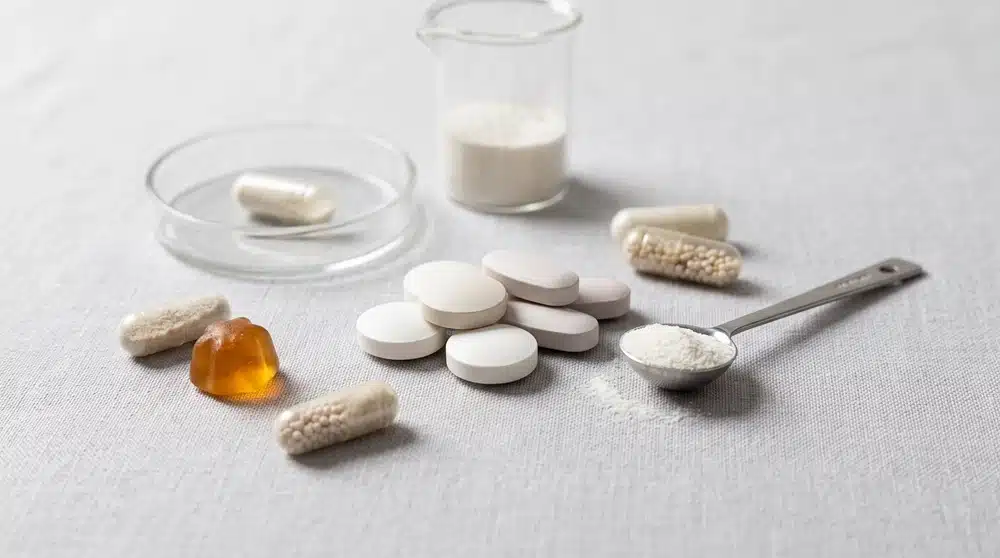
A food supplement tablet is a solid oral dosage form designed to provide nutrients or other substances in a measured amount. Typical ingredients may include vitamins, minerals, amino acids, plant or herbal ingredients, enzymes, or other substances allowed in the target market.
The European Commission describes food supplements as concentrated sources of nutrients or other substances with a nutritional or physiological effect that are marketed in dose form, including pills, tablets and capsules. In the United States, FDA uses the term “dietary supplement” for products intended to supplement the diet and notes that they may be sold as tablets, capsules, softgels, liquids or powders.
Food Supplement vs. Dietary Supplement: Is There a Difference?
The two terms often describe similar product categories, but the regulatory wording depends on the market.
| Рынок | Common Term | Practical Meaning |
|---|---|---|
| UK / European Union | Food supplement | A food product intended to supplement the normal diet and supplied in dose form. |
| Соединенные Штаты | Dietary supplement | A product taken by mouth that contains one or more dietary ingredients and is labeled as a dietary supplement. |
| Other markets | Варьируется | Definitions, permitted ingredients, claims, labeling and notification requirements can differ by country. |
This distinction matters for brands selling internationally. A formula, ingredient or claim that is acceptable in one market may require different wording, documentation or regulatory review in another.
What Makes a Supplement Tablet Different?
A tablet is produced by compressing a prepared blend into a defined shape and weight. Unlike a hard capsule, the product does not rely on a shell to hold the ingredients. Unlike a gummy, it does not require a gelled confectionery matrix. Unlike a powder, the serving is pre-portioned into individual units.
A well-designed tablet has to balance several requirements at the same time: enough active material to meet the serving target, acceptable size and swallowability, sufficient mechanical strength for packaging and shipping, and appropriate disintegration or dissolution behavior for the formula.
What Is Inside a Food Supplement Tablet?
Most tablets contain more than active nutrients alone. Depending on the formula, manufacturers may use excipients such as:
- Fillers or carriers to provide suitable tablet mass and improve processing.
- Binders to help the compressed tablet hold together.
- Disintegrants to help the tablet break apart after ingestion.
- Lubricants and flow aids to support consistent manufacturing.
- Покрытия to improve appearance, swallowability, taste masking or protection from moisture.
The exact excipient system should be appropriate for the ingredients, dose, tablet size, target market and labeling requirements.
Виды таблеток пищевых добавок
“Tablet” is not a single format. Common food supplement tablet types include:
1. Standard Compressed Tablets
These are conventional swallowable tablets made by compressing a powder or granulated blend. They are widely used for vitamins, minerals and botanical formulas when the ingredients have suitable flow and compression properties.
2. Film-Coated Tablets
A thin coating can improve appearance and swallowing, help mask unpleasant taste or odor, and in some cases provide added protection from moisture or light. The coating system has to be compatible with the formula and target market.
3. Chewable Tablets
Chewable tablets are designed to be chewed rather than swallowed whole. Taste, texture, hardness, sweetener choice and flavor masking become especially important because the consumer directly experiences the tablet in the mouth.
4. Effervescent Tablets
Effervescent tablets are dissolved in water before use. They can be useful for larger serving sizes or drink-style products, but moisture control, packaging and the acid-base system require careful formulation.
5. Fast-Dissolve or Orodispersible Tablets
These formats are designed to break down quickly in the mouth or with a small amount of liquid. They may improve convenience for some users, but formulation, taste masking and mechanical strength can be more challenging.
Food Supplement Tablets vs. Capsules, Gummies and Powders
| Формат | Main Strengths | Common Limitations | Often Considered For |
|---|---|---|---|
| Планшеты | Compact unit dose; scalable production; multiple coating and release options | Large tablets may be difficult to swallow; some formulas compress poorly | Vitamins, minerals, botanicals, multinutrient products |
| Твердые капсулы | Neutral taste; relatively simple powder filling; vegetarian shell options available | Shell capacity limits large doses; moisture compatibility matters | Powders, extracts and blends that fill well |
| Жевательные резинки | Consumer-friendly taste and texture | Formula space is limited; sugar/sweetener and stability considerations | Lifestyle, family and convenience-focused products |
| Порошки | Flexible serving size; suitable for larger gram-level doses | Requires measuring or mixing; taste and solubility can be limiting | Protein, collagen, electrolytes, drink mixes |
No format is universally “best.” The right choice depends on the ingredient properties, intended serving size, consumer experience, stability, packaging, cost and regulatory requirements.
How Are Food Supplement Tablets Made?
Tablet production normally starts with formula and raw-material review. Ingredients are weighed and blended, and some formulas may require dry or wet granulation to improve flow or compression. The blend is then compressed on a tablet press, followed by optional coating, inspection, testing and packaging.
For a process-level explanation, see GENSEI’s step-by-step guide to tablet supplement manufacturing.
For commercial production, the formula must be designed for manufacturability. High active loads, hygroscopic ingredients, poor-flowing botanical powders, unpleasant tastes or very large serving sizes can all affect the final tablet design.
What Quality Checks Matter for Supplement Tablets?
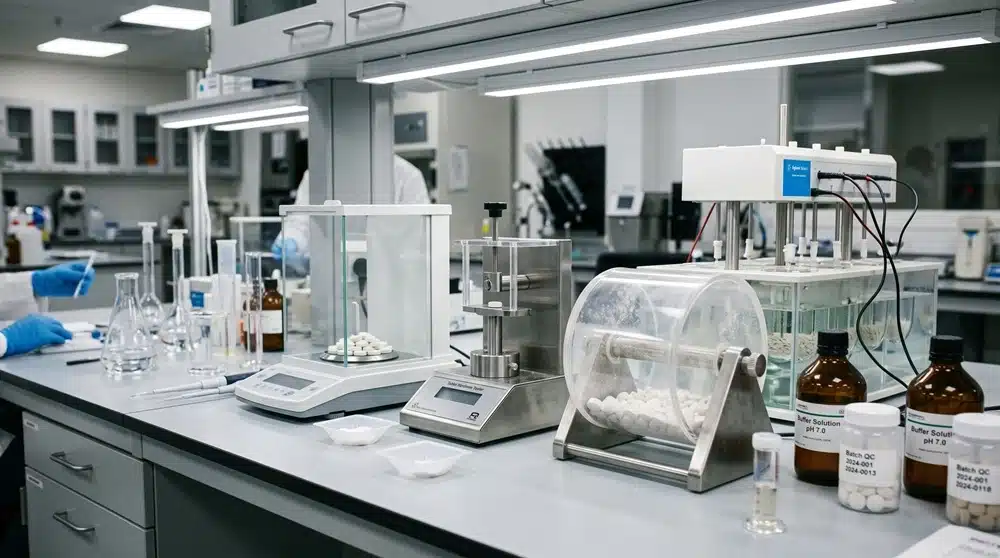
Quality specifications vary by product and market, but common finished-tablet checks may include:
- Identity and potency: confirmation that specified ingredients are present at the intended levels, using appropriate validated or fit-for-purpose methods.
- Weight variation: monitoring tablet-to-tablet consistency.
- Твердость: assessing whether tablets are strong enough for handling while remaining suitable for use.
- Сыпучесть: measuring how easily tablets chip or crumble during handling.
- Disintegration: evaluating how the tablet breaks apart under specified test conditions.
- Dissolution: used where relevant to the product specification or performance requirement.
- Microbiological and contaminant testing: depending on the ingredient risk profile, market and specification.
- Стабильность: confirming that the product continues to meet relevant specifications through its intended shelf life.
For supplement brands, these checks should be agreed before production rather than treated as an afterthought. A tablet that looks acceptable can still fail on weight, hardness, disintegration, potency or stability if the formulation and process are not controlled.
How Should Consumers Choose and Use Food Supplement Tablets?
A supplement should be chosen for a specific nutritional or dietary reason, not because a tablet format automatically makes a product effective. Before use:
- Read the label for serving size, ingredient amounts, warnings, allergens and directions.
- Avoid unintentionally duplicating the same vitamins, minerals or botanicals across several products.
- Do not exceed the labeled amount unless a qualified healthcare professional advises otherwise.
- Check for possible interactions if you take prescription or over-the-counter medicines.
- Ask a healthcare professional for individualized guidance if you are pregnant, breastfeeding, managing a medical condition, preparing for surgery, or considering a supplement for a child.
Food supplements are intended to complement a normal diet. They should not be presented as replacements for varied food intake or as products that diagnose, treat, cure or prevent disease.
Are Food Supplement Tablets Medicines?
Not simply because they are shaped like pills. Product classification depends on the legal framework, ingredients, intended use, claims and labeling. In the UK and EU, food supplements are regulated as foods rather than medicines. In the United States, dietary supplements are regulated by FDA under a framework that differs from both conventional foods and drugs, and they are not approved for safety and effectiveness in the same premarket way as drugs.
This is why supplement content should avoid drug-style promises. Claims such as “treats,” “cures,” or “prevents” a disease can change the regulatory implications and create significant compliance risk.
When Is a Tablet a Good Format for a Supplement Brand?
Tablets can be attractive when a brand needs a compact, scalable, measured-dose format and the formula can be compressed into an acceptable tablet size. They are often considered for multivitamins, minerals, botanical blends, chewables, effervescents and other dry formulations.
Brands comparing dosage forms should review active dose, excipient needs, tablet dimensions, coating, taste, moisture sensitivity, packaging, target market and testing requirements before finalizing the format. GENSEI’s tablet supplement manufacturing service explains the practical development and production considerations for custom tablet projects.
Tablet Project Checklist for Brand Owners
- Target market and regulatory category
- Active ingredients and amount per serving
- Target tablet weight, dimensions and number of tablets per serving
- Direct compression vs. granulation feasibility
- Coating, taste masking or chewable flavor requirements
- Packaging and moisture protection
- Finished-product specifications and testing plan
- Label claims and required warnings
- MOQ, sampling, production lead time and stability program
If the product is being developed under the brand’s own name, compare ready-to-brand, semi-custom and fully custom pathways before selecting a supplier. See the добавка под собственной торговой маркой options for a broader overview of dosage forms, packaging and project planning.
Часто задаваемые вопросы
Что такое таблетки-добавки к пище?
Food supplement tablets are measured-dose solid products made by compressing ingredients such as vitamins, minerals, botanicals, amino acids or other permitted substances. They are intended to supplement the normal diet.
What does a food supplement tablet do?
Its purpose depends on the ingredients and amounts in the formula. A tablet is only the delivery format; the nutritional or physiological role comes from the ingredients it contains. The label and supporting evidence should be used to understand what the product is intended to provide.
What is the difference between a food supplement and a dietary supplement?
They are closely related terms used in different regulatory systems. “Food supplement” is common in the UK and EU, while “dietary supplement” is the legal term commonly used in the United States. Requirements for ingredients, claims and labels can differ by market.
Is a supplement tablet the same as medicine?
No. A tablet shape does not make a product a medicine. Food or dietary supplements are regulated differently from drugs, and they should not be marketed as products that diagnose, treat, cure or prevent disease.
Are supplement tablets considered food?
In the UK and EU, food supplements are legally treated as a category of food. In the United States, dietary supplements are regulated by FDA under the food framework but have specific rules that differ from conventional foods.
What is the difference between a tablet and a capsule?
A tablet is usually made by compressing a blend into a solid unit. A hard capsule normally contains powder or granules inside a shell. The better format depends on dose, ingredient properties, stability, swallowing experience, manufacturing feasibility and cost.
What does “use as a food supplement” mean?
It generally indicates that the product is intended to supplement the diet and should be used according to its labeled directions. It does not mean the product should replace meals or be used as a medicine.
Заключение
A food supplement tablet is a measured-dose way to deliver nutrients or other permitted supplement ingredients in a compact solid form. Understanding the regional terminology, tablet composition, dosage-form options, quality checks and safety considerations makes it easier for consumers to evaluate products and for brands to design tablets that are practical to manufacture and appropriate for the intended market.
Ссылки

Уоррен Ван — опытный специалист с обширным стажем работы в сфере цепочки поставок пищевых добавок, обладающий богатым практическим опытом в области исследований, разработки, контроля производственных процессов и глобального поиска поставщиков ключевых ингредиентов, таких как коллагеновые пептиды, белок костного бульона и кератин. Как автор этой рубрики, он стремится развенчать маркетинговую мистификацию, преобразуя малоизвестные научные факты об ингредиентах и стандарты контроля качества производства в доступные и достоверные научно-популярные материалы, помогая читателям понять правду, скрытую за этикетками, и делать более рациональный выбор в вопросах здоровья.


