Glucosamine and chondroitin sulfate are widely sold for cat joint support, but current feline studies have not shown reliable pain-relieving or activity-improving effects compared with placebo. They should not replace a veterinary diagnosis or proven pain management. A veterinarian should review the exact cat-specific product, serving directions, other ingredients, medical conditions, and medications before use.
For pet brands, the main questions are ingredient legality, feline serving practicality, palatability, glucosamine and chondroitin identity, assay accuracy, contamination controls, finished-product testing, and claim wording. Human dietary-supplement rules should not be copied directly to cat products.
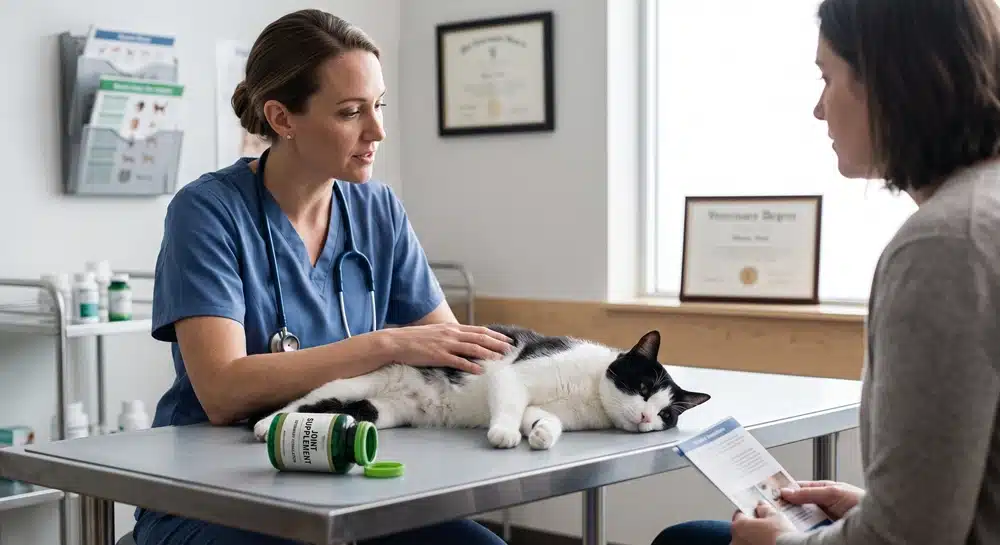
When a Cat Needs a Veterinary Joint Assessment
Cats often hide chronic pain. A reduction in jumping or play should not automatically be treated with a supplement because similar behavior can result from osteoarthritis, injury, neurological disease, dental pain, obesity, kidney disease, weakness, vision problems, or another condition.
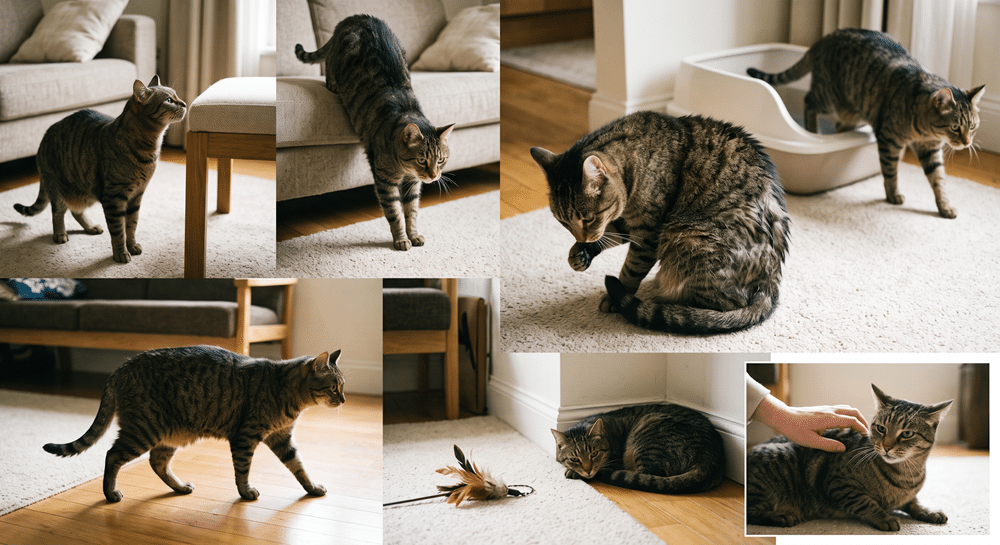
Possible signs that deserve veterinary assessment include:
- hesitation before jumping or using stairs;
- jumping to lower surfaces or pulling up with the front legs;
- stiff movement after resting;
- reduced grooming or an unkempt coat;
- irritability when touched or lifted;
- difficulty entering a high-sided litter box;
- reduced play, hiding, or changes in sleep location;
- muscle loss, limping, or altered posture.
Glucosamine or chondroitin should not be used to delay examination. Veterinarians can evaluate the cat, determine whether pain is present, and discuss evidence-based treatment, weight management, environmental changes, exercise, diet, and any optional supplement trial.
What Are Glucosamine and Chondroitin Sulfate?
葡萄糖胺 is an amino sugar related to the biosynthesis of glycosaminoglycans. Commercial products may contain glucosamine hydrochloride, glucosamine sulfate salts, or N-acetyl-D-glucosamine. These are different ingredient identities and should not be treated as interchangeable.
硫酸軟骨素 is a sulfated glycosaminoglycan. Commercial material may come from bovine, porcine, poultry, marine, or fermentation-derived sources. Its molecular weight, sulfation pattern, purity, protein residues, assay and biological properties can vary.
These compounds are associated with normal cartilage biology, but being a component or precursor does not prove that an oral product repairs cartilage or relieves pain in cats.
| 成分 | Common Commercial Forms | What a Label Does Not Prove |
|---|---|---|
| 葡萄糖胺 | Glucosamine HCl, stabilized glucosamine sulfate salts, N-acetyl-D-glucosamine | That the form is clinically effective in cats or equivalent to another form |
| 硫酸軟骨素 | Usually sodium chondroitin sulfate from a declared animal or non-animal source | Purity, molecular-weight profile, source identity, or feline efficacy |
| Combination product | May add MSM, manganese, ASU, omega-3, HA, collagen, botanicals, or flavors | That glucosamine and chondroitin caused any reported outcome |
Glucosamine vs Chondroitin Sulfate: Quick Comparison
| 因子 | 葡萄糖胺 | 硫酸軟骨素 |
|---|---|---|
| 成分類別 | Amino sugar | Sulfated glycosaminoglycan |
| 共同來源 | Crustacean chitin, fungal chitin, or fermentation process | Bovine, porcine, poultry, marine, or fermentation-derived material |
| Forms to distinguish | HCl, sulfate salts, N-acetyl-D-glucosamine | Source, salt, assay, molecular weight, sulfation and purity |
| Feline OA evidence | The combination has not shown reliable benefit over placebo in the available feline studies | |
| 其中一種可以取代另一種嗎? | No. They are different ingredients; combining them does not establish synergy | |
Do Glucosamine and Chondroitin Work for Cats?
Current cat-specific evidence does not show a reliable treatment effect for feline osteoarthritis pain or mobility.
| 證據 | Design | Main Finding | 其意為何 |
|---|---|---|---|
| 2014 feline OA study | Double-blind, randomized, placebo-controlled comparison involving meloxicam and a glucosamine–chondroitin supplement | Meloxicam produced measurable improvement; the supplement did not establish comparable benefit | Do not present glucosamine–chondroitin as proven OA pain management |
| 2022 feline DJD study | Prospective, randomized, stratified, double-blind, placebo-controlled clinical trial of a commercial combination product | Strong placebo response; no pain-relieving effect compared with placebo | Owner anecdotes and product popularity are not reliable proof |
| 2022 systematic review and meta-analysis | Review of enriched diets and nutraceuticals in canine and feline OA | Marked non-effect for chondroitin–glucosamine nutraceuticals | Current aggregate evidence does not support pain-management claims |
| 2025 feline OA review | Current narrative review focused on cat-specific evidence | Two feline glucosamine–chondroitin studies showed no treatment effect | Cat evidence should not be replaced with human or canine studies |
Why Mechanism Claims Are Not Enough
Laboratory studies can examine cartilage cells, enzymes, inflammatory pathways or glycosaminoglycan metabolism. Those findings do not demonstrate that an orally fed cat product reaches joint tissue at an effective concentration or produces a meaningful clinical benefit.
Why Owner Reports Can Be Misleading
Feline pain studies can have a substantial caregiver placebo effect. Activity also varies with weather, household changes, weight, flooring, access to furniture, other treatments and day-to-day behavior. A structured veterinarian-approved trial should use defined goals rather than relying on a general impression that the cat “seems better.”
Why Common Use Is Not the Same as Proven Benefit
Glucosamine and chondroitin are common in pet products and are discussed by some veterinarians because they are familiar, widely available and generally perceived as low risk. These facts do not establish efficacy.
A responsible conclusion is:
- the ingredients are commonly marketed for cat joint support;
- the available cat-specific trials have not demonstrated reliable OA pain or mobility benefit;
- they should not replace evidence-based veterinary treatment;
- a veterinarian may still discuss a monitored product trial based on the individual cat, product and owner preference;
- lack of observed benefit should trigger reassessment rather than indefinite use.
Is There a Proven Glucosamine or Chondroitin Dose for Cats?
No universally accepted, evidence-based oral dose has been established for cats. Products vary in:
- glucosamine form and assay basis;
- chondroitin source and purity;
- amount per capsule, chew, scoop or milliliter;
- other active ingredients;
- loading and maintenance directions;
- calorie and sodium contribution;
- the cat’s body weight, diet, disease and medication use.
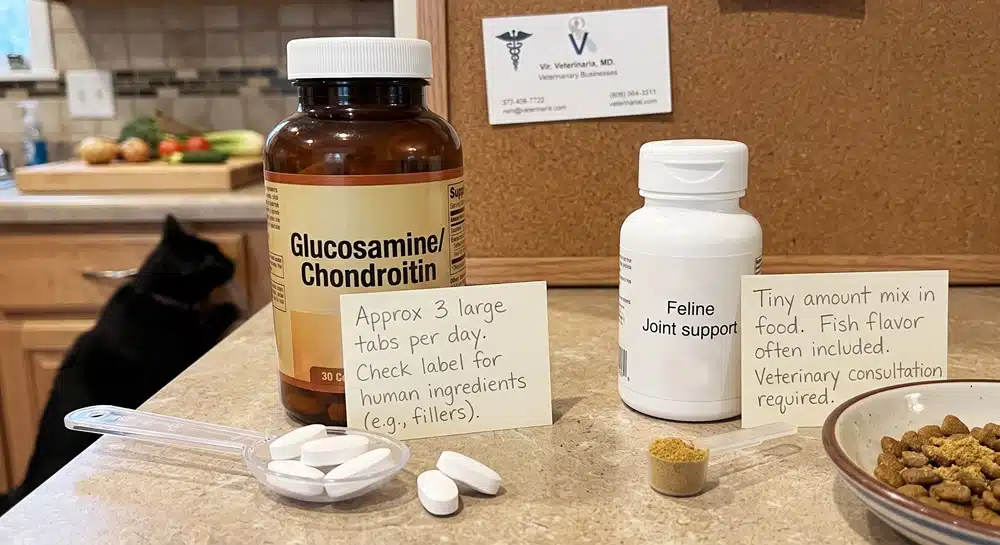
Do not copy a dose from a human product, dog product, online dosage chart or another cat. The veterinarian should review the exact label and determine whether a trial is appropriate.
How Long Does Glucosamine Take to Work in Cats?
No reliable feline onset period has been established. The common “four to six weeks” statement is largely based on product marketing and extrapolation, not a consistent cat-specific treatment effect.
If a veterinarian approves a trial, agree in advance on:
- which product and serving directions will be used;
- which other treatments remain unchanged;
- two or three specific behaviors to track, such as jumping onto one surface or entering the litter box;
- a review date;
- criteria for stopping because of adverse effects or no meaningful improvement.
Glucosamine and Chondroitin Side Effects in Cats
Cat-specific adverse-event data are limited, and combination products make it difficult to attribute a reaction to one ingredient. Possible concerns include:
- vomiting, diarrhea, soft stool or reduced appetite;
- refusal of food because of odor, texture or flavor;
- reaction to the animal source, flavor protein or another excipient;
- excess calories or sodium from a chew, treat or flavored paste;
- duplicate dosing when the same ingredients appear in food and supplements;
- effects or interactions from added MSM, botanicals, omega-3s, manganese or other actives.
Stop the product and contact a veterinarian if the cat develops persistent vomiting or diarrhea, refuses food, becomes unusually lethargic, has facial swelling, breathing difficulty, bleeding, marked thirst or urination changes, or any other concerning sign.
Cats Requiring Extra Veterinary Review
Veterinary review is particularly important for cats with kidney or liver disease, diabetes, bleeding disorders, gastrointestinal disease, food allergy, planned surgery, pregnancy or lactation, or concurrent prescription medicines. This is not because a specific interaction is proven in every cat, but because feline evidence and combination-product safety data are limited.
Accidental Ingestion
If a cat consumes a large amount of a product, contact the veterinarian or an animal poison service with the package available. Risk depends on the complete formula, not only glucosamine or chondroitin.
Can Cats Take Human Glucosamine Products?
Do not give a human glucosamine product unless a veterinarian has reviewed the exact label. The problem is not that every human ingredient is inherently toxic or that cats cannot absorb human-grade glucosamine. The practical concerns are:
- the amount may be inappropriate for a cat;
- the serving unit may be impossible to divide accurately;
- the product may contain multiple human-targeted actives;
- flavors, sweeteners, coatings, herbs or minerals may be unsuitable;
- the source and allergen statement may not fit the cat;
- the product may not be palatable;
- the label may not provide feline feeding directions or veterinary cautions.
| 因子 | Cat-Specific Product | Human Product |
|---|---|---|
| Serving directions | Designed for a declared animal species and body-weight range | Designed for adults, not cats |
| 口感 | May use feline-appropriate flavor and format | Tablet size, coating or taste may be unsuitable |
| Other ingredients | Should be reviewed for feline use | May include ingredients not evaluated for cats |
| Regulatory context | Animal food or animal product requirements apply | Human dietary-supplement requirements apply |
What About Feline Lower Urinary Tract Disease?
The current page should not claim that glucosamine or chondroitin treats feline lower urinary tract disease. A randomized, double-blind, placebo-controlled six-month study tested 125 mg daily N-acetyl-D-glucosamine in 40 cats with recurrent feline idiopathic cystitis and found no significant difference from placebo in owner health scores, monthly clinical scores or days with clinical signs.
N-acetyl-D-glucosamine is also not the same ingredient as glucosamine HCl or glucosamine sulfate. Urinary straining, repeated litter-box visits, blood in urine or inability to urinate require veterinary assessment; urinary obstruction can be an emergency.
How Cat Owners Should Evaluate a Product
- Start with the veterinarian. Confirm that joint pain is the likely cause of the behavior change.
- Choose a cat-specific product. Check the intended species and feeding directions.
- Identify the forms. Note glucosamine HCl, sulfate or NAG and the declared chondroitin source.
- Read the amount per serving. Do not compare front-label totals without checking the actual feeding unit.
- Review all other actives. MSM, ASU, omega-3, HA, collagen and botanicals affect safety and evidence.
- Check calories, sodium and flavors. These matter for senior cats and cats with medical diets.
- 請注重品質的透明度。. The company should be able to explain testing, lot traceability and adverse-event reporting.
- Set measurable goals. Track specific behavior instead of relying on a vague impression.
- Do not delay pain treatment. Stop treating the supplement as sufficient if the cat remains uncomfortable.
Formulation and Quality Requirements for Pet Brands
Brands planning a feline joint product can review our pet supplement manufacturing services. Pet projects require species-specific formulation and animal-food regulatory review rather than simply reducing the serving size of a human joint supplement.
Raw-Material Specification Checklist
| Area | 葡萄糖胺 | 硫酸軟骨素 |
|---|---|---|
| 身分 | Exact salt or derivative, CAS reference, identity method | Chondroitin sulfate salt, source species or fermentation route, identity method |
| 分析法 | Method, dry/as-is basis, free-glucosamine calculation, counterion | Method specificity, chondroitin content, moisture basis |
| 來源 | Crustacean, fungal or fermentation-derived | Bovine, porcine, poultry, marine or non-animal |
| 組成 | Moisture, chloride/sulfate, sodium/potassium if relevant | Molecular weight, sulfation profile, protein, ash and related glycosaminoglycans |
| 污染物 | Heavy metals, microbiology, residual solvents or fermentation residuals | Heavy metals, microbiology, source-specific contaminants, residual protein and DNA where relevant |
| 物理性質 | Particle size, density, flow, solubility and taste | Particle size, density, flow, solubility, viscosity and odor |
| 索賠 | Source, non-shellfish, allergen and animal-use legality require separate support | Species, source, purity and animal-use legality require separate support |
For raw-material sourcing, see our 關節健康成分系列 和 chondroitin sulfate specification page. Materials positioned for human supplements must be separately reviewed for lawful animal-food use.
Cat-Specific Dosage Form Matrix
| 格式 | 優勢 | Key Risks |
|---|---|---|
| Sprinkle powder or open capsule | Low tooling burden and easy dose adjustment | Food refusal, uneven mixing, dust, odor and inaccurate owner measurement |
| Paste or gel | Can support small measured servings and strong flavor systems | Texture rejection, preservative system, water activity and package dosing accuracy |
| Liquid or drops | Flexible serving and mixing with wet food | Solubility, sedimentation, preservation, flavor, pump/dropper accuracy and stability |
| Soft chew or functional treat | Owner convenience when accepted by the cat | Cats may refuse chews; calories, moisture, microbial control and active uniformity |
| Complete or complementary food | Daily compliance may be easier | Nutritional adequacy, ingredient legality, claim classification and processing losses |
Finished-Product Quality
- formula and ingredient legality review for the target market;
- species-specific serving and maximum intake review;
- palatability and food-refusal study;
- active assay and content uniformity;
- microbiology and pathogen controls;
- heavy metals and risk-based contaminants;
- water activity and moisture for chews, pastes and powders;
- preservative effectiveness where needed;
- packaging compatibility and stability;
- batch record, complaint and adverse-event process;
- label and website claim review.
進一步了解我們的 quality-control process 和 客製化配方支援.
U.S. Animal Food, Ingredient, and Claim Considerations
In the United States, the Dietary Supplement Health and Education Act applies to dietary supplements for people, not animals. FDA states that there is no federal “dietary supplement” regulatory classification for animal food substances and products. A product marketed for cats is generally regulated as animal food or a new animal drug depending on its intended use.
Product Classification
- A product used mainly for nutrition, taste or aroma may be animal food.
- A product intended to diagnose, cure, mitigate, treat or prevent disease is a drug.
- A non-nutritive structure/function claim can also create animal-drug intended use.
- Claims about arthritis, pain relief, cartilage repair, reduced inflammation, prevention or improved joint function in an arthritic animal require legal review.
Ingredient Legality
Each ingredient and intended use must have a lawful basis, such as an approved animal-food additive use, a GRAS conclusion for that intended animal-food use, or another applicable FDA/AAFCO pathway or enforcement policy. Human-food or human-supplement use does not automatically establish lawful use in cat products.
Manufacturing Requirements
Animal-food facilities subject to FDA registration generally must comply with applicable 21 CFR Part 507 current good manufacturing practice, hazard analysis and risk-based preventive-control requirements. A food-safety plan should address biological, chemical and physical hazards.
Quality Seals
The NASC Quality Seal may indicate participation in third-party audit, adverse-event reporting, labeling and random product-testing requirements. It is not FDA approval and does not prove clinical efficacy.
Safer Website Positioning
Use factual, non-disease language focused on ingredient identity, intended species, feeding directions, product quality, palatability and general wellness positioning after regulatory review. Do not use:
- treats feline arthritis;
- relieves joint pain;
- reduces inflammation;
- repairs or rebuilds cartilage;
- prevents joint disease;
- restores jumping ability;
- treats FLUTD or cystitis;
- clinically proven, unless the exact product and claim are supported and legally appropriate.
Supplier and Manufacturer RFP Questions
- Is the project classified as animal food, a food supplement under applicable state rules, or another product type?
- What lawful basis supports each ingredient’s intended use in cats?
- Which requirements apply in the target states and countries?
- What exact glucosamine form is used?
- What is the glucosamine source and assay calculation?
- What is the chondroitin source species or fermentation route?
- Which method measures chondroitin sulfate specifically?
- What molecular-weight and sulfation specifications apply?
- What allergen and cross-contact documents are available?
- What feline serving rationale is used?
- Has palatability been tested in cats?
- What happens if the product causes food refusal?
- Which additional actives and flavors are included?
- What active assay and content-uniformity testing is performed?
- What microbiological, pathogen and heavy-metal limits apply?
- How are soft-chew moisture, paste preservation or liquid sedimentation controlled?
- What stability data support the package and shelf life?
- Does the facility comply with applicable 21 CFR Part 507 requirements?
- What complaint, adverse-event and recall systems are maintained?
- What are the sample, MOQ, lead time, packaging and change-control terms?
- Who reviews label, website, testimonial and advertising claims?
- Can the manufacturer provide complete batch records and finished-product COAs?
To discuss a feline joint powder, paste, liquid, chew or private-label concept, contact Gensei with the intended species, formula, serving format, target market, quantity, packaging and claim direction.
常見問題
葡萄糖胺和軟骨素對貓有好處嗎?
They are widely marketed, but the available feline osteoarthritis studies did not show reliable pain or activity benefits over placebo. They should not replace veterinary diagnosis or proven pain management.
Can cats take glucosamine?
A veterinarian may approve a specific cat product after reviewing the cat’s condition, medications and the full label. Do not give a human or dog product without veterinary review.
What does glucosamine do for cats?
Glucosamine is an amino-sugar ingredient related to glycosaminoglycan biology. Its biochemical role does not prove that oral supplementation repairs feline cartilage or improves arthritis symptoms.
What is chondroitin sulfate for cats?
Chondroitin sulfate is a glycosaminoglycan ingredient used in many pet joint products. Source, purity, molecular weight, assay and finished-product quality vary, and feline clinical efficacy has not been established.
Do glucosamine and chondroitin help cats with arthritis?
Current feline trials and systematic reviews do not support reliable pain-management benefit. A cat with suspected arthritis needs a veterinarian-led multimodal plan.
葡萄糖胺對貓有多快的效用?
No reliable feline onset time has been established. The commonly quoted four-to-six-week period is not supported by consistent cat-specific treatment effects.
What are glucosamine side effects in cats?
Possible concerns include vomiting, diarrhea, soft stool, appetite loss, product refusal and reactions to flavors, sources or other active ingredients. Cat-specific frequency data are limited.
Is glucosamine safe for cats with kidney or liver disease?
Do not assume safety. Cats with kidney, liver or other chronic disease should have the exact formula and serving directions reviewed by their veterinarian.
Can I give my cat human glucosamine?
Only if a veterinarian has reviewed the exact product. Human products may have inappropriate serving amounts, multiple actives, unsuitable flavors or excipients and no feline directions.
Is there a standard glucosamine dose for cats?
No universally accepted evidence-based dose has been established. Dose charts vary because forms, products and combinations differ.
Can glucosamine prevent joint problems in a healthy cat?
There is no reliable feline evidence that routine prophylactic supplementation prevents osteoarthritis or joint injury.
Does glucosamine help feline cystitis or FLUTD?
A six-month placebo-controlled study of N-acetyl-D-glucosamine did not find significant clinical differences. Urinary signs require veterinary assessment, and inability to urinate is an emergency.
What is the best cat joint supplement?
There is no universally best product. A veterinarian should identify the cause of mobility changes and prioritize proven treatment, weight and environmental management. Any optional product should be cat-specific, palatable, transparent and quality tested.
How should pet brands verify glucosamine and chondroitin quality?
Verify exact ingredient identity, source, animal-use legality, assay methods, chondroitin molecular characteristics, contaminants, allergens, feline serving rationale, palatability, stability, finished-product testing, Part 507 controls and claims.
參考資料
- Merck Veterinary Manual. Osteoarthritis in Dogs and Cats.
- Lefort-Holguin M, et al. Osteoarthritis in Cats: What We Know, and Mostly, What We Do Not Know Yet.
- Sul RM, et al. Comparison of Meloxicam and a Glucosamine-Chondroitin Supplement in Feline Osteoarthritis.
- Cunningham R, et al. Evaluation of a Nutritional Supplement for Pain Associated With Feline Degenerative Joint Disease.
- Barbeau-Grégoire M, et al. Systematic Review and Meta-Analysis of Therapeutic Diets and Nutraceuticals in Canine and Feline Osteoarthritis.
- Gunn-Moore DA, Shenoy CM. Oral Glucosamine and the Management of Feline Idiopathic Cystitis.
- U.S. Food and Drug Administration. Animal Foods and Feeds.
- U.S. Food and Drug Administration. FDA’s Regulation of Pet Food.
- U.S. Food and Drug Administration. Animal Food Ingredients.
- U.S. Food and Drug Administration. FSMA Preventive Controls for Animal Food.
- FDA CVM GFI #241. 21 CFR Part 507 Small Entity Compliance Guide.
- FDA CVM GFI #293. Enforcement Policy for AAFCO-Defined Animal Feed Ingredients.
- National Animal Supplement Council. NASC Quality Seal Requirements.
- National Animal Supplement Council. Adverse Event Reporting FAQ.

萬華仁(Warren Wan)是一位資深專家,在膳食補充劑供應鏈領域擁有豐富經驗,並在膠原蛋白肽、骨湯蛋白及角蛋白等核心成分的研發、製程控制及全球採購方面具備深厚的實務經驗。 身為本專欄的作者,他致力於剝去行銷包裝的表象,將晦澀難懂的成分科學與生產品質控制標準,轉化為淺顯易懂的硬核科普,協助讀者看清標籤背後的真相,並做出更理性的健康選擇。.