
Softgels are usually a strong starting dosage form for oils, lipophilic ingredients, non-aqueous solutions, selected suspensions, and semi-solid fills. They are not automatically the best format for every supplement. The right decision depends on fill chemistry, target dose, shell-fill compatibility, oxidation risk, stability, packaging, consumer positioning, and manufacturing feasibility.
For supplement brands, the most important question is not “Are softgels premium?” but “Can this exact formula remain stable, manufacturable, releasable, and compliant inside a softgel shell for its intended shelf life?”
什麼是軟膠囊?
A softgel is a one-piece capsule in which the shell is formed, filled, and sealed during the same manufacturing operation. Traditional softgel shells commonly use gelatin, water, and a plasticizer such as glycerin or sorbitol. Plant-based systems may use different film-forming polymers and require their own process conditions and compatibility testing.
The fill is commonly an oil, non-aqueous liquid, solution, suspension, or semi-solid. Softgels are widely used for fish oil, 藻油, vitamin D, vitamin E, CoQ10, carotenoids, botanical oils, and other formulas where a sealed liquid or lipid-based system makes technical and commercial sense.
Is Your Formula Suitable for a Softgel?
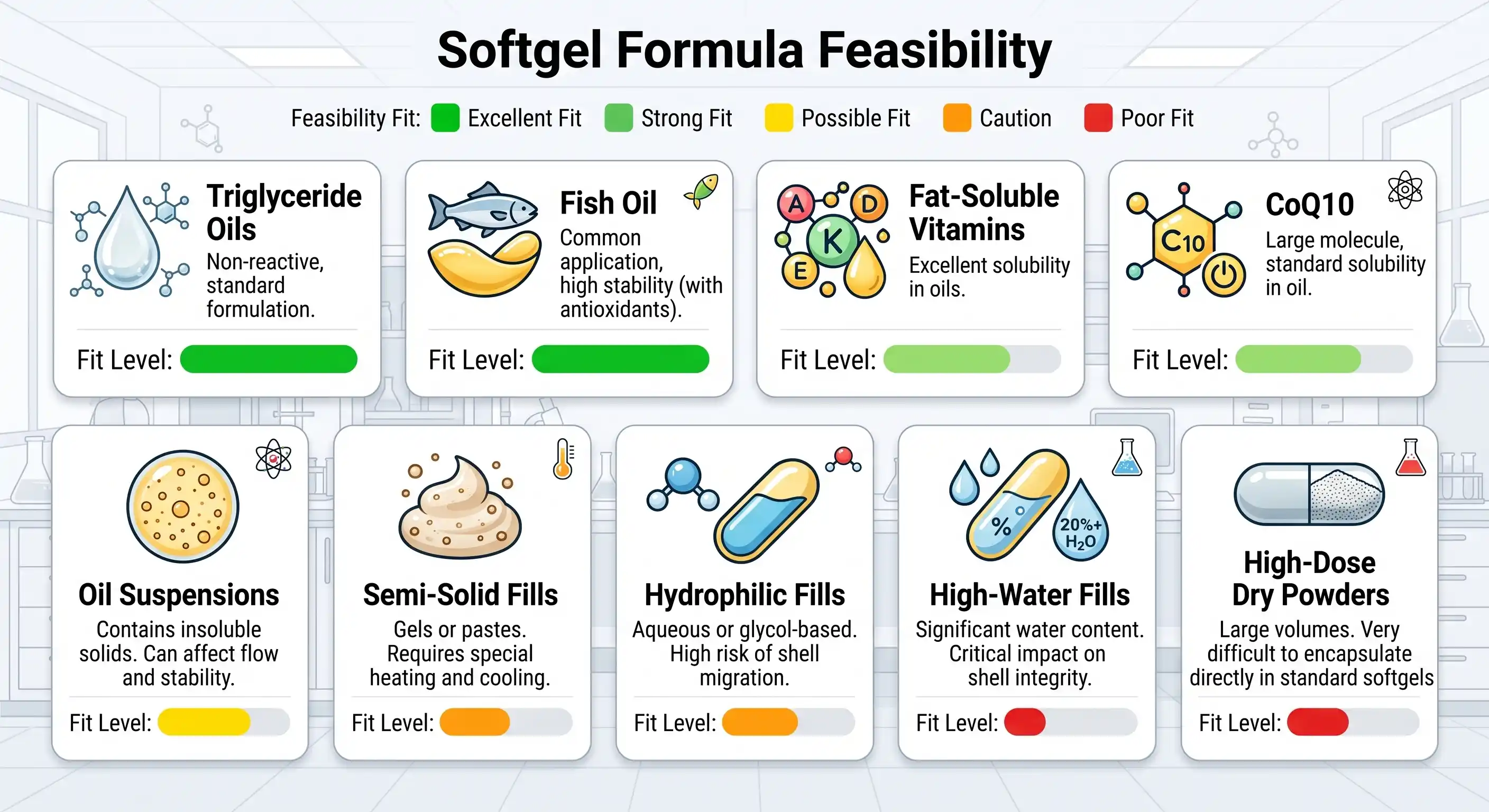
Before requesting custom softgels, screen the formula by physical form, solubility, dose, water activity, oxidation risk, and shell compatibility.
| Fill Type | Softgel Fit | 為什麼 | Development Requirement |
| Triglyceride oils | 極佳 | Natural fit for sealed liquid delivery | Oxidation, fill weight, shell and package review |
| Fish oil/algae oil | 極佳 | Oil is already in the desired physical form | Peroxide/anisidine strategy, oxygen and light protection |
| Fat-soluble vitamins | 強大 | Can be dissolved or dispersed in compatible lipid vehicles | Potency, carrier compatibility and stability |
| CoQ10 / carotenoids / lipophilic actives | Strong when properly formulated | Softgels can support oil-based solution or suspension systems | Solubility, precipitation, particle size and stability |
| Oil suspensions | Possible | Useful when the active cannot be fully dissolved | Sedimentation, particle size, viscosity and dose uniformity |
| 半固態填充物 | Possible | Can support selected waxy or structured systems | Pumpability, temperature, and fill consistency |
| Hydrophilic fills | Use caution | Water-soluble components can interact with or migrate into the shell | Compatibility and stability trials |
| High-water fills | Often challenging | Water migration can change shell mechanical properties | Alternative dosage-form review |
| Very high-dose dry powders | Often poor fit | Fill-volume limits can make serving size impractical | Consider hard capsules, tablets or powders |
If the project already has a draft formula, a 軟膠囊製造 feasibility review should be completed before artwork, tooling, or launch timing is finalized.
What Can Go Inside a Softgel?
Oils and Lipid Solutions
These are the classic softgel use cases. The key development questions are whether the active remains dissolved or uniformly dispersed, whether the oil oxidizes, whether the fill viscosity is compatible with encapsulation, and whether the package protects the product through shelf life.
停賽處分
Suspensions can work when an active does not fully dissolve in the fill vehicle, but they require tighter control of particle size, sedimentation, viscosity, resuspension behavior, and dose uniformity. A formula that looks homogeneous during mixing can still settle during holding, pumping, or long-term storage.
Semi-Solid Systems
Selected semi-solids can be encapsulated when the process temperature and rheology are compatible with filling equipment. Development should confirm that the material remains pumpable and that the active does not precipitate or separate during cooling and storage.
Fills That Require Extra Caution
Water-rich systems, low-molecular-weight hydrophilic solvents, highly volatile solvents, strongly acidic or alkaline fills, and reactive components may create shell problems. The correct conclusion is not that every such formula is impossible; it is that shell-fill compatibility must be demonstrated rather than assumed.
Softgel Shell-Fill Compatibility: What Can Go Wrong?
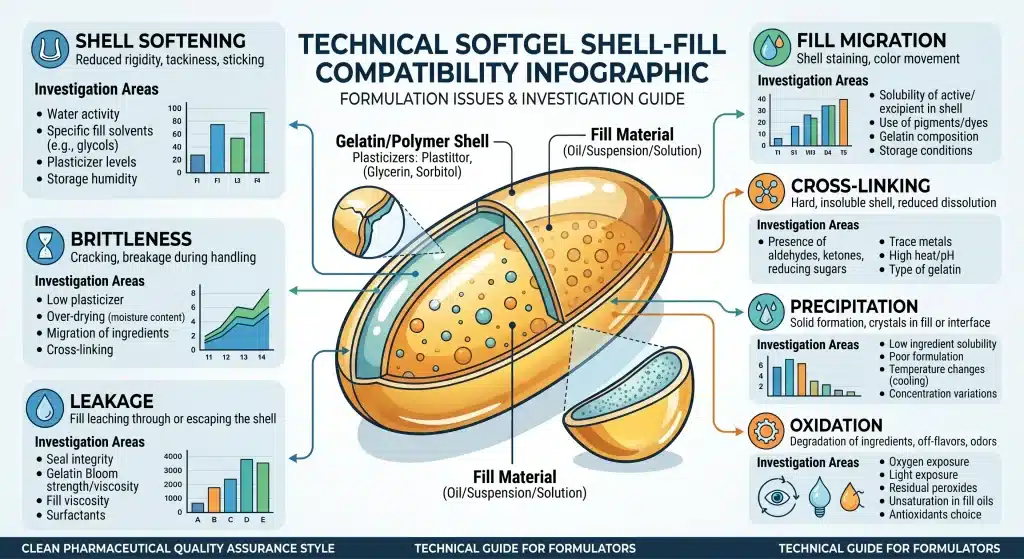
Softgel stability depends on the shell and fill behaving as one system. Water, solvents, plasticizers, reactive compounds, oxidation products, pH, and other formulation variables can migrate or react across the shell-fill interface.
| 風險 | What You May See | What to Investigate | Buyer Question |
| Shell softening | Sticky, deformed or overly flexible softgels | Moisture, plasticizer migration, humidity, fill-shell diffusion | Was shell-fill compatibility tested on stability? |
| Shell brittleness | Cracking during handling, bottling or shipping | Low shell moisture, storage conditions, shell formulation, fill interaction | What is the shell-moisture acceptance range? |
| Leakage | Oil on capsules, bottle residue or seam failure | Seam integrity, ribbon condition, fill viscosity, shell strength | How are leakers and seam defects inspected? |
| Fill migration | Changes in shell texture, clarity or fill composition | Water-soluble components, PEG-type systems, solvents, plasticizer movement | Is migration monitored during accelerated and real-time stability? |
| Cross-linking | Delayed or failed disintegration/dissolution | Aldehydes, oxidized lipids, reactive components, heat/humidity exposure | Is dissolution tracked through shelf life? |
| 降雨量 | Visible crystals or sediment in the fill | Solubility margin, temperature, carrier system, active concentration | Was precipitation challenged under stability conditions? |
| 氧化 | Odor, color change, rancidity or potency loss | Oxygen, light, peroxide formation, trace metals, package barrier | What oxidation and packaging controls are used? |
Why Softgels Fail: Defect and Root-Cause Matrix
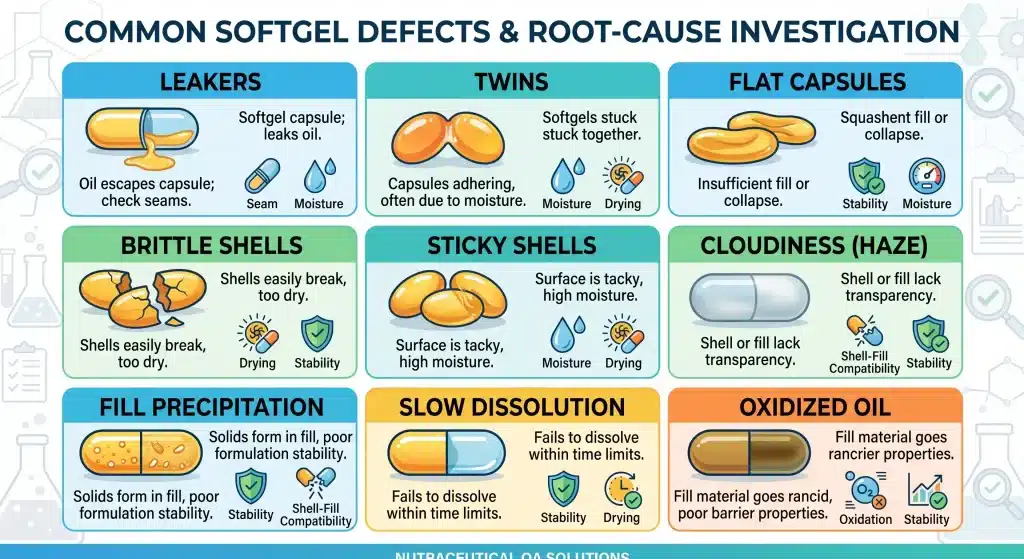
A defect should trigger an investigation, not a one-line diagnosis. The table below shows common softgel failure modes and the areas a brand or quality team should review.
| 缺陷 | What the Brand Sees | Possible Areas to Investigate |
| Leakers | Oil on finished capsules or bottle walls | Seam strength, ribbon thickness, fill viscosity, encapsulation settings, shell condition |
| Twins/sticking | Softgels adhere to one another | Drying endpoint, shell moisture, humidity, plasticizer balance |
| Flat or misshapen capsules | Shape inconsistency | Fill weight, drying conditions, tooling, shell mechanical properties |
| Brittle shell | Cracking during transport or handling | Moisture loss, storage temperature, plasticizer system, shell-fill interaction |
| Sticky shell | Clumping or tacky surface | Excess moisture, humidity, migration, incomplete drying |
| Cloudiness/appearance change | Loss of clarity | Shell composition, storage, fill migration, oxidation or incompatibility |
| Fill precipitation | Crystals or sediment | Solubility, saturation, carrier selection, temperature cycling |
| Slow dissolution | Delayed shell opening or release | Cross-linking, storage conditions, reactive fill components |
| Oxidized oil | Rancid odor, flavor or color change | Raw-oil quality, antioxidants, oxygen exposure, trace metals, package barrier |
Why Some Gelatin Softgels Stop Dissolving Properly
Gelatin can undergo unwanted cross-linking during storage. This can create a more resistant shell network and may slow or interfere with normal disintegration or dissolution. Reactive fill components, aldehydes, oxidized lipids, heat, humidity, and storage conditions can contribute to the problem.
The practical lesson for supplement brands is simple: a softgel that passes a release test at manufacturing is not automatically protected from shelf-life changes. Dissolution or disintegration performance should be part of the stability strategy when cross-linking risk is relevant.
Do Softgels Have Better Absorption?
Sometimes, but not because the shell is soft. A softgel may support better delivery when a lipophilic active is already dissolved or well dispersed in a suitable lipid vehicle and remains stable until consumption. That is a formulation advantage, not a universal dosage-form rule.
Actual absorption depends on the active ingredient, solubility, carrier, particle size, release, digestion, meal conditions, stability, and product-specific evidence. A hard capsule or tablet can perform well when the formulation is appropriate, while a poorly designed softgel can still precipitate, oxidize, cross-link, or release inconsistently.
For a format-by-format comparison without duplicating this guide, see the softgels vs capsules guide.
Gelatin vs Plant-Based Softgel Shells
“Plant-based softgel” is not a single technology. Different polymer systems can have different forming, sealing, drying, mechanical, thermal, and fill-compatibility behavior. The correct shell choice depends on both technical performance and the brand’s vegan, vegetarian, halal, kosher, allergen, and market-positioning requirements.
| 決策因素 | 明膠軟膠囊 | Plant-Based System |
| 原料識別 | Bovine, porcine, fish or other qualified gelatin source | Depends on polymer system and supplier |
| 純素定位 | 沒有 | Potentially yes, if the full system qualifies |
| Halal/kosher | Source and certification dependent | Formula and certification dependent |
| Shell mechanics | Well-established but grade dependent | System specific |
| 填充相容性 | Must be demonstrated | Must be demonstrated |
| Drying behavior | Established process windows | May require different process windows |
| Heat/humidity performance | Formula and storage dependent | Formula and system dependent |
| 成本 | Often lower | Often higher, depending on system |
| Manufacturing capability | 廣泛可用 | Confirm tooling, shell system and line experience |
Brands sourcing traditional shell materials can review the 軟膠囊明膠供應商指南 for Bloom strength, viscosity, source, traceability, COA, and supplier-qualification considerations.
When Should You Not Use a Softgel?
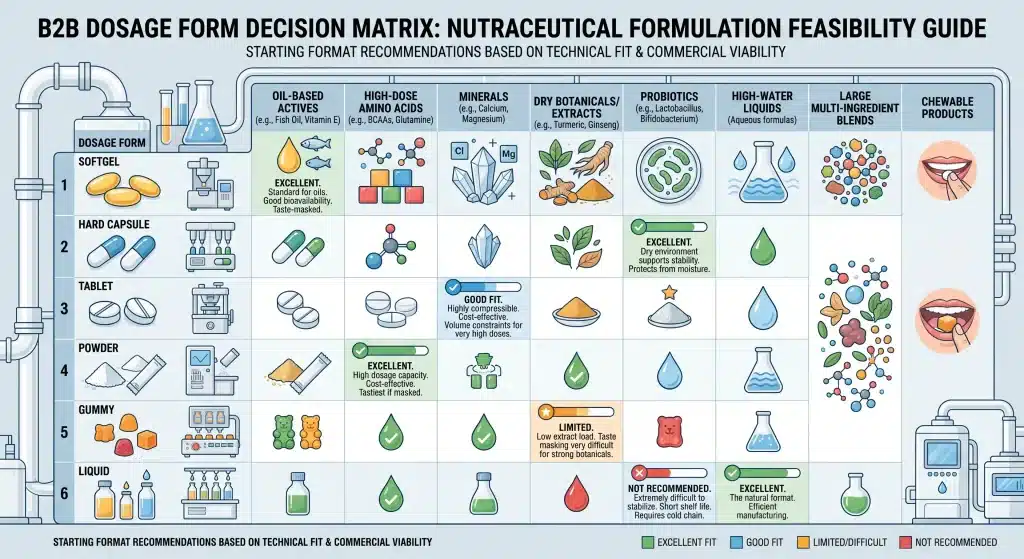
A dosage form should solve the formula’s problem, not create a new one. Softgels may be a weak fit when the target dose is large, the formula is mostly dry powder, the fill requires a large amount of water, or the product needs a format that is easier to prototype at a lower technical barrier.
| Formula Requirement | Often Better Starting Format | 為什麼 |
| High-dose amino acids | Powder/tablet / multiple hard capsules | Gram-level serving load |
| Large mineral load | Tablet/powder | High mass and density requirements |
| Dry botanical blend | Hard capsule/tablet | Direct fit for dry multi-ingredient powders |
| 益生菌複方 | Hard capsule or specialized delivery system | Moisture and viability considerations |
| High-water liquid | Liquid bottle or alternative encapsulation system | Shell interaction risk |
| Large powder blend with many actives | Hard capsule/tablet/powder | More efficient dose capacity |
| Chewable positioning | Gummy / chewable tablet | Consumer-use requirement |
| Oil / fat-soluble actives | Softgel often remains a strong option | Natural fit for sealed lipid delivery |
Softgels vs Hard Capsules for Omega-3 Manufacturing
For conventional fish-oil or algae-oil products, softgels are usually the more natural manufacturing fit because the active is already an oil. The one-piece sealed shell can also help mask odor and contain the liquid fill.
Hard capsules become more relevant when a brand is using a dry omega-3 powder, beadlet, specialized liquid-filled hard-capsule technology, or a multi-ingredient powder concept. The decision should therefore follow the actual omega-3 raw material and target serving, not a generic claim that one capsule type is always better.
Softgel Manufacturing Process: Keep the Guide High-Level
The standard process includes formula and fill development, shell preparation, rotary-die encapsulation, drying and curing, inspection, testing, packaging, and stability monitoring. Each stage has process-specific controls, but this comprehensive guide should not duplicate a full process article.
For step-by-step manufacturing details, review the dedicated 軟膠囊製造工藝 指南。.
Softgel Quality Control: What Should Be Tested?
| 品質部門 | Typical Checks | 為何重要 |
| Identity/assay | Active identity, potency, and applicable composition specifications | Confirms the formula meets defined product specifications |
| 填充重量 | Average fill weight and variation | Supports dose consistency |
| 外觀 | Shape, color, seams, bubbles, twins, dents and visible defects | Detects process and consumer-quality issues |
| Leak/seam integrity | Visual or validated leak/seam checks | Prevents fill loss and package contamination |
| Shell moisture | Finished shell moisture or validated equivalent control | Helps control brittleness, sticking and mechanical properties |
| Disintegration/dissolution | Product-appropriate release testing | Confirms shell opening and active release behavior |
| Oil oxidation | Peroxide value, anisidine value, or other relevant oxidation metrics | Important for omega-3 and oxidation-sensitive oils |
| 微生物學 | Product-specific microbial limits and pathogens | Supports safety and release |
| Heavy metals/contaminants | Risk-based or specification-based testing | Supports raw-material and finished-product compliance |
| 穩定性 | Appearance, assay, oxidation, release, leakage, shell behavior, package performance | Verifies shelf-life performance |
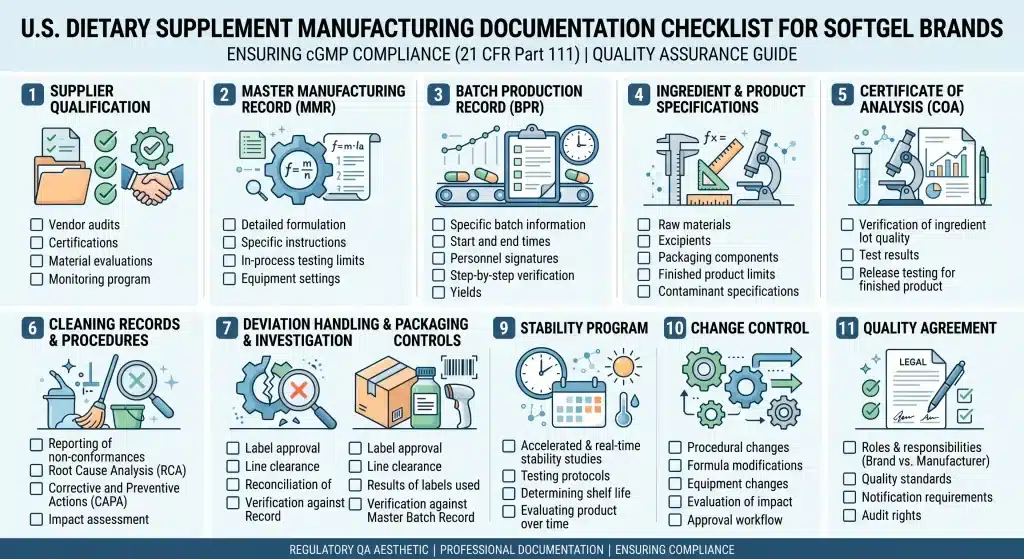
What Documents Should a U.S. Supplement Brand Verify?
For U.S. dietary supplements, 21 CFR Part 111 requires manufacturers to establish and follow current good manufacturing practice systems, including specifications, quality-control procedures, master manufacturing records, batch production records, laboratory records, and related documentation.
A brand does not necessarily receive every proprietary manufacturing record in full, but it should verify that the contract manufacturer maintains the required systems and can support appropriate audits, quality agreements, batch documentation, specifications, test records, traceability, deviation handling, and release controls.
- Current raw-material and finished-product specifications
- Representative or batch-specific COAs and test records
- Supplier qualification and component-identity controls
- Confirmation that Master Manufacturing Records are maintained for each unique formula and batch size
- Confirmation that Batch Production Records are completed for each manufactured batch
- Cleaning, line-clearance and equipment-control records
- Deviation, material-review and disposition procedures
- Packaging and label controls
- Stability program and package-compatibility plan
- Change-control and quality-agreement expectations
How to Choose a Softgel Manufacturing Partner
A capable manufacturer should be able to explain why your formula belongs in a softgel, not simply quote a price for encapsulation.
| Buyer Question | What a Strong Answer Should Cover |
| Is this formula technically suitable for a softgel? | Fill chemistry, dose, viscosity, solubility, suspension risk and shell compatibility |
| Which shell system should we use? | Gelatin source or plant-based system, claim requirements and compatibility |
| What are the main shelf-life risks? | Oxidation, precipitation, cross-linking, moisture migration, leakage and packaging |
| What needs pilot or feasibility testing? | Shell-fill interaction, fill stability, encapsulation, drying and release |
| What release tests will apply? | Formula-specific specifications, appearance, fill weight, assay, disintegration/dissolution and relevant contaminants |
| How will stability be monitored? | Real-time/accelerated plan, critical quality attributes and package configuration |
| What commercial terms matter? | Tooling, MOQ, pilot availability, packaging, lead time and change control |
For a formula-specific assessment, request a softgel ssmefeasibility review with your active ingredients, target dose, shell preference, serving size, destination market, and packaging concept.
常見問題
What are softgel supplements?
Softgel supplements are one-piece capsules that contain a liquid, oil, suspension, or semi-solid fill inside a flexible shell. They are commonly used for oils and fat-soluble ingredients but are not automatically suitable for every formula.
軟膠囊比膠囊更好嗎?
Not universally. Softgels are often a better fit for compatible oil-based formulas, while hard capsules are often more practical for dry powders, botanicals, amino acids, minerals, probiotics, and multi-ingredient blends.
Do softgels absorb better?
Sometimes a properly designed lipid-based softgel can support better delivery of a lipophilic active, but the dosage form alone does not guarantee better absorption. Performance depends on the ingredient and formulation.
What ingredients are not suitable for softgels?
High-water fills, very high-dose dry powders, strongly reactive fills, and formulas with poor shell compatibility may be unsuitable or require specialized development. Feasibility should be tested rather than decided from ingredient category alone.
Can softgels be vegan?
Yes, plant-based softgel systems exist, but “vegan softgel” is not one single shell technology. The polymer system, processing aids, colors, fill ingredients, and certification should all be verified.
為什麼軟膠囊會滲漏?
Leakage can be associated with seam integrity, ribbon condition, shell strength, fill viscosity, drying, storage, or shell-fill compatibility. A quality investigation should identify the actual root cause.
Why do softgels become sticky or brittle?
Shell moisture, humidity, drying conditions, plasticizer balance, storage, and migration between fill and shell can all affect softgel mechanical properties.
What is softgel cross-linking?
Cross-linking is the formation of additional bonds within the gelatin network that can make the shell more resistant to normal disintegration or dissolution. Reactive compounds, oxidized lipids, heat, humidity, and storage conditions may contribute.
Where can I manufacture vegan softgels?
Choose a manufacturer that can document experience with the specific plant-based shell system, compatible fill types, pilot testing, drying, stability, quality control, and the certifications needed for the intended vegan claim.
What should I send before requesting a custom softgel quote?
Send the ingredient list, active form, target amount per serving, preferred shell type, target softgel size or serving count, destination market, packaging concept, annual volume, and any claim or certification requirements.
總結
Softgels are valuable because they solve specific formulation problems: sealed liquid delivery, oil-based dosing, odor masking, and selected lipid-soluble systems. They are not automatically the most bioavailable, most stable, or most premium dosage form.
The strongest softgel project starts with formula feasibility, then validates shell-fill compatibility, encapsulation, drying, release, stability, packaging, and quality documentation. Brands should choose the dosage form that fits the chemistry and commercial objective rather than forcing every supplement concept into a softgel.
參考資料
- U.S. Food and Drug Administration. Small Entity Compliance Guide: Current Good Manufacturing Practice in Manufacturing, Packaging, Labeling, or Holding Operations for Dietary Supplements.
- Córdoba-Díaz D, et al. Shell Formulation in Soft Gelatin Capsules: Design and Characterization.
- Cole ET, et al. Gelatin and Non-Gelatin Capsule Dosage Forms.

萬華仁(Warren Wan)是一位資深專家,在膳食補充劑供應鏈領域擁有豐富經驗,並在膠原蛋白肽、骨湯蛋白及角蛋白等核心成分的研發、製程控制及全球採購方面具備深厚的實務經驗。 身為本專欄的作者,他致力於剝去行銷包裝的表象,將晦澀難懂的成分科學與生產品質控制標準,轉化為淺顯易懂的硬核科普,協助讀者看清標籤背後的真相,並做出更理性的健康選擇。.


