Bone Broth Collagen vs Collagen Peptides: Which Should You Use?

Bone broth collagen is best when a brand wants a savory, whole-food-positioned ingredient with collagen-derived gelatin, amino acids, and variable minerals from bone broth. Collagen peptides are better when the formula needs a consistent collagen protein dose, neutral taste, easier dispersion, and clearer specifications for powders, sticks, capsules, gummies, or functional beverages.

Both options can fit a supplement line, but they should not be treated as identical ingredients. 骨湯膠原蛋白 is usually positioned around traditional broth nutrition and savory wellness formats. Collagen peptides, also called hydrolyzed collagen, are processed into smaller peptides and are commonly used when brands want a standardized protein ingredient with predictable use levels.

For supplement brands comparing collagen ingredients, the decision should be based on target audience, serving size, flavor system, protein declaration, solubility, cost, testing requirements, and claim strategy. If you are developing a collagen powder, stick pack, capsule, gummy, or functional beverage, Gensei can support ingredient selection, formula design, powder manufacturing, and finished supplement production through dietary supplement OEM manufacturing粉末補充劑製造.

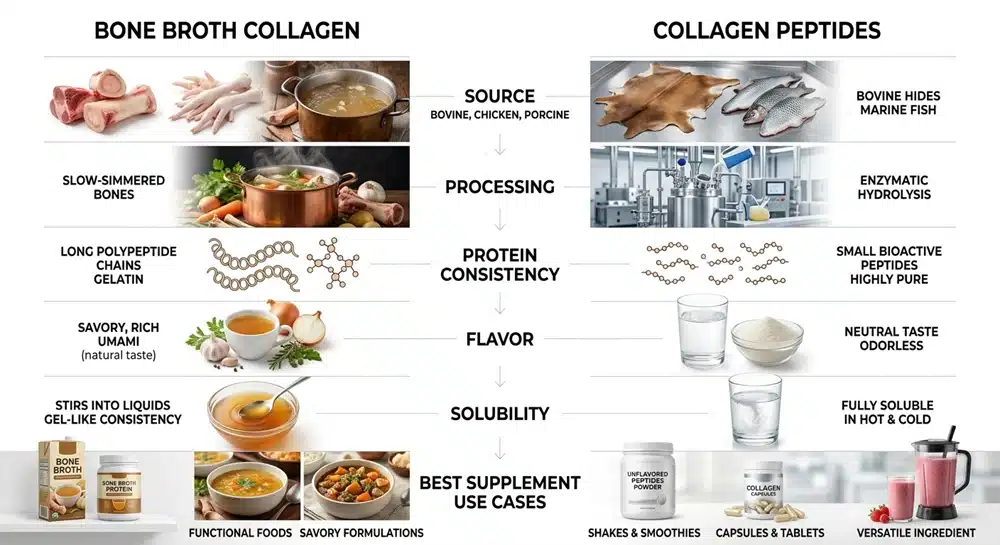
Bone broth collagen vs collagen peptides comparison chart

What Is Bone Broth Collagen?

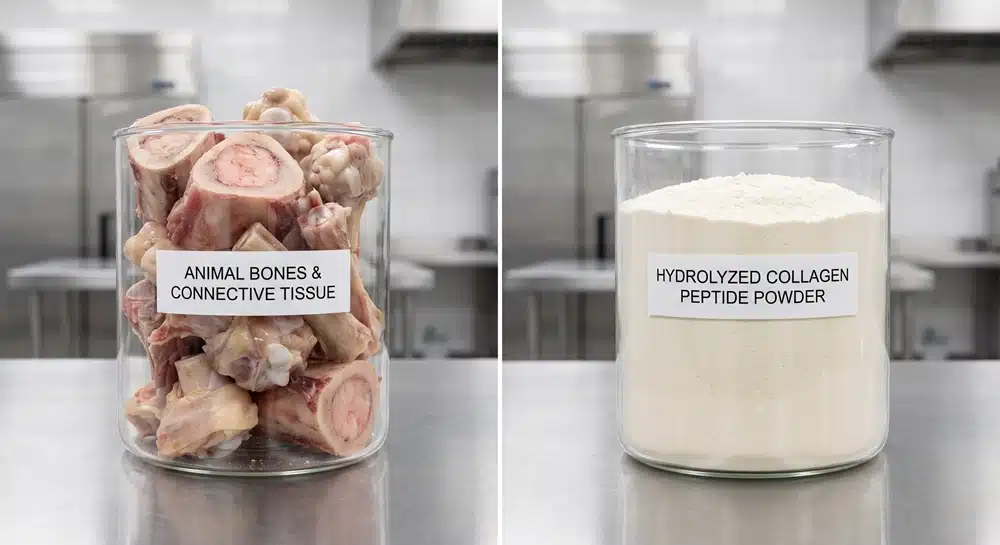
Bone broth collagen is made from animal bones and connective tissues that are simmered, concentrated, dried, and processed into a powder. During cooking, collagen can break down into gelatin and related protein fragments. Depending on the source material and processing conditions, bone broth collagen may also contain amino acids and small amounts of minerals.

The key point is variability. Bone broth products can differ widely by animal source, bone-to-water ratio, cooking time, filtration, concentration, drying method, sodium level, and protein specification. This makes bone broth collagen attractive for whole-food and savory positioning, but it also means supplement brands should request a detailed COA rather than assuming every bone broth collagen powder provides the same collagen-equivalent dose.

What Are Collagen Peptides?

Collagen peptides are produced by hydrolyzing collagen into smaller peptide chains. They are commonly sourced from bovine hide, fish skin, porcine materials, or other collagen-rich tissues. Because they are hydrolyzed and standardized, collagen peptides are widely used in beauty, joint health, sports nutrition, healthy aging, and protein powder formulas.

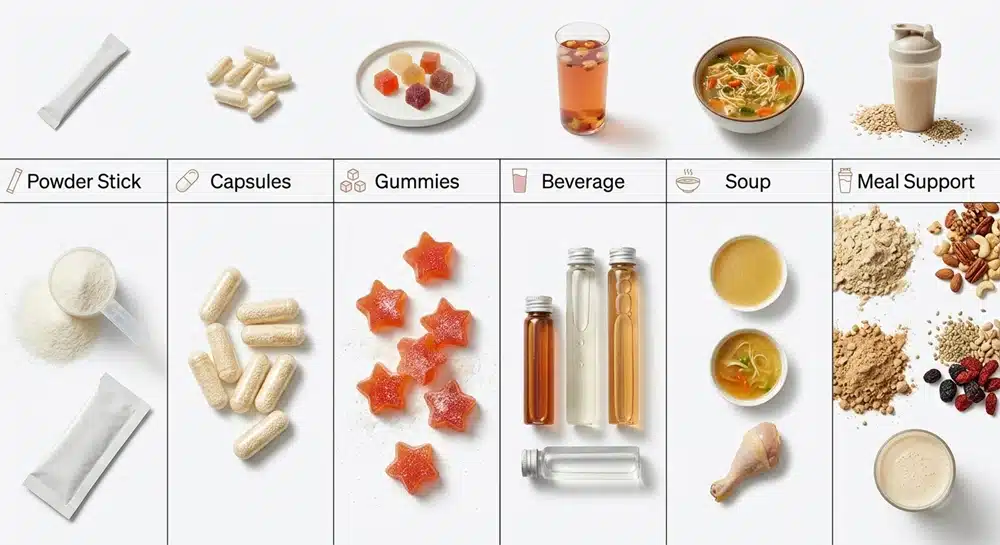
Compared with bone broth collagen, collagen peptides are usually easier to formulate into neutral-flavor powders, capsules, stick packs, gummies, ready-to-mix beverages, and other consumer-friendly supplement formats. Brands should still verify source, molecular weight range, protein content, heavy metals, microbiology, allergens, and sensory profile before selecting a supplier.

Bone broth collagen and collagen peptides source comparison

Bone Broth Collagen vs Collagen Peptides: Key Differences

因子 骨湯膠原蛋白 膠原蛋白勝肽
Primary source Animal bones and connective tissues Hydrolyzed collagen from bovine, marine, porcine, or other collagen sources
處理 Simmering, concentration, drying, and powder processing Collagen extraction followed by enzymatic hydrolysis
Protein consistency Can vary by recipe and concentration Usually more standardized by protein content and peptide profile
Typical taste Savory, broth-like, sometimes salty or meaty Often neutral, slightly characteristic, easier to flavor
Best formats Savory powders, soups, meal support blends, gut-health-positioned products Beauty powders, stick packs, capsules, gummies, sports nutrition, functional drinks
Claim approach Whole-food nutrition and broth-based wellness positioning Standardized collagen peptide support for skin, joint, bone, or connective tissue wellness when substantiated
B2B specification focus Protein content, sodium, minerals, source, flavor, microbiology, heavy metals Protein content, molecular weight, solubility, source, amino acid profile, microbiology, heavy metals

Is Bone Broth the Same as Collagen Peptides?

No. Bone broth may contain collagen-derived gelatin and amino acids, but it is not the same as collagen peptides. Collagen peptides are hydrolyzed and typically standardized for protein content and peptide characteristics. Bone broth is a broader food-derived ingredient with a more variable nutrient profile.

For consumers, this means collagen peptides may be the more predictable option when the goal is a consistent collagen serving. For supplement brands, it means the two ingredients should be evaluated with different specifications and different product positioning.

Does Bone Broth Have Collagen Peptides?

Bone broth may contain collagen-derived gelatin and smaller protein fragments, but most bone broth is not the same as a standardized hydrolyzed collagen peptide ingredient. The amount and form of collagen-related amino acids in bone broth can vary greatly depending on the raw material and manufacturing process.

This is important for label and marketing accuracy. A brand should avoid implying that ordinary bone broth automatically provides the same dose or evidence profile as a clinically studied collagen peptide ingredient unless testing and substantiation support that claim.

Which Is Better for Skin, Joints, or Gut Health?

There is no single best option for every product concept. The better choice depends on the use case.

目標 Better starting point 為什麼
Beauty-from-within powder 膠原蛋白勝肽 Neutral taste, higher serving consistency, easier to combine with vitamin C, hyaluronic acid, or other beauty ingredients
Joint or connective tissue formula Collagen peptides or a blended collagen system More predictable serving size and easier evidence alignment
Savory wellness or broth-based product 骨湯膠原蛋白 Natural savory flavor and whole-food positioning
Gut-health-positioned powder Depends on formula strategy Bone broth may fit whole-food positioning, while collagen peptides may offer better dose consistency
Low-flavor functional beverage 膠原蛋白勝肽 Better sensory control and easier dispersion
Clean-label soup or meal support blend 骨湯膠原蛋白 Fits culinary use and savory product identity

Can You Take Bone Broth and Collagen Peptides Together?

For most healthy adults, bone broth and collagen peptides can be used together as food and dietary supplement ingredients. A simple example is adding unflavored collagen peptides to a warm cup of bone broth. However, people with medical conditions, kidney disease, sodium restrictions, pregnancy, lactation, allergies, or medication concerns should consult a healthcare professional before making significant supplement changes.

For brands, a combined formula can make sense when the positioning is “bone broth plus standardized collagen peptides.” In that case, clearly separate the role of each ingredient: bone broth for savory nutrition and collagen peptides for a more consistent collagen protein contribution.

Collagen ingredient formulation matrix for supplement brands

Formulation Considerations for Supplement Brands

1. Serving Size and Protein Declaration

Collagen peptides are usually easier to use when a label requires a clear protein amount per serving. Bone broth collagen may also provide protein, but the final value should be confirmed through testing and supplier documentation.

2. Flavor and Sensory Profile

Bone broth collagen is naturally savory and may not fit fruit, chocolate, vanilla, or beauty powder flavor systems. Collagen peptides are usually better for neutral or sweet formulations, although source and processing still affect taste and odor.

3. Solubility and Processing

Collagen peptides are commonly selected for instant powder blends and beverage applications because they can disperse well in hot or cold liquids depending on specification. Bone broth collagen may need additional flavor balancing, anticaking support, and solubility testing.

4. Cost and Positioning

Bone broth collagen can justify a premium if the brand story is culinary, whole-food, paleo, keto, or gut-health-adjacent. Collagen peptides often fit broader beauty, joint, sports, and healthy-aging products because the serving size and sensory performance are easier to standardize.

5. Quality Control

For either ingredient, request a current COA and confirm source, protein content, microbiology, heavy metals, allergens, residual solvents if applicable, moisture, ash, particle size, and sensory profile. For bone broth products, sodium and mineral content should also be reviewed carefully.

Buyer Checklist: How to Choose the Right Collagen Ingredient

  • Confirm whether the product concept needs savory bone broth positioning or neutral collagen peptide performance.
  • Ask for protein content, amino acid profile, and serving-size recommendations.
  • Review the source: bovine, chicken, marine, porcine, or mixed source.
  • Check whether the supplier provides COA, heavy metal testing, microbiology, allergen statement, and traceability documents.
  • Test taste, odor, color, dispersibility, and compatibility with the planned flavor system.
  • Confirm the intended dosage and ensure claims are substantiated.
  • For finished products, evaluate packaging format, moisture protection, shelf-life testing, and label compliance.

Where Gensei Fits

Gensei supports supplement brands with collagen ingredient sourcing, custom formulation, powder blending, packaging, and finished dietary supplement manufacturing. If your brand is comparing bone broth collagen, bovine collagen peptides, marine collagen, gelatin, or multi-collagen blends, our team can help evaluate specifications, sensory profile, cost, claims, and manufacturing feasibility.

Explore related support through bone broth collagen ingredient supply, collagen peptides manufacturing, 粉末補充劑製造以及 supplement packaging solutions.

常見問題

骨湯比膠原蛋白肽更好嗎?

Bone broth is not automatically better than collagen peptides. Bone broth may be better for savory, whole-food-positioned products. Collagen peptides are usually better for standardized collagen protein dose, neutral taste, and broad supplement formulation use.

您能從骨湯中攝取足夠的膠原蛋白嗎?

It depends on the product and serving size. Bone broth collagen content can vary, so brands should verify protein and amino acid data instead of assuming a consistent collagen-equivalent dose.

Is collagen powder the same as bone broth powder?

No. Collagen powder usually refers to collagen peptides or hydrolyzed collagen. Bone broth powder is a dried broth ingredient that may contain collagen-derived gelatin, amino acids, minerals, sodium, and savory flavor compounds.

Can you add collagen peptides to bone broth?

Yes, unflavored collagen peptides can be added to warm bone broth. This can create a product or serving format that combines savory broth positioning with a more standardized collagen peptide contribution.

What should supplement brands test before launching a bone broth collagen product?

Brands should review protein content, amino acid profile, sodium, minerals, microbiology, heavy metals, moisture, particle size, taste, odor, and finished-product stability.

總結

Bone broth collagen and collagen peptides are related, but they serve different formulation goals. Bone broth collagen is strongest for savory, whole-food, broth-based positioning. Collagen peptides are stronger for predictable collagen protein dosing, neutral flavor, and scalable supplement formats. For brands, the best choice is not based on trend language. It should be based on specifications, sensory testing, compliance review, and the consumer promise on the label.

參考資料

  1. Campos LD et al. Collagen supplementation in skin and orthopedic diseases: A review of the literature.
  2. Martinez-Puig D et al. Collagen Supplementation for Joint Health: The Link between Composition and Scientific Knowledge.
  3. Pu SY et al. Effects of Oral Collagen for Skin Anti-Aging: A Systematic Review and Meta-Analysis.
  4. Harvard T.H. Chan School of Public Health – Collagen.
  5. FDA – Questions and Answers on Dietary Supplements.
  6. FTC – Health Products Compliance Guidance.
滾動到頂端