
This page is a selection and manufacturing guide, not a consumer-brand ranking. Consumers can use the comparison tables to evaluate labels, while supplement brands can use the quality and RFP sections to qualify ingredients and manufacturers.
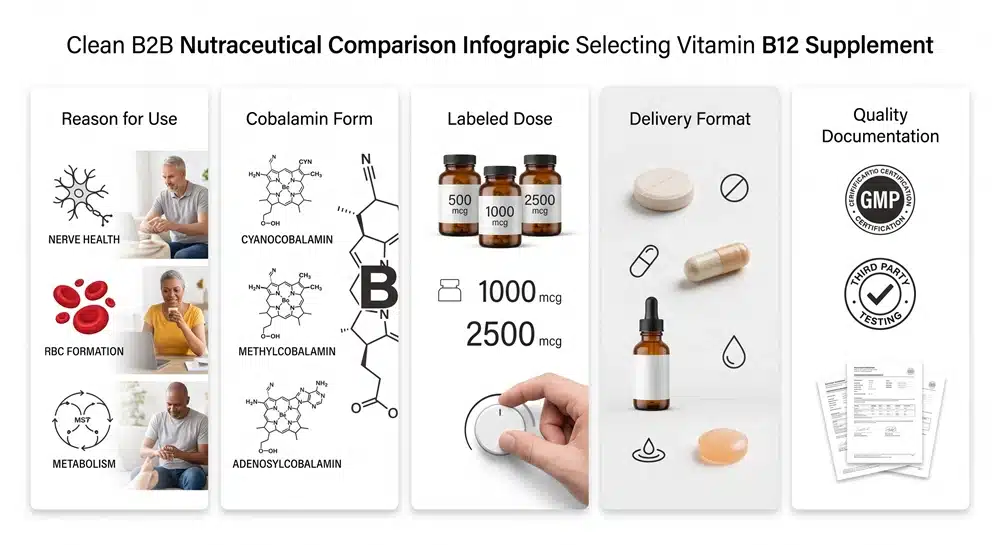
Quick Comparison: What Makes a Good Vitamin B12 Supplement?
| عامل اتخاذ القرار | ما الذي تبحث عنه | What to Avoid |
|---|---|---|
| Reason for use | A nutritional need, dietary gap or clinician-directed purpose. | Self-diagnosing every episode of fatigue, brain fog or tingling as B12 deficiency. |
| B12 form | Cyanocobalamin, methylcobalamin or another permitted form stated clearly. | Claims that one form is universally superior, “toxin free” or mandatory for everyone. |
| Amount | A serving amount that fits the intended user and product positioning. | Using “maximum strength” as the only quality signal. |
| Delivery format | A tablet, capsule, lozenge, gummy, liquid or spray the user can take correctly and consistently. | Claims that sublingual, spray or gummy formats always absorb better. |
| الجودة | Identity, potency, uniformity, contaminants, microbiology and stability controls. | “Third-party tested” with no test scope, lot reference or supporting documentation. |
| Claims | Careful statements about normal red blood cell formation, neurological function and energy metabolism. | Promises to cure fatigue, reverse neuropathy, improve intelligence or provide instant energy. |
What Is Vitamin B12?
Vitamin B12 is a water-soluble nutrient involved in normal red blood cell formation, neurological function and DNA synthesis. The recommended dietary amount for most adults is 2.4 mcg per day, increasing to 2.6 mcg during pregnancy and 2.8 mcg during lactation.
Food sources include animal-derived foods and fortified products. Supplements can provide a reliable source for people whose diets contain little B12 or whose ability to absorb food-bound B12 is reduced. A supplement does not replace evaluation when symptoms or laboratory findings suggest a deficiency.
Who May Need a Vitamin B12 Supplement?
People may use fortified foods or supplements when dietary intake or absorption is insufficient. Groups that often require closer attention include:
- People following vegan diets or highly restrictive vegetarian diets
- Adults over age 50 who may absorb food-bound vitamin B12 less efficiently
- People who have had gastrointestinal surgery
- People with pernicious anemia or other conditions that impair absorption
- People using metformin or acid-suppressing medicines for prolonged periods
- Pregnant or breastfeeding people whose diets contain little or no animal-derived food
Fatigue, numbness, balance problems, cognitive changes and anemia can have many causes. Consumers should not use a high-dose supplement to delay medical assessment when symptoms are persistent or significant.
Methylcobalamin vs Cyanocobalamin
Methylcobalamin and cyanocobalamin are common forms used in dietary supplements. Methylcobalamin is a naturally occurring coenzyme form and is often selected for “methylated” or premium positioning. Cyanocobalamin is a manufactured form widely used in supplements and fortified foods.
Available evidence does not show that absorption rates of vitamin B12 supplements consistently differ by form. Methylcobalamin should therefore not be described as universally more bioavailable, better retained or more effective. Cyanocobalamin should not be presented as a dangerous or unusable form merely because its name contains “cyano.”
| العامل | ميثيل كوبالامين | سيانوكوبالامين |
|---|---|---|
| تحديد الموقع | Coenzyme-form or methylated-product positioning. | Widely recognized supplement and fortification form. |
| Formulation consideration | May require more careful light and stability management depending on the finished product. | Often selected when cost, familiarity and formulation stability are priorities. |
| Absorption conclusion | No evidence of universal absorption superiority. | No evidence that it is inherently ineffective or poorly absorbed. |
| Best B2B decision rule | Choose when product positioning, evidence and stability data support it. | Choose when specification, cost and stability fit the product brief. |
What About Adenosylcobalamin and Hydroxocobalamin?
Adenosylcobalamin is another coenzyme form. Hydroxocobalamin is associated with medical products in some markets and may also appear in selected supplements. Brands should verify market status, specification, stability, label naming and evidence before choosing a less common form.
Oral vs Sublingual Vitamin B12
Vitamin B12 is sold as swallowed tablets and capsules, chewables, lozenges, liquids, sprays and products labeled for sublingual use. Sublingual products are often promoted as bypassing digestion, but evidence does not show a meaningful efficacy advantage over standard oral products.
The practical decision should focus on dose, adherence, swallowing preference, sugar and excipient profile, dose-delivery accuracy, stability, packaging and cost. Prescription injections and medical nasal products should not be presented as interchangeable with ordinary retail supplements.
How Much Vitamin B12 Should a Supplement Contain?
The correct amount depends on the intended use. The adult recommended dietary amount of 2.4 mcg is a nutritional reference, not a universal supplement dose. Stand-alone products often contain hundreds of micrograms because absorption becomes much less efficient at high oral doses.
| Reference or Product Type | Typical Design Context | Important Boundary |
|---|---|---|
| Adult dietary reference | 2.4 mcg/day for most adults. | This is not a diagnosis or a universal stand-alone supplement dose. |
| Pregnancy and lactation | 2.6 mcg/day during pregnancy and 2.8 mcg/day during lactation. | Individual prenatal needs should be reviewed with a qualified professional. |
| Multivitamin or B-complex | Often near or above the Daily Value, depending on the product. | Review the total from all serving units and overlapping products. |
| High-dose oral product | Commonly 500–1,000 mcg per serving. | Only a small fraction may be absorbed; a high label number is not proof of better results. |
| Clinician-directed deficiency management | Dose and route may differ substantially. | Requires diagnosis and professional guidance; do not market routine wellness products as treatment. |
Vitamin B12 has no established Tolerable Upper Intake Level because of its low toxicity potential. However, “no UL” does not mean every person needs a high-dose product, that all adverse reactions are impossible or that medical supervision is unnecessary in complex cases.
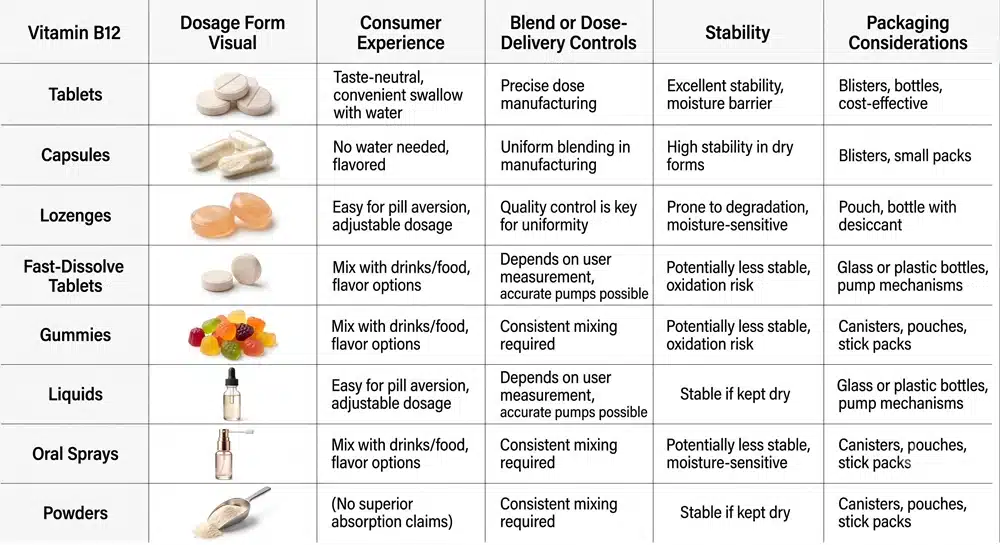
Which Delivery Format Is Best?
| التنسيق | الخيار الأنسب | Development Checks | Claim Boundary |
|---|---|---|---|
| الأجهزة اللوحية | Cost-efficient daily products and multivitamins. | Hardness, friability, disintegration, blend uniformity and light protection. | Compression does not make the vitamin less effective when the product meets specification. |
| الكبسولات | Simple formulas and flexible shell options. | Premix distribution, flowability, fill weight, shell compatibility and package barrier. | Capsules are not inherently more bioavailable than tablets. |
| Lozenges or fast-dissolve tablets | Users who prefer no-water or mouth-dissolving formats. | Taste masking, disintegration, moisture, packaging and dose uniformity. | Fast mouth breakdown is not proof of superior systemic absorption. |
| العلكة | Flavor-forward and easy-to-take consumer concepts. | Potency over shelf life, sugar/sweetener system, water activity and serving consistency. | Do not promise faster absorption or instant energy. |
| Liquids or sprays | Flexible serving experience and users who avoid pills. | Metered dose, preservative system, microbiology, light exposure and package compatibility. | Spray delivery does not automatically bypass digestion or work faster. |
| المساحيق | Premixes and multi-ingredient drink products. | Microgram-level premix design, blend uniformity, scoop accuracy and stability. | Consumers should not casually measure high-potency B12 with an uncalibrated scoop. |
How to Evaluate “Third-Party Tested” Vitamin B12
“Third-party tested” is useful only when the scope is clear. A brand or manufacturer should be able to identify the laboratory, method, specification, batch and attributes tested. Testing can confirm identity, potency or contaminants, but it does not automatically prove a product’s health claims.
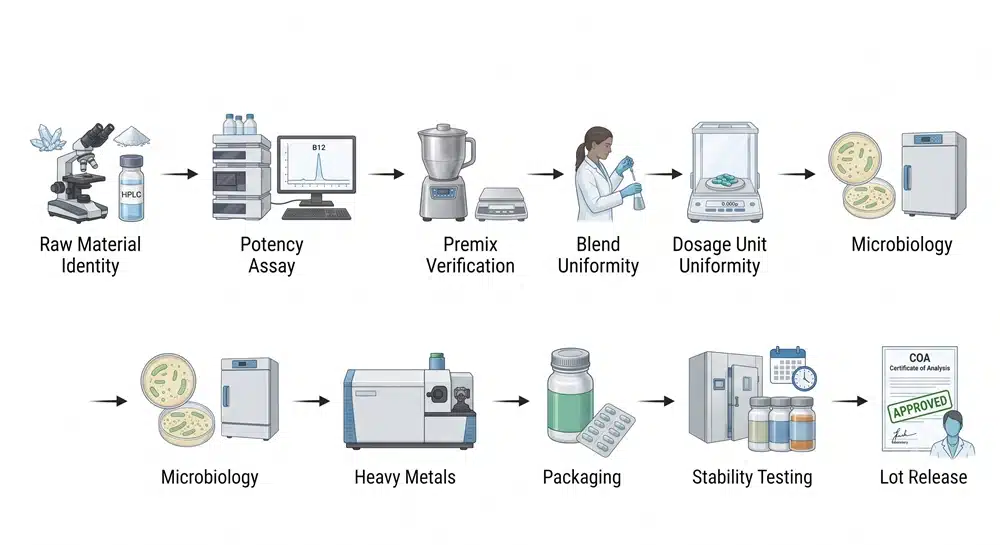
| منتج عالي الجودة | ما الذي يجب طلبه | ما أهمية ذلك |
|---|---|---|
| الهوية | Validated identification of the declared cobalamin form and raw-material documentation. | Confirms the ingredient matches the label and formula. |
| الفاعلية | Assay method, raw-material potency, finished-product specification and lot result. | Verifies label strength and supports a justified overage strategy. |
| التوحيد | Premix qualification, blend uniformity or dosage-unit uniformity data. | Critical because vitamin B12 is used at microgram-level amounts. |
| علم الأحياء الدقيقة | Total counts and specified organism tests appropriate to the dosage form. | Supports finished-product release. |
| المعادن الثقيلة | Lead, arsenic, cadmium and mercury limits where applicable. | Supports market and product safety requirements. |
| الاستقرار | Real-time and accelerated data in the final package. | Shows whether potency and product quality are maintained through shelf life. |
| Label and claims | Serving size, form, amount, Daily Value, claim wording and required disclaimer review. | Reduces labeling, dosage and advertising errors. |
How Supplement Brands Should Choose a B12 Manufacturer
For raw-material options and B-complex premixes, compare vitamin B ingredient sourcing by form, potency, carrier, assay method and documentation rather than marketing terminology alone.
A capable التصنيع التعاقدي للفيتامينات partner should be able to control microgram-level blending, protect sensitive ingredients, justify potency overage, validate shelf-life performance and maintain complete production records. These controls should connect to a documented مراقبة جودة المكملات الغذائية program.
Capabilities to Verify
- Qualified sources for cyanocobalamin, methylcobalamin and other proposed forms
- Premix calculation and verification for diluted or carrier-based raw materials
- Blend or unit uniformity controls for microgram-level active ingredients
- Light, moisture and oxygen controls appropriate to the form and dosage format
- Finished-product potency methods and laboratory qualification
- Real-time or scientifically justified stability program in the final package
- Master manufacturing records, batch production records and change control
- Label, structure/function claim and advertising review
RFP Questions for a Vitamin B12 Manufacturer
- Which cobalamin forms can you source, and how is identity verified?
- Is the raw material supplied as a pure ingredient, dilution, beadlet or premix?
- How is potency converted into the formula amount and label declaration?
- What blend-uniformity or dosage-unit uniformity controls are used?
- How are light-sensitive materials protected during weighing, blending, filling and packaging?
- Which assay method and laboratory are used for raw materials and finished products?
- How is formulation overage determined, documented and confirmed through stability?
- Can you provide recent lot-specific COAs, master records and batch records?
- What are the MOQ, sample quantity, tooling needs and lead time for each format?
- What stability data are available for tablets, capsules, gummies, liquids, sprays or lozenges?
- How are “energy,” “brain,” “methylated,” “vegan” and “third-party tested” claims reviewed?
- What change-control process applies if the B12 source, form, potency or carrier changes?
Common Vitamin B12 Marketing Mistakes
- Calling methylcobalamin the universal gold standard or the only bioavailable form
- Claiming cyanocobalamin is unsafe solely because it contains a cyanide ligand
- Promising instant energy to people who are not deficient
- Claiming sublingual, spray or gummy B12 always bypasses digestion and works faster
- Using MTHFR as a blanket reason that every consumer needs methylcobalamin
- Calling a dietary supplement or manufacturing facility “FDA approved”
- Using “third-party tested” without defining the laboratory, test scope or lot
- Marketing a higher dose as automatically higher quality
الأسئلة الشائعة
What is the best form of vitamin B12?
No form is best for every user. Evidence does not show that absorption rates consistently differ among supplemental forms. The decision should consider the user’s need, dose, product stability, evidence, price and professional advice.
Is methylcobalamin better than cyanocobalamin?
Not universally. Both can supply vitamin B12. Methylcobalamin may fit a coenzyme-form product concept, while cyanocobalamin may fit products prioritizing familiarity, cost or stability.
Is sublingual vitamin B12 better than a tablet?
Evidence does not show a meaningful efficacy difference between oral and sublingual vitamin B12. The better format is usually the one that meets specification and can be taken consistently and correctly.
Is 1,000 mcg of vitamin B12 too much?
Many stand-alone products provide 1,000 mcg, and vitamin B12 has no established UL. However, only a small fraction of a high oral dose may be absorbed, and not everyone needs this amount. The reason for use matters more than the headline dose.
Should vegans take vitamin B12?
People following vegan diets need a reliable vitamin B12 source from fortified foods or supplements. Product form and dose should be selected according to the person’s diet, health status and professional guidance where needed.
What does third-party tested mean?
It should mean that an independent or qualified external laboratory tested clearly defined attributes for a specific batch. The term alone does not reveal whether the lab checked identity, potency, contaminants, stability or claim effectiveness.
الوجبات الجاهزة النهائية
The best vitamin B12 supplement is the product that matches a real need, declares the form and amount clearly, uses a practical delivery format, maintains potency through shelf life and is supported by transparent quality records. “Methylated,” “high potency,” “sublingual” and “third-party tested” are not substitutes for a well-designed formula and verified manufacturing controls.
يمكن للعلامات التجارية أن اتصل بـ GENSEI with the target B12 form, serving amount, dosage format, market, packaging and testing requirements to request specifications, samples or a project quotation.
المراجع
- NIH Office of Dietary Supplements: Vitamin B12 Fact Sheet for Health Professionals
- NIH Office of Dietary Supplements: Vitamin B12 Fact Sheet for Consumers
- إدارة الغذاء والدواء الأمريكية (FDA): الادعاءات المتعلقة بالبنية والوظيفة
- إدارة الغذاء والدواء الأمريكية (FDA): أسئلة وأجوبة حول المكملات الغذائية
- لجنة التجارة الفيدرالية (FTC): إرشادات الامتثال الخاصة بالمنتجات الصحية
- 21 CFR الجزء 111: الممارسات التصنيعية الجيدة الحالية للمكملات الغذائية
- 21 CFR 101.36: Nutrition Labeling of Dietary Supplements

وارن وان خبير متمرس يتمتع بخبرة واسعة في سلسلة توريد المكملات الغذائية، ولديه خبرة عملية غنية في مجالات البحث والتطوير ومراقبة العمليات والتوريد العالمي للمكونات الأساسية مثل ببتيدات الكولاجين وبروتين مرق العظام والكيراتين. وبصفته كاتب هذه الزاوية، يكرس جهوده لتجريد الموضوعات من غلافها التسويقي، وتحويل العلوم الغامضة المتعلقة بالمكونات ومعايير مراقبة جودة الإنتاج إلى معلومات علمية متعمقة وسهلة الفهم، مما يساعد القراء على فهم الحقيقة الكامنة وراء الملصقات واتخاذ خيارات صحية أكثر عقلانية.


