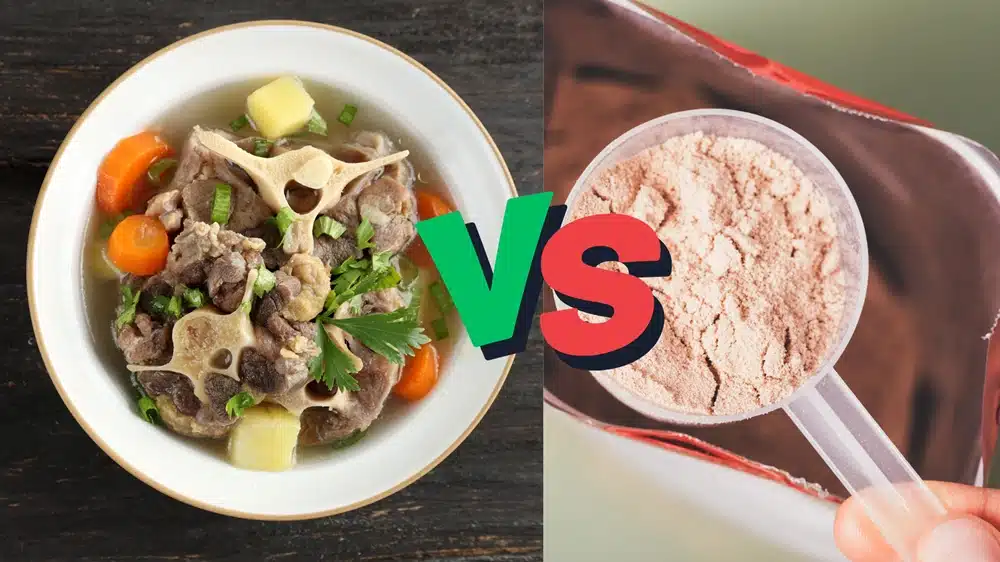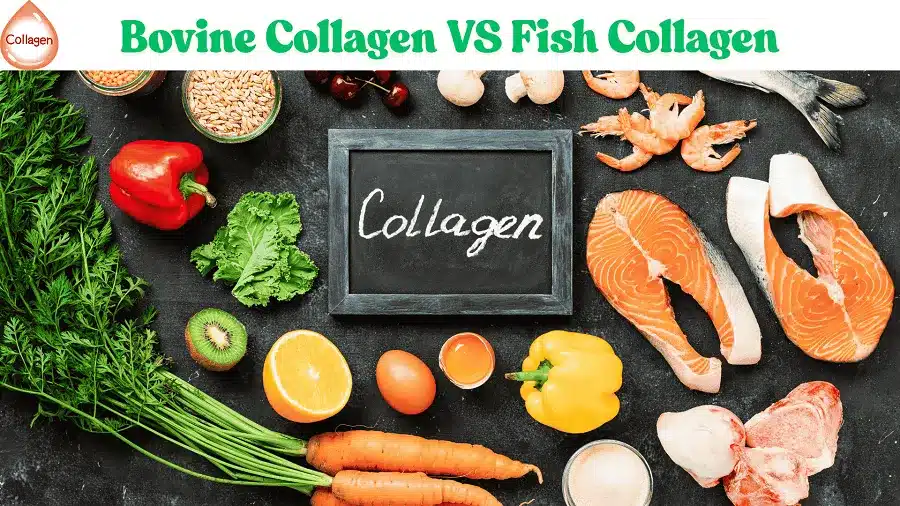
Soluble collagen and hydrolyzed collagen are not simply “large collagen versus small collagen.” Soluble collagen generally describes collagen that can be extracted or kept in solution under defined conditions and may retain much of its native triple-helical structure. الكولاجين المتحلل بالماء is collagen that has been intentionally broken into a mixture of smaller peptides. For oral powders and beverages, hydrolyzed collagen is usually more practical because it is non-gelling and can be formulated for broad water solubility. For topical or biomaterial applications, soluble/native collagen may be selected when retaining larger collagen structures is useful. The exact behaviour depends on pH, ionic strength, temperature, source, processing and molecular-weight distribution.
The most important distinction for buyers is this: “soluble” is a physical property measured under specific conditions, while “hydrolyzed” describes a processing state. A label or specification should therefore tell you more than the marketing name.
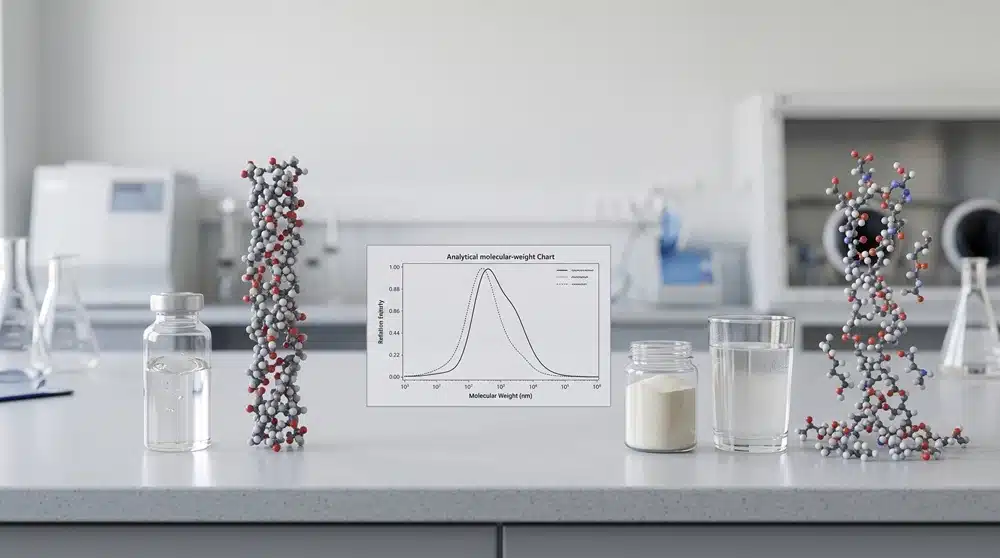
Soluble Collagen vs Hydrolyzed Collagen at a Glance
| العامل | الكولاجين القابل للذوبان | الكولاجين المتحلل بالماء |
|---|---|---|
| What the term describes | Collagen that is soluble/extractable under stated conditions; may retain triple-helical structure | Collagen that has undergone hydrolysis into smaller peptide chains |
| الهيكل | Often closer to native collagen, depending on extraction and processing | Triple helix is disrupted and peptide bonds are cleaved to varying degrees |
| الحجم الجزيئي | Usually much larger than collagen hydrolysates, but the specification should state actual data | Mixture of lower-molecular-weight peptides; distribution varies by process and product |
| Water solubility | Strongly dependent on pH, ionic strength, temperature and cross-linking | Usually easier to formulate in water over a broader range, but still product- and pH-dependent |
| Gelling behaviour | Depends on form and thermal history; native/partially الكولاجين المشوّه behaves differently from peptides | Normally non-gelling at typical supplement concentrations |
| Common commercial use | Cosmetics, specialty biomaterials, research and some technical formulations | Powders, sachets, beverages, capsules, tablets, gummies and functional foods |
| Best B2B metric | Identity, extraction method, structural integrity, pH solubility, viscosity and microbiology | Molecular-weight distribution, protein/peptide profile, solubility, sensory quality and COA |
What Is Soluble Collagen?
Soluble collagen is not one universally standardised molecule or one guaranteed molecular weight. In collagen research and raw-material processing, the term can refer to collagen fractions that are extractable in acidic or enzyme-assisted conditions. Acid-soluble collagen and pepsin-soluble collagen, for example, can retain the characteristic collagen triple helix while showing different extraction yield and solubility profiles.
This matters because searchers often assume “soluble collagen” means “collagen that instantly dissolves in a glass of neutral water.” That is not a reliable definition. Native-like collagen solubility changes with pH, salt concentration, temperature, species, tissue source, cross-linking and processing history. Research on collagen materials has repeatedly shown that measured collagen solubility changes when the solution conditions change.
In cosmetic ingredient lists, “Soluble Collagen” is also used as an ingredient name. For formulation and procurement, buyers should still request the supplier’s technical definition: source, extraction route, protein content, pH range, viscosity, molecular/structural data and intended application.
Is Collagen Soluble in Water?
It depends on which collagen material and which water conditions. “Collagen is soluble” and “collagen is insoluble” can both be misleading when no pH, salt concentration, temperature or processing state is stated.
Native and extracted collagen commonly shows its highest solubility away from its isoelectric region, often under acidic conditions. In one study of type I collagen extracted from yellowfin tuna swim bladders, both acid-soluble and pepsin-soluble collagen retained triple-helical features and showed their highest solubility at acidic pH. Other collagen-solubility research has shown that ionic strength and pH materially change the percentage of collagen measured as soluble.
Hydrolysis changes the situation because large collagen chains are cleaved into smaller peptides. This generally makes collagen hydrolysates easier to formulate into beverage powders and other aqueous systems, but a supplier should still provide a real solubility method and test condition rather than the vague claim “100% water soluble.”
Why collagen solubility changes
- الأس الهيدروجيني: protein charge changes with pH, which affects aggregation and solubility.
- Ionic strength: salts can either improve or reduce apparent solubility depending on concentration and protein state.
- درجة الحرارة: heating can denature collagen and change viscosity, gel behaviour and extraction.
- Cross-linking: mature, highly cross-linked collagen is harder to extract and dissolve than less-cross-linked material.
- التحلل المائي: cleaving peptide bonds reduces chain length and usually improves beverage-formulation practicality.
- Source and tissue: fish skin, bovine hide, bone, cartilage and other tissues can yield collagen with different thermal and physicochemical properties.
What Is Hydrolyzed Collagen?
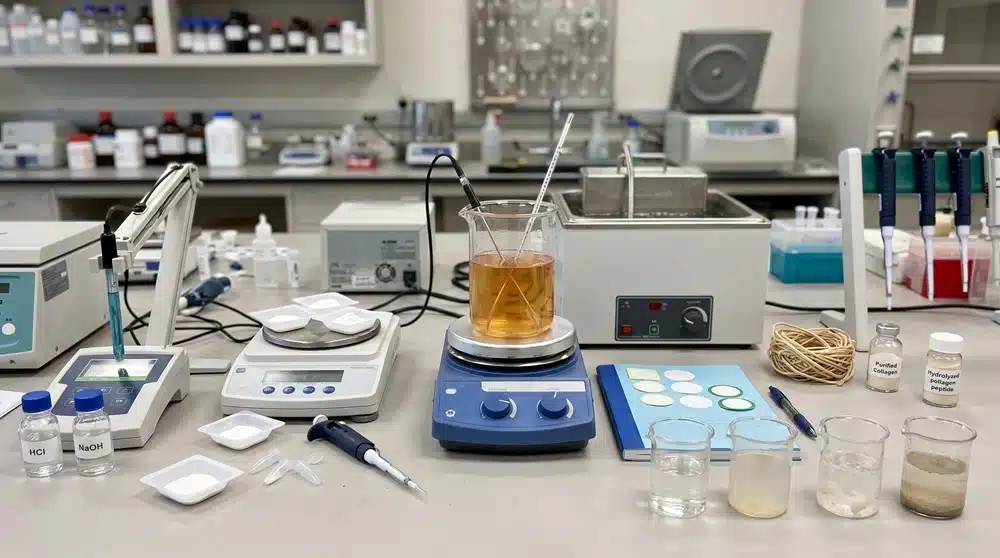
Hydrolyzed collagen, also called collagen hydrolysate and commonly marketed as collagen peptides, is produced by breaking collagen into smaller peptide chains through controlled hydrolysis. Enzymatic hydrolysis is widely used for supplement-grade materials because the process can be adjusted to target a desired peptide-size distribution and sensory profile.
However, “hydrolyzed collagen” does not automatically mean one fixed molecular weight such as 2,000-5,000 Da. Published analytical work shows that collagen hydrolysates are complex peptide mixtures and that their mass-distribution patterns differ by raw material, hydrolysis conditions and product. A good specification therefore reports a molecular-weight distribution or peptide profile rather than only one marketing number.
For a more detailed terminology review, see الكولاجين المتحلل بالماء مقابل ببتيدات الكولاجين. In most supplement contexts those terms describe the same ingredient category, but the raw-material specification matters more than the wording.
Native Collagen, Soluble Collagen, Gelatin and Hydrolyzed Collagen
| المواد | Processing State | Typical Structure / Behaviour | Common Application |
|---|---|---|---|
| الكولاجين الطبيعي | Intact or minimally processed collagen | Triple-helical macromolecular structure; limited practical drink solubility | Specialty biomaterials, research, tissue scaffolds |
| Soluble collagen | Extracted/processed so collagen is soluble under specified conditions | Can retain triple-helical/native-like structure depending on process | Cosmetics, specialty liquid systems, biomaterials |
| الجيلاتين | Thermally denatured/partially hydrolyzed collagen | Dissolves hot and forms a gel when cooled | الحلوى الهلامية، الأطعمة، الكبسولات، أنظمة القوام |
| Hydrolyzed collagen / collagen peptides | Further hydrolyzed into shorter peptides | Lower viscosity, usually non-gelling and easier to disperse in drinks | Supplement powders, beverages, sachets, tablets and capsules |
This four-part distinction is more useful than calling soluble collagen simply “regular collagen.” If the formulation depends on gelling or food texture, gelatin is a separate functional material. If the goal is an instant-mixing powder, hydrolyzed collagen is usually the more practical starting point.
Does Hydrolyzed Collagen Absorb Better?
Human studies show that after people ingest collagen hydrolysates, collagen-derived metabolites—including hydroxyproline-containing dipeptides and tripeptides—can appear in plasma. This supports the statement that hydrolyzed collagen is digested and absorbed as amino acids and small peptides.
What the evidence does not support is a universal claim that “more than 90% of collagen peptides enter the bloodstream intact,” or that any specific low molecular weight automatically gives a proportional clinical advantage.
A 2024 randomized crossover study compared collagen hydrolysates from fish, porcine and bovine sources, including bovine materials with average molecular weights around 2,000 and 5,000 Da. All tested hydrolysates produced relevant circulating collagen metabolites, and the investigators reported comparable uptake of free hydroxyproline across the products. This is a useful warning against treating “2,000 Da” as automatically superior to “5,000 Da.”
Even gelatin is digestible. Human research has detected hydroxyproline-containing peptides after gelatin ingestion as well as after gelatin/collagen hydrolysates. The defensible formulation statement is therefore: hydrolyzed collagen is pre-processed into smaller peptides and is usually more convenient for low-viscosity, non-gelling supplement formats; exact absorption and biological response depend on the peptide profile and product.
Soluble Collagen in Skin Care vs Hydrolyzed Collagen in Skin Care
The topical comparison should be separated from the oral supplement comparison. Large collagen proteins do not automatically penetrate deeply through intact skin simply because they are described as “soluble.” Free macromolecular collagen has poor passive transdermal permeability, which is why research groups use delivery systems such as liposomes, nanoparticles or microneedles when they want to improve collagen delivery through the skin barrier.
For a conventional cosmetic cream or serum, soluble/native-like collagen is more defensibly discussed as a surface-conditioning, film-forming or water-binding ingredient unless the finished formulation has penetration data. Hydrolyzed collagen has a lower molecular size, but that also does not justify a blanket claim that it reaches the dermis or rebuilds dermal collagen when applied topically.
Brands should distinguish three questions:
- Does the ingredient dissolve and remain stable in the cosmetic base?
- Does the finished product change surface hydration, feel or appearance?
- Has the finished delivery system actually demonstrated penetration to the claimed skin layer?
Those are different endpoints and should not be merged into the single marketing word “absorption.”
Soluble Collagen vs Hydrolyzed Collagen for Oral Supplements
For ordinary oral collagen powders, hydrolyzed collagen is usually the better formulation choice because it is designed for lower viscosity, non-gelling behaviour and easier dispersion. It also has direct human pharmacokinetic evidence showing collagen-derived peptide metabolites after ingestion.
That does not mean intact or soluble collagen is “wasted” by digestion. Dietary proteins are digested. The issue is practical formulation and the specific peptide profile, not whether the stomach can process the ingredient at all.
Brands developing oral products can compare a current bulk collagen peptides specification by species/source, protein result, molecular-weight distribution, hydroxyproline/amino-acid profile, solubility, sensory quality, heavy metals, microbiology and batch documentation.
What Does the Human Evidence Say About Hydrolyzed Collagen?
Hydrolyzed collagen has been studied in randomized trials for skin and musculoskeletal outcomes, but the evidence should be presented with its limitations. Earlier meta-analyses reported improvements in skin hydration and elasticity across collagen-supplement trials. A 2025 meta-analysis found that apparent skin benefits were not significant in higher-quality or non-industry-funded subgroups. A 2026 systematic review also concluded that preliminary dermatological benefits are possible but noted that most included trials had high risk of bias and that better standardized trials are needed.
For a comparison article, the key point is that these trials study specific oral hydrolyzed-collagen products. They do not prove that hydrolyzed collagen is universally superior to every soluble/native collagen material for every endpoint, and they do not validate topical claims.
Which Is Better: Soluble or Hydrolyzed Collagen?
| الهدف | نقطة انطلاق أفضل | لماذا |
|---|---|---|
| Instant-mixing supplement powder | الكولاجين المتحلل بالماء | Lower viscosity, non-gelling, easier beverage formulation |
| RTM drink / sachet | الكولاجين المتحلل بالماء | Peptide-size and sensory specs can be optimized for dispersion |
| Gummy / gel texture | Gelatin, sometimes combined with peptides | Gelatin provides the functional gel network |
| Conventional cosmetic film/hydration | Soluble collagen or validated hydrolyzed grade | Choose based on INCI, film formation, viscosity and finished-formula testing |
| Biomaterial / scaffold | Native/soluble collagen | Retained higher-order structure can be technically important |
| Clinical oral collagen claim | Exact studied hydrolysate | Match source, peptide profile, dose and study to the finished product |
B2B Quality Specifications to Request
| المواصفات | Soluble / Native-Like Collagen | الكولاجين المتحلل بالماء |
|---|---|---|
| Raw material identity | Species, tissue, collagen type, extraction fraction | Species, tissue, collagen source and hydrolysis route |
| المعالجة | Acid/enzyme extraction, purification, thermal history | Enzyme type/process, hydrolysis conditions, filtration |
| الهيكل | Triple-helix/denaturation data if structural integrity is a selling point | Peptide profile / degree of hydrolysis where relevant |
| الوزن الجزيئي | Method and distribution when relevant; do not assume 300 kDa from the label alone | MW distribution, not just one average number |
| القابلية للذوبان | Test pH, temperature, concentration and ionic conditions | Cold/hot water test, target concentration, pH and clarity |
| Viscosity / gel behaviour | Important for cosmetics and specialty biomaterials | Usually low viscosity/non-gelling; confirm in target formula |
| Protein / collagen markers | Protein, amino-acid profile, hydroxyproline where appropriate | Protein, amino-acid/hydroxyproline profile, peptide assay if claimed |
| Sensory | Odour, colour, formulation compatibility | Taste, odour, colour, clarity, dispersibility |
| Safety / QC | Heavy metals, microbiology, source contaminants | Heavy metals, microbiology, source contaminants |
| المستندات | COA, specification, SDS/TDS, source/process statement | COA, specification, SDS/TDS, MW data, source/allergen documentation |
How to Test Collagen Solubility for a Real Formula
A supplier statement such as “highly soluble” is incomplete unless the method matches your finished product. For beverage and supplement development, define a repeatable test:
- Set the target concentration, for example the actual grams of collagen per serving.
- Specify water temperature and mixing energy/time.
- Record pH before and after addition.
- Measure visible clumping, sediment, turbidity and foam after a defined period.
- Repeat in the real flavour/mineral/acid system, not only in purified water.
- For shelf-stable liquids, test after heat processing and throughout stability.
- For native/soluble collagen, include viscosity and aggregation/precipitation checks over the intended pH range.
For a commercial drink powder, تصنيع مسحوق المكملات الغذائية should validate actual dose, blend uniformity, dispersibility, flavour masking, moisture control, packaging and finished-product stability rather than relying on raw-material solubility alone.
Common Marketing Claims to Avoid
- “Soluble collagen is always native collagen.” Ask how the material is extracted and whether structural integrity is demonstrated.
- “Soluble means fully water-soluble at any pH.” Protein solubility depends on conditions.
- “Hydrolyzed collagen is always 2,000-5,000 Da.” MW distributions vary by process and product.
- “90%+ of hydrolyzed collagen reaches the blood intact.” Human studies show amino acids and small collagen-derived peptides in circulation, not wholesale intact absorption of the powder.
- “Lower molecular weight is always more bioavailable and more effective.” A 2024 human crossover study found relevant metabolite uptake across hydrolysates of different sources and molecular weights.
- “Marine collagen is automatically 1.5x more absorbable than bovine.” Source alone does not establish a universal bioavailability multiplier.
- “Topical hydrolyzed collagen penetrates into the dermis because it is smaller.” Finished-formula penetration must be demonstrated.
- “Collagen repairs cartilage / reverses ageing / rebuilds skin.” Health and cosmetic claims should match the actual evidence and applicable regulation.
الأسئلة الشائعة
What is soluble collagen?
Soluble collagen is collagen that can be extracted or maintained in solution under defined conditions. It may retain native-like triple-helical structure, but the exact form depends on source and processing. It should not be defined only by one assumed molecular weight.
Is collagen soluble in water?
Some collagen materials are soluble under particular water, pH, salt and temperature conditions, while others aggregate or remain poorly soluble. Hydrolyzed collagen is generally easier to formulate in water because it contains shorter peptide chains.
What is the difference between soluble collagen and hydrolyzed collagen?
“Soluble” describes physical behaviour under specific conditions; “hydrolyzed” describes collagen that has been cleaved into smaller peptides. Soluble collagen can retain larger native-like structures, while hydrolyzed collagen is a peptide mixture.
Is soluble collagen the same as native collagen?
Not always. Some soluble collagen fractions retain native triple-helical features, but “soluble collagen” should not be treated as a universal synonym for every native collagen product. Check the extraction method and structural data.
هل الكولاجين المتحلل مائيًا هو نفسه ببتيدات الكولاجين؟
In most supplement contexts, yes. “Hydrolyzed collagen,” “collagen hydrolysate,” and “collagen peptides” commonly describe the same lower-molecular-weight ingredient category.
Why is hydrolyzed collagen more soluble?
Hydrolysis breaks long collagen chains into shorter peptides, reducing intermolecular interactions and usually lowering viscosity and improving dispersibility. Actual solubility still depends on pH, concentration and the finished formula.
Is hydrolyzed collagen better absorbed than soluble collagen?
Hydrolyzed collagen has direct human evidence showing collagen-derived dipeptides and tripeptides in blood after ingestion. However, exact absorption varies by peptide profile, and low molecular weight alone does not guarantee greater clinical efficacy.
Is soluble collagen used in skin care?
Yes. Soluble collagen is used in cosmetic formulations. For ordinary topical products, claims should focus on demonstrated surface-conditioning, film-forming or hydration effects unless penetration of the finished formula has been specifically validated.
What collagen powder has the best solubility?
Do not choose by source name or average molecular weight alone. Request a test at the actual serving concentration, pH, water temperature and mixing conditions, then verify clarity, sediment and sensory performance in the finished formula.
What should a B2B buyer request before purchasing hydrolyzed collagen?
Request source/tissue identity, protein result, molecular-weight distribution, amino-acid or hydroxyproline profile, solubility method, taste/odour, heavy metals, microbiology, allergen/source documents, batch COA, MOQ, lead time and stability information relevant to the finished product.
المراجع
- Characteristics of acid-soluble and pepsin-soluble type I collagen from yellowfin tuna swim bladders
- New recommendations for measuring collagen solubility
- Peptide profile consistency and quality attributes of collagen hydrolysates
- Absorption of bioactive peptides following collagen hydrolysate intake: randomized crossover study
- Identification of food-derived collagen peptides in human blood after oral ingestion
- Comparison of gelatin and low-molecular-weight gelatin hydrolysate ingestion in humans
- 2026 study on enhanced transdermal delivery of natural collagen using a liposome system
- 2025 systematic review and meta-analysis of collagen supplements and skin ageing
- 2026 systematic review of hydrolyzed collagen supplementation and skin outcomes
- Cosmetic Ingredient Review: Hydrolyzed Collagen
- إدارة الغذاء والدواء الأمريكية (FDA): الادعاءات المتعلقة بالبنية والوظيفة
- لجنة التجارة الفيدرالية (FTC): إرشادات الامتثال الخاصة بالمنتجات الصحية

وارن وان خبير متمرس يتمتع بخبرة واسعة في سلسلة توريد المكملات الغذائية، ولديه خبرة عملية غنية في مجالات البحث والتطوير ومراقبة العمليات والتوريد العالمي للمكونات الأساسية مثل ببتيدات الكولاجين وبروتين مرق العظام والكيراتين. وبصفته كاتب هذه الزاوية، يكرس جهوده لتجريد الموضوعات من غلافها التسويقي، وتحويل العلوم الغامضة المتعلقة بالمكونات ومعايير مراقبة جودة الإنتاج إلى معلومات علمية متعمقة وسهلة الفهم، مما يساعد القراء على فهم الحقيقة الكامنة وراء الملصقات واتخاذ خيارات صحية أكثر عقلانية.