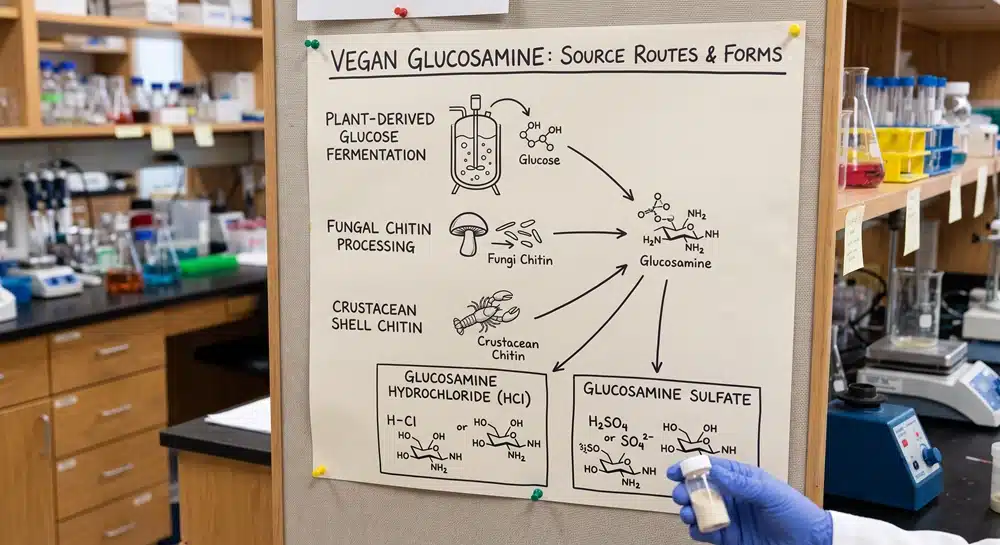
Vegan glucosamine is glucosamine produced without crustacean shell material. It is commonly made by microbial fermentation using plant-derived glucose, such as corn glucose, or through a fungal chitin process. “Vegan” describes the sourcing route, not the salt form or clinical effectiveness. Products may contain glucosamine HCl or stabilized sulfate salts, and evidence for glucosamine’s joint benefits remains mixed.
For consumers, the key questions are source, complete-product vegan status, glucosamine form, serving amount, safety, and third-party quality information. For supplement brands, the project should begin with ingredient identity, assay basis, source documentation, allergen controls, specification review, stability, and claim substantiation.
ما هو الجلوكوزامين النباتي؟
Glucosamine is an amino sugar that the body uses as a building block for molecules found in cartilage and other tissues. Commercial glucosamine supplements are commonly sold as glucosamine hydrochloride, glucosamine sulfate sodium chloride, or glucosamine sulfate potassium chloride.
Traditional commercial glucosamine is often produced from chitin obtained from crustacean shells. Vegan glucosamine uses a non-animal manufacturing route. The finished glucosamine may be chemically comparable when the same salt form and specifications are met, but the source route does not by itself prove equal clinical effectiveness, impurity profile, environmental impact, or safety.
Brands sourcing bulk material can review our vegan glucosamine ingredient and specification page.
What Is Vegan Glucosamine Made From?
Fermentation-Derived Glucosamine
Many vegan glucosamine ingredients are produced through microbial fermentation. A carbohydrate feedstock—often glucose made from corn—is supplied to a controlled fermentation process. Microorganisms convert the feedstock into glucosamine or a precursor, after which the material is recovered, purified, crystallized, and converted into the intended salt form.
This is why “corn-derived glucosamine” should not be interpreted as glucosamine extracted directly from whole corn. Corn commonly supplies the glucose feedstock. The microorganism, fermentation medium, purification steps, processing aids, and salt-conversion process are separate parts of the ingredient identity.
Fungal Chitin-Derived Glucosamine
Another non-crustacean route may use chitin or chitosan obtained from fungal biomass, such as selected fermentation fungi. The chitin is hydrolyzed and purified to produce glucosamine. This route can be non-animal, but buyers still need a complete vegan statement and process documentation.
Source Route Comparison
| Route | Starting Material | Key Verification Questions |
|---|---|---|
| Direct microbial fermentation | Plant-derived glucose or another carbohydrate feedstock | Feedstock origin, fermentation organism, processing aids, GMO statement, purification, residuals, and final salt form |
| Fungal chitin route | Chitin or الشيتوزان from fungal biomass | Fungal species, culture medium, chitin isolation, hydrolysis, allergen assessment, residual protein, and final salt form |
| Crustacean chitin route | Crab, shrimp, or other crustacean shells | Species, allergen controls, residual protein, contaminants, source declaration, and target-market labeling |
Is All Glucosamine Vegan?
No. The word الغلوكوزامين identifies the ingredient, not its source. A label must be checked for the actual sourcing statement.
A product is not automatically vegan simply because it uses glucosamine HCl. Glucosamine HCl can be made from crustacean chitin, fungal chitin, or fermentation-derived material. Similarly, glucosamine sulfate can be made through animal-derived or non-animal routes.
A complete vegan assessment should cover:
- the glucosamine source and production route;
- fermentation media and processing aids;
- carriers and excipients;
- capsule shell, tablet coating, lubricants, colors, and flavors;
- chondroitin or other animal-derived actives;
- cross-contact controls;
- the criteria used for any vegan certification.
“Vegan,” “non-GMO,” “organic,” “shellfish-free,” “allergen-free,” “halal,” and “kosher” are separate claims. One does not automatically establish another.
Vegan Glucosamine vs Shellfish-Derived Glucosamine
| العامل | Vegan / Non-Animal Glucosamine | Crustacean-Derived Glucosamine |
|---|---|---|
| Source route | Microbial fermentation or fungal chitin process | Chitin from crustacean shells |
| Suitable for vegan formulas | Potentially, if the full process and finished formula are verified | لا يوجد |
| Salt forms | May be HCl or stabilized sulfate salts | May be HCl or stabilized sulfate salts |
| الأدلة السريرية | Limited direct clinical outcome data comparing source routes | Most historical glucosamine trials did not focus on vegan sourcing |
| Shellfish-source concern | Avoids crustacean-derived raw material when documented | Uses crustacean shell material; residual protein and label controls should be reviewed |
| Allergy conclusion | Do not call allergy-free; review all ingredients and cross-contact | Shellfish allergy is mainly caused by proteins, not purified glucosamine itself, but product-specific advice and sourcing review are appropriate |
| Sustainability conclusion | Compare actual energy, water, feedstock, solvent, yield, waste, and transport data. Source labels alone do not prove a lower environmental footprint. | |
| أيهما أفضل? | Vegan glucosamine may be preferable for animal-free sourcing and formula positioning. Clinical superiority has not been established by source alone. | |
Glucosamine HCl vs Sulfate: Source Is Not the Same as Form
“Vegan” describes where and how the glucosamine is produced. HCl and sulfate describe the chemical salt form. These are separate decisions.
| الاستمارة | What the Name Means | Brand and Label Questions |
|---|---|---|
| D-Glucosamine HCl | Glucosamine hydrochloride | Source route, assay basis, chloride, free glucosamine calculation, moisture, particle size, and clinical claim support |
| Glucosamine sulfate sodium chloride | A stabilized glucosamine sulfate salt containing sodium chloride | Assay basis, sodium contribution, sulfate content, label nomenclature, stability, and study relevance |
| Glucosamine sulfate potassium chloride | A stabilized glucosamine sulfate salt containing potassium chloride | Assay basis, potassium contribution, sulfate content, label nomenclature, and target-user suitability |
| D-Glucosamine base | Free glucosamine rather than an HCl or stabilized sulfate salt | Stability, hygroscopicity, assay, application behavior, and regulatory/label suitability |
Clinical findings from one salt form should not automatically be applied to another. For a detailed form comparison, see our glucosamine sulfate vs glucosamine HCl guide.
Is Vegan Glucosamine Effective?
The most accurate answer is that the clinical evidence is uncertain. Research on glucosamine for osteoarthritis and joint symptoms has produced inconsistent results, and professional guidelines do not agree. The strongest conclusions often depend on the exact preparation, salt form, study quality, and whether a prescription crystalline product or a general dietary supplement was tested.
Evidence for Glucosamine Overall
Glucosamine has been extensively studied for knee osteoarthritis, but studies and guidelines have reached different conclusions. Some analyses or guidelines identify possible benefit for selected preparations, while others recommend against routine use because clinically important effects were not consistently demonstrated.
Evidence Comparing Vegan and Crustacean Sources
A pharmacokinetic study compared a bio-fermented glucosamine sulfate product with a chitosan-derived product and reported comparable systemic exposure under the study conditions. That type of study evaluates how the body is exposed to the ingredient; it does not establish that the two products produce the same improvement in pain, mobility, cartilage, or long-term outcomes.
A 2024 scientific commentary specifically raised concerns about the limited clinical evidence for vegan glucosamine, the methodology of the available bioequivalence work, quality parameters, and the absence of adequate safety data for the fermentation organism discussed.
Evidence Hierarchy
| الأدلة | What It Can Show | What It Cannot Show Alone |
|---|---|---|
| Chemical identity and assay | The ingredient meets defined chemical specifications | Clinical effectiveness |
| Dissolution or solubility | How the product behaves in a test system | Improved joint symptoms |
| Pharmacokinetic comparison | Relative systemic exposure under study conditions | Equal pain, function, cartilage, or safety outcomes |
| Randomized clinical trial | Effects of the exact tested product in the studied population | Effects of every other source, salt, dose, or formula |
| Systematic review or guideline | Overall assessment of available studies | Guaranteed benefit for an individual consumer |
Potential Benefits: Claims vs Evidence
| الادعاء الشائع | تقييم الأدلة | Responsible Wording |
|---|---|---|
| Supports normal cartilage structure | Glucosamine is related to glycosaminoglycan biology, but supplement outcomes are inconsistent | May be formulated for general joint-health support when substantiated |
| Reduces osteoarthritis pain or stiffness | Clinical evidence and guidelines conflict | Do not present as an established treatment or guaranteed result |
| Repairs or rebuilds damaged cartilage | Not established for commercial dietary supplements | لا تستخدم |
| Protects athletes’ joints | No general evidence that supplementation prevents impact-related cartilage damage | Do not use without product-specific trials |
| Works as well as shellfish glucosamine | Direct clinical outcome comparison is limited | Same source-independent chemical form may be possible, but clinical equivalence is not established by source alone |
| Is safer than shellfish glucosamine | May avoid crustacean sourcing, but overall safety depends on the product and user | Suitable for non-animal-source formulas when sourcing and cross-contact are verified |
Vegan Glucosamine Side Effects and Safety
Changing the source does not remove the general safety considerations associated with glucosamine. Reported effects may include nausea, heartburn, diarrhea, constipation, headache, drowsiness, or skin reactions. Product tolerability also depends on dose, salt form, excipients, and other active ingredients.
Warfarin and Bleeding Risk
Glucosamine and glucosamine–chondroitin products have been associated with increased bleeding risk in people taking warfarin. Anyone using warfarin or another anticoagulant should discuss the exact product with a qualified healthcare professional.
Blood Glucose
Glucosamine may affect blood glucose in some people. People with diabetes, impaired glucose regulation, or glucose-lowering medication should seek professional advice and monitor as appropriate.
Pregnancy and Breastfeeding
There is not enough information to establish safety during pregnancy or breastfeeding. Use should be avoided unless a qualified healthcare professional recommends the exact product.
Other Conditions and Medicines
People with asthma, glaucoma or elevated eye pressure, liver disease, planned surgery, multiple medication use, or a history of supplement reactions should consult a healthcare professional before use.
Shellfish Allergy: An Important Nuance
Shellfish allergy is usually caused by proteins such as tropomyosin, while glucosamine is traditionally made from the shell rather than shellfish muscle. Allergy organizations note that purified glucosamine is generally not the same as consuming shellfish protein. However, consumers with a serious allergy may still prefer verified shellfish-free glucosamine and should review the exact product with an allergist or healthcare professional.
A vegan-source product should not be called “allergy-free.” Corn, soy, wheat, fungal materials, capsule excipients, flavors, or cross-contact may create separate concerns. Brands should maintain source, allergen, and cross-contact documentation for the complete finished product.
Are There Vegan Foods With Glucosamine?
Common fruits, vegetables, grains, beans, nuts, and seeds are not practical dietary sources of glucosamine at amounts comparable with supplements. Glucosamine occurs in biological structures such as chitin and is produced in the body, but there is no established list of common vegan foods that supplies a standardized supplement-like amount.
Statements such as “glucosamine-rich vegetables” should be treated cautiously. Vegan glucosamine supplements are normally manufactured ingredients produced through fermentation or a fungal chitin process—not concentrated vegetable powders.
Vegan Glucosamine with Chondroitin, MSM, or Other Ingredients
A formula that contains vegan glucosamine is not automatically a vegan joint supplement.
| المكوّنات | Common Source Issue | ما الذي يجب التحقق منه |
|---|---|---|
| كبريتات الشوندروتن | Traditionally sourced from bovine, porcine, chicken, shark, or marine cartilage | Non-animal production route, assay method, molecular-weight profile, vegan statement, and batch documents |
| MSM | Usually manufactured rather than animal-derived | Purity, identity, heavy metals, residuals, and formula claim evidence |
| حمض الهيالورونيك | May be fermentation-derived or animal-derived | Source, molecular weight, assay, microbial controls, and vegan statement |
| الكولاجين | البروتين المشتق من الحيوانات | Not suitable for a vegan finished product |
| Boswellia or turmeric | Botanical source does not guarantee finished-product efficacy | Extract specification, marker assay, dose, interactions, and claim substantiation |
| Capsule shell | May contain gelatin or animal-derived processing aids | HPMC/pullulan or other shell identity, color, lubricant, and vegan documentation |
For non-animal chondroitin options, review our vegan chondroitin sulfate ingredient page.
How Consumers Should Choose a Vegan Glucosamine Supplement
- Confirm the source. Look for fermentation-derived, fungal-derived, non-animal, or shellfish-free documentation—not only a vegan-looking package.
- Identify the glucosamine form. HCl and sulfate salts are not interchangeable in evidence or label calculation.
- Check the actual amount per serving. Compare the declared ingredient and serving count rather than the front-label number alone.
- Review every active ingredient. Chondroitin, collagen, hyaluronic acid, and capsule materials may change vegan status.
- Review safety. Check medicines, anticoagulants, blood glucose, pregnancy, breastfeeding, and medical conditions.
- Look for quality documentation. Third-party testing is useful when the tested lot, methods, and results are clear.
- Avoid disease promises. A supplement should not claim to cure arthritis, rebuild cartilage, reverse degeneration, or replace medical care.
Quality Specifications for Supplement Brands
For B2B sourcing, “vegan glucosamine” is not a sufficient specification. The purchase specification should define the exact ingredient and how it will be verified.
| مجال المواصفات | ما الذي يجب طلبه |
|---|---|
| الهوية | Exact chemical name, salt form, CAS reference, molecular formula, and validated identity tests |
| المصدر | Fermentation or fungal route, feedstock, organism, country of origin, source declaration, and vegan statement |
| التحليل | Method, assay basis, as-is/dry basis, glucosamine calculation, chloride or sulfate, sodium or potassium where relevant |
| الخصائص الفيزيائية | Appearance, solubility, particle size, bulk density, tapped density, flow, moisture, and hygroscopicity |
| Purity and residuals | Related substances, residual solvents, fermentation residuals, processing aids, ash, and loss on drying |
| الملوثات | Lead, arsenic, cadmium, mercury, microbiology, specified pathogens, and risk-based contaminants |
| Claims | Vegan, shellfish-free, allergen, non-GMO, organic, halal, kosher, gluten-free, and country-specific documents separately |
| الاستقرار | Retest period, storage, packaging, stability data, and behavior in the intended dosage form |
| Commercial | MOQ, sample, lead time, packaging, change control, traceability, complaint handling, and recall responsibilities |
مستلزمات «جينسي» joint health ingredients for supplement formulas and supports raw-material documentation review, dosage-form planning, and custom joint product development.
Dosage-Form Considerations
- الكبسولات: Review dose volume, capsule material, flowability, and number of capsules per serving.
- الأجهزة اللوحية: Review compression, excipients, tablet size, coating, and disintegration.
- Powders and sachets: Review taste, solubility, bulk density, serving volume, and moisture protection.
- العلكة: A high glucosamine serving may require multiple gummies and creates taste, stability, and claim challenges.
- Liquids: Review solubility, pH, flavor, preservatives, stability, and package compatibility.
Brands developing finished products can review our custom and private label joint supplement manufacturing services أو custom formulation capabilities.
اعتبارات تتعلق بالملصقات والادعاءات في الولايات المتحدة
Dietary supplements are not approved by FDA before marketing. The manufacturer or distributor is responsible for safety, compliant labeling, and truthful, non-misleading claims.
بالنسبة للمنتجات الأمريكية:
- the Supplement Facts panel should identify the actual dietary ingredient and quantity per serving;
- source ingredients and other ingredients should be declared as required;
- vegan, shellfish-free, non-GMO, allergen, halal, kosher, and sustainability claims require separate support;
- structure/function claims require substantiation and the applicable disclaimer;
- claims to treat, prevent, cure, or mitigate osteoarthritis or another disease are drug claims;
- manufacturing, packaging, labeling, and holding must follow applicable 21 CFR Part 111 requirements.
Terms such as “FDA approved glucosamine,” “FDA certified vegan glucosamine,” “clinically proven to rebuild cartilage,” and “allergy-free” should not be used.
أسئلة حول طلب تقديم العروض للموردين
- What is the exact chemical name and salt form?
- What is the CAS reference and molecular formula?
- Is the ingredient made by direct fermentation or fungal chitin hydrolysis?
- What carbohydrate feedstock and fermentation organism are used?
- Are any animal-derived media, enzymes, antifoams, carriers, or processing aids used?
- What documents support the vegan claim?
- What documents support shellfish-free and allergen statements?
- Is a non-GMO statement available, and what does it cover?
- What is the country of origin and manufacturing site?
- What identity tests are used?
- What assay method and calculation basis are used?
- For sulfate salts, what are the sulfate, sodium, potassium, and chloride specifications?
- What related substances and fermentation residuals are controlled?
- What residual-solvent limits apply?
- What heavy-metal and microbiological specifications apply?
- What are the particle size, density, flowability, and solubility?
- What stability or retest data support the shelf life?
- Is the ingredient suitable for capsules, tablets, gummies, powders, or liquids?
- What clinical or claim evidence uses this exact salt and material?
- What are the MOQ, lead time, packaging, change-control, complaint, and recall terms?
To request a vegan glucosamine sample, COA, specification, MOQ, or finished-product feasibility review, contact Gensei with your salt form, dose, dosage form, target market, quantity, and claim requirements.
الأسئلة الشائعة
What is vegan glucosamine?
Vegan glucosamine is glucosamine made without crustacean shell material. It is commonly produced through microbial fermentation using plant-derived glucose or through a fungal chitin process. The term describes source, not whether the product is HCl or sulfate.
What is vegan glucosamine made from?
Many products use glucose obtained from corn or another carbohydrate as a fermentation feedstock. Microorganisms produce glucosamine or a precursor, which is purified and converted into the intended salt. Other products may use chitin from fungal biomass.
Is glucosamine vegan?
Not always. Traditional glucosamine is often made from crustacean shells. Check the ingredient’s source declaration and the complete finished formula, including chondroitin, capsule shell, coatings, and processing aids.
Is vegan glucosamine effective?
Evidence for glucosamine’s effects on osteoarthritis symptoms is inconsistent, and professional guidelines disagree. Limited pharmacokinetic data do not prove that every vegan product has the same clinical outcome as every crustacean-derived product.
Does vegan glucosamine work the same as shellfish glucosamine?
The same glucosamine salt can potentially meet similar chemical specifications regardless of source. However, source alone does not establish clinical equivalence, impurity equivalence, stability, or finished-product performance.
Is vegan glucosamine HCl?
Many vegan products use glucosamine HCl, but vegan glucosamine can also be supplied as stabilized sulfate salts. Always verify both source route and salt form.
هل كبريتات الغلوكوزامين نباتي؟
It can be, but sulfate does not identify the source. Request a vegan or non-animal source statement for the exact glucosamine sulfate ingredient.
Is vegan glucosamine safe for people with shellfish allergy?
A verified vegan product avoids crustacean-derived raw material, but no supplement should be called universally allergy-free. Review all ingredients, cross-contact controls, and personal medical advice. Shellfish allergy is usually caused by proteins rather than purified glucosamine itself.
What are vegan glucosamine side effects?
Possible effects include nausea, heartburn, diarrhea, constipation, headache, drowsiness, or skin reactions. Glucosamine may interact with warfarin and may affect blood glucose in some people.
Are there vegan foods with glucosamine?
Common vegan foods are not practical standardized sources of glucosamine at supplement-like amounts. Vegan glucosamine is normally a manufactured fermentation- or fungal-derived ingredient.
Is vegan glucosamine better than shellfish glucosamine?
It may be a better fit for vegan, vegetarian, non-animal-source, or shellfish-free product positioning. Clinical superiority and environmental superiority should not be assumed without direct evidence.
Is vegan glucosamine chondroitin vegan?
Only if the chondroitin and every other ingredient are also non-animal. Traditional chondroitin is commonly sourced from animal cartilage, so a separate source statement is required.
What dose of vegan glucosamine is used?
Many glucosamine studies have used a total of about 1,500 mg per day, but the salt form, product, indication, and evidence differ. This is study context, not a personal recommendation.
How should brands verify vegan glucosamine powder?
Verify exact salt form, source route, assay method and basis, identity, vegan and allergen statements, fermentation organism, processing aids, residuals, contaminants, physical properties, stability, COA, and target-market labeling.
المراجع
- National Center for Complementary and Integrative Health. Glucosamine and Chondroitin for Osteoarthritis: What You Need To Know.
- Verma H. Vegan Glucosamine versus Crustacean Glucosamine in Osteoarthritis: Choosing the Correct One During Clinical Practice.
- Kang HE, et al. Pharmacokinetic Comparison of Chitosan-Derived and Bio-Fermented Glucosamine Sulfate.
- Kolasinski SL, et al. 2019 American College of Rheumatology/Arthritis Foundation Guideline for Osteoarthritis Management.
- American Academy of Allergy, Asthma & Immunology. Shellfish Allergy.
- إدارة الغذاء والدواء الأمريكية. أسئلة وأجوبة حول المكملات الغذائية.
- U.S. Food and Drug Administration. Structure/Function Claims.
- U.S. Food and Drug Administration. Dietary Supplement CGMP Small Entity Compliance Guide.
- القانون الاتحادي للوائح التنظيمية في صيغته الإلكترونية. 21 CFR الجزء 111.
- لجنة التجارة الفيدرالية. إرشادات الامتثال الخاصة بالمنتجات الصحية.
- The Vegan Society. Definition of Veganism.

وارن وان خبير متمرس يتمتع بخبرة واسعة في سلسلة توريد المكملات الغذائية، ولديه خبرة عملية غنية في مجالات البحث والتطوير ومراقبة العمليات والتوريد العالمي للمكونات الأساسية مثل ببتيدات الكولاجين وبروتين مرق العظام والكيراتين. وبصفته كاتب هذه الزاوية، يكرس جهوده لتجريد الموضوعات من غلافها التسويقي، وتحويل العلوم الغامضة المتعلقة بالمكونات ومعايير مراقبة جودة الإنتاج إلى معلومات علمية متعمقة وسهلة الفهم، مما يساعد القراء على فهم الحقيقة الكامنة وراء الملصقات واتخاذ خيارات صحية أكثر عقلانية.