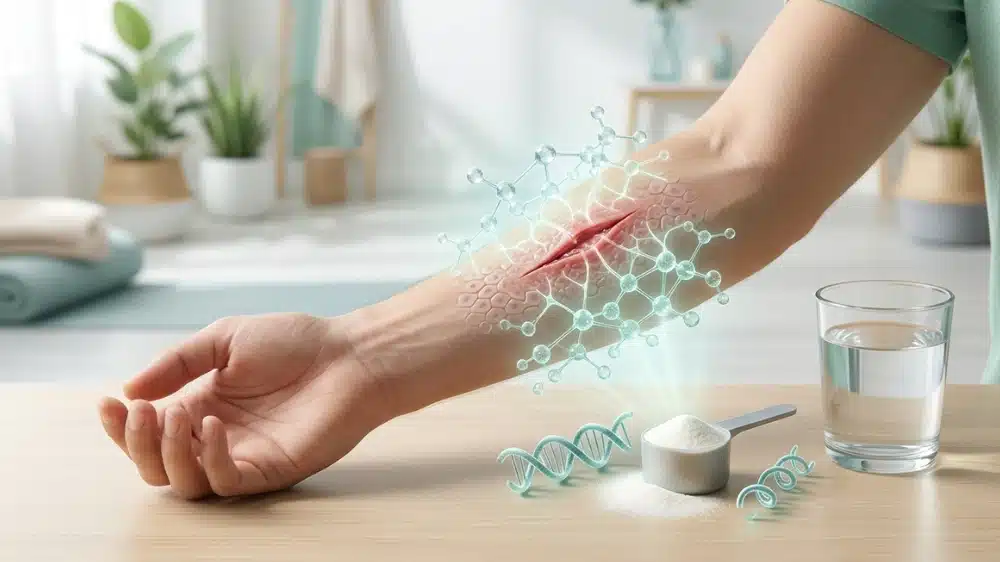
When we think of collagen, our minds often jump to anti-aging serums or beauty supplements designed for glowing skin and healthy hair. However, the true biological power of this structural protein lies in its original function: serving as the essential scaffolding for the body’s repair system. As the most abundant protein in the human body, collagen is the primary building block required for skin, tendons, and ligaments to knit back together after an injury.

Whether you are managing a minor scrape, recovering from a surgical procedure, or dealing with chronic skin issues, the speed and quality of your recovery depend heavily on how efficiently your body can synthesize new tissue. This has led to a surge of interest in a pivotal question: Can the targeted use of collagen powder for wounds actually accelerate the healing process? In this guide, we will explore the science of tissue regeneration, distinguish between the benefits of topical and oral applications, and help you understand how to leverage this biological building block for a faster, more effective recovery.
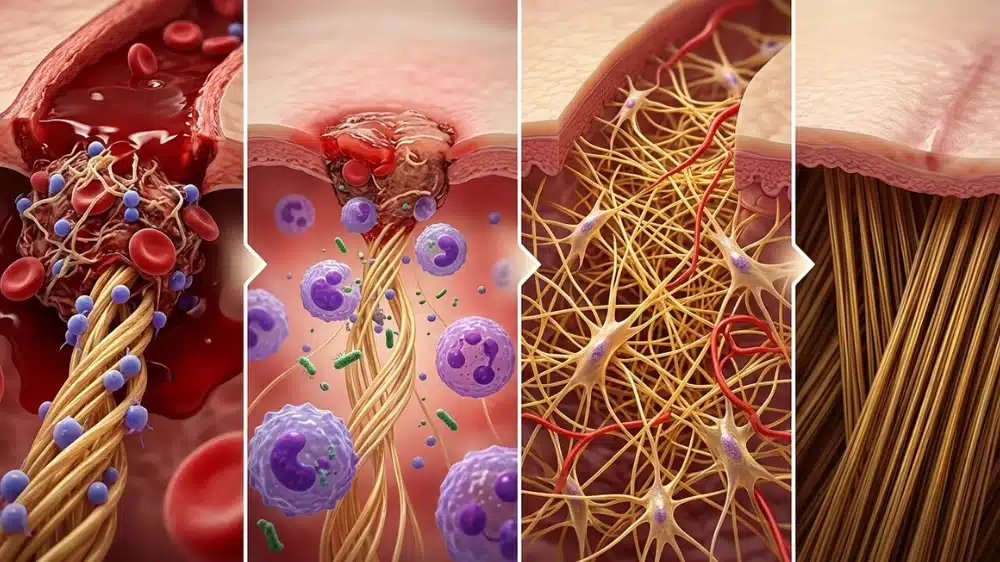
How Collagen Works in Four Stages
Detailed Breakdown of the Four Stages of Wound Healing
Wound healing is not a single event but a complex, overlapping sequence of biological phases. Collagen is the most critical component in this timeline, acting as both a signal and a physical structure. To understand how collagen powder for wounds functions, it is essential to look at the four distinct stages of tissue repair.
1. Hemostasis: The Initial Response
The moment an injury occurs, the body’s first priority is to stop blood loss. Collagen plays a leading role here. When blood vessels are damaged, the underlying collagen fibers are exposed. Platelets in the blood recognize these exposed fibers and stick to them, triggering a chemical reaction that forms a fibrin clot. This initial collagen-platelet interaction is what creates the plug that seals the wound.
2. Inflammation: Cleaning the Site
Once the bleeding is controlled, the body enters the inflammatory phase. During this stage, collagen acts as a chemoattractant. This means it sends out signals that draw white blood cells, such as neutrophils and macrophages, to the injury site. These cells are responsible for clearing out bacteria, debris, and damaged tissue. Collagen effectively “calls in the cleanup crew” to ensure the wound is sterile before new tissue begins to grow.

3. Proliferation: Building the Foundation
This is the stage where the actual repair happens. Fibroblasts—the cells responsible for producing collagen—migrate to the wound. They begin synthesizing a temporary matrix known as granulation tissue. This tissue is incredibly rich in collagen, which provides the necessary framework for new blood vessels to form and for skin cells to migrate across the surface. Without sufficient collagen, this scaffold is weak, which can lead to delayed healing or “stalled” wounds.
4. Remodeling: Strengthening the Tissue
The final phase of healing can last for months or even years. During remodeling, the initial “emergency” collagen (Type III) is slowly replaced by stronger, more organized collagen (Type I). This process increases the tensile strength of the new skin and helps to minimize scar tissue. Supplementing with collagen powder can support this phase by ensuring the body has a constant supply of the specific amino acids needed to build these high-quality fibers.
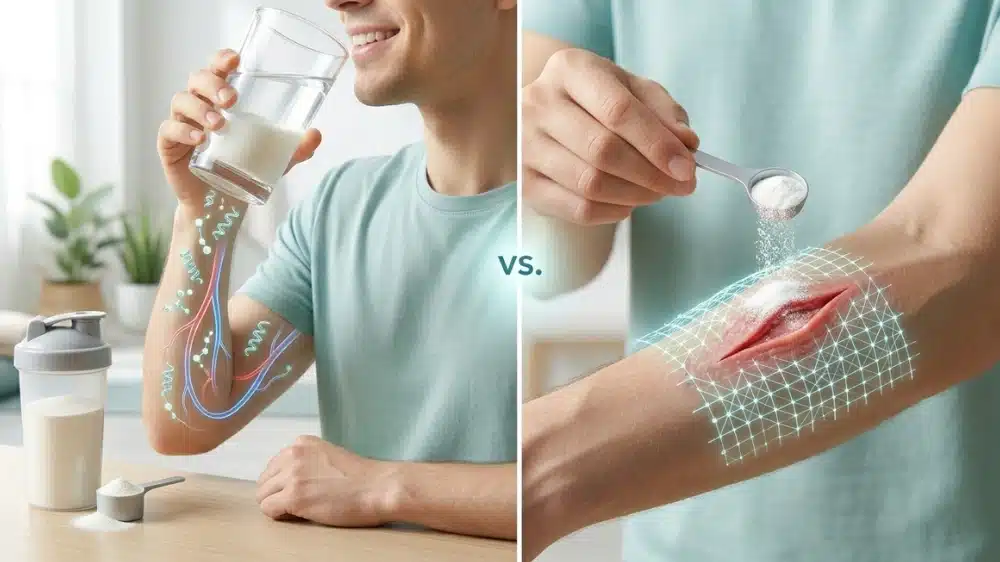
Topical vs. Oral: Two Ways to Use Collagen for Healing
If you are considering using collagen to support wound recovery, you will likely encounter two very different application methods: swallowing it or applying it directly to the skin. While they both utilize the same protein, they function in completely different ways and are often used for different types of wounds. Understanding this distinction is vital to getting the best results.
Oral Collagen Peptides: Healing from Within
The most common form of collagen found in supplements is hydrolyzed collagen peptides. When you consume collagen powder orally, it does not travel directly to the wound. Instead, your digestive system breaks the collagen down into its basic building blocks: amino acids.
These specific amino acids—particularly glycine, proline, and hydroxyproline—are highly bioavailable, meaning they are easily absorbed into the bloodstream. Once in the blood, they are transported to where they are needed most. For someone with an injury, they serve as the raw materials that the fibroblasts at the wound site need to rebuild tissue during the proliferation stage (Stage 3).

Topical Collagen Powder: An External Scaffold
Topical collagen works by an entirely different mechanism. It is applied directly to an open wound, usually in the form of a fine powder, gel, or a matrix (like a sponge).
Topical collagen does not “absorb” into the bloodstream to act as an amino acid building block. Instead, it serves as a sophisticated medical matrix. It provides an immediate physical scaffold or template for the wound. As we discussed in the science section, a “stalled” wound is often one that lacks a sufficient extracellular matrix (ECM). Topical collagen effectively jumps in and acts as a placeholder ECM.
Furthermore, topical collagen powder can balance the moisture environment of the wound, which is critical for cell migration, and it can also attract and bind to destructive matrix metalloproteinases (MMPs)—enzymes that, in excess, can break down healthy tissue and stall healing.、
Summary: Which Approach Should You Use?
For the vast majority of consumer health purposes—such as recovering from minor injuries, pre- and post-surgery optimization, or general skin health—oral hydrolyzed collagen peptides are the practical, daily choice. They provide the systemic, nutritional foundation the body needs to heal from the inside out.
Topical collagen application is a powerful, direct intervention that is almost always managed by a healthcare professional for specific, non-healing wounds.
What the Research Says: Clinical Evidence for Wound Recovery
While the theoretical framework for how collagen aids repair is sound, it is crucial to examine the clinical evidence. Does supplementing with or applying collagen powder for wounds actually result in measurable, faster healing times in real-world scenarios?
The short answer is yes. A growing body of peer-reviewed research supports the efficacy of collagen in wound care, both as a nutritional supplement (oral) and as a medical device (topical).
Nutrition Synergy: Boosting Collagen with Vitamin C and Zinc
While high-purity collagen powder provides the essential building blocks for tissue repair, it does not work in a vacuum. For your body to effectively convert these raw amino acids into strong, functional skin and connective tissue, it requires specific micronutrients to act as catalysts. Understanding the synergy between collagen, vitamin C, and zinc is the key to maximizing the efficiency of your recovery.
Vitamin C: The Essential Cofactor
Vitamin C is arguably the most important partner for collagen. In fact, the body cannot synthesize collagen at all without it. On a molecular level, vitamin C acts as a cofactor for the enzymes responsible for stabilizing and cross-linking collagen fibers. This process, known as hydroxylation, is what gives collagen its structural integrity and “tensile strength.”
Without adequate vitamin C, the collagen fibers produced by your body are weak and fragile, which can lead to wounds reopening or healing with poor tissue quality. For anyone using collagen powder for wounds, ensuring a high intake of vitamin C—either through diet or supplementation—is non-negotiable for a successful proliferation and remodeling phase.
Zinc: The Master of Cell Division
Zinc is a trace mineral that plays a massive role in every stage of the wound healing process. It is a vital component of over 300 different enzymes in the human body, many of which are responsible for DNA synthesis and cell division.
During the early stages of healing, your body must rapidly produce new cells to replace those that were damaged. Zinc ensures this process happens efficiently. Furthermore, zinc is involved in the “remodeling” phase, helping to regulate the enzymes that swap out temporary Type III collagen for the more permanent Type I tissue. A deficiency in zinc is one of the most common reasons for “stalled” wounds, making it a critical partner for your collagen regimen.
Creating the Optimal Healing Environment
To get the most out of your collagen supplementation, you should view your nutrition as a complete system. While the hydrolyzed peptides in your collagen powder provide the “bricks” for the new structure, vitamin C and zinc act as the “mortar” and the “builders.”
When these nutrients are present in optimal levels, the body can repair tissue faster, build stronger scars, and reduce the overall duration of the inflammatory phase. Whether you are recovering from a major surgery or a minor sports injury, combining your collagen intake with these essential cofactors ensures that your biological repair kit is fully operational.
Industry Leaders: Top Collagen Brands for Targeted Recovery
When selecting a collagen supplement specifically for wound healing, the quality and source of the raw material are paramount. The market is filled with options, but a few industry leaders have distinguished themselves through rigorous testing, transparent sourcing, and specialized formulations. Below are some of the most reputable brands categorized by their unique strengths to help you choose the best fit for your recovery needs.
How to Choose the Right Collagen for Your Situation
Technical Comparison of Collagen Raw Material 情報源
Selecting the most effective collagen powder for wounds requires looking beyond the marketing and focusing on the technical specifications of the product. Because the body’s demand for protein increases significantly during the repair process, the quality of the supplement you choose can directly influence the speed of your recovery. Here are the primary factors to consider when making your selection.
Identify the Source and Type
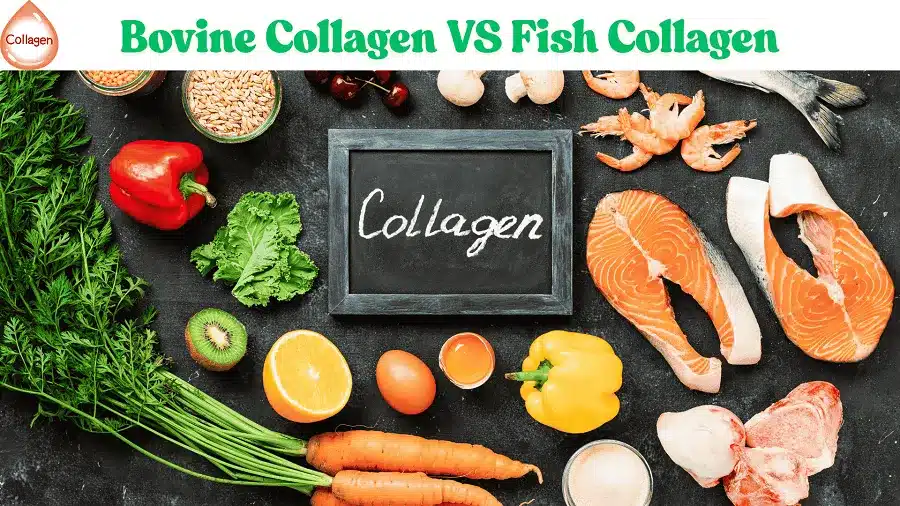
The source of the collagen determines which “types” of peptides you are consuming. Bovine-sourced collagen is typically rich in both Type I and Type III collagen. This is ideal for wound healing because Type III is the first responder during the early stages of repair, while Type I is the primary component of the final, strong skin tissue. Marine collagen is almost exclusively Type I and is often praised for having a smaller molecular weight, which some evidence suggests may lead to slightly faster absorption in the digestive tract.
Verify Hydrolysis for Maximum Bioavailability
The term “hydrolyzed” is the most important word to look for on a label. In its raw state, collagen is a large, complex protein that is difficult for the body to break down. Hydrolysis is a manufacturing process that uses enzymes to break the collagen down into short-chain amino acids called peptides. These peptides are small enough to pass through the intestinal wall and enter the bloodstream. Without this process, much of the collagen powder would simply be wasted by the digestive system rather than reaching the injury site.
Demand Purity and Third-Party Testing
Because collagen is derived from animal sources, the quality of the raw material is vital. Look for products that are “grass-fed and pasture-raised” for bovine sources or “wild-caught” for marine sources. Furthermore, high-quality brands will undergo third-party testing to ensure the powder is free from heavy metals, pesticides, and antibiotics. A clean label with no added sugars or artificial fillers ensures that every gram of the powder is contributing to your recovery rather than introducing unnecessary inflammation.
Consider Solubility and Daily Routine
The best collagen powder for wounds is the one you will take consistently throughout the entire remodeling phase, which can last for several weeks. Choose a powder that is “agglomerated” or “instantized,” which means it will dissolve completely in water, coffee, or smoothies without clumping. Consistency is key because the body needs a steady, daily supply of amino acids to maintain the complex process of tissue synthesis.
Check for Added Support Nutrients
If you do not already have a diet high in fruits and vegetables, you may want to choose a collagen product that already includes Vitamin C or Zinc. As discussed earlier, these cofactors are the catalysts that allow your body to actually “use” the collagen peptides you are ingesting. Selecting a formula that combines these elements can simplify your recovery routine and ensure you aren’t missing a critical piece of the healing puzzle.
よくあるご質問
結論
The use of collagen powder for wounds marks a significant shift from viewing collagen solely as a beauty supplement to recognizing it as a fundamental tool in clinical recovery. By understanding the four stages of repair—from the initial clotting to the long-term remodeling of skin—it becomes clear that providing the body with high-quality, hydrolyzed peptides is not just an option, but a biological necessity for optimal healing. Whether used as a systemic nutritional foundation or a direct topical scaffold, collagen empowers the body to rebuild itself with greater strength and efficiency.
As we look toward the future of regenerative medicine, the focus has shifted toward the source of these life-changing proteins. The effectiveness of any collagen supplement or medical wound dressing is entirely dependent on the purity and bioactivity of the raw material used in its creation.
Behind the most trusted brands in the global nutrition and beauty sectors is Gensei, a global leader in the collagen raw material manufacturing industry. Renowned for its advanced processing techniques and rigorous quality standards, Gensei produces premium collagen raw material from sustainable sources, including bovine hides, fish scales, and poultry cartilage.
Gensei’s innovative production methods ensure high-purity, bioactive collagen that meets the strictest international requirements for safety and efficacy. With cutting-edge research and a robust global supply chain, Gensei solidifies its position as a trusted manufacturer, delivering superior solutions to brands worldwide. When you choose a recovery product powered by Gensei materials, you are choosing a foundation built on excellence, sustainability, and scientific innovation.
参考文献
- National Library of Medicine: Collagen Fragments and Wound Repair
- Oregon State University (Linus Pauling Institute): Vitamin C and Skin Health
- NIH Office of Dietary Supplements: Zinc Fact Sheet for Health Professionals
- Journal of Drugs in Dermatology (JDD): Oral Collagen Supplementation: A Systematic Review
- 欧州食品安全機関(EFSA): Scientific Opinion on Collagen Health Claims
- Centers for Medicare & Medicaid Services (CMS): Wound Care Guidelines