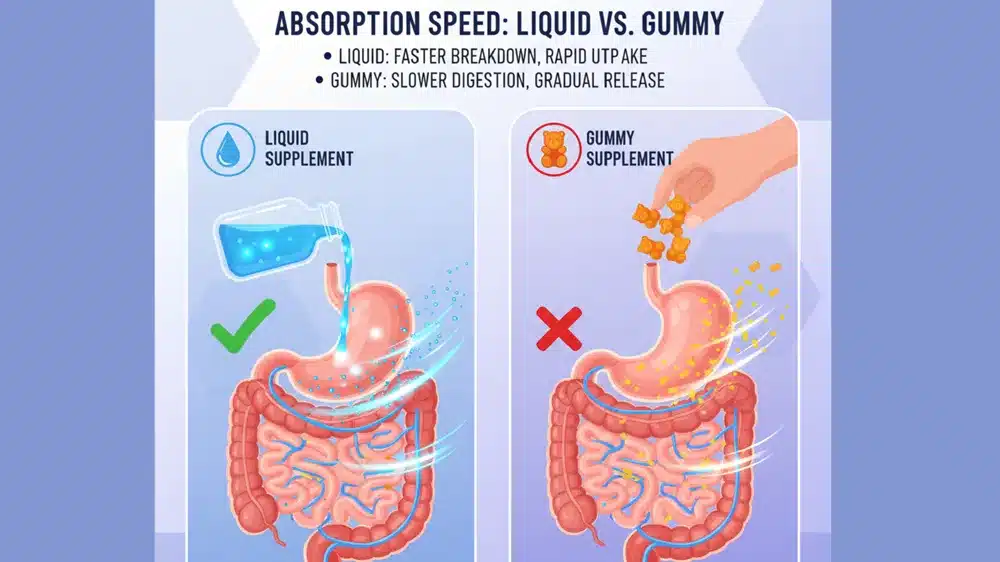
Creatine gummies and powder can both be effective ways to take creatine monohydrate. When choosing between creatine powder and gummies, the better option depends less on the creatine itself and more on what you want from the format.
Powder is simple, easy to dose and usually gives you more control over how much creatine you take. Gummies are portable, require no mixing and may be easier to use consistently if you dislike powder.
That makes this less of a contest between “good” and “bad” creatine than it first appears. The useful questions are whether each product delivers the amount of creatine you want, how easily it fits your routine, what comes with that dose, and—particularly with a finished product such as a gummy—what evidence supports the amount stated on the label.
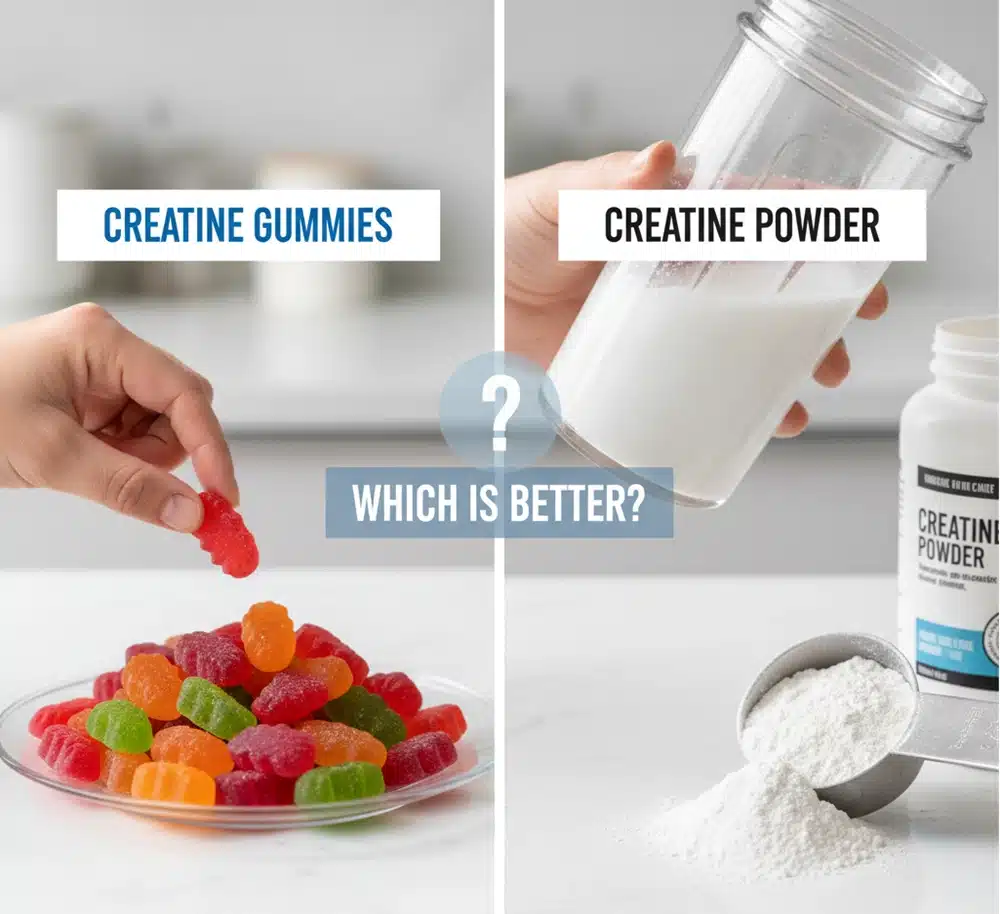
Creatine Gummies vs Powder at a Glance
The active ingredient may be the same, but the product experience is not. Powder favors simplicity and flexibility. Gummies favor convenience and portability.
Are Creatine Gummies as Effective as Powder?
Creatine gummies can be effective when they provide an adequate amount of creatine monohydrate. What has not yet been established is that gummies and powder are universally interchangeable under every formulation and storage condition.
There is now direct human evidence that creatine can work in gummy form. A 2026 randomized controlled trial followed 32 female collegiate and professional beach volleyball athletes for 10 weeks. Seventeen received 5 g of creatine monohydrate per day in gummy form, while 15 were assigned to a non-supplemented control group. The gummy group improved countermovement-jump and change-of-direction performance.
That is useful evidence, but it needs to be interpreted correctly. The study compared creatine gummies with no creatine supplementation; it did not compare gummies directly with an equivalent dose of powder.
Creatine does not become ineffective because it is delivered in a gummy. If a finished gummy provides the intended amount of creatine monohydrate, it can be a practical way to supplement creatine.
The important qualification is if it provides the intended amount. A scoop of dry powder and a finished gummy are different product environments. A gummy contains water and other formulation components and goes through additional manufacturing steps before it reaches the consumer. That makes the amount present in the finished product—not merely the amount of raw creatine originally used—an important part of evaluating it.This is one reason the question “Do creatine gummies work as well as powder?” cannot be answered from the dosage form alone. The formulation has to deliver what the label promises.
How Many Creatine Gummies Equal a 3–5 g Dose?
The number of gummies you need depends on how much creatine is actually present in each piece. With powder, adjusting the amount is straightforward. With gummies, the dose moves in whole pieces.
The arithmetic is simple, but it reveals an important difference between the formats. Four gummies containing 1.25 g each deliver exactly 5 g. If each gummy contains 2 g, however, two pieces provide 4 g and three provide 6 g. Neither is inherently a problem; the dose is simply less granular than it is with powder.
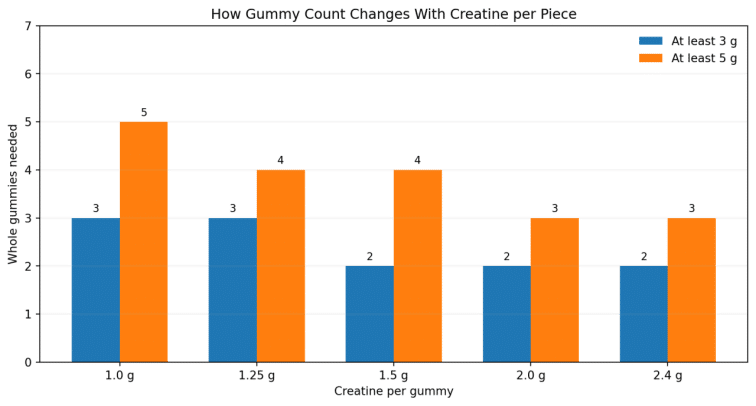
This is also why the largest number on the front of a gummy bottle can be misleading without context. If a product advertises 5 g of creatine, check the Supplement Facts panel and serving size. The 5 g may refer to the complete serving rather than one gummy, and that serving may consist of several pieces.
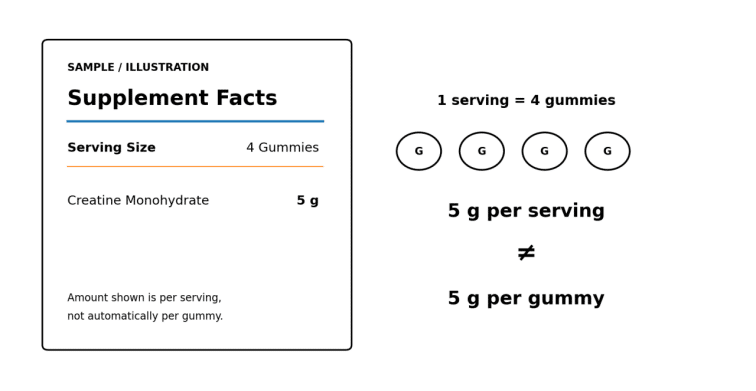
The same check helps when comparing two gummy products. A bottle with more gummies does not necessarily contain more usable servings if more pieces are required each day.
Compare the Cost at the Same Creatine Dose
Bottle price alone is a poor way to compare creatine gummies with powder. A $30 bottle of gummies and a $30 tub of powder may contain very different total amounts of creatine. The comparison becomes more meaningful when both are reduced to the same dose.
For example, if 60 gummies contain 1 g of creatine each, the bottle contains 60 g of creatine in total, or twelve 5 g doses. A 500 g tub of powder contains one hundred 5 g doses. The shelf price could be identical while the amount of creatine supplied is very different.
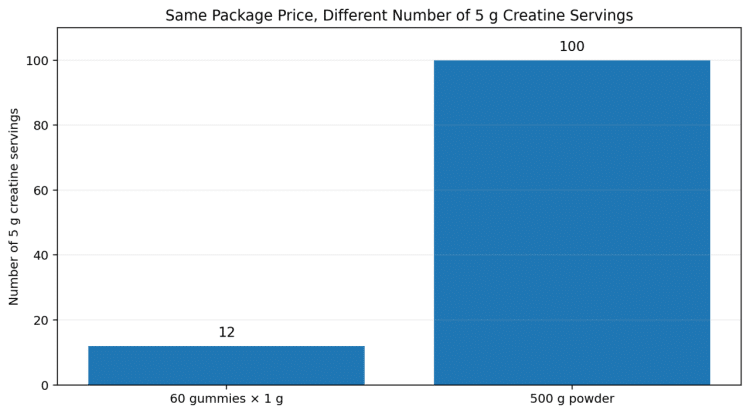
A simple calculation avoids that problem:
Cost per 5 g = product price ÷ total grams of creatine in the package × 5
Gummies often carry a premium per equivalent amount of creatine, although the size of that premium varies by product and prices change over time. That difference is not simply a question of paying more for the same white powder.
A gummy is a finished delivery system. In addition to creatine, it needs the ingredients and processing that create its texture, flavor, stability and ready-to-eat form, as well as its own packaging and finished-product quality controls.
Those features have value when they solve a real problem for the person taking the product. Someone who already mixes powder every day with no inconvenience may see little reason to pay for a different format. Someone who travels frequently, dislikes mixing supplements or repeatedly skips powder may value a portable product much more.
Powder therefore tends to favor cost efficiency. Gummies favor convenience and product experience. Neither tells you whether the creatine molecule itself is better.
What Else Comes With a Gummy Dose?
A scoop of unflavored creatine monohydrate can have a very short ingredient list. Turning creatine into a gummy requires more.
Depending on the formulation, that may include pectin or gelatin, sugar or alternative sweeteners, acids, flavors, colors and other ingredients needed to produce the desired texture and taste.
That does not make gummies inherently unhealthy or inferior. Sugar-free creatine gummies exist, and formulations vary considerably. What matters is reading the nutrition panel in the context of the amount you will actually take.
If one gummy provides 1 g of creatine and 1.5 g of sugar, for example, the meaningful comparison is not one gummy. Reaching 5 g of creatine would require five pieces, bringing the total to 7.5 g of sugar. Another product may deliver the same creatine with fewer pieces. A sugar-free formulation may provide it with no sugar at all.
Calories and other added ingredients should be read the same way: look at the complete amount that accompanies your actual creatine dose, not just the numbers for one piece.
For some people, those differences matter. For others, they are a reasonable trade-off for a format they prefer taking.
When Do Creatine Gummies Make More Sense?
Gummies make the most sense when convenience changes consistency.
Powder works well for people who are comfortable measuring a serving and mixing it into water, a shake or another drink. It also makes small dose adjustments easy.
Gummies remove those steps. There is no scoop, shaker or mixing, and individual pieces are easy to carry. That advantage can matter if powder’s texture bothers you, if you travel frequently, or if the extra preparation is enough to make you skip creatine regularly.
Convenience has much less value when powder is already effortless for you.
Choose powder when you value simplicity, dose flexibility and cost efficiency. Choose gummies when portability and ease of use make you more likely to take creatine consistently.
Whichever format you choose, the amount on the label still needs to mean something. With gummies, that deserves a closer look because the creatine has already passed through a finished-product formulation and manufacturing process.
What Does Testing Actually Tell You About a Creatine Gummy?
A high-quality creatine raw material and a high-quality finished gummy are connected, but they are not the same quality claim.
A raw-material certificate of analysis (COA) can establish important information about the creatine before production. Depending on the specification and test panel, that can include identity, assay, relevant impurities, heavy metals and microbiological results.
That evidence matters. Finished-product quality starts with the material going into production. But a raw-material COA cannot tell you exactly how much creatine is present in a gummy after formulation, manufacturing and storage. That requires evidence from the finished product.
This distinction is particularly useful when a product says “third-party tested.” Rather than stopping at the phrase, look for what was actually tested:
Was the creatine raw material tested before manufacturing?
Was the finished gummy tested for creatine content?
Is the result connected to an identifiable product or batch?
Does the documentation report potency, or only other quality parameters?
Raw-material testing helps establish what went into production. Finished-product testing helps establish what came out.
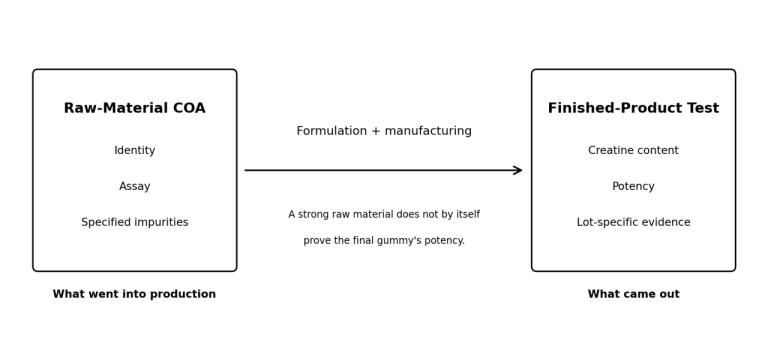
Independent testing of retail creatine gummies has found label-claim discrepancies in some samples. Those results should not be treated as a failure rate for every gummy on the market: different studies have tested different products, batches and sample sizes. They do show why finished-product evidence can add useful information that a raw-material COA alone cannot provide.
A finished-product result also has a time dimension. A potency test at release shows what was measured at that point; it does not automatically establish what the product will contain throughout its shelf life. Published stability research shows that conditions such as water activity and temperature can influence creatine degradation, so shelf-life claims need evidence from the finished formulation rather than assumptions based on the raw ingredient alone.
The same principle works in the other direction. A finished-product potency result does not make raw-material specifications irrelevant. Reliable products depend on both appropriate starting materials and control of the finished dosage form.
Creatine Powder or Gummies: Which Fits You Better?
There is no need to make the choice more absolute than it is.
If you already take powder consistently, value precise dose control and prefer a simple formula, powder is difficult to beat.
If mixing powder is the part of creatine supplementation you dislike, a well-made gummy can remove that friction. Portability and ease of use are legitimate product advantages, particularly when they help you maintain a routine.
The active ingredient may still be creatine monohydrate in either case. What changes is how that ingredient reaches you.
Before buying, four questions usually tell you more than the format name:
How much creatine does the amount I will actually take provide?
How many scoops or gummies does that require?
What else comes with that dose?
For a finished gummy, what evidence supports the labeled creatine content?
Powder and gummies optimize for different things. The better choice is the one that delivers an appropriate amount of creatine in a format you can use consistently—and, especially for a more complex finished dosage form, gives you enough evidence to trust what the label says.
자주 묻는 질문
Can You Switch From Creatine Powder to Gummies?
Yes. Switching formats does not require treating creatine as a different ingredient if both products use creatine monohydrate. What needs to be checked is the dose: compare the grams of creatine you were getting from powder with the grams provided by the full gummy serving rather than assuming one scoop equals one gummy.
Does “5 g of Creatine” Mean 5 g per Gummy?
Not necessarily. On many supplement labels, the stated amount refers to a serving, and one serving may contain several gummies. Check both “Serving Size” and the amount of creatine listed per serving before calculating how many pieces you need.
Can You Use Gummies While Traveling and Powder at Home?
Yes, the formats do not have to be mutually exclusive. If both products provide creatine monohydrate, the practical issue is keeping track of the amount supplied by each format. A travel day with gummies and a home day with powder can still be part of the same routine without trying to match “one gummy” to “one scoop.”
Do Sugar-Free Creatine Gummies Work Differently From Regular Gummies?
Sugar is not what makes creatine effective. A sugar-free gummy can still deliver creatine monohydrate; what matters is how much creatine the finished serving provides and whether the formulation maintains that amount appropriately. Sugar-free and regular gummies can differ in sweeteners, calories, texture and formulation, so their labels should still be evaluated individually.
참조
5. U.S. Food and Drug Administration. Dietary Supplement Labeling Guide: Chapter IV. Nutrition Labeling.6. NIH 식이 보충제 사무소. 운동 및 운동 능력을 위한 식이 보충제 - 건강 전문가 팩트 시트.

워렌 완은 식이 보충제 공급망 분야에서 폭넓은 경험을 갖춘 노련한 전문가로, 콜라겐 펩타이드, 뼈 육수 단백질, 케라틴과 같은 핵심 원료의 연구, 개발, 공정 관리 및 글로벌 조달에 풍부한 실무 경험을 보유하고 있습니다. 이 칼럼의 필자로서 그는 마케팅적 포장만을 벗겨내고, 난해한 원료 과학 및 생산 품질 관리 기준을 누구나 쉽게 이해할 수 있는 심도 있는 과학 대중화 콘텐츠로 재구성함으로써, 독자들이 라벨 뒤에 숨겨진 진실을 파악하고 보다 합리적인 건강 선택을 할 수 있도록 돕는 데 전념하고 있습니다.