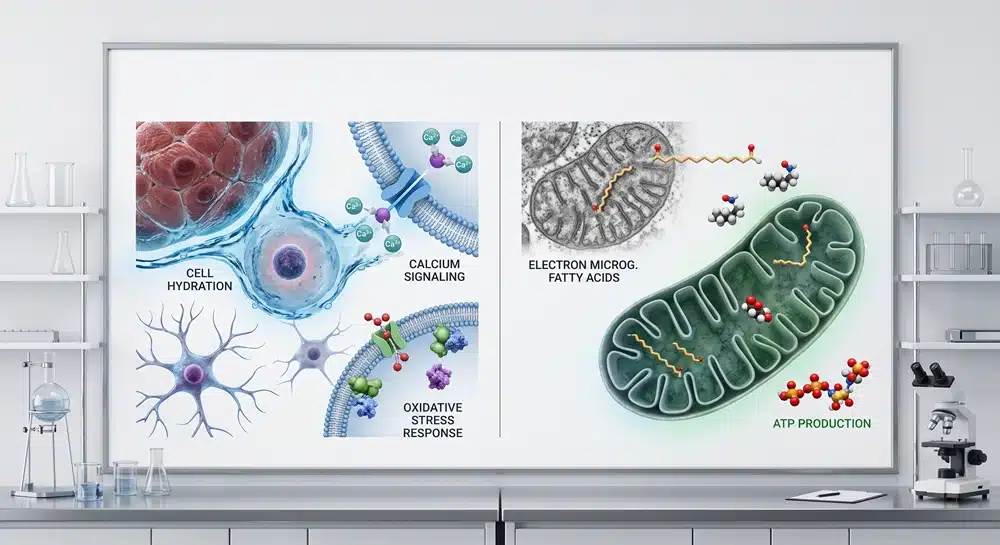
For sports nutrition brands, functional beverage developers, and private-label supplement teams, taurine and L-carnitine are not simply “energy ingredients.” Taurine supports cell-volume regulation, calcium signaling, bile-acid conjugation, and oxidative-stress control, while L-carnitine functions as a mitochondrial shuttle that helps transport long-chain fatty acids into mitochondria for energy production.
The commercial question is whether both ingredients can be delivered in a stable, compliant, and consumer-friendly dosage form without caking, off-taste, capsule-fill limitations, or overstated weight-management claims. This guide compares taurine and L-carnitine from both a nutrition-science and manufacturing perspective, including form selection, moisture control, QC release tests, and dosage-form feasibility for 스포츠 뉴트리션 계약 제조.
타우린이란 무엇인가요?
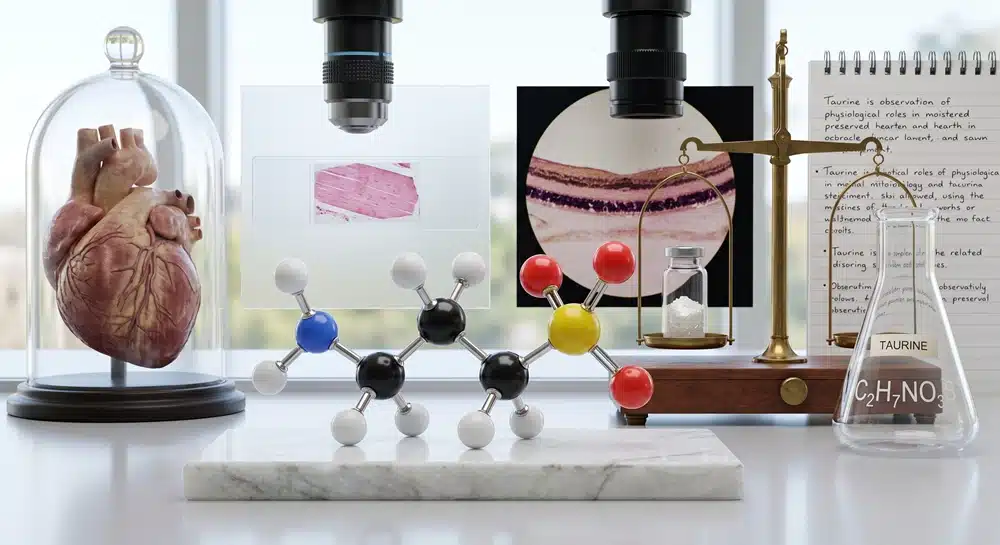
Taurine is an amino sulfonic acid rather than a protein-building amino acid. Its molecular formula is C2H7NO3S and its molecular weight is approximately 125.15 g/mol. In the body, taurine is concentrated in tissues such as the heart, retina, brain, and skeletal muscle, where it is involved in osmoregulation, bile-acid conjugation, calcium signaling, and cellular stress response.
For supplement brands, taurine is attractive because it is generally neutral in taste compared with many bitter amino acids, dissolves well in water-based systems, and can be positioned for hydration, endurance, active lifestyle, and energy-support formulas. It is commonly used in 분말 보충제 제조, capsules, tablets, and functional beverage premixes.
타우린의 입증된 효능
Taurine should be explained with evidence calibration. It is not a caffeine-like stimulant; it supports cellular functions that may be relevant to exercise, hydration, cardiovascular support, and recovery-oriented formulas.
- Exercise support: Human studies have investigated acute taurine ingestion before time-trial exercise, including a trained-runner study reporting improved 3-km time-trial performance after 1 g taurine.
- Cellular hydration and muscle function: Taurine acts as an organic osmolyte and is involved in calcium handling, both relevant to muscle contraction and fatigue-management positioning.
- Heart and metabolic support: Taurine is concentrated in cardiac tissue and is frequently studied for cardiovascular and metabolic health markers, but product claims should stay within supported structure/function wording.
- Healthy aging research: A 2023 Science paper reported lifespan and healthspan effects in animal models, but human anti-aging claims are premature without stronger human outcome trials.
L-카르니틴이란 무엇인가요?
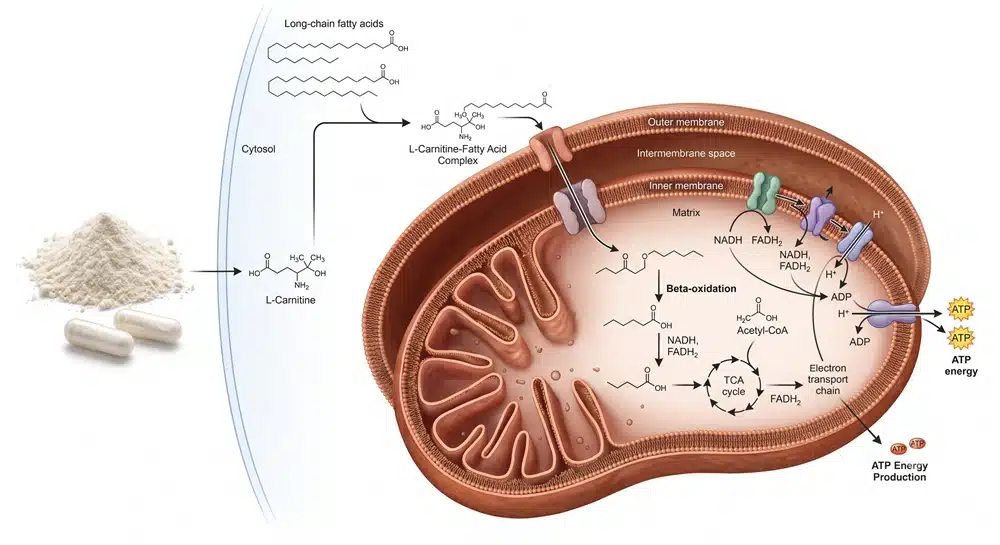
L-carnitine is an amino-acid derivative that plays a critical role in energy production. NIH ODS describes carnitine as helping transport long-chain fatty acids into mitochondria so they can be oxidized to produce ATP.
L-carnitine should not be treated as a single raw-material option in commercial formulation. Common forms include L-carnitine base, L-carnitine L-tartrate (LCLT), acetyl-L-carnitine (ALCAR), propionyl-L-carnitine, and L-carnitine fumarate. Each form changes the finished-product brief: LCLT is widely selected for dry sports nutrition formulas, while ALCAR is often used when the formula is positioned around cognitive and mental-energy support.
For label design, brands must calculate the actual L-carnitine equivalent supplied by each salt form rather than assuming the full ingredient weight equals active L-carnitine. This matters for capsule payload, serving size, cost of goods, and claim substantiation in 캡슐 보충제 제조 그리고 태블릿 보충제 제조.
L-카르니틴의 강력한 효능
- Energy metabolism: L-carnitine supports the transport of long-chain fatty acids into mitochondria for oxidation and ATP production.
- Exercise and recovery positioning: L-carnitine is commonly used in sports nutrition and active-lifestyle formulas, although benefit size depends on population, dose, form, and training context.
- Weight-management support: L-carnitine may support fat metabolism when combined with diet and exercise, but it should not be described as a guaranteed belly-fat reducer.
- Mental-energy positioning: Acetyl-L-carnitine is frequently chosen when the commercial brief is cognitive or mental-energy support rather than only workout support.
타우린과 L-카르니틴을 함께 사용하는 것이 더 낫나요?
Taurine and L-carnitine can be used together when the formulation goal is to support cellular energy, hydration balance, and exercise recovery through complementary pathways. L-carnitine is associated with mitochondrial fatty-acid transport, while taurine is associated with osmoregulation, calcium handling, and oxidative-stress modulation. This makes the pair a logical combination for sports nutrition and active-lifestyle formulas, but the claim language should remain structure/function-oriented rather than disease- or fat-loss-cure oriented.
The human clinical evidence for each ingredient is stronger than the evidence for the exact two-ingredient stack as a finished formula. Therefore, brands should describe the combination as “complementary support” rather than making guaranteed synergy claims. If a brand wants to claim formula-level benefits, it should support those claims with finished-product testing or a substantiation dossier built from ingredient-level literature, dose alignment, and intended-use context.
Why the Combination Makes Formulation Sense
- L-carnitine brings a fat-metabolism and mitochondrial-energy angle.
- Taurine brings a cellular-hydration, muscle-function, and oxidative-stress angle.
- Together, the pair supports a broader sports nutrition story than either ingredient alone.
- The combination can be adapted to powders, capsules, tablets, and RTD premixes when moisture and taste are controlled.
Formulation Reality Check: Moisture, Flowability, and Caking Control
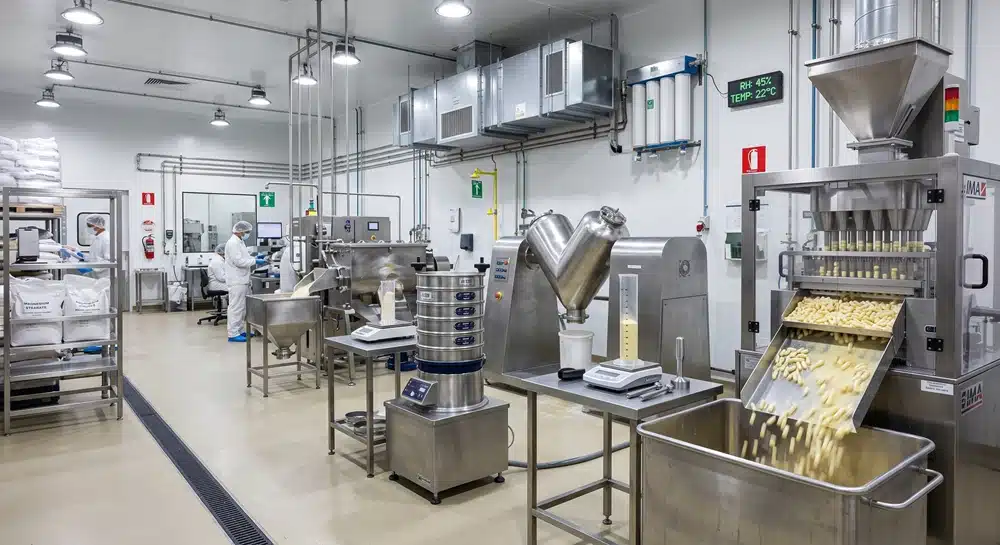
In a production environment, the main challenge is not explaining what taurine and L-carnitine do; it is keeping the blend uniform and stable after mixing, filling, and storage. L-carnitine raw materials are often hygroscopic, meaning they can absorb moisture from the air and cause caking, poor flow, capsule weight variation, tablet sticking, or flavor deterioration.
For dry blends, Gensei would normally review incoming loss on drying or Karl Fischer moisture, particle-size distribution, bulk density, tapped density, angle of repose, and compatibility with sweeteners, electrolytes, creatine, caffeine, citric acid, and flavor systems. For high-humidity or tropical-market products, the formula may require anti-caking carriers, desiccant packaging, foil-laminate sachets, or controlled relative humidity during blending and filling.
This manufacturing step is where a generic “taurine + L-carnitine supplement” becomes a scalable commercial product. Brands developing pre-workout powders, fat-metabolism support capsules, or functional beverage premixes should review blend density, serving size, taste masking, and packaging before confirming MOQ and launch timeline through custom formulation support.
타우린과 L-카르니틴: 비교 살펴보기
The table below compares taurine and L-carnitine from a product-development perspective, not only a consumer benefit perspective.
| 속성 | 타우린 | L-카르니틴 |
|---|---|---|
| Chemical category | Amino sulfonic acid; not a protein-building amino acid. | Amino-acid derivative / quaternary ammonium compound involved in fatty-acid transport. |
| Primary physiology angle | Cell-volume regulation, bile-acid conjugation, calcium signaling, antioxidant response, heart/retina/muscle support. | Transport of long-chain fatty acids into mitochondria for beta-oxidation and ATP production. |
| Common formula positioning | Hydration, endurance, active lifestyle, energy drink, heart and muscle support. | Fat-metabolism support, active lifestyle, pre-workout/recovery, weight-management support, mental energy when using ALCAR. |
| Evidence caveat | Human exercise studies exist, but anti-aging claims remain premature without human outcome trials. | Human evidence varies by outcome and population; weight-loss claims should be qualified and not guaranteed. |
| Material handling | Generally easier to use in powders and beverages; still requires assay and particle-size control. | Often more hygroscopic depending on form; moisture control and anti-caking strategy are critical. |
| 일반적인 투여 형식 | Powder, capsule, tablet, RTD/energy drink premix. | Powder, capsule, tablet, liquid, 소프트젤 depending on form and formulation target. |
| QC release checks | Identity, assay, microbial limits, heavy metals, particle size, bulk density, sensory profile. | Identity, assay, L-carnitine equivalent, isomer/form verification, microbial limits, heavy metals, moisture, flowability. |
| Best internal link | 분말 보충제 제조 | 캡슐 보충제 제조 또는 스포츠 영양제 계약 제조 |
제형 타당성 분석표
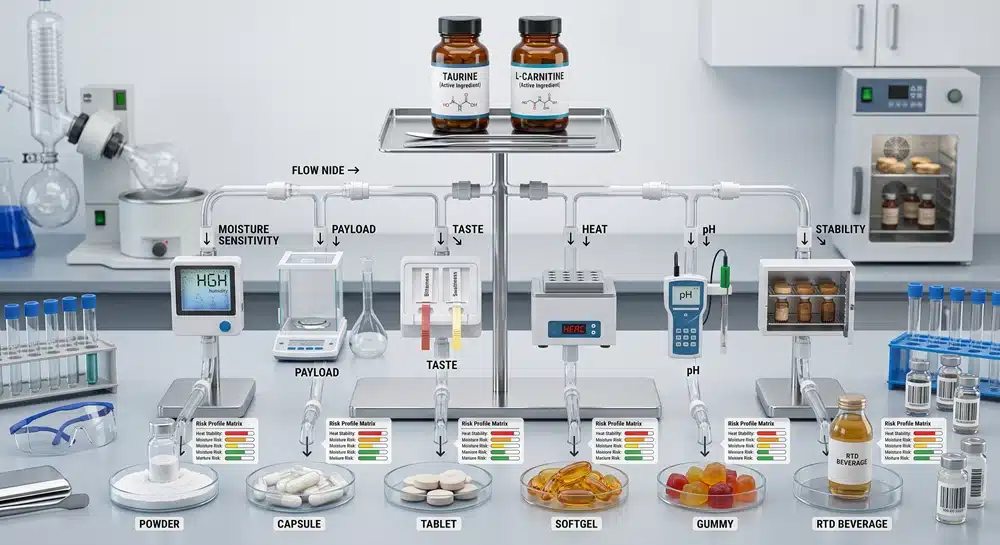
The best taurine and L-carnitine formula depends on dosage target, flavor system, shelf-life requirements, and label positioning. Use the following matrix before choosing a finished product format.
| 투여 형태 | Fit for Taurine + L-Carnitine | Key Manufacturing Risk | 제조 서비스 |
|---|---|---|---|
| Powder / stick pack | Very strong for pre-workout, hydration, energy, and weight-management positioning. | L-carnitine moisture uptake, caking, sour/bitter taste interactions, scoop-size creep. | OEM Powder Supplement Manufacturing |
| 경질 캡슐 | Good for lower-dose or multi-capsule formulas when taste masking matters. | Capsule payload limitation, powder density, fill-weight variation, hygroscopic blend flow. | 캡슐 보충제 제조 |
| 태블릿 | Possible for compact daily formulas, but requires compression feasibility review. | Sticking, capping, hardness/friability failures, disintegration timing. | 태블릿 보충제 제조 |
| 소프트젤 | Useful if L-carnitine form and co-actives are compatible with fill system. | Water activity, suspension stability, shell interaction, active loading limit. | 소프트젤 캡슐 제조 |
| Gummy | Possible for low-dose consumer formulas, but technically less ideal for high-payload sports doses. | Heat exposure, pH, hygroscopic actives, texture collapse, active uniformity. | 젤리 보충제 제조 |
| RTD / energy drink | Commercially attractive for energy and active-lifestyle positioning. | Flavor masking, pH, preservative system, caffeine interaction perception, label compliance. | 액체 보충제 제조업체 |
Quality Control and Claim Compliance for Taurine + L-Carnitine Products
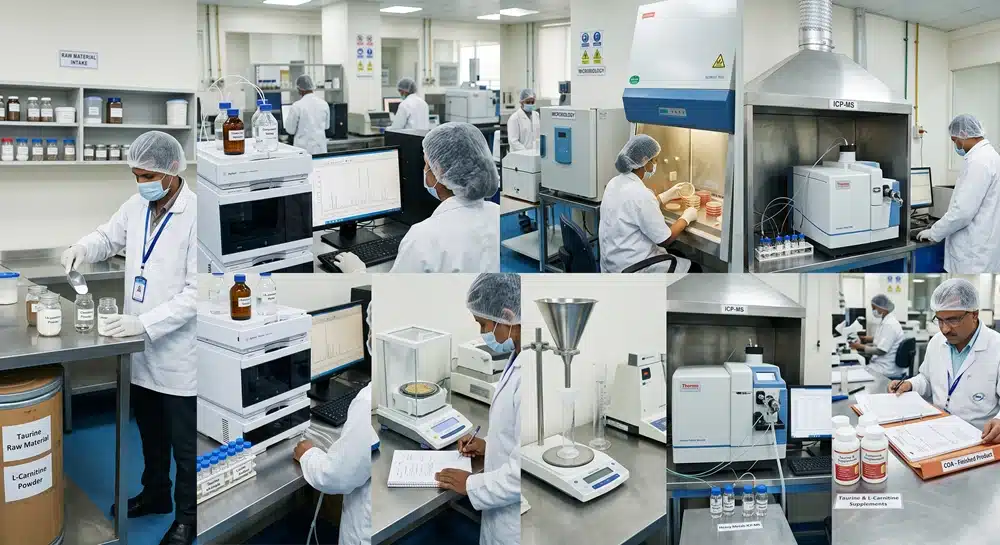
A scalable taurine and L-carnitine product should be released against measurable specifications, not only against a marketing brief. For each production lot, brands should define identity testing, assay method, microbiological limits, heavy-metal limits, moisture control, and packaging stability requirements in the master manufacturing record. Dietary supplement manufacturers selling into the U.S. market should align manufacturing, packaging, labeling, and holding practices with 21 CFR Part 111 cGMP expectations.
Typical release specifications may include HPLC assay for taurine and L-carnitine, verification of the carnitine salt form and L-carnitine equivalent, loss on drying or Karl Fischer moisture, bulk and tapped density, particle size, total plate count, yeast and mold, E. coli, Salmonella, Staphylococcus aureus, and ICP-MS heavy metals where required by the market.
Marketing language should avoid guaranteed weight-loss, disease-treatment, or stimulant-style claims. Claim-safe wording includes “supports cellular energy production,” “supports fat metabolism when combined with diet and exercise,” “supports hydration and muscle function,” and “helps support exercise recovery.” Dietary supplement structure/function claims require substantiation and the appropriate FDA disclaimer on product labeling.
결론
Taurine and L-carnitine are best understood as complementary ingredients rather than interchangeable ones. Taurine supports cellular balance, muscle function, and stress-response pathways, while L-carnitine supports fatty-acid transport and energy metabolism. For consumers, this explains why both ingredients often appear together in sports nutrition and energy-support formulas. For brands, the real differentiator is manufacturing execution: selecting the right L-carnitine form, controlling moisture, validating assay and identity, and choosing a dosage form that matches the active payload.
For custom taurine and L-carnitine powders, capsules, tablets, or beverage premixes, review your formula through 스포츠 뉴트리션 계약 제조, 분말 보충제 제조또는 캡슐 보충제 제조 before scaling.
자주 묻는 질문
참조
- National Institutes of Health (NIH) Office of Dietary Supplements. “Carnitine – Health Professional Fact Sheet.” Available at: https://ods.od.nih.gov/factsheets/Carnitine-HealthProfessional/
- U.S. Food and Drug Administration (FDA). “Current Good Manufacturing Practice in Manufacturing, Packaging, Labeling, or Holding Operations for Dietary Supplements.” Available at: https://www.fda.gov/regulatory-information/search-fda-guidance-documents/small-entity-compliance-guide-current-good-manufacturing-practice-manufacturing-packaging-labeling
- U.S. Food and Drug Administration (FDA). “Structure/Function Claims.” Available at: https://www.fda.gov/food/nutrition-food-labeling-and-critical-foods/structurefunction-claims
- United States Department of Agriculture (USDA) Agricultural Marketing Service. “L-Carnitine Technical Evaluation Report.” Available at: https://www.ams.usda.gov/sites/default/files/media/Carnitine%20TR.pdf
- National Center for Biotechnology Information (NCBI). “PubChem Compound Record for Taurine.” Available at: https://pubchem.ncbi.nlm.nih.gov/compound/Taurine
- National Center for Biotechnology Information (NCBI). “PubChem Compound Record for L-carnitine.” Available at: https://pubchem.ncbi.nlm.nih.gov/compound/l-carnitine
- Balshaw, T. G., et al. (2013). “The effect of acute taurine ingestion on 3-km running performance in trained middle-distance runners.” PubMed. 이용 가능: https://pubmed.ncbi.nlm.nih.gov/22855206/
- Singh, P., et al. (2023). “Taurine deficiency as a driver of aging.” 과학. 이용 가능: https://www.science.org/doi/10.1126/science.abn9257
- Xie, J., et al. (2014). “L-carnitine and taurine synergy in vascular smooth muscle cells.” PubMed Central(PMC). 이용 가능: https://pmc.ncbi.nlm.nih.gov/articles/PMC4002410/

W. Wenyang은 식이 보조제 공급망 분야에서 폭넓은 경험을 갖춘 노련한 전문가로, 콜라겐 펩타이드, 뼈 육수 단백질, 케라틴과 같은 핵심 원료의 연구, 개발, 공정 관리 및 글로벌 조달에 대한 풍부한 실무 경험을 보유하고 있습니다. 이 칼럼의 필자로서 그는 마케팅적 포장지를 벗겨내고, 난해한 원료 과학 및 생산 품질 관리 기준을 누구나 쉽게 이해할 수 있는 알기 쉬운 과학 지식으로 풀어내어, 독자들이 라벨 뒤에 숨겨진 진실을 파악하고 보다 합리적인 건강 선택을 할 수 있도록 돕는 데 전념하고 있습니다.