
간단한 답변
Berberine is the active plant alkaloid, while berberine HCl is a specific hydrochloride salt form commonly used in dietary supplements. The HCl label does not by itself prove that a material is synthetic, safer, more effective, or better absorbed. For consumers and supplement brands, the more useful comparison is the exact form, source documentation, assay basis, impurity limits, dosage-form fit, and finished-product quality controls.
This guide is designed for consumers, formulators, purchasing teams, and supplement brands comparing ingredient labels or supplier specifications. It focuses on terminology, safety boundaries, COA review, formulation considerations, and supplier qualification rather than making disease-treatment claims.
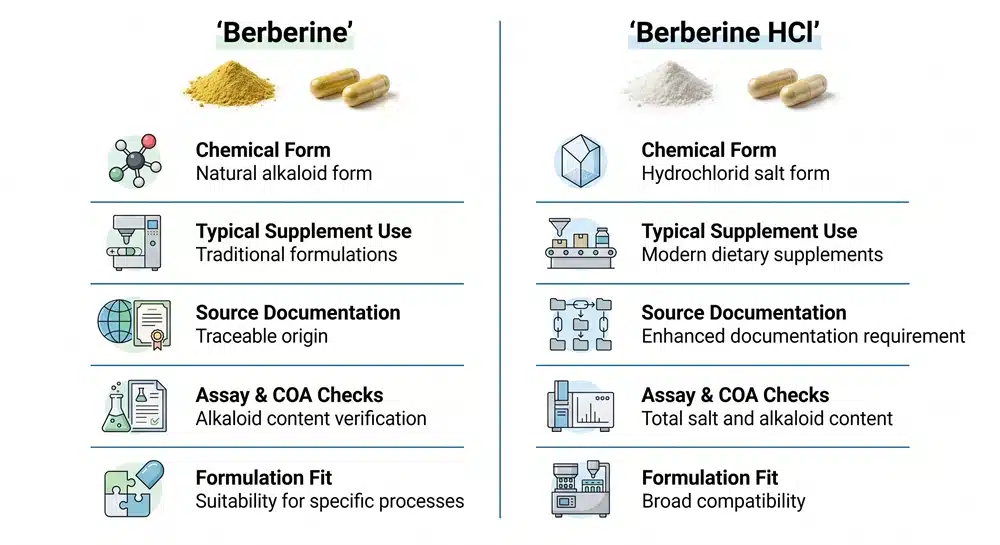
Berberine vs Berberine HCl at a Glance
| 요인 | 베르베린 | 베르베린 HCl |
|---|---|---|
| What the term usually means | The berberine alkaloid, a broad ingredient name, or a berberine-containing botanical material | Berberine supplied as the hydrochloride or chloride salt form |
| Common supplement use | May appear in consumer language or as part of a botanical extract description | Frequently supplied as a standardized powder for capsules and tablets |
| Source question | Botanical species, plant part, extraction process, and standardization must be defined | The starting source and conversion process must still be documented; HCl does not automatically mean synthetic |
| Specification focus | Source, active marker, assay, carrier, contaminants, and test method | Identity, assay basis, moisture, related substances, residual solvents, contaminants, and physical properties |
| Formulation fit | Depends on whether the material is a crude extract, standardized extract, or purified compound | Often easier to compare across lots when the salt form and specification are clearly defined |
| Key buyer mistake | Assuming every product labeled “berberine” is chemically and quantitatively equivalent | Assuming HCl automatically provides superior absorption, safety, or clinical performance |
What Is Berberine?
Berberine is a yellow isoquinoline alkaloid found in several plants, including species in the 베르베리스 genus. In supplement discussions, “berberine” may refer to the active alkaloid, a botanical extract standardized for berberine, or a finished supplement marketed around that ingredient. Those meanings are not interchangeable.
When comparing products, check the ingredient declaration, botanical source, plant part, standardization level, assay method, serving size, and other ingredients. A broad front-label statement does not tell you whether the product contains a crude botanical extract, a standardized extract, or a purified berberine salt.
What Is Berberine HCl?
Berberine HCl is berberine hydrochloride, a chloride salt form widely used in capsules and tablets. The “HCl” describes the chemical form. It does not independently establish whether the starting material was botanical, semi-synthetic, or produced by another manufacturing route.
For B2B sourcing, compare the actual batch documentation rather than relying on the ingredient name alone. Buyers evaluating bulk Berberine HCl powder specifications should confirm the salt form, hydration status, assay basis, identity method, impurity profile, particle size, contaminant limits, and lot-specific COA.
Is Berberine HCl the Same as Berberine?
Berberine HCl is a specific salt form of berberine, not an unrelated active ingredient. In everyday supplement language, the terms are often used closely. In technical purchasing, labeling, and formulation work, however, they should not be treated as perfectly interchangeable.
The declared ingredient amount may be expressed for the salt, the active moiety, an anhydrous basis, or an as-is basis. Brands should align the supplier specification, formulation calculation, Supplement Facts declaration, and finished-product test method before approving a formula or comparing quotations.
Natural Berberine vs Synthetic Berberine HCl
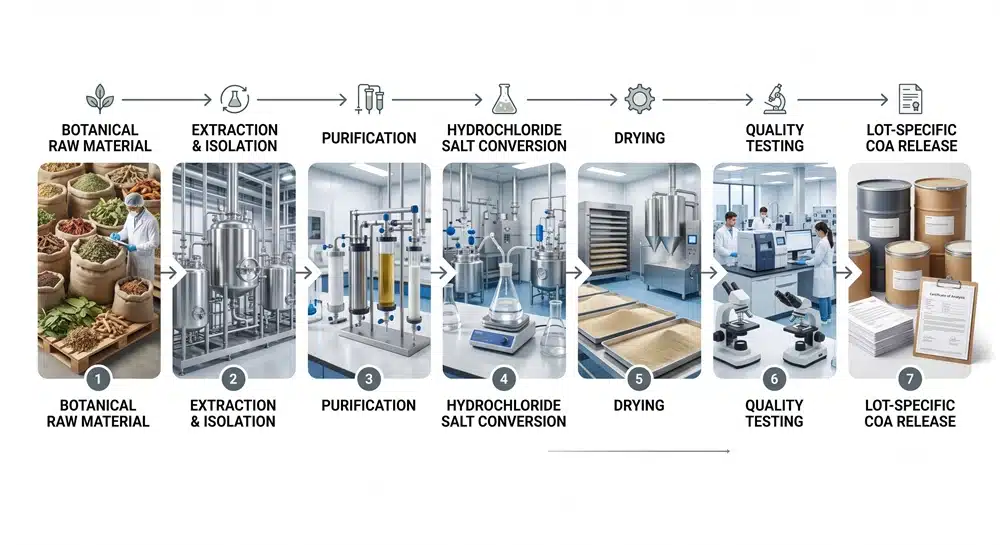
“Natural versus synthetic” is usually too simple for a quality decision. A supplier may isolate berberine from botanical material and then convert it into the hydrochloride salt. Another supplier may use a different processing route. Materials with the same declared identity can still differ in trace impurities, residual solvents, related alkaloids, environmental profile, and supporting documentation.
Do not assume that “natural” automatically means safer or that “synthetic” automatically means purer. Those conclusions require evidence from the process description, source declaration, specification, analytical results, and supplier qualification records.
Questions That Clarify the Source
- What is the botanical or manufacturing starting material?
- Which plant species and plant part are used, if the material is botanically sourced?
- Is the material isolated, semi-synthesized, or fully synthesized?
- Which solvents, reagents, and processing aids are used?
- How are identity and assay confirmed?
- Are related alkaloids and process impurities included in the specification?
- Can the supplier provide traceability from the starting material to the finished lot?
Which Form Is Better for Supplements?
There is no universal answer based only on the words “berberine” and “berberine HCl.” Berberine HCl is often selected for capsules and tablets because it can be purchased as a defined, high-assay powder with familiar analytical and manufacturing specifications. A standardized botanical extract may fit a brand that intentionally wants a whole-extract positioning, but the marker level, carrier, and serving-size calculation must be clear.
The better material is the one that matches the target market, label declaration, dosage form, serving size, stability plan, quality specification, legal review, and commercial target. A 건강기능식품 OEM can help compare these variables before pilot production rather than selecting an ingredient on marketing language alone.
Berberine HCl Safety and Use Considerations
Berberine can cause gastrointestinal effects such as nausea, abdominal discomfort, bloating, constipation, or diarrhea. It may interact with medicines, including cyclosporine, and interaction review is especially important for people using prescription drugs.
Berberine is likely unsafe for infants and may be unsafe during pregnancy or breastfeeding because of possible effects on the fetus or infant. People who are pregnant, breastfeeding, taking medications, or managing a medical condition should discuss use with a qualified healthcare professional.
Dietary supplement content should not present berberine as a replacement for medical treatment or claim that it treats, cures, or prevents diabetes, obesity, high cholesterol, or another disease. Structure/function or general-wellness wording must be truthful, not misleading, properly substantiated, and accompanied by applicable labeling requirements.
Berberine HCl Quality Checklist for Supplement Brands
| Check | 요청 사항 | 왜 중요한가요? |
|---|---|---|
| 정체성 | Validated identity method, reference standard, and chromatogram or spectrum where appropriate | Confirms that the material is the declared ingredient and salt form |
| 분석법 | Target percentage, test method, and reporting basis such as as-is or dry basis | Prevents dose and cost errors caused by different calculation bases |
| 출처 | Botanical source or manufacturing-route declaration | Supports traceability and truthful sourcing claims |
| 관련 물질 | Impurity profile, related alkaloids, and acceptance limits | Distinguishes a complete purity assessment from a headline assay value |
| 잔류 용제 | Solvent list, analytical method, and batch result | Verifies that process-related residues are controlled |
| 오염 물질 | Heavy metals, microbiology, and pesticide testing where relevant | Supports raw-material and finished-product safety controls |
| 물리적 특성 | Particle size, bulk density, tapped density, loss on drying, and flowability | Affects blend uniformity, capsule fill, tablet compression, and process consistency |
| 문서 | Lot-specific COA, specification, TDS, SDS, allergen statement, origin statement, and change-control expectations | Supports qualification, release, audit readiness, and ongoing supply management |
Formulation Considerations
캡슐
Capsules are a common format for berberine HCl because they contain the intense yellow color and bitter taste. Formulators should evaluate bulk density, flowability, capsule size, fill weight, serving size, blend uniformity, excipient compatibility, and the number of capsules required per serving. A qualified 캡슐 보충제 제조업체 should validate these factors during sampling and pilot production.
태블릿
Tablet formulas require compressibility, hardness, friability, disintegration, and stability testing. High active loading may increase tablet size or require granulation and flow-supporting excipients. Yellow pigment transfer and cleaning verification should also be considered in shared equipment.
Powder Blends and Sachets
Berberine HCl has a strong color and bitter taste, which can make direct-consumption powders challenging. Powder formats require taste masking, dispersion testing, serving-size review, moisture control, packaging evaluation, and clear instructions for use. Encapsulation may be more practical when a formula cannot achieve acceptable flavor or color.

Supplier Qualification and RFP Questions
- What exact ingredient form, hydration status, and assay will appear on the COA?
- Is the starting material botanical, semi-synthetic, or synthetic?
- Which identity, assay, and related-substance methods are used?
- 최근에 발행된 해당 로트별 원산지 증명서(COA) 3부를 제공해 주실 수 있나요?
- Which residual solvents, heavy metals, pesticides, and microorganisms are tested?
- What are the particle size, bulk density, tapped density, and flow characteristics?
- What are the MOQ, sample quantity, packaging options, lead time, and shelf life?
- How are supplier changes, specification changes, and out-of-specification results communicated?
- Can you support finished-product testing, stability planning, label review, and claim review?
- Are manufacturing, packaging, labeling, and holding operations managed under applicable dietary supplement GMP requirements?
- Can batch records, traceability records, and cleaning-control documentation be reviewed during qualification or audit?
Common Label and Content Mistakes
- Calling a dietary supplement “FDA approved.”
- Claiming that natural berberine is automatically safer than synthetic material.
- Claiming that berberine HCl is automatically better absorbed because it is an HCl salt.
- Claiming that berberine treats diabetes, obesity, high cholesterol, or another disease.
- Quoting a dose without defining the ingredient form, assay basis, and serving size.
- Using “clinically proven” when the cited study does not match the finished formula, dose, population, and endpoint.
- Failing to disclose carriers or other ingredients in a standardized botanical material.
- Using competitor product pages as the primary support for health or safety facts.
자주 묻는 질문
Is berberine HCl the same as berberine?
Berberine HCl is the hydrochloride salt form of berberine. It is a specific form of the broader ingredient, so the terms are closely related but should not be used carelessly when comparing labels, assay bases, and specifications.
Is berberine HCl natural or synthetic?
The HCl form alone does not answer the sourcing question. Berberine can be isolated from botanical material and then converted into the hydrochloride salt. Ask the supplier for the starting source, manufacturing-route declaration, and lot-specific documentation.
Does berberine HCl have better absorption than berberine?
The HCl salt is practical and widely standardized, but the label “HCl” does not by itself prove superior absorption. Delivery systems such as phytosome, liposomal formats, or other modified forms should be evaluated separately using evidence that matches the specific ingredient and finished formula.
Is berberine HCl safe?
Berberine can cause gastrointestinal side effects and may interact with medicines. It is likely unsafe for infants and may be unsafe during pregnancy or breastfeeding. People taking medications or managing health conditions should consult a qualified healthcare professional.
What should a berberine HCl COA include?
Review identity, assay, moisture, related substances, residual solvents, heavy metals, microbiology, particle size, and the exact test methods and reporting basis. The COA should be lot-specific and consistent with the approved specification.
최종 요점
Berberine HCl is a defined salt form of berberine commonly used in dietary supplements. The best comparison is not “natural good, synthetic bad” or “HCl automatically absorbs better.” It is a documented comparison of identity, source, assay, impurity controls, contaminants, physical properties, dosage-form performance, safety boundaries, and regulatory support.
Supplement brands can contact Gensei for a COA, sample, specification review, or formulation quotation and should provide the target market, dosage form, assay, serving size, quantity, and documentation requirements.
참조
- PubChem: Berberine
- PubChem: Berberine Chloride
- NCCIH: Berberine and Weight Loss—What You Need To Know
- FDA: 구조·기능 관련 주장
- FDA: 건강기능식품에 관한 질문과 답변
- FTC: 건강 관련 제품 규정 준수 지침
- eCFR: 21 CFR Part 111—Dietary Supplement Current Good Manufacturing Practice
- Variability in Potency Among Commercial Preparations of Berberine

워렌 완은 식이 보충제 공급망 분야에서 폭넓은 경험을 갖춘 노련한 전문가로, 콜라겐 펩타이드, 뼈 육수 단백질, 케라틴과 같은 핵심 원료의 연구, 개발, 공정 관리 및 글로벌 조달에 풍부한 실무 경험을 보유하고 있습니다. 이 칼럼의 필자로서 그는 마케팅적 포장만을 벗겨내고, 난해한 원료 과학 및 생산 품질 관리 기준을 누구나 쉽게 이해할 수 있는 심도 있는 과학 대중화 콘텐츠로 재구성함으로써, 독자들이 라벨 뒤에 숨겨진 진실을 파악하고 보다 합리적인 건강 선택을 할 수 있도록 돕는 데 전념하고 있습니다.