Berberine vs Berberine HCL: Differences, Absorption, Specs, and Formulation Guide

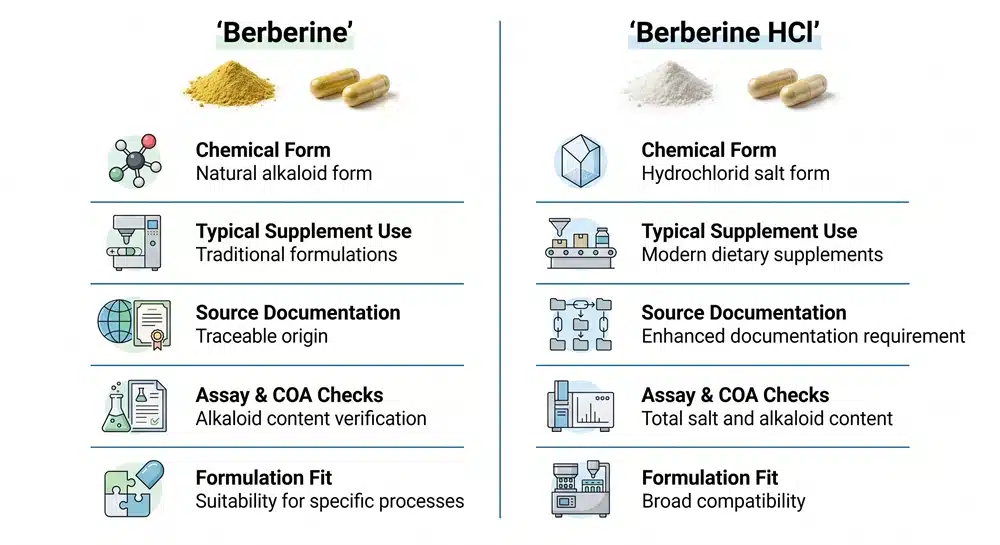
Berberine vs Berberine HCL comparison with plant alkaloid and hydrochloride salt supplement form

ベルベリンは、ベルベリス種を含むいくつかの植物に含まれる化合物で、何世紀にもわたって伝統的な中国医学やアーユルヴェーダ医学で使用されてきました。その鮮やかな黄色と強力な健康効果で知られるベルベリンは、代謝の健康や心血管系の機能などをサポートする能力から、欧米で人気を博しています。

Featured Answer: Berberine is the natural plant alkaloid, while berberine HCL is its hydrochloride salt form commonly used in dietary supplements. Berberine HCL is usually easier to standardize, test, and formulate for capsules or tablets, but enhanced forms such as phytosome or dihydroberberine may offer additional absorption advantages.

サプリメントを調べていると、ラベルに「ベルベリン」と「ベルベリンHCL」の両方が記載されていることがあり、その違いやどの形が自分のニーズに最適なのか混乱することがあります。この記事では、ベルベリンとベルベリンHCLの違いを説明し、それらの区別、利点、およびあなたに合ったものを選択する方法を強調します。

What Is Berberine?

Berberine is a yellow, plant-derived benzylisoquinoline alkaloid found in botanicals such as Berberis species, Coptis chinensis, goldenseal, Oregon grape, and tree turmeric. Chemically, berberine is a quaternary ammonium alkaloid; it is known for its bright yellow color and fluorescence, which is why it has also been used in dyes and laboratory staining applications.

In dietary supplements, the word “berberine” may refer to a botanical extract standardized for berberine content, or to a purified berberine salt such as berberine hydrochloride. This distinction matters because a crude plant extract, a standardized extract, and a purified HCL powder can differ in assay method, active marker percentage, excipients, dose calculation, and regulatory documentation.

For consumer education, berberine is often discussed for metabolic, glucose, lipid, and gut-health support. For supplement manufacturers, the more important first question is usually: What is the exact chemical form, assay value, test method, particle size, and batch documentation?

What Is Berberine HCL?

Berberine HCL, also called berberine hydrochloride or berberine chloride, is the hydrochloride salt form of berberine and is one of the most common forms used in capsules, tablets, and bulk supplement powders. The HCL form is popular because it gives manufacturers a defined chemical form, a clear assay target, and a practical powder format for standardized supplement production.

Compared with vague “berberine extract” labels, berberine HCL is usually easier to specify by CAS number, HPLC assay, moisture, mesh size, heavy metals, microbiology, and residual solvent limits. This makes it more suitable for private label supplement projects that require COA review, label claim calculation, and consistent batch-to-batch documentation.

Safety note: Berberine and berberine HCL should not be positioned as a drug or disease treatment. Reported side effects in human research are mainly gastrointestinal symptoms such as nausea, abdominal discomfort, constipation, bloating, or diarrhea. Berberine may also interact with medicines, including cyclosporine and drugs affecting blood glucose or blood pressure. Pregnant or breastfeeding people, infants, and users taking prescription medications should consult a healthcare professional before use.

Berberine vs Berberine HCL: Key Differences

The main difference is not that the two have completely different health effects. The difference is that berberine HCL is a standardized salt form that is easier to verify, dose, and manufacture than a generic berberine botanical extract.

Comparison Point Berberine / Botanical Extract Berberine HCL / Berberine Chloride なぜ重要なのか
定義 Natural alkaloid or extract standardized for berberine content Hydrochloride salt form of berberine HCL gives a more defined supplement raw material identity
Typical formula reference Berberine ion: C20H18NO4+ Berberine chloride: C20H18NO4.Cl Useful for technical documents, TDS, and specification sheets
標準化 May vary by plant source, extract ratio, carrier, and assay method Commonly specified as 97% or 98% by HPLC in B2B supply Improves label claim calculation and batch comparison
Formulation use May be used in botanical blends, but assay can be less direct Common for capsules, tablets, powder blends, and private label formulas Better fit for contract manufacturing and COA-based procurement
バイオアベイラビリティ Generally limited by poor absorption, P-gp efflux, and intestinal metabolism More standardized and practical, but still faces berberine’s broader absorption limitations HCL is not the same as phytosome, liposomal, or dihydroberberine technologies
最適 Brands emphasizing whole-plant botanical positioning Brands needing standardized, high-assay, scalable supplement production The right choice depends on label claims, cost, dosage form, and target market

Technical Specifications for Supplement Formulation

For supplement brands and contract manufacturers, the choice between berberine and berberine HCL should be based on testable specifications, not only on consumer-facing benefit claims.

Specification Item What to Check Why It Matters in Manufacturing
Assay / Purity Berberine HCL 97% or 98% by HPLC; confirm whether the value is “as is” or dry basis Determines label claim, dosage calculation, and cost per active gram
Identity HPLC fingerprint, UV, FTIR, or other identity method by batch Confirms the raw material matches the specification and reduces adulteration risk
粒子径 Common commercial requests include 80 mesh or 100 mesh, depending on dosage form Affects blending uniformity, capsule filling, tablet compression, and powder dispersion
Bulk Density / Flowability Ask for tapped density, bulk density, angle of repose, or flow data if high-speed filling is planned Poor flow can cause capsule weight variation or tablet compression issues
Contaminants Heavy metals, pesticide residues, residual solvents, PAHs where applicable, and microbiology Critical for import clearance, third-party review, and retailer requirements
Documents COA, TDS, SDS/MSDS, allergen statement, non-GMO statement, flow chart, country of origin Supports product development, compliance review, and B2B procurement decisions
Berberine HCL powder specification checklist for COA HPLC mesh size and heavy metals testing

Absorption and Bioavailability: Why HCL Is Not the Whole Story

Berberine HCL is a practical and standardized form, but it does not fully solve berberine’s low oral bioavailability. Research suggests that berberine absorption is limited by factors such as P-glycoprotein (P-gp) efflux, self-aggregation, intestinal metabolism, and rapid hepatic processing. This is why many newer formulations focus on delivery technologies rather than only changing the salt form.

フォーム Main Advantage Main Limitation Best Fit
ベルベリンHCL Standardized, common, cost-effective, easy to test by HPLC Still limited by berberine’s broader absorption barriers Standard capsules and tablets
Berberine Phytosome Designed to improve absorption using a lipid/phospholipid matrix Higher cost and more brand-specific ingredient sourcing Premium metabolic health formulas
Dihydroberberine Developed to improve plasma appearance at lower doses Less long-term commercial history than traditional HCL High-end products focused on absorption and GI tolerance
Liquid / micelle / liposomal berberine May improve dispersion and user experience Requires stability, taste, preservative, and packaging validation Drops, liquids, or specialized delivery formats
Berberine absorption flowchart showing P-gp efflux intestinal metabolism and formulation strategies

ベルベリンとベルベリンHCLの選び方

ベルベリンとベルベリンHCLのどちらを選ぶかを決める際には、以下の要素を考慮する:。
● 健康目標:最大限の効能、特に代謝と心臓血管のサポートを求めるなら、バイオアベイラビリティが向上しているベルベリンHCLの方がよい選択かもしれない。
● 消化器過敏症:胃が弱い人は、どのような剤形を選ぶにせよ、耐性を評価するために低用量から始める。
● 品質と純度:信頼できるブランドのサプリメントを探しましょう。そのブランドは、製品の純度や効能を保証するために、調達先や製造方法、第三者機関による試験について透明性を提供しています。
● 添加物に対する過敏症:ベルベリンやベルベリンHCLのサプリメントを選ぶ際には、添加物に対する潜在的な過敏症に注意することが重要です。サプリメントの中には、充填剤、結合剤、または敏感な人に副作用を引き起こす可能性のある他の添加物が含まれている場合があります。添加物を最小限に抑えた高品質で純粋な製剤を選ぶことで、このリスクを軽減し、より優れた耐性を確保することができます。

How to Choose Berberine HCL for Private Label Supplements

If you are developing a private label berberine supplement, the best raw material is not only the one with the strongest consumer claim. It is the ingredient that matches your dosage form, label claim, testing standard, market positioning, and cost target.

  • For capsule manufacturing: request mesh size, bulk density, flowability, and compatibility with excipients. Berberine HCL can be dense and intensely yellow, so blend uniformity and capsule fill weight should be validated during pilot production.
  • For tablet manufacturing: check compressibility, hygroscopicity, color migration, and whether granulation is needed. High-assay HCL powder may require excipients to improve flow and tablet hardness.
  • For powder blends or sachets: confirm taste masking, color impact, dispersibility, and whether the product is intended for direct consumption or encapsulation.
  • For premium formulas: compare traditional HCL with phytosome, dihydroberberine, or delivery-enhanced forms if your brand positioning centers on absorption and digestive tolerance.
  • For compliance review: avoid disease-treatment claims such as “treat diabetes” or “cure obesity.” Use structure/function wording such as “supports healthy glucose metabolism” only when you have proper substantiation and label disclaimers.

Collagensei can support botanical extract sourcing, custom formulation, capsule manufacturing, tablet manufacturing, powder manufacturing, and quality-control documentation for berberine supplement projects.

Potential Benefits and Supplement Positioning

Berberine and berberine HCL are most often positioned in dietary supplements for metabolic, digestive, and cardiovascular wellness support. The strongest consumer interest is usually around healthy glucose metabolism, lipid metabolism, weight-management support, and gut microbiome balance.

  • Healthy glucose metabolism: berberine is widely studied for its role in metabolic signaling pathways such as AMPK, but supplement labels should avoid claiming to treat diabetes.
  • Lipid metabolism support: berberine is commonly discussed in relation to cholesterol and triglyceride metabolism, but claims should be carefully worded and substantiated.
  • Gut health positioning: because berberine has a long history of use in digestive health contexts, it can fit gut-health supplement concepts when formulated and labeled appropriately.
  • Weight-management formulas: berberine may be included in formulas positioned for metabolism and body-composition support, but it should not be compared to prescription GLP-1 drugs or positioned as a medical weight-loss treatment.

Side Effects, Drug Interactions, and Who Should Avoid Berberine

Berberine is not appropriate for everyone. The most commonly reported side effects are gastrointestinal symptoms, including nausea, abdominal discomfort, bloating, constipation, or diarrhea. These effects may be more likely at higher intakes or when berberine is taken without food.

Berberine may interact with prescription medicines. It has been reported to interact with cyclosporine, and people using medications for blood glucose, blood pressure, cholesterol, blood thinning, immunosuppression, or heart rhythm should consult a healthcare professional before using berberine supplements.

Berberine should not be used by infants. Pregnant or breastfeeding people should avoid berberine unless specifically advised by a qualified healthcare professional, because berberine may affect bilirubin handling in infants and newborns.

Manufacturer note: brands should avoid aggressive disease claims and should include the required dietary supplement disclaimer where structure/function claims are used.

よくあるご質問

Is berberine HCL the same as berberine?

Berberine HCL is not a different active family; it is the hydrochloride salt form of berberine. In supplement manufacturing, HCL is preferred because it is more defined, easier to assay, and easier to formulate than vague botanical extracts.

Which is better, berberine or berberine HCL?

For most capsules and tablets, berberine HCL is usually the more practical choice because it is standardized and easy to test. For brands focused on enhanced absorption, phytosome or dihydroberberine formats may be worth comparing.

Does berberine HCL have better bioavailability?

Berberine HCL is a practical salt form, but berberine still has broader absorption challenges. P-gp efflux, self-aggregation, intestinal metabolism, and hepatic processing can still limit systemic exposure.

What is the best form of berberine for supplements?

The best form depends on the product goal. HCL is cost-effective and well-known, phytosome and liposomal formats target improved absorption, and dihydroberberine is used in premium formulas that emphasize lower-dose delivery and tolerance.

Is berberine HCL synthetic or natural?

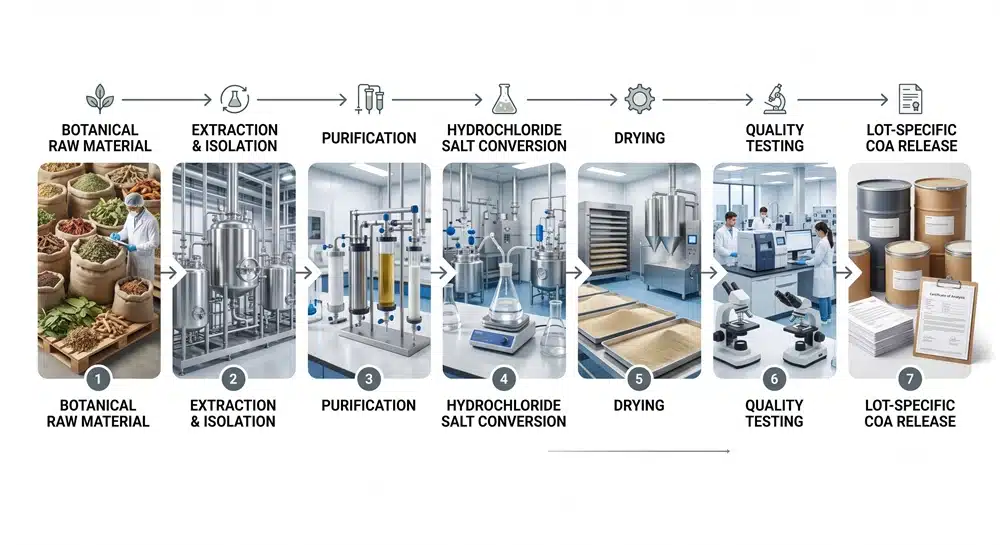
Berberine HCL may be produced from botanical berberine sources and converted into a hydrochloride salt. Buyers should confirm botanical source, process route, assay, solvent residues, and actual batch COA.

What specifications should supplement brands request?

Brands should request assay by HPLC, mesh size, bulk density, loss on drying, heavy metals, microbiology, residual solvents, COA, TDS, SDS, allergen statement, and country-of-origin documentation.

Can berberine HCL be used in capsules?

Yes. Berberine HCL is commonly used in capsules, but capsule filling should validate powder flow, density, blend uniformity, fill weight variation, color transfer, and compatibility with excipients.

Can berberine HCL be used in tablets?

Yes, but tablet projects should check compressibility, flowability, granulation needs, tablet hardness, disintegration, and dissolution. Pilot production is recommended before scaling.

Who should avoid berberine supplements?

Infants, pregnant or breastfeeding people, and people taking prescription medications should avoid berberine unless advised by a qualified healthcare professional. Drug interaction review is especially important.

Can brands claim berberine treats diabetes or obesity?

No. Dietary supplement brands should avoid disease-treatment claims. Safer wording focuses on structure/function support, such as healthy glucose metabolism or metabolic wellness, when substantiated and properly disclaimed.

結論

要約すると、ベルベリンとベルベリンHCLは、潜在的な健康上の利点を持つ2つの類似しているが異なるサプリメントです。ベルベリンは様々な植物で発見された天然化合物ですが、ベルベリンHCLは塩酸とベルベリンを組み合わせることによって作成されたより濃縮されたフォームです。どちらの化合物も、血糖調節、心臓血管の健康、消化器系の健康における潜在的な用途について研究されている。しかし、2つのどちらかを選択する際には、効力、生物学的利用能、および投与量の違いを考慮することが重要です。いつものことですが、新しいサプリメントを始める前に、医療専門家に相談してください。。

参考文献

  1. PubChem – Berberine
  2. Battu et al., 2010 – Physicochemical characterization of berberine chloride
  3. Kwon et al., 2020 – Enhanced intestinal absorption and pharmacokinetic modulation
  4. Moon et al., 2021 – Absorption kinetics of berberine and dihydroberberine
  5. Solnier et al., 2023 – Berberine phytosome PK assessment
  6. NCCIH – Berberine and Weight Loss
  7. MotherToBaby / NCBI Bookshelf – Berberine
  8. FDA – Structure/Function Claims
  9. FDA – 403(r)(6) claims notification
  10. Nature Made – Berberine Phytosome vs HCL
  11. iHerb – Berberine HCL vs Phytosome
  12. MedicalNewsToday – Berberine benefits/side effects/dosage
  13. WebMD – Berberine

トップに戻る