
This guide explains the practical differences for consumers, formulators and supplement brands, including evidence limits, dose and safety considerations, dosage-form selection and supplier quality checks.
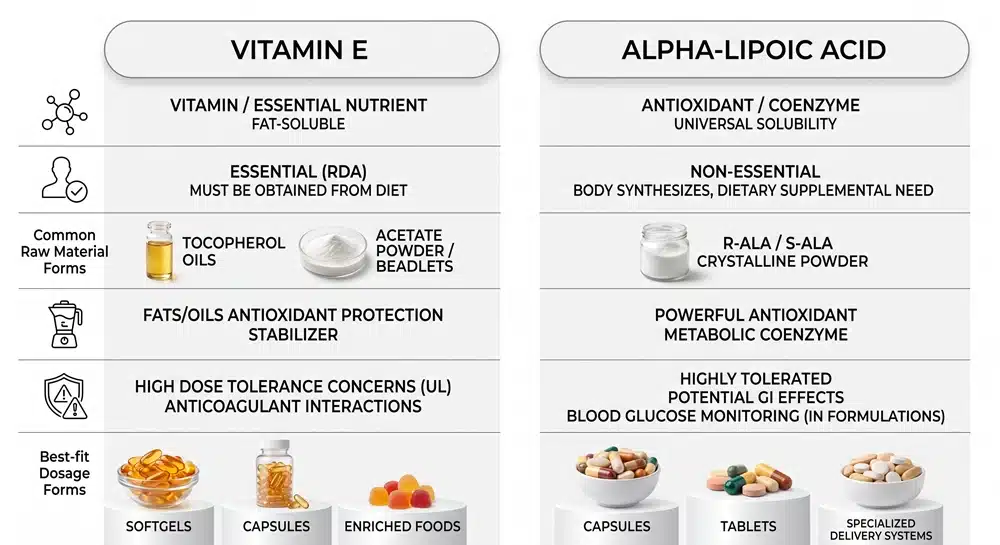
Vitamin E vs Alpha-Lipoic Acid at a Glance
| 요인 | 비타민 E | 알파 리포산(ALA) |
|---|---|---|
| 재료 유형 | Essential fat-soluble vitamin | Sulfur-containing metabolic cofactor and supplemental ingredient |
| Main biological role | Helps protect cell membranes from oxidative damage and supports normal immune function | Participates in mitochondrial enzyme systems and can take part in redox reactions |
| 일반적인 보충제 형태 | Natural or synthetic alpha-tocopherol, mixed tocopherols and tocotrienol ingredients | Racemic alpha-lipoic acid or R-alpha-lipoic acid ingredients |
| 용해성 | 지용성 | Has both water- and lipid-phase behavior, but is not simply “fully soluble in both” in every formulation |
| Nutritional requirement | Has an established Recommended Dietary Allowance | No established dietary requirement or recognized deficiency syndrome for healthy adults |
| Primary safety concern | High supplemental doses can increase bleeding risk, especially with anticoagulant or antiplatelet drugs | May cause gastrointestinal effects, may lower blood glucose and can interact with medicines |
| Best B2B use | Vitamin products, multivitamins, softgels, oils and antioxidant blends | Targeted capsules, tablets and powders with carefully reviewed claims and stability controls |
What Is Vitamin E?
Vitamin E is a family of eight fat-soluble compounds: four tocopherols and four tocotrienols. Alpha-tocopherol is the form used by the human body to meet vitamin E requirements. Vitamin E contributes to antioxidant protection of cell membranes and supports normal immune function.
The adult Recommended Dietary Allowance is 15 mg of alpha-tocopherol per day. Most people should obtain vitamin E from foods such as vegetable oils, nuts, seeds and green vegetables. Supplementation may be appropriate when intake is inadequate or a clinician identifies a specific need. Supplement brands can review GENSEI’s vitamin E ingredient options and specifications.
천연 비타민 E와 합성 비타민 E
Natural-source alpha-tocopherol is commonly labeled as d-알파-토코페롤 or RRR-alpha-tocopherol. Synthetic vitamin E is commonly labeled as dl-알파-토코페롤 or all-rac-alpha-tocopherol and contains multiple stereoisomers. The forms should not be compared by milligrams alone without reviewing the label unit, active form and specification. See the related natural vs synthetic vitamin E formulation guide.
알파-리포산이란?
Alpha-lipoic acid is a sulfur-containing compound that functions as a cofactor in mitochondrial enzyme complexes. The body produces small amounts, and food contains only limited quantities. Supplemental alpha-lipoic acid is usually provided at much higher amounts than food sources. For procurement, review the alpha-lipoic acid powder ingredient page.
Commercial ALA may be supplied as a racemic mixture containing R- and S-enantiomers or as R-alpha-lipoic acid. R-ALA is the naturally occurring enantiomer, but that does not automatically make every R-ALA product more stable, clinically superior or more bioavailable. Salt form, formulation, dose and stability data must be reviewed.
Is Alpha-Lipoic Acid the Same as Vitamin E?
아니요. Vitamin E is an essential vitamin with established intake recommendations. Alpha-lipoic acid is a metabolic cofactor and supplement ingredient without an established daily nutritional requirement. Both can participate in antioxidant systems, but they differ in chemistry, metabolism, evidence, safety and product use.
How Their Antioxidant Roles Differ
비타민 E
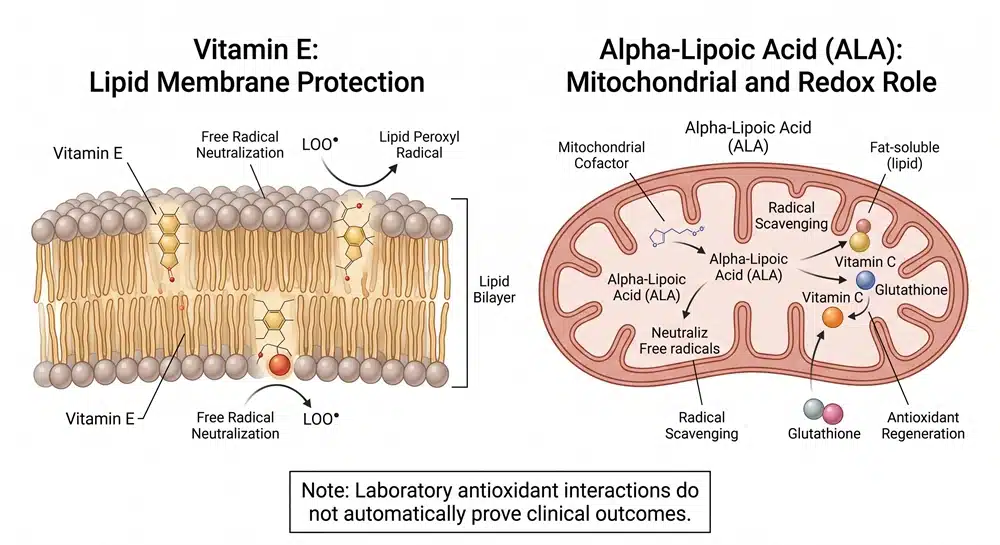
Vitamin E is located mainly in lipid environments, including cell membranes and lipoproteins. It can interrupt lipid-peroxidation chain reactions by reacting with lipid radicals. This role should be described as supporting normal antioxidant protection, not as preventing cancer, heart disease or neurodegenerative disease.
알파-리포산
Alpha-lipoic acid and its reduced form, dihydrolipoic acid, participate in redox chemistry. Laboratory research suggests that lipoic acid can interact with other antioxidant systems. However, claims that oral ALA “regenerates vitamin E,” “repairs cells” or “detoxifies the body” should not be presented as guaranteed clinical outcomes.
Which Is Better for Antioxidant Support?
There is no universal winner. Vitamin E is the appropriate choice when a formula needs to supply an essential vitamin or meet a defined alpha-tocopherol target. Alpha-lipoic acid may be considered for a separate, evidence-based formulation concept, but it should not replace vitamin E in a product that is intended to provide vitamin E.
| 제품 목표 | 가장 유력한 원료 | 이유 |
|---|---|---|
| Meet a vitamin E nutritional target | 비타민 E | ALA cannot satisfy vitamin E requirements |
| Multivitamin or prenatal formula | Vitamin E, with market-specific review | Provides an essential nutrient; dose and form must fit the full formula |
| Oil-based antioxidant softgel | Vitamin E or a mixed-antioxidant system | Vitamin E is compatible with lipid-based formulas and may also protect formulation oils |
| Targeted ALA capsule or tablet | 알파 리포산 | Requires a clear ingredient-specific rationale, safety review and claim substantiation |
| Combined antioxidant formula | Possible combination | Combination is not automatically synergistic; compatibility, dose and evidence must be validated |
Evidence Boundaries and Health Claims
비타민 E
Vitamin E deficiency is rare in healthy people and is usually associated with disorders that impair fat absorption. Large clinical trials have not established high-dose vitamin E supplements as a general strategy to prevent cardiovascular disease, cancer or cognitive decline. A supplement should not be marketed as a disease-prevention product.
알파-리포산
ALA has been studied in people with diabetes and diabetic neuropathy, but results are inconsistent. NCCIH notes that research does not support alpha-lipoic acid for blood-glucose control, and evidence for neuropathy-related outcomes is mixed. Ordinary supplements should not be presented as treatments for diabetes or nerve disease.
Safety, Side Effects and Interactions
Vitamin E Safety
- High supplemental doses can increase bleeding risk.
- People taking anticoagulant or antiplatelet medicines should obtain professional advice.
- Vitamin E can interact with chemotherapy and radiation treatments.
- The U.S. adult Tolerable Upper Intake Level for supplemental alpha-tocopherol is 1,000 mg per day, but lower doses may still be inappropriate for some users.
- Product labels should distinguish milligrams from older International Unit labeling.
Alpha-Lipoic Acid Safety
- Possible effects include nausea, heartburn, headache, dizziness or gastrointestinal discomfort.
- ALA may lower blood glucose and can interact with diabetes medicines.
- People with thyroid conditions or using thyroid medicine should seek professional advice.
- Pregnancy, breastfeeding and long-term high-dose use require a cautious review because evidence is limited.
- Individuals with poor nutritional status or heavy alcohol use may need thiamin assessment before using high-dose ALA.
Can Vitamin E and Alpha-Lipoic Acid Be Taken Together?
They can appear in the same formula, but “more antioxidants” does not automatically mean better outcomes. A combined product needs a rationale for each ingredient, a review of the total dose, interaction risks, target population, dosage form and claim language.
Consumers using blood-thinning medicine, glucose-lowering medicine, thyroid medicine or cancer therapy should consult a qualified healthcare professional before combining these ingredients. Brands comparing other antioxidant ingredients can also review alpha-lipoic acid vs CoQ10.
Dosage-Form and Formulation Considerations
Vitamin E Softgels and Oils
Vitamin E is commonly used in oil-based softgels and liquid products. Formulators should confirm the exact tocopherol form, potency unit, carrier oil, oxidation control, capsule-shell compatibility and packaging. Review GENSEI’s 소프트젤 캡슐 제조 기능.
Vitamin E Powders and Beadlets
Dry vitamin E forms can be spray-dried powders or beadlets designed for tablets, capsules, gummies and beverage powders. The carrier, encapsulation system, dispersibility and declared potency must be included in the specification. See vitamin E beadlet vs powder considerations.
Alpha-Lipoic Acid Capsules and Tablets
ALA is sensitive to heat, light and formulation conditions. Tablet and capsule development should evaluate identity, enantiomeric form, assay, polymerization or degradation, particle size, odor, dissolution and packaging. GENSEI supports 캡슐 제조 그리고 태블릿 제조.
Powder and Combination Products
ALA’s taste and stability can make drink powders challenging. Vitamin E powders require a compatible delivery system. Multi-ingredient products should be tested for blend uniformity, potency and stability rather than assuming antioxidant ingredients are automatically compatible.
품질 사양 체크리스트
| 사양 | 비타민 E | 알파-리포산 |
|---|---|---|
| 정체성 | Tocopherol/tocotrienol form and stereochemical designation | Alpha-lipoic acid identity and enantiomeric form |
| 분석법 | Alpha-tocopherol equivalent, mg/IU basis and method | ALA assay, dry/as-is basis and method |
| Carrier system | Oil, beadlet or powder carrier and all excipients | Salt, stabilizer, carrier or encapsulation system |
| 관련 물질 | Oxidation products and process impurities | Degradation products, polymeric material and process impurities |
| 물리적 특성 | Dispersibility, particle size, bulk density or oil characteristics | Particle size, bulk density, flow, color and odor |
| 오염 물질 | Heavy metals, microbiology and residual solvents as applicable | Heavy metals, microbiology and residual solvents |
| 안정성 | Light, oxygen, temperature and final-package data | Light, heat, moisture and final-package data |
| 문서 | Lot COA, specification, TDS, origin and allergen/GMO statements | Lot COA, specification, TDS, origin and chiral documentation |
RFP Questions for a Supplier or Manufacturer
- What exact vitamin E or alpha-lipoic acid form is supplied?
- For vitamin E, how are milligrams, IU and alpha-tocopherol equivalents calculated?
- For ALA, is the material racemic ALA, R-ALA or a stabilized salt?
- Which identity, assay and related-substance methods are used?
- 최근에 발행된 해당 로트별 원산지 증명서(COA) 3부를 제공해 주실 수 있나요?
- Which carriers, excipients and processing aids are present?
- What are the heavy metal, microbiological and residual-solvent limits?
- What stability data are available in the intended dosage form and package?
- How are light, oxygen, heat and moisture controlled during manufacturing?
- What are the MOQ, sample quantity, lead time and packaging options?
- Can you support softgel, capsule, tablet or powder pilot production?
- How do you review antioxidant, energy, blood-sugar, nerve-health and anti-aging claims?
GENSEI의 활용 분야
GENSEI supports the vitamin ingredients hub에서 기능성 보충제 원료 정보 센터, 비타민 계약 제조, 맞춤형 보충제 배합 그리고 품질 관리 보완.
브랜드는 request a sample, COA or quotation with the target form, potency, dosage format, market, packaging and order quantity.
자주 묻는 질문
Is alpha-lipoic acid better than vitamin E?
No universal comparison applies. Vitamin E is an essential nutrient; ALA is a separate metabolic cofactor and supplement ingredient. The correct choice depends on the nutritional and formulation goal.
Does alpha-lipoic acid regenerate vitamin E?
Redox interactions have been demonstrated in laboratory systems, but a supplement should not promise that oral ALA will reliably “recycle” vitamin E or produce a specific clinical benefit in every user.
Can vitamin E and alpha-lipoic acid be taken together?
They can be combined, but the total dose, medicines, health conditions and claim rationale should be reviewed. Combining antioxidants does not automatically improve outcomes.
어떤 것이 피부에 더 좋을까요?
Vitamin E is an essential nutrient and is also used in topical products. Oral ALA is not established as a universal anti-aging or skin-repair supplement. Product route and evidence should be evaluated separately.
Does alpha-lipoic acid lower blood sugar?
ALA has been studied in diabetes, but NCCIH reports that it has not been shown to help control blood sugar. It may interact with glucose-lowering medicines.
What is the difference between R-ALA and regular ALA?
Regular commercial ALA is often a racemic mixture of R- and S-forms. R-ALA contains the naturally occurring enantiomer. Quality and performance still depend on stability, dose, salt form and formulation.
최종 요점
Vitamin E and alpha-lipoic acid belong in different decision categories. Vitamin E is an essential nutrient with defined intake recommendations; ALA is a nonessential metabolic cofactor used in targeted supplement formulations. Responsible products should avoid disease-treatment and “detox” promises, define the exact ingredient form, verify stability and interactions, and use finished-product evidence rather than generic antioxidant marketing.
참조

워렌 완은 식이 보충제 공급망 분야에서 폭넓은 경험을 갖춘 노련한 전문가로, 콜라겐 펩타이드, 뼈 육수 단백질, 케라틴과 같은 핵심 원료의 연구, 개발, 공정 관리 및 글로벌 조달에 풍부한 실무 경험을 보유하고 있습니다. 이 칼럼의 필자로서 그는 마케팅적 포장만을 벗겨내고, 난해한 원료 과학 및 생산 품질 관리 기준을 누구나 쉽게 이해할 수 있는 심도 있는 과학 대중화 콘텐츠로 재구성함으로써, 독자들이 라벨 뒤에 숨겨진 진실을 파악하고 보다 합리적인 건강 선택을 할 수 있도록 돕는 데 전념하고 있습니다.


