
Hướng dẫn này giải thích những khác biệt thực tiễn đối với người tiêu dùng, các nhà sản xuất công thức và các thương hiệu thực phẩm bổ sung, bao gồm các giới hạn về bằng chứng, các yếu tố cần cân nhắc về liều lượng và an toàn, việc lựa chọn dạng bào chế cũng như việc kiểm tra chất lượng nhà cung cấp.
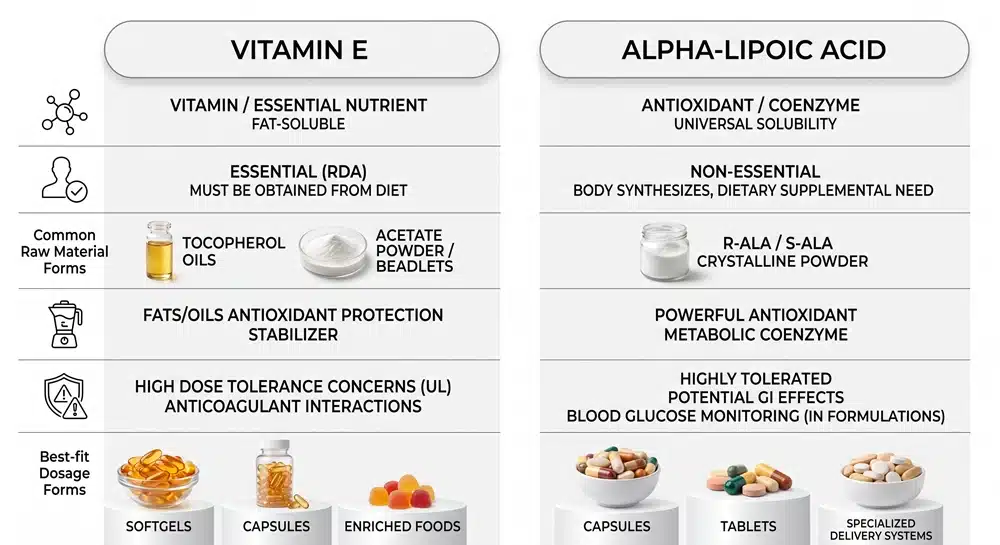
So sánh nhanh giữa Vitamin E và Axit Alpha-Lipoic
| Yếu tố | Vitamin E | Axit alpha-lipoic (ALA) |
|---|---|---|
| Loại nguyên liệu | Vitamin tan trong chất béo thiết yếu | Chất đồng yếu tố chuyển hóa chứa lưu huỳnh và thành phần bổ sung |
| Chức năng sinh học chính | Giúp bảo vệ màng tế bào khỏi tổn thương do oxy hóa và hỗ trợ chức năng miễn dịch bình thường | Tham gia vào các hệ thống enzym của ty thể và có thể tham gia vào các phản ứng oxy hóa khử |
| Các dạng thực phẩm bổ sung phổ biến | Các thành phần alpha-tocopherol tự nhiên hoặc tổng hợp, hỗn hợp tocopherol và tocotrienol | Thành phần axit alpha-lipoic dạng racemic hoặc axit R-alpha-lipoic |
| Độ hòa tan | Tan trong chất béo | Có cả tính chất của pha nước lẫn pha lipid, nhưng không đơn thuần là “hoàn toàn hòa tan trong cả hai” trong mọi công thức |
| Nhu cầu dinh dưỡng | Đã có mức khuyến nghị về lượng dinh dưỡng hàng ngày được xác định rõ ràng | Không có yêu cầu dinh dưỡng cụ thể nào được xác định cũng như không có hội chứng thiếu hụt nào được công nhận đối với người trưởng thành khỏe mạnh |
| Mối quan tâm hàng đầu về an toàn | Liều bổ sung cao có thể làm tăng nguy cơ chảy máu, đặc biệt khi dùng cùng với thuốc chống đông máu hoặc thuốc ức chế tiểu cầu | Có thể gây ra các tác dụng phụ trên đường tiêu hóa, có thể làm giảm đường huyết và có thể tương tác với các loại thuốc |
| Ứng dụng B2B tốt nhất | Các sản phẩm vitamin, vitamin tổng hợp, viên nang mềm, dầu và hỗn hợp chất chống oxy hóa | Các viên nang, viên nén và bột có mục tiêu cụ thể, với các tuyên bố về công dụng đã được xem xét kỹ lưỡng và các biện pháp kiểm soát độ ổn định |
Vitamin E là gì?
Vitamin E là một nhóm gồm tám hợp chất tan trong chất béo: bốn tocopherol và bốn tocotrienol. Alpha-tocopherol là dạng được cơ thể con người sử dụng để đáp ứng nhu cầu về vitamin E. Vitamin E góp phần bảo vệ màng tế bào nhờ tác dụng chống oxy hóa và hỗ trợ chức năng miễn dịch bình thường.
Lượng vitamin E khuyến nghị hàng ngày cho người trưởng thành là 15 mg alpha-tocopherol. Hầu hết mọi người nên bổ sung vitamin E từ các loại thực phẩm như dầu thực vật, các loại hạt, hạt giống và rau xanh. Việc sử dụng thực phẩm chức năng có thể là phù hợp khi lượng vitamin E nạp vào cơ thể không đủ hoặc bác sĩ xác định có nhu cầu cụ thể. Các thương hiệu thực phẩm chức năng có thể tham khảo GENSEI’s Các lựa chọn và thông số kỹ thuật của thành phần vitamin E.
Vitamin E tự nhiên so với Vitamin E tổng hợp
Alpha-tocopherol có nguồn gốc tự nhiên thường được ghi trên nhãn là d-alpha-tocopherol hoặc RRR-alpha-tocopherol. Vitamin E tổng hợp thường được ghi trên nhãn là dl-alpha-tocopherol hoặc all-rac-alpha-tocopherol và chứa nhiều đồng phân lập thể. Không nên so sánh các dạng này chỉ dựa trên đơn vị miligam mà không xem xét đơn vị ghi trên nhãn, dạng hoạt tính và thông số kỹ thuật. Xem phần liên quan Hướng dẫn so sánh công thức vitamin E tự nhiên và tổng hợp.
Axit alpha-lipoic là gì?
Axit alpha-lipoic là một hợp chất chứa lưu huỳnh, có chức năng như một đồng yếu tố trong các phức hợp enzym của ty thể. Cơ thể tự sản sinh ra một lượng nhỏ chất này, trong khi thực phẩm chỉ chứa một lượng hạn chế. Axit alpha-lipoic bổ sung thường được cung cấp với liều lượng cao hơn nhiều so với các nguồn thực phẩm. Để tìm hiểu thêm về việc mua sản phẩm, vui lòng tham khảo Trang thông tin về thành phần bột axit alpha-lipoic.
ALA thương mại có thể được cung cấp dưới dạng hỗn hợp racemic chứa các enantiomer R- và S-, hoặc dưới dạng axit R-alpha-lipoic. R-ALA là enantiomer có nguồn gốc tự nhiên, nhưng điều đó không có nghĩa là mọi sản phẩm R-ALA đều tự động ổn định hơn, vượt trội hơn về mặt lâm sàng hoặc có sinh khả dụng cao hơn. Cần xem xét kỹ các thông tin về dạng muối, công thức, liều lượng và độ ổn định.
Axit alpha-lipoic có giống vitamin E không?
Không. Vitamin E là một loại vitamin thiết yếu có các khuyến nghị về liều lượng đã được xác định. Axit alpha-lipoic là một đồng yếu tố chuyển hóa và thành phần bổ sung chưa có nhu cầu dinh dưỡng hàng ngày được xác định. Cả hai đều có thể tham gia vào các hệ thống chống oxy hóa, nhưng chúng khác nhau về mặt hóa học, quá trình chuyển hóa, bằng chứng khoa học, độ an toàn và cách sử dụng sản phẩm.
Sự khác biệt trong vai trò chống oxy hóa của chúng
Vitamin E
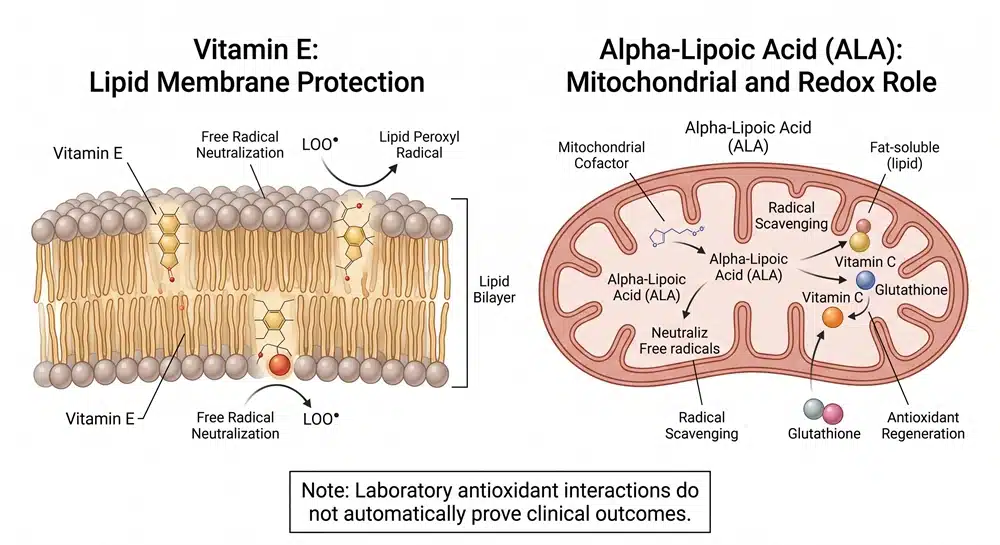
Vitamin E chủ yếu tồn tại trong môi trường lipid, bao gồm màng tế bào và lipoprotein. Chất này có thể ngăn chặn các phản ứng dây chuyền peroxy hóa lipid bằng cách phản ứng với các gốc tự do lipid. Vai trò này nên được mô tả là hỗ trợ cơ chế bảo vệ chống oxy hóa bình thường, chứ không phải là phòng ngừa ung thư, bệnh tim mạch hay các bệnh thoái hóa thần kinh.
Axit alpha-lipoic
Axit alpha-lipoic và dạng khử của nó, axit dihydrolipoic, tham gia vào các phản ứng oxy hóa-khử. Các nghiên cứu trong phòng thí nghiệm cho thấy axit lipoic có thể tương tác với các hệ thống chống oxy hóa khác. Tuy nhiên, các tuyên bố rằng ALA uống “tái tạo vitamin E”, “sửa chữa tế bào” hoặc “giải độc cơ thể” không nên được trình bày như những kết quả lâm sàng được đảm bảo.
Loại nào tốt hơn trong việc hỗ trợ chống oxy hóa?
Không có giải pháp nào là tối ưu cho mọi trường hợp. Vitamin E là lựa chọn phù hợp khi một công thức cần cung cấp một loại vitamin thiết yếu hoặc đáp ứng mục tiêu cụ thể về hàm lượng alpha-tocopherol. Axit alpha-lipoic có thể được xem xét trong một khái niệm công thức riêng biệt, dựa trên bằng chứng khoa học, nhưng không nên thay thế vitamin E trong sản phẩm có mục đích cung cấp vitamin E.
| Mục tiêu sản phẩm | Thành phần có khả năng được sử dụng làm nguyên liệu ban đầu | Lý do |
|---|---|---|
| Đáp ứng mục tiêu dinh dưỡng về vitamin E | Vitamin E | ALA không thể đáp ứng nhu cầu về vitamin E |
| Thuốc đa vitamin hoặc công thức dành cho phụ nữ mang thai | Vitamin E, kèm theo đánh giá cụ thể theo từng thị trường | Cung cấp một chất dinh dưỡng thiết yếu; liều lượng và dạng bào chế phải phù hợp với công thức tổng thể |
| Viên nang mềm chống oxy hóa có nguồn gốc từ dầu | Vitamin E hoặc hệ thống chống oxy hóa hỗn hợp | Vitamin E tương thích với các công thức có nền lipid và cũng có thể bảo vệ các loại dầu trong công thức |
| Viên nang hoặc viên nén ALA có tác dụng nhắm mục tiêu | Axit alpha-lipoic | Yêu cầu phải có cơ sở lý luận rõ ràng về từng thành phần cụ thể, đánh giá an toàn và chứng minh tính xác thực của các tuyên bố |
| Công thức chống oxy hóa kết hợp | Các kết hợp có thể có | Sự kết hợp không tự động mang lại hiệu quả hiệp đồng; cần phải xác minh tính tương thích, liều lượng và bằng chứng |
Phạm vi bằng chứng và các tuyên bố về sức khỏe
Vitamin E
Tình trạng thiếu vitamin E rất hiếm gặp ở những người khỏe mạnh và thường liên quan đến các rối loạn làm suy giảm khả năng hấp thu chất béo. Các thử nghiệm lâm sàng quy mô lớn chưa chứng minh được rằng việc bổ sung vitamin E liều cao là một chiến lược chung để phòng ngừa bệnh tim mạch, ung thư hoặc suy giảm chức năng nhận thức. Không nên quảng cáo thực phẩm bổ sung này như một sản phẩm phòng ngừa bệnh tật.
Axit alpha-lipoic
ALA đã được nghiên cứu trên những người mắc bệnh tiểu đường và bệnh thần kinh do tiểu đường, nhưng kết quả còn chưa thống nhất. NCCIH lưu ý rằng các nghiên cứu không ủng hộ việc sử dụng axit alpha-lipoic để kiểm soát đường huyết, và bằng chứng về các kết quả liên quan đến bệnh thần kinh còn trái chiều. Các sản phẩm bổ sung thông thường không nên được quảng cáo là phương pháp điều trị bệnh tiểu đường hoặc bệnh thần kinh.
An toàn, tác dụng phụ và tương tác
Tính an toàn của vitamin E
- Liều bổ sung cao có thể làm tăng nguy cơ chảy máu.
- Những người đang dùng thuốc chống đông máu hoặc thuốc chống kết tập tiểu cầu nên tham khảo ý kiến chuyên gia.
- Vitamin E có thể tương tác với các phương pháp điều trị hóa trị và xạ trị.
- Mức tiêu thụ tối đa an toàn (UL) đối với alpha-tocopherol dưới dạng thực phẩm bổ sung dành cho người trưởng thành tại Hoa Kỳ là 1.000 mg mỗi ngày, nhưng liều lượng thấp hơn vẫn có thể không phù hợp với một số người dùng.
- Nhãn sản phẩm cần phân biệt đơn vị miligam với hệ đơn vị quốc tế (IU) được sử dụng trước đây.
Tính an toàn của axit alpha-lipoic
- Các tác dụng phụ có thể gặp bao gồm buồn nôn, ợ chua, đau đầu, chóng mặt hoặc khó chịu ở đường tiêu hóa.
- ALA có thể làm giảm đường huyết và có thể tương tác với các loại thuốc điều trị tiểu đường.
- Những người mắc các bệnh về tuyến giáp hoặc đang sử dụng thuốc điều trị tuyến giáp nên tham khảo ý kiến chuyên gia.
- Thai kỳ, cho con bú và việc sử dụng liều cao trong thời gian dài cần được xem xét thận trọng do bằng chứng còn hạn chế.
- Những người có tình trạng dinh dưỡng kém hoặc lạm dụng rượu có thể cần được đánh giá nồng độ thiamin trước khi sử dụng ALA liều cao.
Có thể dùng chung vitamin E và axit alpha-lipoic không?
Chúng có thể xuất hiện trong cùng một công thức, nhưng “nhiều chất chống oxy hóa hơn” không tự động đồng nghĩa với kết quả tốt hơn. Một sản phẩm kết hợp cần có cơ sở lý luận cho từng thành phần, đánh giá về liều lượng tổng thể, rủi ro tương tác, đối tượng mục tiêu, dạng bào chế và nội dung tuyên bố.
Người tiêu dùng đang sử dụng thuốc chống đông máu, thuốc hạ đường huyết, thuốc điều trị tuyến giáp hoặc đang điều trị ung thư nên tham khảo ý kiến của chuyên gia y tế có chuyên môn trước khi kết hợp các thành phần này. Các thương hiệu so sánh với các thành phần chống oxy hóa khác cũng có thể tham khảo Axit alpha-lipoic so với CoQ10.
Các yếu tố cần xem xét về dạng bào chế và công thức
Viên nang mềm và dầu Vitamin E
Vitamin E thường được sử dụng trong các viên nang mềm dạng dầu và các sản phẩm lỏng. Các nhà bào chế cần xác nhận chính xác dạng tocopherol, đơn vị hàm lượng, dầu nền, biện pháp kiểm soát quá trình oxy hóa, tính tương thích với vỏ viên nang và hình thức đóng gói. Tham khảo tài liệu của GENSEI Sản xuất viên nang mềm khả năng.
Bột và viên nang nhỏ chứa vitamin E
Các dạng vitamin E khô có thể là bột sấy phun hoặc các hạt nhỏ được thiết kế dành cho viên nén, viên nang, kẹo dẻo và bột pha chế đồ uống. Chất mang, hệ thống bao bọc, khả năng phân tán và hàm lượng công bố phải được nêu rõ trong tiêu chuẩn kỹ thuật. Xem Những điểm cần lưu ý khi so sánh viên nang vitamin E với dạng bột.
Viên nang và viên nén axit alpha-lipoic
ALA rất nhạy cảm với nhiệt độ, ánh sáng và các điều kiện trong công thức. Quá trình phát triển viên nén và viên nang cần đánh giá các yếu tố như tính đồng nhất, dạng enantiomer, hàm lượng, quá trình trùng hợp hoặc phân hủy, kích thước hạt, mùi, tốc độ hòa tan và bao bì. GENSEI hỗ trợ Sản xuất viên nang và sản xuất máy tính bảng.
Sản phẩm dạng bột và sản phẩm kết hợp
Hương vị và độ ổn định của ALA có thể gây khó khăn cho các sản phẩm bột uống. Bột vitamin E cần có hệ thống phân phối tương thích. Các sản phẩm có nhiều thành phần cần được kiểm tra về độ đồng nhất của hỗn hợp, hàm lượng hoạt chất và độ ổn định, thay vì cho rằng các thành phần chống oxy hóa sẽ tự động tương thích với nhau.
Danh sách kiểm tra tiêu chuẩn chất lượng
| Thông số kỹ thuật | Vitamin E | Axit alpha-lipoic |
|---|---|---|
| Bản sắc | Dạng tocopherol/tocotrienol và ký hiệu lập thể | Bản chất và dạng enantiomer của axit alpha-lipoic |
| Phương pháp định lượng | Tương đương alpha-tocopherol, mg/IU: cơ sở và phương pháp | Phương pháp định lượng ALA, trên cơ sở khô/nguyên trạng và phương pháp thực hiện |
| Hệ thống vận chuyển | Dầu, hạt vi nang hoặc chất mang dạng bột và tất cả các tá dược | Muối, chất ổn định, chất mang hoặc hệ thống bao bọc |
| Các chất có liên quan | Các sản phẩm oxy hóa và tạp chất trong quá trình sản xuất | Các sản phẩm phân hủy, vật liệu polymer và tạp chất trong quá trình sản xuất |
| Tính chất vật lý | Khả năng phân tán, kích thước hạt, mật độ khối hoặc các đặc tính của dầu | Kích thước hạt, mật độ khối, độ chảy, màu sắc và mùi |
| Các chất gây ô nhiễm | Kim loại nặng, vi sinh vật và dung môi dư (nếu có) | Kim loại nặng, vi sinh vật và dung môi dư |
| Sự ổn định | Dữ liệu về ánh sáng, oxy, nhiệt độ và bao bì thành phẩm | Dữ liệu về ánh sáng, nhiệt độ, độ ẩm và bao bì thành phẩm |
| Tài liệu | Số lô, Giấy chứng nhận xuất xứ (COA), thông số kỹ thuật, Bảng dữ liệu kỹ thuật (TDS), thông tin về nguồn gốc và tuyên bố về chất gây dị ứng/sinh vật biến đổi gen (GMO) | Giấy chứng nhận xuất xứ lô hàng (COA), thông số kỹ thuật, bảng dữ liệu kỹ thuật (TDS), nguồn gốc và tài liệu liên quan đến tính đối xứng |
Các câu hỏi trong hồ sơ yêu cầu đề xuất (RFP) dành cho nhà cung cấp hoặc nhà sản xuất
- Cụ thể thì sản phẩm này cung cấp dạng vitamin E hay axit alpha-lipoic nào?
- Đối với vitamin E, cách tính miligam, IU và lượng tương đương alpha-tocopherol như thế nào?
- Đối với ALA, chất này là ALA racemic, R-ALA hay một loại muối ổn định?
- Các phương pháp xác định, định lượng và phân tích các chất liên quan nào được sử dụng?
- Quý vị có thể cung cấp ba giấy chứng nhận xuất xứ (COA) gần đây dành riêng cho từng lô hàng được không?
- Các chất mang, tá dược và chất phụ trợ chế biến nào có trong sản phẩm?
- Các giới hạn về kim loại nặng, vi sinh vật và dung môi dư là gì?
- Có những dữ liệu nào về tính ổn định đối với dạng bào chế và bao bì dự kiến?
- Trong quá trình sản xuất, ánh sáng, oxy, nhiệt độ và độ ẩm được kiểm soát như thế nào?
- Số lượng đặt hàng tối thiểu (MOQ), số lượng mẫu, thời gian giao hàng và các tùy chọn đóng gói là gì?
- Quý công ty có thể hỗ trợ sản xuất thử nghiệm các dạng bào chế như viên nang mềm, viên nang, viên nén hoặc bột không?
- Làm thế nào để đánh giá các tuyên bố liên quan đến chất chống oxy hóa, năng lượng, đường huyết, sức khỏe hệ thần kinh và chống lão hóa?
Vị trí của GENSEI
GENSEI hỗ trợ Trung tâm thành phần vitamin, , Trung tâm các thành phần thực phẩm bổ sung chuyên biệt, Sản xuất gia công vitamin, công thức chế phẩm bổ sung tùy chỉnh và kiểm soát chất lượng thực phẩm bổ sung.
Các thương hiệu có thể Yêu cầu mẫu sản phẩm, Giấy chứng nhận phân tích (COA) hoặc báo giá cùng với mẫu sản phẩm mục tiêu, hàm lượng hoạt chất, dạng bào chế, thị trường, bao bì và số lượng đặt hàng.
Câu hỏi thường gặp
Axit alpha-lipoic có tốt hơn vitamin E không?
Không có cách so sánh chung nào áp dụng được. Vitamin E là một chất dinh dưỡng thiết yếu; ALA là một đồng yếu tố chuyển hóa và thành phần bổ sung riêng biệt. Lựa chọn đúng đắn phụ thuộc vào mục tiêu dinh dưỡng và công thức.
Axit alpha-lipoic có giúp tái tạo vitamin E không?
Các tương tác oxy hóa-khử đã được chứng minh trong các hệ thống thí nghiệm, nhưng một loại thực phẩm chức năng không nên hứa hẹn rằng ALA uống sẽ “tái chế” vitamin E một cách đáng tin cậy hoặc mang lại một lợi ích lâm sàng cụ thể cho mọi người dùng.
Có thể dùng vitamin E và axit alpha-lipoic cùng lúc không?
Có thể kết hợp các loại thuốc này với nhau, nhưng cần xem xét lại tổng liều lượng, các loại thuốc, tình trạng sức khỏe và cơ sở lý luận cho yêu cầu thanh toán. Việc kết hợp các chất chống oxy hóa không tự động mang lại kết quả tốt hơn.
Cái nào tốt hơn cho da?
Vitamin E là một chất dinh dưỡng thiết yếu và cũng được sử dụng trong các sản phẩm bôi ngoài da. ALA dùng đường uống chưa được công nhận là một loại thực phẩm chức năng chống lão hóa hoặc phục hồi da có tác dụng phổ quát. Cần đánh giá riêng biệt về đường dùng của sản phẩm và các bằng chứng khoa học liên quan.
Axit alpha-lipoic có giúp hạ đường huyết không?
ALA đã được nghiên cứu trong điều trị bệnh tiểu đường, nhưng theo báo cáo của NCCIH, chưa có bằng chứng cho thấy chất này giúp kiểm soát lượng đường trong máu. Chất này có thể tương tác với các loại thuốc hạ đường huyết.
Sự khác biệt giữa R-ALA và ALA thông thường là gì?
ALA thương mại thông thường thường là hỗn hợp racemic gồm các dạng R và S. R-ALA chứa enantiomer tự nhiên. Chất lượng và hiệu quả vẫn phụ thuộc vào độ ổn định, liều lượng, dạng muối và công thức.
Điểm chính cần ghi nhớ
Vitamin E và axit alpha-lipoic thuộc các nhóm quyết định khác nhau. Vitamin E là một chất dinh dưỡng thiết yếu có khuyến nghị liều lượng cụ thể; ALA là một đồng yếu tố chuyển hóa không thiết yếu được sử dụng trong các công thức thực phẩm bổ sung chuyên biệt. Các sản phẩm có trách nhiệm nên tránh đưa ra những lời hứa về điều trị bệnh và “thải độc”, cần xác định rõ dạng chính xác của thành phần, kiểm chứng tính ổn định và tương tác, đồng thời sử dụng bằng chứng từ sản phẩm hoàn chỉnh thay vì các chiến dịch tiếp thị chung chung về chất chống oxy hóa.
Tài liệu tham khảo
- Văn phòng Phụ gia Dinh dưỡng thuộc Viện Y tế Quốc gia Hoa Kỳ (NIH): Tờ thông tin về Vitamin E dành cho các chuyên gia y tế
- Văn phòng Phụ gia Dinh dưỡng thuộc Viện Y tế Quốc gia Hoa Kỳ (NIH): Tờ thông tin về Vitamin E dành cho người tiêu dùng
- NCCIH: Bệnh tiểu đường và thực phẩm chức năng
- NCCIH: Bệnh tiểu đường loại 2 và thực phẩm chức năng — Cơ sở khoa học
- FDA: Các tuyên bố về cấu trúc/chức năng
- FTC: Hướng dẫn tuân thủ đối với các sản phẩm chăm sóc sức khỏe
- 21 CFR Phần 111: Thực hành sản xuất tốt hiện hành đối với thực phẩm bổ sung

Warren Wan là một chuyên gia dày dạn với kinh nghiệm phong phú trong chuỗi cung ứng thực phẩm bổ sung, sở hữu kinh nghiệm thực tiễn sâu rộng trong nghiên cứu, phát triển, kiểm soát quy trình và tìm nguồn cung ứng toàn cầu các thành phần cốt lõi như peptit collagen, protein từ nước hầm xương và keratin. Với tư cách là tác giả của chuyên mục này, ông cam kết loại bỏ những lớp bao bọc tiếp thị, biến những kiến thức khoa học phức tạp về thành phần và các tiêu chuẩn kiểm soát chất lượng sản xuất thành những nội dung phổ biến khoa học dễ hiểu nhưng sâu sắc, giúp độc giả hiểu rõ sự thật đằng sau các nhãn mác và đưa ra những lựa chọn sức khỏe hợp lý hơn.


