Collagen peptides do not directly cause fat gain because a 10 g serving typically provides only about 35–40 calories. Sudden “weight gain” after collagen is usually temporary water retention, digestive bloating, histamine sensitivity, or additives in flavored blends. For clean-label collagen formulas, choose low-molecular-weight hydrolyzed collagen with minimal sweeteners, low sodium, verified microbiology, and clear serving guidance.
The Calories vs. Fat Math: Why Collagen Isn’t “Fattening”
Pure hydrolyzed collagen peptides are protein calories, not fat-storage signals. A typical 10 g scoop contributes roughly 35–40 kcal and usually contains no sugar or fat when the label lists only “hydrolyzed collagen peptides.” To gain 1 lb of body fat, the body generally needs a sustained calorie surplus, not one low-calorie serving of collagen.
The risk changes when collagen is sold as a flavored beauty drink, meal-replacement mix, or creamer-style powder containing maltodextrin, sugar alcohols, oils, or added carbohydrates. In other words, pure collagen peptides are not the issue; the finished product formula may be.
For B2B buyers, the better question is not “Does collagen make people fat?” but “Is the finished formula still a clean collagen peptide powder?” Brands developing low-bloat collagen products should review active protein content, total carbohydrates, sodium, moisture, sweetener system, flavor carrier and flow agent choice before scaling through custom powder supplement manufacturing.
Clinical Evidence: What Human Studies Actually Say
Human trials suggest that collagen peptide supplementation may support body-composition outcomes in specific populations, especially when paired with resistance training or lifestyle control. However, the evidence does not mean collagen is a weight-loss drug. A compliant dietary supplement article should frame collagen as supporting satiety, connective tissue, skin elasticity, joint comfort, and active-lifestyle body composition—not as treating obesity or causing guaranteed fat loss.
Why Do I Feel Puffy? The 3 Hidden Causes of False Weight Gain
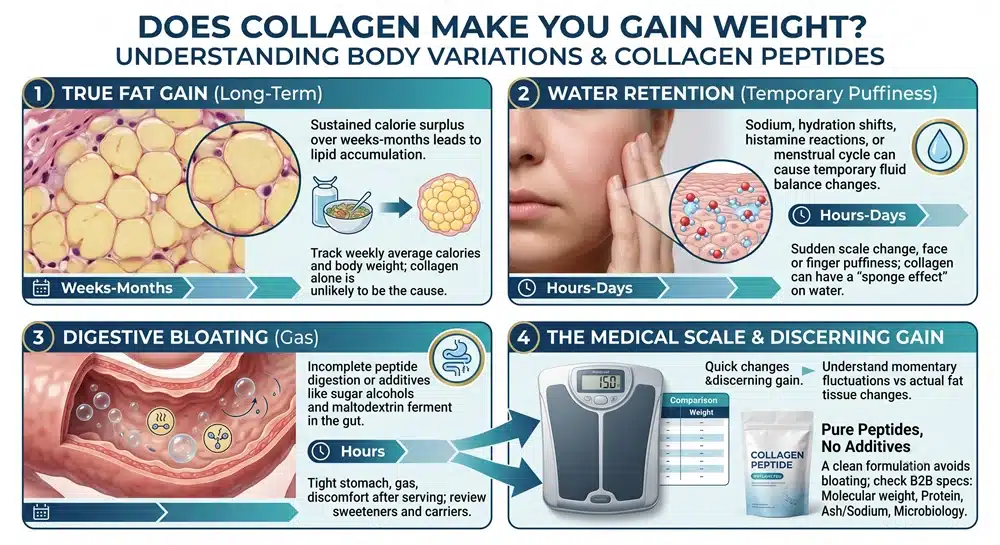
The same scale increase can come from different mechanisms. Fat gain is slow and requires a sustained calorie surplus; water retention can appear within 24–72 hours; digestive bloating often appears within hours after a serving. Collagen users often misread water or gas as fat because the timeline is fast and visible around the stomach, face, or fingers.
Quick Symptom Map: Fat Gain vs Water Retention vs Bloating
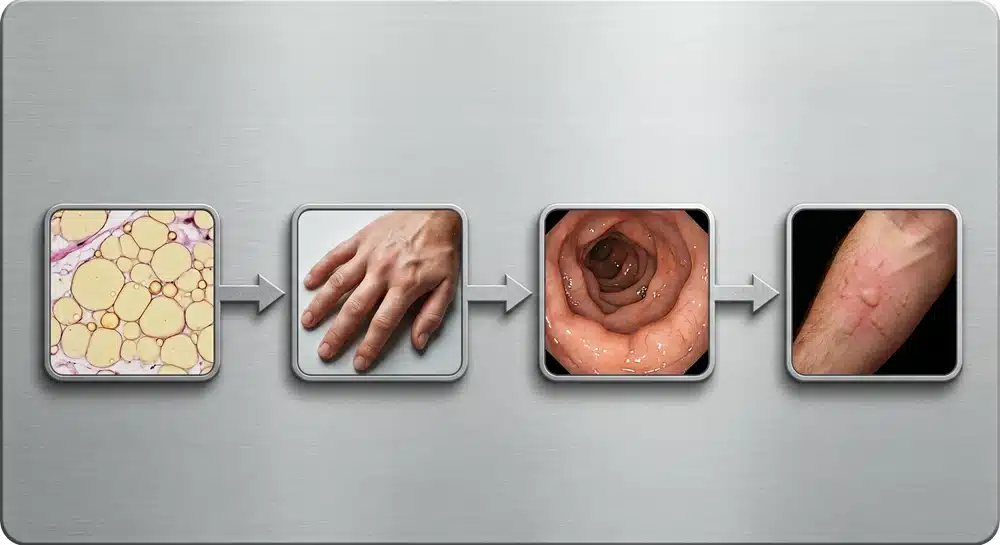
The same scale increase can come from different mechanisms. Fat gain is slow and requires a sustained calorie surplus; water retention can appear within 24–72 hours; digestive bloating often appears within hours after a serving. Collagen users usually misread water or gas as fat because the timeline is fast and visible around the stomach, face, or fingers.
| User Feeling | 일반적인 타임라인 | Likely Mechanism | Best Next Step |
|---|---|---|---|
| True fat gain | Gradual increase over weeks | Sustained calorie surplus from total diet | Track weekly average calories and body weight; collagen alone is unlikely to be the cause. |
| Water retention / puffy face | Sudden scale change, face or finger puffiness | Hydration shift, sodium, histamine reaction, menstrual cycle, medication factors | Increase water, review sodium/ash level, switch source, consider histamine sensitivity. |
| Digestive bloating | Tight stomach, gas, discomfort after serving | Sugar alcohols, maltodextrin, high dose, poor solubility, low digestive tolerance | Start 2.5–5 g/day, choose unflavored pure peptides, avoid “beauty blend” additives. |
| Actual intolerance / allergy | Itching, rash, headache, swelling, nausea | Fish allergy, histamine sensitivity, preservatives, sulfites, source issues | Stop use and consult a healthcare professional if symptoms are significant. |
A. The “Sponge Effect”: Water Retention
Collagen peptides are hydrophilic, meaning they interact with water. This does not mean they create fat. In some users, especially those starting with large servings or drinking too little fluid, collagen may temporarily increase gut water or make the stomach feel heavier.
The “sponge effect” is not only about collagen peptides attracting water. Finished powder quality also depends on sodium, total ash, moisture, water activity and packaging protection. A high-ash collagen ingredient or salty flavored blend can make consumers feel heavier even when the product is low-calorie.
For manufacturer-grade collagen powders, brands should request a batch COA showing protein on dry basis, moisture, ash, sodium, microbiology, heavy metals and sensory notes. Moisture-barrier packaging, desiccant decisions and anti-caking strategy should be reviewed before launch, especially for sachets, stick packs and large tubs.
B. Histamine Intolerance: The “Moon Face”
Some users report face puffiness, headaches or a generally swollen feeling after collagen. This may reflect histamine sensitivity rather than fat gain. Bone broth powders, aged animal-derived materials or poorly controlled raw materials may be less suitable for highly sensitive users.
Histamine reactions are often discussed as a consumer sensitivity issue, but the upstream supply chain also matters. Animal material freshness, time-to-processing, microbial control, filtration, deodorization, drying temperature and warehouse humidity can influence the final tolerance profile.
Brands targeting sensitive consumers should ask suppliers about raw material traceability, microbiology release testing, odor control, storage conditions and optional biogenic amine review where appropriate. This is a stronger trust signal than simply saying “third-party tested.”
C. Gut Fermentation and Additives: The Bloat
Pure collagen is usually well tolerated, but many commercial “beauty blends” are not pure collagen. Sugar alcohols, maltodextrin, gums, fibers and heavy flavor systems can cause gas, bloating or water retention in sensitive users.
Many bloating complaints come from the finished formula rather than collagen peptides themselves. Maltodextrin may be used as a flavor carrier or cost diluent; sugar alcohols improve sweetness while reducing sugar claims; gums and fibers improve mouthfeel but can ferment in sensitive users; excessive flavor systems can require carriers that increase carbohydrate load.
A clean collagen formulation can avoid these problems by using high-purity hydrolyzed peptides, controlled agglomeration or instantization, minimal carriers, verified solubility, and a serving-size design that does not require heavy sweetening. For brands building collagen drink mixes, review solubility, clumping, mouthfeel and sweetener tolerance with an experienced 단백질 보충제 제조업체 before commercial production.
Debunking the “Fat Rat” Myth
Some users encounter claims that collagen caused weight gain in animal research. The missing context is dose. Extreme animal dosing should not be translated into ordinary human servings without adjustment. A normal collagen serving is usually 5–15 g/day. Very high experimental dosing is not evidence that normal collagen supplementation is fattening.
Collagen vs Whey: Which Is Better for Weight Management?
Collagen is not whey, and whey is not collagen. Use collagen when the primary claim territory is skin, hair, nails, joint comfort, connective tissue and beauty-from-within. Use whey when the primary target is complete protein, post-workout muscle protein synthesis and satiety. For weight management, the best choice depends on product positioning, amino acid profile and the consumer’s digestive tolerance.
If your goal is appetite control and muscle protein synthesis, whey may be stronger. If your goal is joint comfort, skin elasticity or beauty-from-within positioning, collagen is a better fit. Some active-lifestyle formulas use both, but serving size and digestive tolerance must be tested carefully.
| 요인 | 콜라겐 펩타이드 | 유청 단백질 |
|---|---|---|
| Core role | Connective tissue, skin elasticity, joint comfort, beauty powder positioning | Complete protein, muscle protein synthesis, post-workout recovery |
| 아미노산 조성 | Rich in glycine, proline and hydroxyproline; lacks tryptophan; not a complete protein | Complete protein with high essential amino acids and BCAAs |
| Typical serving | 5–15 g/day in beauty, joint or active-lifestyle formulas | 20–30 g/serving in sports nutrition formulas |
| Satiety | Can support fullness, but usually less satiating than complete dairy protein | Strong satiety profile, especially in meal-replacement or sports nutrition formats |
| Bloat triggers | Flavor carriers, sugar alcohols, poor solubility, high starting dose | Lactose, dairy intolerance, thickeners, large serving size |
| Best manufacturing format | Unflavored collagen powder, stick pack, beauty drink mix, joint-health blend | Protein tub, sachet, meal replacement, RTD or high-protein snack |
Formulator’s Checklist: How to Design a Low-Bloat Collagen Powder

For supplement brands, “collagen bloat” is often a formulation and quality-control problem. Review these specifications before launching a collagen powder positioned for sensitive consumers:
- Molecular weight: Request the average molecular weight and distribution of the hydrolyzed peptides. Lower-molecular-weight collagen is generally more soluble and easier to formulate, but the final sensory profile still needs pilot testing.
- Purity and dry-basis protein: Confirm protein content on dry basis and avoid excessive carriers that dilute active collagen.
- Additive control: Minimize maltodextrin, sugar alcohols, gums and unnecessary flavor carriers if the product is positioned as low-bloat or clean-label.
- Moisture and water activity: Review moisture, water activity, packaging barrier and desiccant strategy to reduce clumping and microbial risk.
- Histamine and odor control: For sensitive users, evaluate source freshness, deodorization, microbiology and storage conditions.
- Solubility and dispersion: Run shaker-cup testing in cold and room-temperature water. Poor dispersion is often perceived by consumers as heaviness or poor digestion.
- Label transparency: Use exact source labeling, clear serving size, allergen disclosure and realistic structure/function language.
These checkpoints align naturally with custom powder supplement manufacturing, gut health supplement manufacturing 그리고 weight-loss supplement manufacturing projects where consumer tolerance, texture and label claims matter.
| B2B Specification | How to Verify | Why It Matters for “Puffy” Complaints |
|---|---|---|
| Average MW / MW distribution | Supplier specification or HPLC/GPC profile where available | Supports solubility, absorption positioning and gut tolerance narrative |
| Protein on dry basis | COA assay | Confirms the formula is not diluted with carriers |
| Moisture / water activity | Loss on drying, aw where appropriate | Controls clumping, microbial risk and consumer texture |
| Ash / sodium | COA minerals or sodium spec | Helps explain water-weight complaints and salt perception |
| 미생물학 | TPC, yeast/mold, pathogens as required | Supports safe finished product release under cGMP |
| 중금속 | ICP-MS panel as required | Supports trust for animal-derived ingredients |
| Solubility / dispersibility | Cold-water shaker test, sediment observation | Reduces “heavy stomach” and poor mouthfeel complaints |
| Sweetener/filler system | Label review and sensory pilot | Avoids sugar alcohol and maltodextrin-driven bloating |
Action Plan: How to Take Collagen Without the Bloat
If collagen makes you feel puffy, do not assume you gained fat. Try the following steps:
- Switch to pure, unflavored hydrolyzed collagen peptides with no sugar alcohols, maltodextrin or heavy flavor carriers.
- Start with 2.5–5 g per day for the first week, then increase gradually.
- Drink one extra glass of water with each serving.
- Compare sources. Marine collagen may suit some users but requires fish allergen awareness; bovine collagen may suit others but quality and histamine control matter.
- Review the full supplement routine. Protein bars, sweetened coffee, creamers, fiber powders and meal replacements can all affect weight and bloating.
- Stop use and consult a healthcare professional if swelling, rash, headaches, kidney concerns or strong digestive symptoms occur.
결론
Collagen peptides do not cause fat gain at normal serving sizes. If you feel heavier after starting collagen, the likely explanation is water retention, bloating, histamine sensitivity, dosing speed or additives in the finished formula. Choose a pure hydrolyzed collagen peptide product, start low, hydrate well and avoid unnecessary sweeteners or fillers.
fAQ
참조
- U.S. Food and Drug Administration (FDA).https://www.fda.gov/regulatory-information/search-fda-guidance-documents/small-entity-compliance-guide-current-good-manufacturing-practice-manufacturing-packaging-labeling
- Electronic Code of Federal Regulations (eCFR).https://www.ecfr.gov/current/title-21/chapter-I/subchapter-B/part-111
- U.S. Food and Drug Administration (FDA).https://www.fda.gov/food/nutrition-food-labeling-and-critical-foods/structurefunction-claims
- Leon-Lopez, A., et al.https://pmc.ncbi.nlm.nih.gov/articles/PMC6891674/
- Scientific Study.https://pmc.ncbi.nlm.nih.gov/articles/PMC11325589/
- Clinical Trial.https://pmc.ncbi.nlm.nih.gov/articles/PMC10641330/
- Meta-Analysis.https://pmc.ncbi.nlm.nih.gov/articles/PMC11561013/
- Scientific Research.https://pmc.ncbi.nlm.nih.gov/articles/PMC2268952/

W. Wenyang은 식이 보조제 공급망 분야에서 폭넓은 경험을 갖춘 노련한 전문가로, 콜라겐 펩타이드, 뼈 육수 단백질, 케라틴과 같은 핵심 원료의 연구, 개발, 공정 관리 및 글로벌 조달에 대한 풍부한 실무 경험을 보유하고 있습니다. 이 칼럼의 필자로서 그는 마케팅적 포장지를 벗겨내고, 난해한 원료 과학 및 생산 품질 관리 기준을 누구나 쉽게 이해할 수 있는 알기 쉬운 과학 지식으로 풀어내어, 독자들이 라벨 뒤에 숨겨진 진실을 파악하고 보다 합리적인 건강 선택을 할 수 있도록 돕는 데 전념하고 있습니다.