
MSM, short for methylsulfonylmethane, is an organosulfur compound used in dietary supplements for joint comfort, mobility support, exercise recover y formulas, and beauty-from-within products. It is often paired with 글루코사민, chondroitin, collagen peptides, vitamin C, hyaluronic acid, turmeric extract, or boswellia in joint-health formulations.
This guide explains how to choose an MSM 보충제, what quality specifications matter, which dosage form fits different users, and what supplemen t brands should verify before launching a private label or custom MSM product.
For brands developing joint-health formulas, Gensei can support joint health supplement manufacturing, 캡슐 보충제 제조, powder supplem ent manufacturing, and custom formula development.
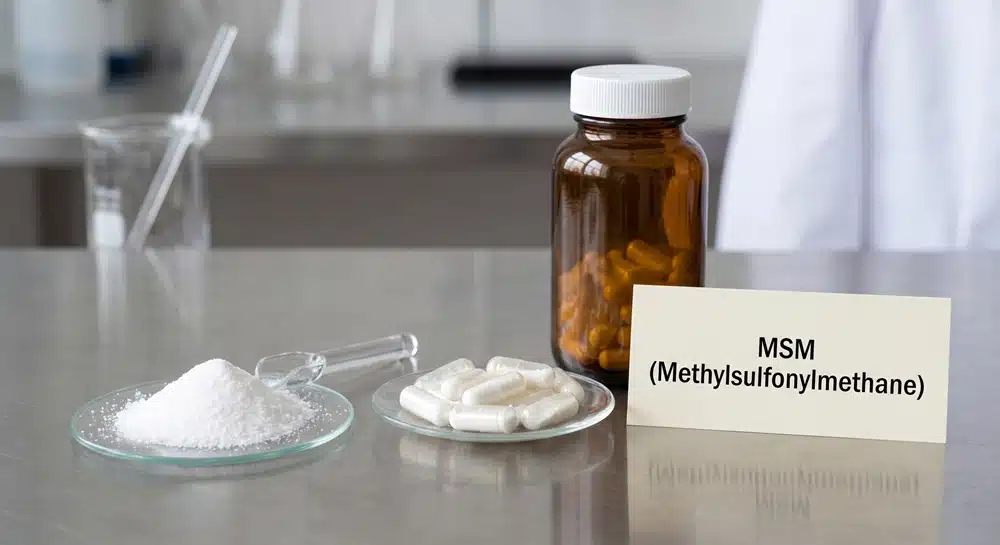
MSM이란 무엇인가요?
MSM is a sulfur-containing compound found in small amounts in some foods and in the human body. In supplements, MSM is usually produced as a purifi ed ingredient and used as a source of organic sulfur. Sulfur is involved in normal connective tissue structure, and MSM is commonly positioned in form ulas that support joint comfort, flexibility, and active lifestyles.
Best MSM Supplement: What to Look For
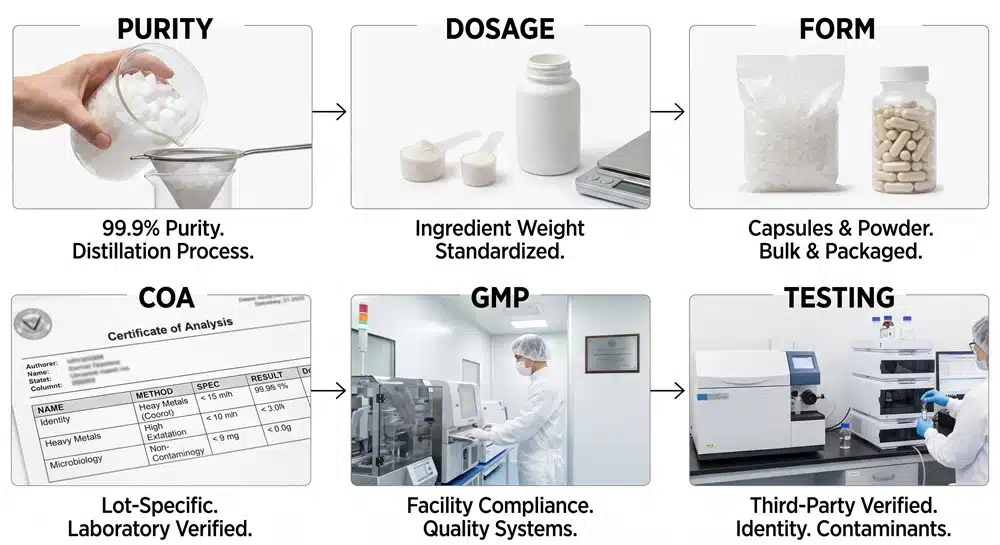
A high-quality MSM supplement should be evaluated by ingredient quality, dosage form, testing, label transparency, and formulation fit. For supplem ent brands, the same criteria should be used when selecting an MSM raw material supplier or contract manufacturer.
| Selection Factor | 왜 중요한가요? | 확인할 사항 | B2B Formulation Note |
|---|---|---|---|
| MSM identity | Confirms the ingredient is methylsulfonylmethane, not a vague sulfur blend. | Ingredient specification, COA, assay method, raw material name. | Ask suppliers to confirm identity testing for every batch. |
| Purity and assay | Supports consistency and label accuracy. | Assay percentage, heavy metals, residual solvents, microbiology. | Use documented specifications before approving production. |
| Dosage per serving | Users compare MSM products by practical daily intake. | Common label ranges include 1,000 mg to 3,000 mg per day, depending on format. | Balance serving size, capsule count, tablet size, or scoop size. |
| 제형 | Capsules, powders, tablets, and gummies solve different use cases. | Convenience, taste masking, dose flexibility, cost per serving. | Powder is efficient for higher doses; capsules are easier for compliance. |
| Complementary ingredients | Joint-health formulas often combine MSM with other ingredients. | Glucosamine, chondroitin, collagen, vitamin C, hyaluronic acid, curcumin, boswellia. | Check claim language and ingredient compatibility before launch. |
| Testing and documentation | Builds trust and reduces quality risk. | COA, allergen statement, non-GMO statement if applicable, GMP production records. | Request batch records and finished product testing from the manufacturer. |
MSM Capsules vs MSM Powder vs Tablets vs Gummies
There is no single “best” MSM dosage form for every audience. The right format depends on dose size, flavor tolerance, target consumer, price point , and manufacturing feasibility.
| 형식 | 최상의 대상 | 장점 | 제한 사항 | Brand Recommendation |
|---|---|---|---|---|
| MSM capsules | Daily joint-support products and clean-label capsule lines. | Convenient, taste masked, easy to combine with other capsule-friendly ingredients. | Higher daily doses may require multiple capsules. | Strong option for premium joint-health formulas with 1,000-2,000 mg/day positioning. |
| MSM powder | Higher-dose users, sports recovery powders, and cost-sensitive formulas. | Flexible dose, efficient cost per gram, suitable for drink mixes. | Taste and solubility experience must be managed. | Good for bulk MSM powder, recovery blends, and joint-health powder sticks. |
| MSM tablets | Compact daily tablets and combination joint formulas. | Can deliver structured serving sizes with multiple active ingredients. | Tablet size and swallowability can become limiting at higher doses. | Useful when combined with glucosamine, chondroitin, or minerals. |
| MSM gummies | Consumer-friendly joint-support products with lower active loads. | Good user experience and repeat purchase appeal. | Harder to deliver high MSM doses without large serving sizes or taste challenges. | Use for lifestyle joint-support positioning, not high-dose MSM claims. |
| MSM liquid or shot | Convenience-focused formulas and active lifestyle products. | Ready-to-use and easy to stack with collagen or vitamin C. | Stability, flavor, preservative system, and packaging cost need attention. | Best when the brand has a clear format advantage and strong flavor system. |
What Dosage of MSM Is Commonly Used?
MSM dosage varies by study design, consumer goal, and product format. Many dietary supplement labels use daily serving amounts around 1,000 mg to 3 ,000 mg. Some research and reviews discuss higher intakes, but brands should not imply that more is always better.
For consumer-facing content, a safer approach is to recommend that adults follow the product label and speak with a qualified healthcare profession al if they are pregnant, breastfeeding, managing a medical condition, using medication, or planning long-term high-dose use.
| 사용 사례 | Common Formula Direction | 브랜드를 위한 참고 사항 |
|---|---|---|
| General joint support | MSM as a single active or combined with collagen, glucosamine, or vitamin C. | Use “supports joint comfort and mobility” language rather than disease claims. |
| Active lifestyle and recovery | MSM paired with collagen peptides, electrolytes, or antioxidants. | Keep recovery claims moderate and avoid promising faster healing. |
| 내면에서 우러나는 아름다움을 위한 포뮬러 | MSM paired with collagen, vitamin C, hyaluronic acid, or biotin. | Support normal collagen formation and skin wellness without anti-aging guarantees. |
| High-dose powder | Flexible scoop format with clear serving instructions. | Flavor masking, solubility, and label clarity become important. |
Is MSM Safe? Side Effects and Cautions
MSM is generally reported as well tolerated in many short-term studies, but “safe” should not be written as an unlimited guarantee. Some users may experience mild digestive discomfort, bloating, nausea, headache, rash, or sensitivity. Long-term safety data are less extensive than short-term use d ata.
Consumers should speak with a healthcare professional before using MSM if they are pregnant or breastfeeding, have kidney or liver disease, have a chronic medical condition, are taking blood thinners or other medications, or are considering MSM for a disease-related concern.
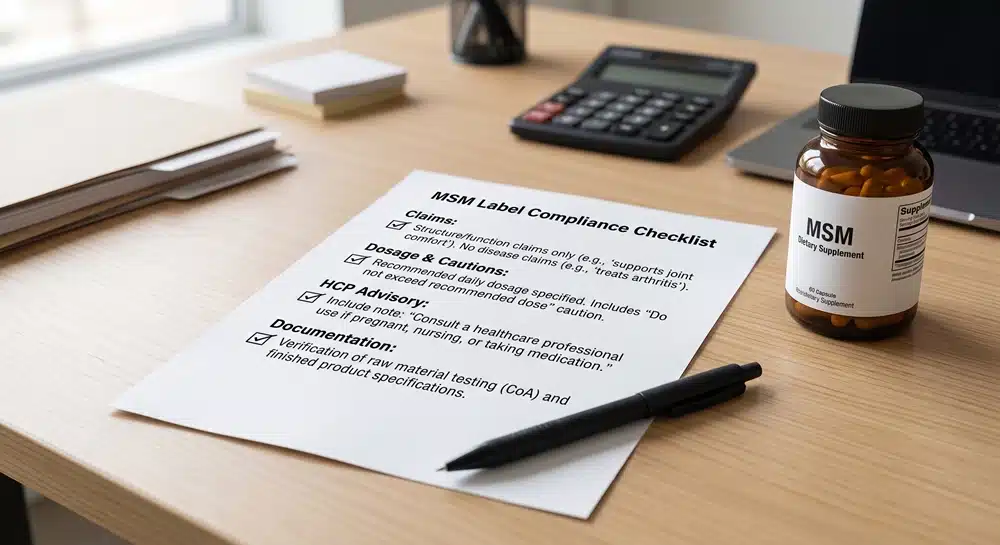
Supplement brands should review all safety language carefully. MSM content should not claim to treat arthritis, cure joint pain, reduce disease inf lammation, repair cartilage, or replace medical care. Better language includes “supports joint comfort,” “helps maintain mobility,” “supports connecti ve tissue,” and “supports an active lifestyle.”
MSM vs Glucosamine vs Chondroitin vs Collagen
MSM is often compared with other joint-health ingredients. The best choice depends on the formula concept, target demographic, dosage form, and cla im strategy.
| 성분 | Typical Role | Common Formula Use | Best Positioning |
|---|---|---|---|
| MSM | Organic sulfur source used in joint comfort and mobility formulas. | Capsules, powders, tablets, and combination joint blends. | Joint comfort, mobility, connective tissue support. |
| 글루코사민 | Amino sugar commonly used in cartilage-support formulas. | Often paired with chondroitin and MSM. | Cartilage and joint structure support, with careful claim review. |
| 콘드로이틴 | Glycosaminoglycan associated with cartilage matrix support. | Classic joint-health stacks with glucosamine and MSM. | Joint structure support and cartilage matrix positioning. |
| 콜라겐 펩타이드 | Amino acid source for collagen-rich tissues. | Powders, sticks, tablets, gummies, and beauty/joint formulas. | Skin, joint, bone, and connective tissue support. |
| 히알루론산 | Moisture-binding ingredient used in joint and beauty formulas. | Low-dose capsules, tablets, gummies, and liquids. | Joint lubrication support and skin hydration support. |
| Curcumin or boswellia | Botanical ingredients used in joint comfort formulas. | Capsules, tablets, softgels, and combination products. | Comfort and active lifestyle support, avoiding disease treatment claims. |
How Supplement Brands Should Choose an MSM Supplier or Manufacturer
For B2B buyers, “best MSM supplement” should translate into a practical supplier checklist. A strong manufacturer should be able to support ingredi ent sourcing, formulation, quality control, packaging, compliance review, and scale-up.
Supplier Checklist
- Confirm MSM raw material identity, purity, and specification limits.
- Request a recent COA for assay, heavy metals, residual solvents, microbiology, and contaminants.
- Ask whether the MSM is suitable for capsules, tablets, powders, gummies, or liquids.
- Check whether the manufacturer can support GMP documentation and batch records.
- Review excipients, allergens, capsule shell materials, sweeteners, flavors, and color systems.
- Confirm MOQ, lead time, pilot batch options, packaging choices, and label review process.
- Ask for finished product testing, stability support, and retain-sample procedures.
RFP Questions to Ask Before Launch
- What MSM raw material source do you use, and what specifications are available?
- Can you provide COA, allergen statement, non-GMO statement, and regulatory documents?
- What dosage forms are most practical for 1,000 mg, 2,000 mg, or 3,000 mg daily serving targets?
- What are the MOQ, lead time, pilot batch policy, and reorder timeline?
- Can you manufacture capsule, tablet, powder, gummy, or liquid formats?
- How do you handle flavor masking for MSM powder or gummy products?
- Can your team review label claims and avoid disease-treatment language?
- What in-process and finished-product tests are performed before release?
- Can you support private label packaging, custom formula development, and export documentation?
Red Flags When Comparing MSM Supplements
- Unclear MSM source or no ingredient specification.
- No COA or incomplete testing documentation.
- Overly aggressive claims such as “cures arthritis,” “rebuilds cartilage,” or “eliminates joint pain.”
- Very high dose claims without safety context.
- No explanation of capsule count, serving size, or daily intake.
- No allergen, excipient, or manufacturing transparency.
- Combination formulas that add many ingredients without clear dosage logic.
- Retail pages that list “best” products but do not explain quality criteria.
겐세이의 역할
Gensei supports brands that want to develop MSM-based joint-health supplements, sports recovery formulas, beauty-from-within products, and connecti ve tissue support formulas. Depending on the target concept, MSM can be formulated as capsules, tablets, powders, gummies, or liquid products.
For brands looking beyond a generic MSM product, Gensei can help evaluate formula structure, dosage form, quality documentation, flavor masking, pa ckaging, MOQ, and claim language. Explore custom pr ivate label supplements, capsule manufacturing, 정제 보충제 제조및 분말 보충제 제조.
자주 묻는 질문
What is the best MSM supplement?
The best MSM supplement is one that provides methylsulfonylmethane at a practical daily serving size, uses a transparent raw material source, provi des quality testing, and matches the user’s preferred format. Capsules are convenient, powders are flexible for higher doses, and combination formulas may be suitable for broader joint-health positioning.
Is MSM powder better than MSM capsules?
MSM powder is often better for dose flexibility and cost per gram. MSM capsules are better for convenience, taste masking, and travel. For suppleme nt brands, powders can support higher daily MSM amounts, while capsules may improve compliance for users who prefer pre-measured servings.
What is the best MSM supplement for joint support?
For joint support, look for MSM with clear dosage, purity testing, and moderate claims. MSM may be used alone or combined with ingredients such as glucosamine, chondroitin, collagen peptides, vitamin C, hyaluronic acid, curcumin, or boswellia. Disease-treatment claims should be avoided.
How much MSM should adults take daily?
MSM dosage varies by product and use case. Many supplement labels use daily servings around 1,000 mg to 3,000 mg, while some studies and reviews di scuss higher amounts. Consumers should follow the product label and consult a healthcare professional if they have medical conditions, use medications , or plan long-term high-dose intake.
MSM과 섞어 먹으면 안 되는 식품은 무엇인가요?
There is no universal “do not mix” list for healthy adults, but people using medications, especially blood thinners, or those with medical conditio ns should ask a healthcare professional before combining MSM with other supplements or drugs.
MSM은 혈압을 높이나요?
MSM is not generally known as a blood-pressure-raising ingredient, but individual responses can vary. Anyone with cardiovascular conditions or medi cation use should ask a healthcare professional before using MSM or other joint-health supplements.
MSM은 노인에게 좋은가요?
MSM is often used in products positioned for joint comfort and mobility support, which may be relevant to older adults. However, seniors are also m ore likely to use medications or have health conditions, so they should review MSM use with a healthcare professional.
참조
- Methylsulfonylmethane: Applications and Safety of a Nov el Dietary Supplement
- Methylsulfonylmethane: Applications and Safety of a Novel Dieta ry Supplement – PubMed
- MSM – Versus Arthritis
- Methylsulfonylmethane (MSM) Uses, Si de Effects, and More – WebMD
- Methylsulfonylmeth ane: A Safe Treatment for Arthritis? – Poison Control
- FDA Structur e/Function Claims
- FTC Health Products C ompliance Guidance
- 21 CFR Part 111 – Dietary Supplemen t GMP

워렌 완은 식이 보충제 공급망 분야에서 폭넓은 경험을 갖춘 노련한 전문가로, 콜라겐 펩타이드, 뼈 육수 단백질, 케라틴과 같은 핵심 원료의 연구, 개발, 공정 관리 및 글로벌 조달에 풍부한 실무 경험을 보유하고 있습니다. 이 칼럼의 필자로서 그는 마케팅적 포장만을 벗겨내고, 난해한 원료 과학 및 생산 품질 관리 기준을 누구나 쉽게 이해할 수 있는 심도 있는 과학 대중화 콘텐츠로 재구성함으로써, 독자들이 라벨 뒤에 숨겨진 진실을 파악하고 보다 합리적인 건강 선택을 할 수 있도록 돕는 데 전념하고 있습니다.


