
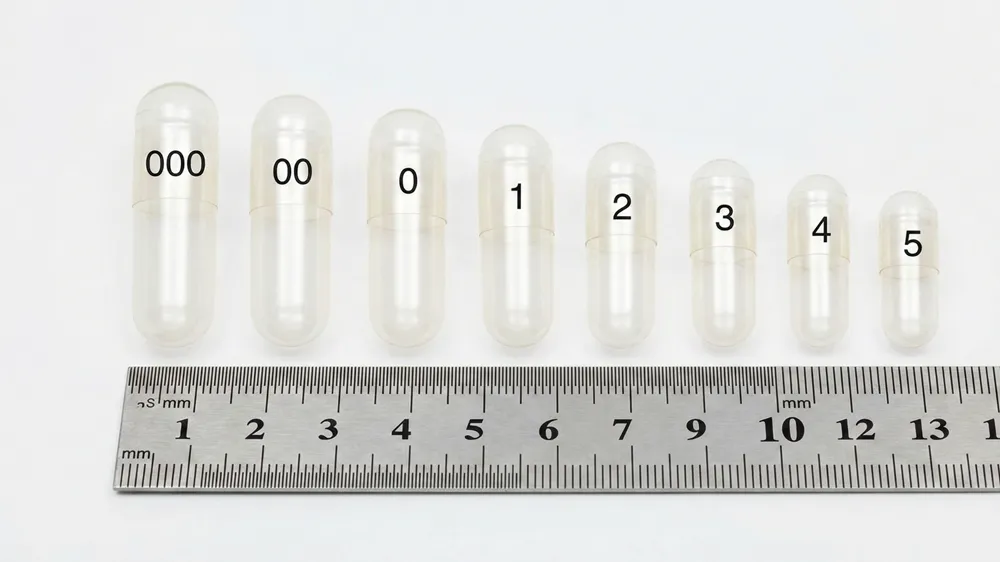
Choosing a capsule size starts with volume—not a fixed milligram number.
Hard capsules are manufactured in standard size ranges, but the amount of powder that fits inside a capsule depends on the density and filling behavior of the final formulation. Two blends with the same target weight can therefore require different capsule sizes.
Use this guide to compare capsule sizes 000 through 5, estimate powder capacity, compare Size 0 vs Size 00, and calculate a starting capsule size for formulation development.
Quick reference
Largest standard size: Размер 000
Smallest standard size: Размер 5
Common commercial supplement sizes: Size 0 and Size 00
What determines fill weight: Capsule volume × formulation density
Important: The capacities shown in this guide are planning estimates. Final capsule selection should be confirmed with the actual finished blend, shell specification and intended filling process.
Capsule Size Chart: Volume, Dimensions & Estimated Fill Weight
The most useful fixed specification for estimating capsule capacity is the shell’s internal volume.
Milligram capacity is variable because powders have different densities.
The estimated fill weights below are calculated using:
Estimated Fill Weight (mg) = Capsule Volume (mL) × Powder Density (g/mL) × 1,000
| Размер капсулы | Nominal Volume | Approx. Locked Length | At 0.4 g/mL | At 0.6 g/mL | At 0.8 g/mL | At 1.0 g/mL | At 1.2 g/mL |
|---|---|---|---|---|---|---|---|
| 000 | 1.37 mL | 26.1 mm | 548 mg | 822 мг | 1,096 mg | 1,370 mg | 1,644 mg |
| 00 | 0.91 mL | 23,3 мм | 364 mg | 546 mg | 728 mg | 910 mg | 1,092 mg |
| 0 | 0.68 mL | 21,7 мм | 272 mg | 408 мг | 544 мг | 680 мг | 816 мг |
| 1 | 0.50 mL | 19.4 mm | 200 mg | 300 мг | 400 мг | 500 мг | 600 мг |
| 2 | 0.37 mL | 18.0 mm | 148 mg | 222 мг | 296 мг | 370 мг | 444 mg |
| 3 | 0.30 mL | 15.9 mm | 120 мг | 180 мг | 240 мг | 300 мг | 360 mg |
| 4 | 0.25 mL | 14.3 mm | 100 мг | 150 mg | 200 mg | 250 мг | 300 мг |
| 5 | 0.13 mL | 11.1 mm | 52 mg | 78 мг | 104 мг | 130 мг | 156 mg |
These values should be treated as reference estimates rather than guaranteed production capacities.
Published capsule specifications can differ slightly between manufacturers. More importantly, actual production fill depends on the finished blend, including powder density, particle characteristics, flowability, excipients and the capsule-filling process.
How to Use the Capsule Size Chart
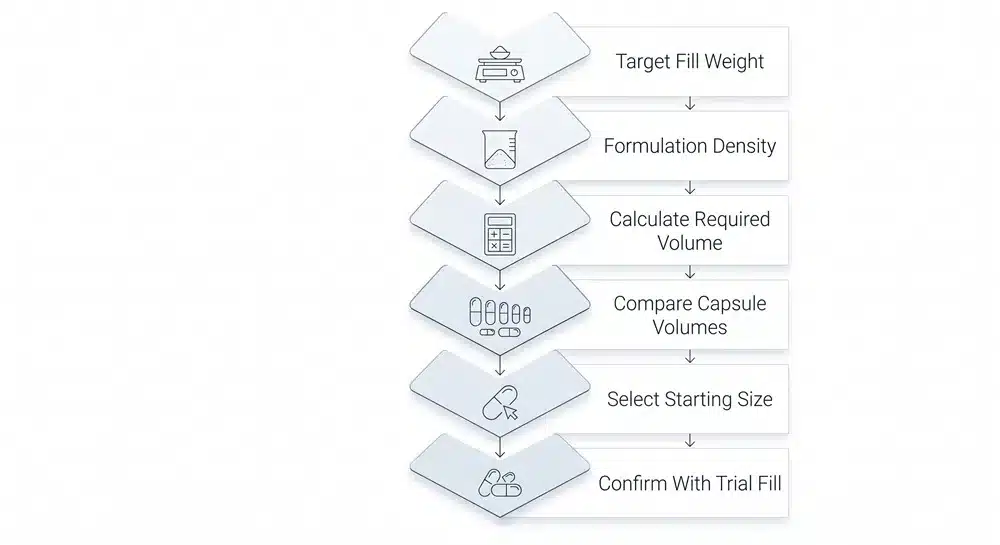
Start with the amount of formulation you want to place in each capsule.
This should include not only active ingredients but also any excipients required for the finished formulation.
Next, determine or estimate the density of the formulation.
The approximate internal volume required can then be calculated using:
Required Volume (mL) = Target Fill Weight (mg) ÷ [Density (g/mL) × 1,000]
For example, suppose the target fill weight is 500 мг and the finished blend has a density of 0.8 g/mL:
500 ÷ 800 = 0.625 mL
A capsule therefore needs more than approximately 0.625 mL of usable volume for this formulation.
A Size 0 capsule has a nominal reference volume of about 0.68 mL, so it may be a reasonable starting size to evaluate.
That does не mean Size 0 is guaranteed to hold the formula in commercial production. The result should still be confirmed using the actual finished blend and intended filling process.
What Are the Largest and Smallest Capsule Sizes?
Within the common Size 000 through Size 5 hard-capsule reference range, the sequence runs:
000 → 00 → 0 → 1 → 2 → 3 → 4 → 5
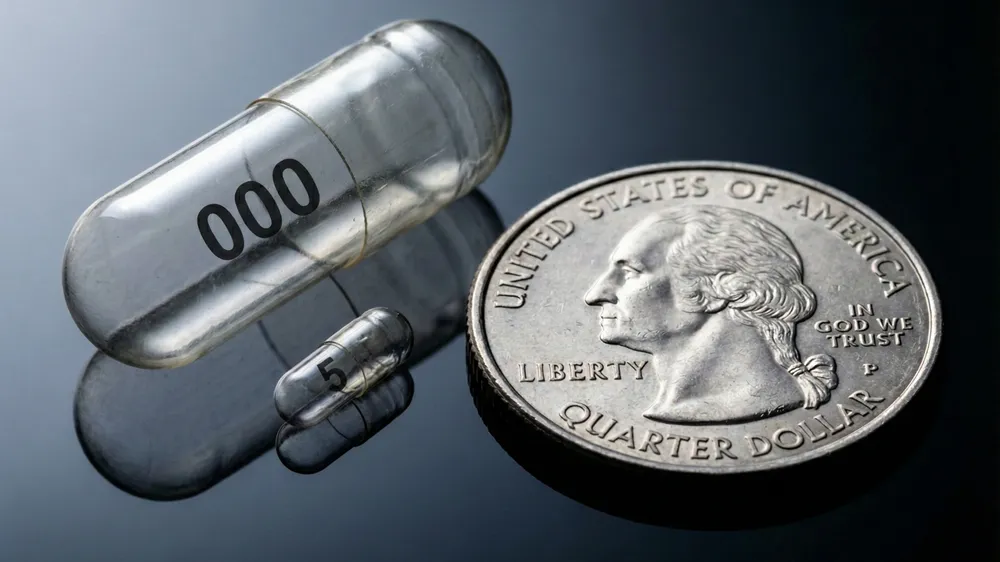
Размер 000 is the largest in this sequence.
Размер 5 is the smallest.
As the capsule size moves from 000 toward 5, both the physical capsule dimensions and available internal volume decrease.
This is why capsule size should be selected according to the amount of formulation volume required—not simply according to the target number of milligrams.
Size 000 and Size 00 Capsules
Капсула размера 000
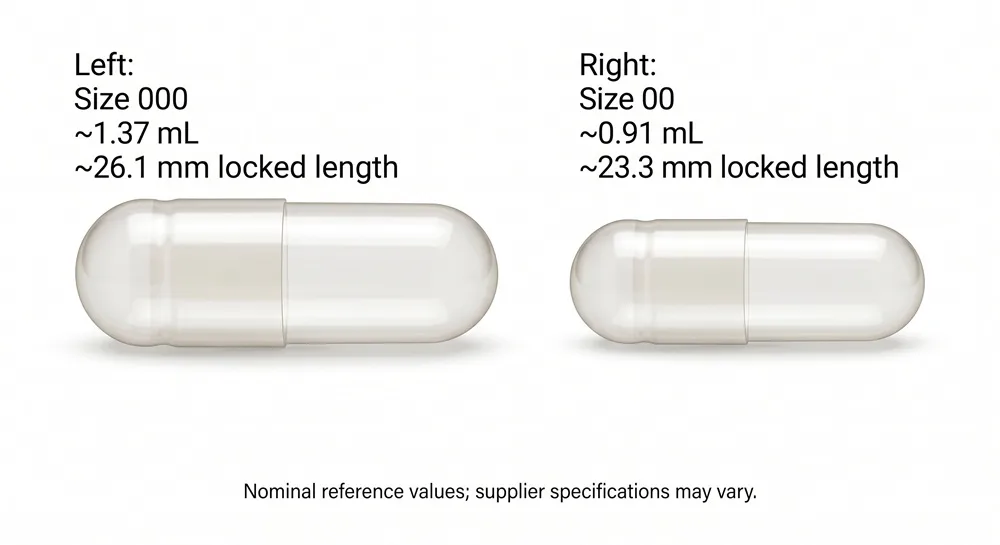
Size 000 provides the largest nominal volume in the standard 000-to-5 range.
Its nominal reference volume is approximately 1.37 mL, with a locked length of approximately 26.1 mm.
A theoretical fill calculation illustrates how strongly formulation density affects capacity:
На сайте 0.6 g/mL, approximately 822 мг of powder would occupy 1.37 mL.
На сайте 0.8 g/mL, the theoretical fill weight increases to approximately 1,096 mg.
На сайте 1.0 g/mL, it increases to approximately 1,370 mg.
These figures are mathematical estimates. Actual production performance depends on the finished blend and filling process.
Капсула размера 00
Size 00 provides more internal volume than Size 0 and is often evaluated when a formulation requires more space than a smaller shell can provide.
Its nominal reference volume is approximately 0.91 mL, with a locked length of approximately 23,3 мм.
Theoretical capacity is approximately:
546 mg at 0.6 g/mL
728 mg at 0.8 g/mL
910 mg at 1.0 g/mL
This is why statements such as “a Size 00 capsule holds 700 mg” should be treated cautiously. A value near 700 mg may be reasonable for some blends, while a lighter or denser formulation can produce a very different result.
Size 0 and Size 1 Capsules
Капсула размера 0
Size 0 has a nominal internal volume of approximately 0.68 mL and a locked length of approximately 21,7 мм.
Theoretical fill weight is approximately:
408 mg at 0.6 g/mL
544 mg at 0.8 g/mL
680 mg at 1.0 g/mL
Whether a specific formula will fit should be confirmed using the complete formulation, including excipients—not just the declared active ingredients.
Size 1 Capsule
Size 1 provides approximately 0.50 mL of nominal internal volume and has an approximate locked length of 19.4 mm.
At a density of 0.8 g/mL, its theoretical capacity is approximately 400 мг.
At a density of 1.0 g/mL, the theoretical value is approximately 500 мг.
As with every capsule size, these values are estimates based on volume and density rather than guaranteed filling specifications.
Sizes 2, 3, 4 and 5
Smaller capsule sizes provide progressively less internal volume.
Size 2: approximately 0.37 mL
Size 3: approximately 0.30 mL
Size 4: approximately 0.25 mL
Size 5: approximately 0.13 mL
The same formulation rule applies at every size:
Required formulation volume should be calculated first, and the final capsule should then be validated using the actual blend and production process.
Smaller капсулы are therefore not automatically “better” or “easier.” They are appropriate only when the required formulation volume is compatible with the available shell capacity.
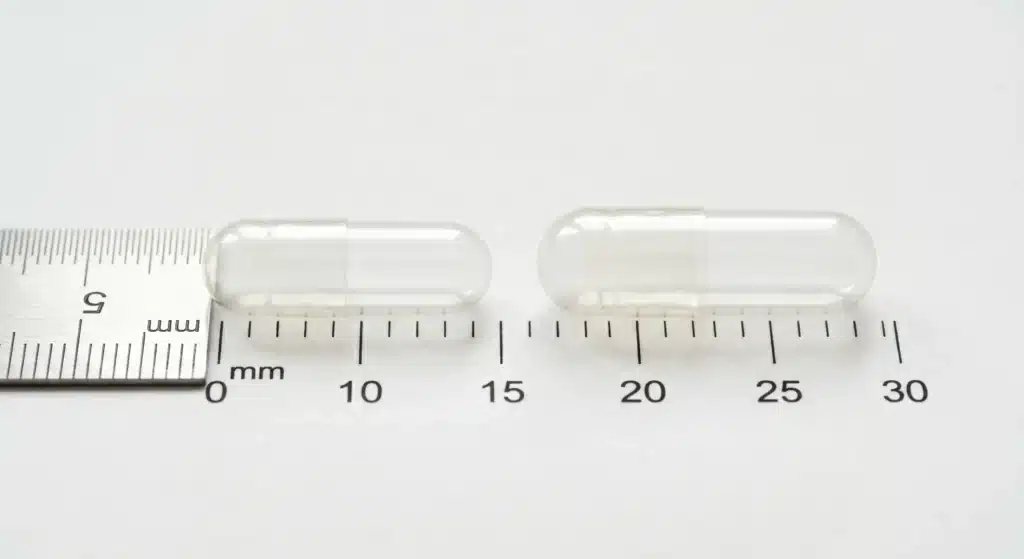
Size 0 vs Size 00 Capsules: What Is the Difference?
Size 0 and Size 00 are frequently compared because both are commonly considered for dietary supplement formulas.
The main difference is available internal volume.
| Фактор | Размер 0 | Размер 00 |
|---|---|---|
| Nominal volume | ~0.68 mL | ~0.91 mL |
| Приблизительная длина в заблокированном состоянии | ~21.7 mm | ~23.3 mm |
| Estimated fill at 0.6 g/mL | ~408 мг | ~546 mg |
| Estimated fill at 0.8 g/mL | ~544 мг | ~728 mg |
| Estimated fill at 1.0 g/mL | ~680 мг | ~910 mg |
| Primary difference | Smaller physical format | More formulation volume |
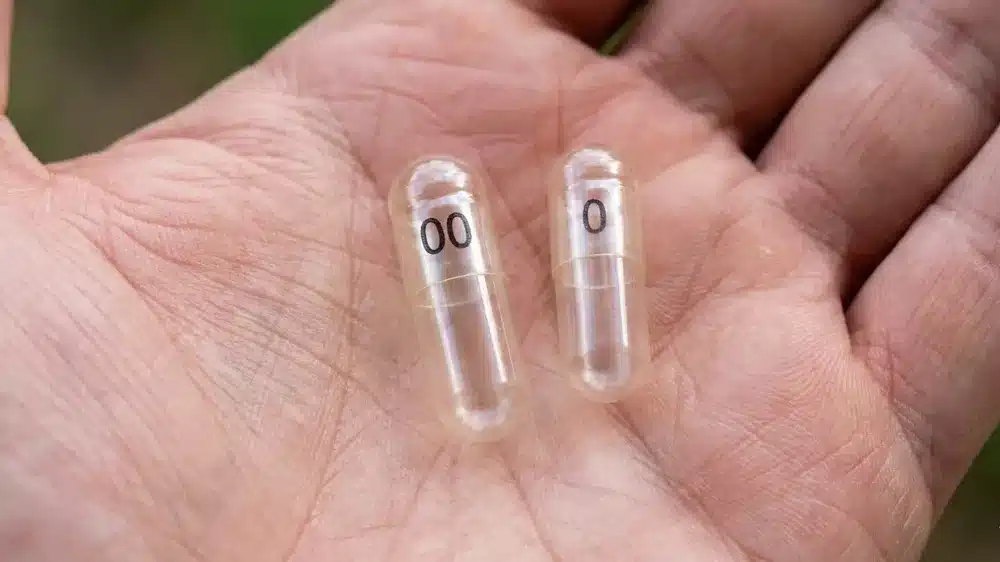
Size 00 offers approximately 34% more nominal internal volume than Size 0 based on the reference values above.
That additional volume can matter when a formula contains high-dose ingredients, low-density powders or multiple active ingredients and excipients.
If the complete formulation fits comfortably into Size 0 under realistic filling conditions, moving to a larger shell may not be necessary.
If Size 0 does not provide sufficient volume, possible options include:
moving to Size 00;
using more than one capsule per serving;
adjusting the target dose; or
reviewing the formulation and excipient system.
The best solution depends on the product rather than on capsule size alone.
How Many Milligrams Fit in a Capsule?
Существует no single milligram capacity for any capsule size.
A capsule shell defines volume.
Milligrams define вес.
The relationship between volume and weight depends on formulation density.
A light botanical powder may occupy a relatively large volume even at a modest weight. A denser mineral-containing blend can place substantially more weight into the same nominal capsule volume.
The basic planning equation is:

Estimated Fill Weight (mg) = Capsule Volume (mL) × Formulation Density (g/mL) × 1,000
For example, consider a Size 00 capsule with a nominal reference volume of approximately 0.91 mL.
At 0.4 g/mL:
0.91 × 0.4 × 1,000 = approximately 364 mg
At 0.8 g/mL:
0.91 × 0.8 × 1,000 = approximately 728 mg
At 1.2 g/mL:
0.91 × 1.2 × 1,000 = approximately 1,092 mg
The capsule size has not changed.
Only the assumed powder density changed.
That is why capsule capacity should not be described using one universal milligram figure.
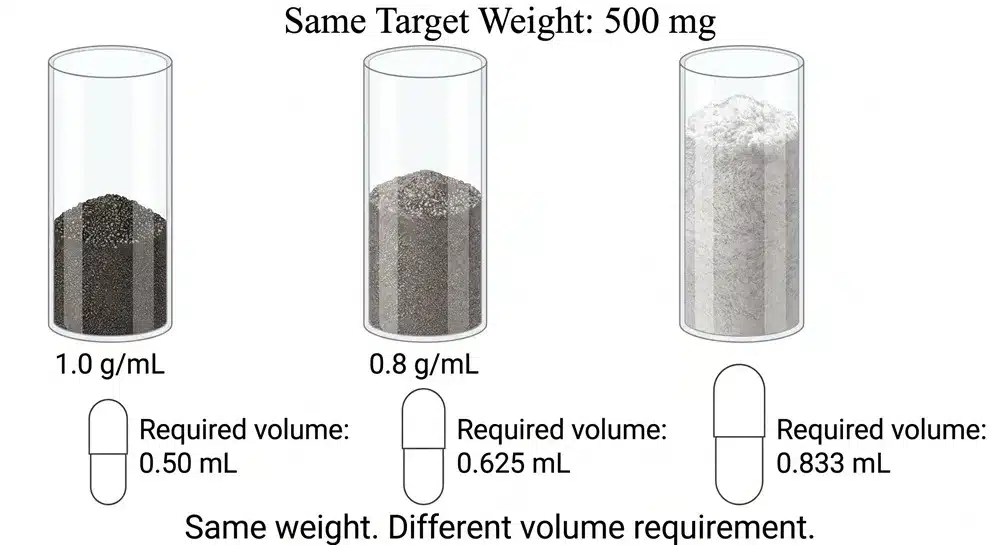
What Capsule Size Is Needed for 500 mg?
A target of 500 mg does not determine capsule size by itself.
The required capsule volume depends on the density of the complete finished blend.
Example 1: Density = 1.0 g/mL
500 mg ÷ 1,000 mg/mL = 0.50 mL
A formulation with this density requires approximately 0.50 mL of theoretical volume.
Example 2: Density = 0.8 g/mL
500 mg ÷ 800 mg/mL = 0.625 mL
A Size 0 capsule, with approximately 0.68 mL of nominal reference volume, may therefore be an appropriate starting size to evaluate.
Example 3: Density = 0.6 g/mL
500 mg ÷ 600 mg/mL = 0.833 mL
This exceeds the nominal reference volume of Size 0.
A larger capsule such as Size 00 would therefore be a more appropriate starting option to evaluate.
The same 500 mg target can therefore require different capsule sizes depending on formulation density.
In commercial development, additional factors such as excipients, flowability and the filling process must also be considered.
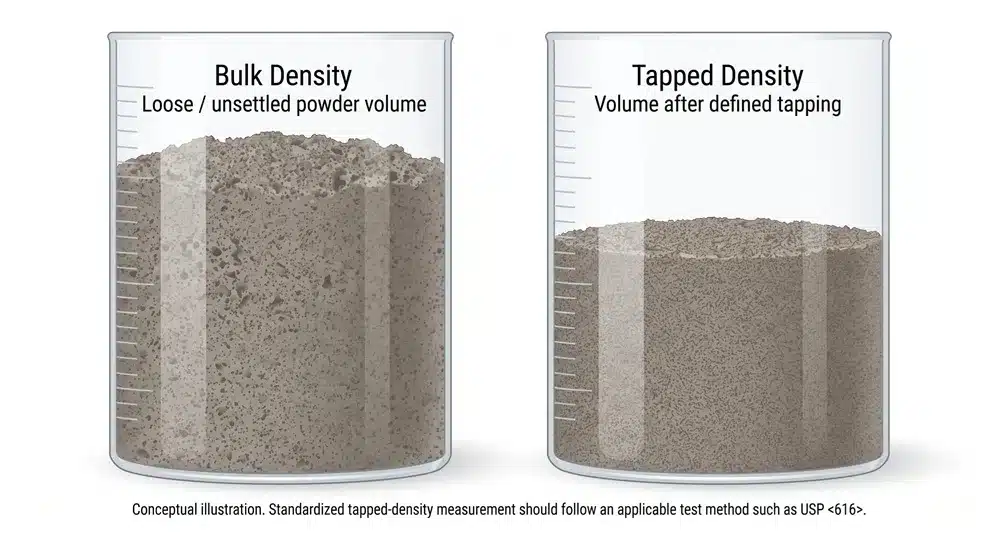
Bulk Density vs Tapped Density
Density is one of the most important factors when estimating capsule capacity, but not every density measurement represents the same powder condition.
Насыпная плотность
Bulk density is the mass of a powder divided by the volume it occupies in its loose, unsettled condition.
It includes the empty spaces between particles and is affected by the material itself as well as how the particles arrange in the powder bed.
Уплотненная плотность
Tapped density is measured after a powder sample undergoes a defined mechanical tapping procedure that reduces some of the void space between particles.
describes standardized concepts and procedures for measuring bulk and tapped density of powders.
Tapped density is normally higher than loose bulk density because the particles have been allowed to consolidate.
Which Density Should Be Used for Capsule Filling?
Neither number should automatically be treated as the final commercial capsule-fill value.
Both can provide useful information during development, but actual filling performance can also depend on:
particle-size distribution;
powder flowability;
formulation composition;
excipients;
cohesiveness;
moisture behavior; and
the dosing mechanism used by the capsule-filling equipment.
Commercial capsule-filling systems can use different approaches, including tamping and dosator-based mechanisms. Powder properties can influence how these systems form and deliver the dose.
For this reason:
Use density calculations to shortlist capsule sizes. Confirm the final target using the finished blend and intended filling process.
Worked Example: When a 500 mg Formula May Not Fit Size 0
Illustrative formulation example.
Consider a botanical supplement formula with a target fill weight of 500 мг на капсулу.
Assume the finished powder blend has a measured density of 0.58 g/mL.
Required volume:
500 mg ÷ 580 mg/mL = approximately 0.86 mL
A Size 0 capsule has a nominal reference volume of approximately 0.68 mL.
Based on the theoretical calculation, the formula therefore requires more volume than Size 0 provides.
A formulation team could then evaluate several options:
move to a larger capsule such as Size 00;
reduce the amount placed into each capsule and use multiple capsules per serving;
adjust the formula or excipient system if technically appropriate; or
reconsider the intended serving design.
This example shows why a generic statement such as “500 mg fits in Size 0” can be misleading.
The target milligrams must always be considered together with formulation volume and density.
Capsule Fill Weight & Size Calculator
Use the calculator below as an early formulation screening tool.
It is not a guaranteed production specification.
Find a Starting Capsule Size
Enter:
Target fill weight: ___ mg
Formulation density: ___ g/mL
The calculator should first determine:
Required volume = Target weight ÷ Density
It can then compare that volume with the nominal capsule volumes shown in this guide.
Пример
Target fill weight: 500 мг
Density: 0.80 g/mL
Required volume:
500 ÷ 800 = 0.625 mL
Starting size estimate:
Размер 0
Important: The result is based on nominal capsule volume and the density entered into the calculator. Confirm the final capsule size using the actual formulation, shell specification and intended filling process.
Capsule Fill Weight & Size Calculator
Estimate a starting capsule size from target fill weight and formulation density, or estimate the theoretical fill weight of a selected capsule.
Required Volume (mL) = Target Fill Weight (mg) ÷ [Density (g/mL) × 1,000]
Estimated Fill Weight (mg) = Capsule Volume (mL) × Density (g/mL) × 1,000
| Размер капсулы | Nominal Volume | Approx. Locked Length |
|---|---|---|
| 000 | 1.37 mL | 26.1 mm |
| 00 | 0.91 mL | 23,3 мм |
| 0 | 0.68 mL | 21,7 мм |
| 1 | 0.50 mL | 19.4 mm |
| 2 | 0.37 mL | 18.0 mm |
| 3 | 0.30 mL | 15.9 mm |
| 4 | 0.25 mL | 14.3 mm |
| 5 | 0.13 mL | 11.1 mm |
Do Gelatin and HPMC Capsules Use the Same Size System?
Gelatin and HPMC hard capsules generally use the familiar numerical size system, including Sizes 000, 00, 0, 1, 2, 3, 4 and 5.
However, using the same size number does not mean every supplier’s capsule is identical.
Depending on the product and manufacturer, there can be differences in:
dimensional tolerances;
shell weight;
moisture characteristics;
material behavior; and
filling performance.
For commercial production, the shell specification actually selected for the project should therefore be used when confirming capsule size and process compatibility.
Related Guide: Gelatin vs HPMC Capsules
Choosing Capsule Size for a Commercial Supplement Formula
For a commercial dietary supplement project, capsule size affects more than the theoretical amount of powder that fits into the shell.
1. Complete Formula Volume
Active ingredients are not the only materials that occupy capsule space.
The final formulation may also contain excipients used to support flow, processing, stability or manufacturing performance.
Capsule selection should therefore be based on the complete finished blend.
2. Capsules per Serving
If the intended dose does not fit inside one capsule, the product may require either:
a larger capsule;
a lower fill weight per capsule; or
multiple capsules per serving.
This is both a formulation and product-positioning decision.
3. Packaging Configuration
Capsule size and capsules-per-serving can affect:
bottle selection;
count per bottle;
packaging dimensions; and
overall product configuration.
A formulation decision can therefore influence packaging decisions later in development.
4. Manufacturing Validation
A density calculation can narrow down the likely capsule-size range.
It does not replace production validation.
The finished blend should ultimately be assessed using the shell specification and filling equipment intended for manufacturing.
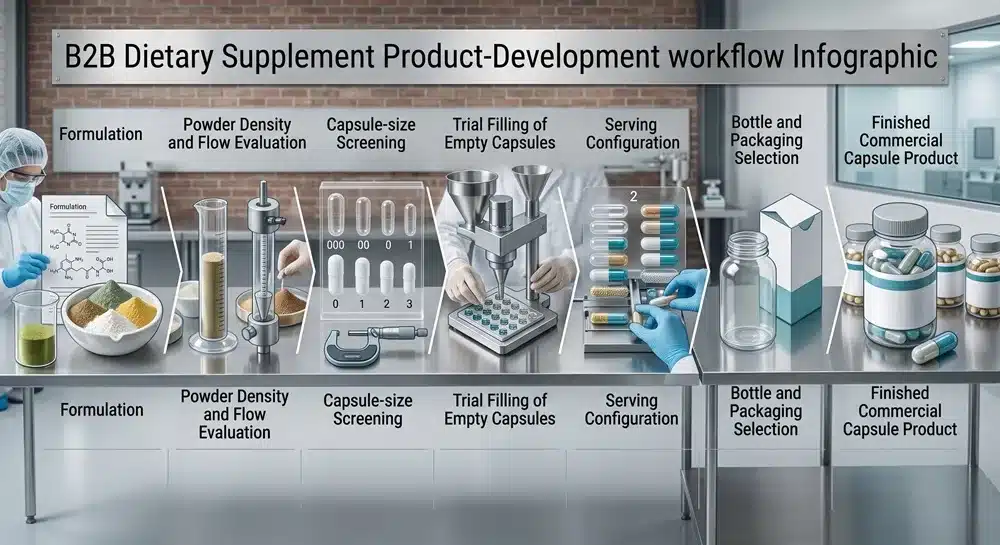
Developing a Capsule Supplement?
If you are developing a commercial capsule product, GENSEI can support projects involving capsule formulation, ingredient sourcing and finished-product manufacturing.
If you already have a formula, we can review the project requirements and capsule-format feasibility.
If you are starting with a product concept, formulation development can help determine dose, ingredient compatibility, capsule size and manufacturing requirements before commercial production.
Узнать больше Производство капсульных добавок →
Discuss a Custom Formula →
Frequently Asked Questions About Capsule Sizes
Каков самый большой размер капсулы?
Size 000 is the largest capsule in the standard 000-to-5 hard-capsule reference range.
Commonly published reference specifications give Size 000 a nominal volume of approximately 1.37 mL and a locked length of approximately 26.1 mm.
Actual specifications should be confirmed with the selected capsule supplier.
Какой самый маленький размер капсулы?
Size 5 is the smallest capsule in the standard 000-to-5 reference range.
Common reference specifications give it a nominal internal volume of approximately 0.13 mL and a locked length of approximately 11.1 mm.
How many mg fit in a Size 00 capsule?
There is no single milligram capacity for Size 00 because powder density varies.
Using a nominal reference volume of approximately 0.91 mL:
at 0.6 g/mL, the theoretical fill weight is approximately 546 mg;
at 0.8 g/mL, approximately 728 mg;
at 1.0 g/mL, approximately 910 mg.
Actual production capacity can differ depending on the finished formulation and filling process.
What is the difference between Size 0 and Size 00?
Size 00 is physically larger and provides more internal volume than Size 0.
Typical reference volumes are approximately:
Size 0: 0.68 mL
Size 00: 0.91 mL
This gives Size 00 roughly one-third more nominal volume than Size 0.
The appropriate choice depends on formulation volume, serving design and production feasibility.
What capsule size is needed for 500 mg?
It depends on the density of the formulation.
At a density of 1.0 g/mL, 500 mg requires approximately 0.50 mL.
At 0.8 g/mL, it requires approximately 0.625 mL.
At 0.6 g/mL, it requires approximately 0.833 mL.
The same 500 mg target may therefore require different capsule sizes.
Why can the same capsule size hold different milligram amounts?
Capsule size determines internal volume, while milligrams measure weight.
A denser powder places more mass into the same volume than a lighter, lower-density powder.
That is why capsule fill capacity should be calculated using formulation density rather than one universal milligram value.
Do gelatin and HPMC capsules use the same size numbers?
Generally, yes.
Both gelatin and HPMC hard capsules commonly use the standard capsule-size numbering system.
However, exact dimensions, tolerances and shell properties can vary according to the capsule product and supplier.
Commercial manufacturing should therefore use the specification for the shell actually selected.
Заключение
Capsule size should be selected by volume first and milligrams second.
Sizes 000 through 5 provide progressively smaller internal volumes, but there is no universal milligram capacity for any capsule size.
The actual fill weight depends on the properties of the finished formulation.
A capsule size chart, density measurement and fill-weight calculation can provide a useful starting point during product development.
Final commercial selection should then be confirmed using:
the complete finished blend;
the selected capsule-shell specification; and
the intended filling process.
For supplement brands developing a capsule product, this approach helps connect formulation requirements with capsule selection before commercial production.
Explore Capsule Supplement Manufacturing →
Discuss a Custom Formulation Project →
Ссылки
- 1. United States Pharmacopeia (USP). General Chapter
<616>— Bulk Density of Powders. - 2. Franc A, Vetchý D, Fülöpová N. Commercially Available Enteric Empty Hard Capsules, Production Technology and Application. Фармацевтика. 2022;15(11):1398.
- 3. Fauzi MARD, Pudjiastuti P, Wibowo AC, Hendradi E. Preparation, Properties and Potential of Carrageenan-Based Hard Capsules for Replacing Gelatine: A Review. Polymers. 2021;13(16):2666.

Уоррен Ван — опытный специалист с обширным стажем работы в сфере цепочки поставок пищевых добавок, обладающий богатым практическим опытом в области исследований, разработки, контроля производственных процессов и глобального поиска поставщиков ключевых ингредиентов, таких как коллагеновые пептиды, белок костного бульона и кератин. Как автор этой рубрики, он стремится развенчать маркетинговую мистификацию, преобразуя малоизвестные научные факты об ингредиентах и стандарты контроля качества производства в доступные и достоверные научно-популярные материалы, помогая читателям понять правду, скрытую за этикетками, и делать более рациональный выбор в вопросах здоровья.


