Fish Collagen vs Chicken Type II Collagen: Differences, Evidence and Quality Guide

Quick Answer

Fish collagen is usually a hydrolyzed, type I-rich peptide ingredient used at gram-level servings. Chicken type II collagen may be supplied as undenatured/native type II collagen at a much smaller serving or as hydrolyzed chicken cartilage collagen at a larger serving. These materials are not interchangeable, so buyers must identify the source, collagen type, processing form, dose and test method before comparing evidence or choosing a formula.

This guide is for consumers, formulators, supplement brands and procurement teams. It separates three decisions that are often mixed together: animal source, collagen type and processing form. Brands comparing raw materials can begin with GENSEI’s 批發膠原蛋白肽 portfolio, then verify the exact specification for the intended finished product.

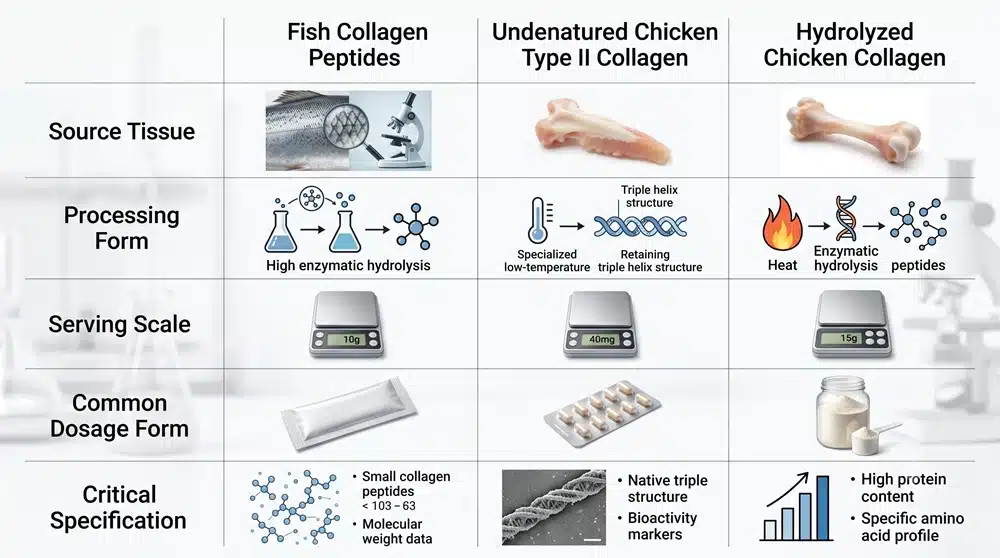
Fish collagen peptides compared with undenatured and hydrolyzed chicken type II collagen

Fish Collagen vs Chicken Type II Collagen at a Glance

因子魚膠原蛋白勝肽Undenatured Chicken Type IIHydrolyzed Chicken Collagen
Typical sourceFish skin, scales or bonesChicken sternum cartilageChicken cartilage or other collagen-rich poultry tissue
Common collagen profileUsually type I-richType II with native structures or epitopes intentionally preservedType II-rich or mixed collagen-derived peptides, depending on the specification
Processing form水解勝肽Native or 不成熟 material processed under controlled conditions水解勝肽
Typical serving scaleUsually gramsOften tens of milligrams for specific studied ingredientsHundreds of milligrams to grams, depending on the ingredient and formula
Common product fitPowders, sachets, drinks and larger-serving collagen productsLow-dose capsules or tablets for targeted joint-health positioningCapsules, tablets, powders and multi-collagen products
Critical buyer checkSpecies, tissue, protein, molecular-weight distribution, sensory profile and allergen documentsNative type II content, preservation method, stability and ingredient-specific evidenceHydrolyzed status, type II characterization, peptide profile and serving rationale
Common mistakeAssuming marine source alone proves superior absorption or skin outcomesTreating it as a gram-level collagen proteinBorrowing evidence from undenatured type II collagen

What Is Fish Collagen?

Commercial fish collagen supplements are commonly produced from fish skin, scales or bones and hydrolyzed into peptides. Most fish-skin and fish-scale collagen peptide ingredients are predominantly type I-derived and are designed for solubility, dispersibility and gram-level delivery in powders, sachets or beverages.

術語 海洋膠原蛋白 is not a complete specification. It does not identify the fish species, tissue, country of origin, extraction process, average molecular-weight range, protein basis, flavor profile, contaminant limits or allergen labeling information. These details should be verified on the specification, technical data sheet and lot-specific certificate of analysis.

What Is Chicken Type II Collagen?

Chicken type II collagen is usually associated with chicken sternum cartilage, but the commercial term can describe materially different ingredients. The processing form determines the relevant serving size, analytical method, formulation constraints and supporting evidence.

Undenatured or Native Type II Collagen

Undenatured type II collagen is processed to preserve selected native structures or epitopes. Specific commercial ingredients have been evaluated at low daily amounts in joint-health research. A brand should not generalize those findings to every chicken 軟骨粉; the exact ingredient identity, native type II specification, dose and study match must be confirmed.

Hydrolyzed Chicken Collagen Peptides

Hydrolyzed chicken collagen is broken into smaller peptides. It may be characterized as type II-rich, but it no longer has the same native structure as an undenatured ingredient. It is therefore evaluated as a peptide or protein ingredient, often at a larger serving, and requires its own evidence, molecular profile and finished-product rationale.

Does Fish Collagen Contain Type II Collagen?

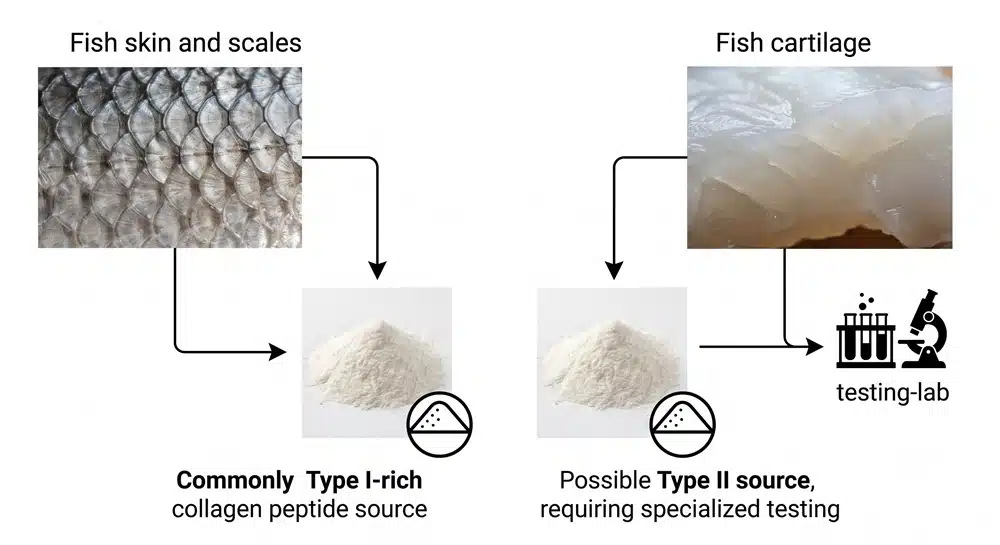
Most standard fish-skin or fish-scale collagen peptide powders are positioned as type I-rich materials. Fish cartilage can contain type II collagen, and specialized fish-cartilage ingredients may be developed for that purpose. However, a generic fish collagen powder should not be assumed to deliver a meaningful native type II collagen amount.

To support a type II claim, request the tissue source, collagen-type method, quantitative specification and lot result. Source language such as “marine collagen” or “fish collagen” is not enough by itself.

Fish skin and scales type I collagen compared with fish cartilage type II collagen

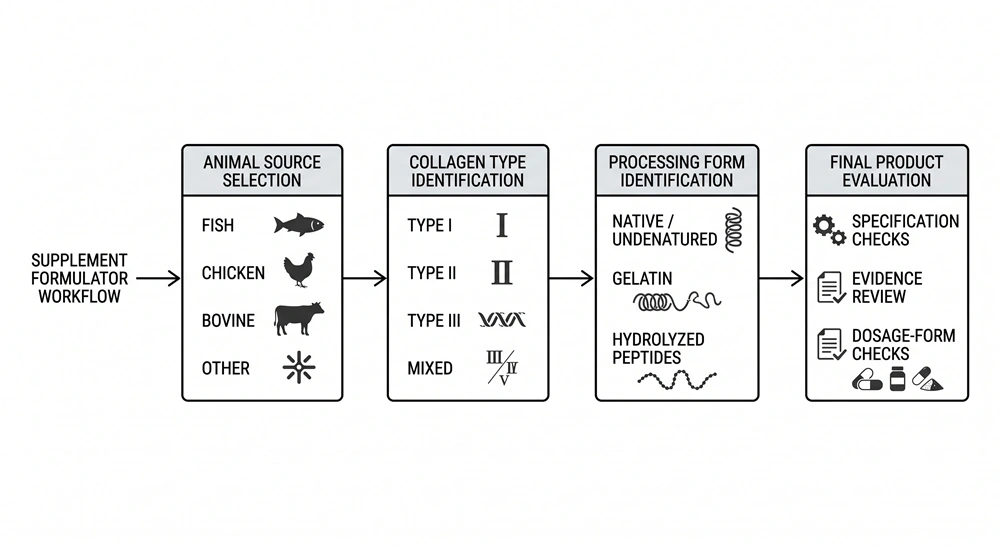
Source, Collagen Type and Processing Form Are Separate Decisions

Use the following three-question framework before comparing products:

  1. 來源 Is the material derived from fish, chicken, bovine, porcine or another source?
  2. 膠原蛋白類型: Is it predominantly type I, type II, type III or a characterized mixture?
  3. Processing form: Is it native/undenatured collagen, gelatin or hydrolyzed peptides?

A source name does not prove the collagen type, and a collagen type does not prove whether the ingredient is native or hydrolyzed. These distinctions determine which test method, serving scale, manufacturing process and evidence are relevant.

Collagen source, collagen type and processing form decision flowchart

Which Ingredient Is Better for Each Product?

產品目標Likely Starting IngredientWhy It May FitVerification Priority
High-serving collagen powder or drinkFish collagen peptidesMore practical for soluble gram-level collagen deliveryProtein basis, sensory profile, solubility, species and allergen documents
Beauty-from-within sachetQualified hydrolyzed collagen peptidesFits larger servings and beverage-style productsMatch the exact ingredient and dose to any claim substantiation
Low-dose targeted joint capsuleQualified undenatured chicken type II collagenSmall serving and ingredient-specific joint-health evidence may fit capsulesNative type II content, preservation, stability and study match
Multi-collagen powderHydrolyzed fish and/or chicken collagenAllows a broader source story at gram-level servingsDisclose meaningful amounts rather than using token inclusions
Fish-allergen-free collagen conceptQualified non-fish sourceAvoids fish-derived ingredient useReview poultry, bovine or other source sensitivities and certifications
Joint-health finished productIngredient selected by dose and processing formCan be combined with other suitable actives after feasibility reviewClaims, interactions, allergens, serving size and finished-product testing

For finished dosage-form development, brands can review GENSEI’s joint supplement manufacturing capabilities after the ingredient form and evidence boundary are defined.

Evidence: Do Not Mix Ingredient Categories

魚膠原蛋白勝肽

Reviews of oral hydrolyzed collagen have reported possible changes in selected skin or exercise-related outcomes, but the studies vary by source, peptide profile, serving amount, co-ingredients, duration, funding and study quality. Findings for one characterized or branded ingredient should not automatically be applied to every fish collagen powder.

未變性的 II 型膠原蛋白

Undenatured type II collagen has been evaluated in healthy adults and in joint-health or osteoarthritis study populations. Some studies report changes in pain, function or range-of-motion measures, while reviews also note limitations and the need for additional independent research. Supplement content should not present these ingredients as treatments for arthritis or cartilage disease.

Hydrolyzed Chicken Collagen

Hydrolyzed chicken collagen requires evidence that matches its own processing form and dose. Research on native or undenatured type II collagen cannot be transferred automatically to hydrolyzed chicken peptides because the structure, serving scale and proposed mechanism differ.

吸收和生物利用率

Hydrolyzed collagen peptides are digested and absorbed, but a smaller average molecular size does not by itself prove superior clinical performance, targeted delivery to skin or cartilage, or a better outcome than another source. “High bioavailability” should not be used as a substitute for ingredient-matched human evidence.

Procurement and content teams should request a molecular-weight distribution rather than a vague small-peptide claim, confirm whether human data use the same ingredient and dose, distinguish digestibility from clinical outcomes, and review stability and sensory performance in the intended dosage form.

Serving Size and Dosage-Form Reality

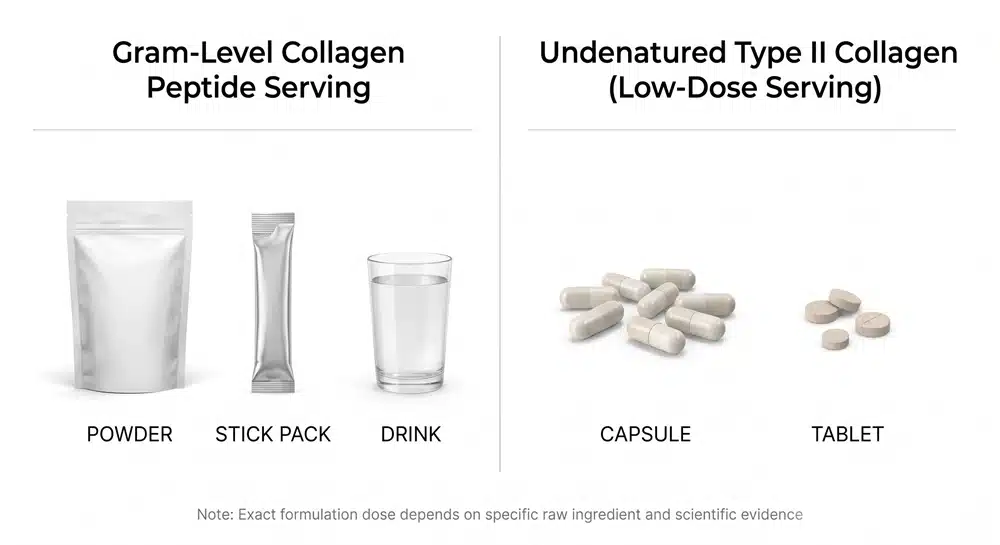
Fish collagen peptide products commonly use gram-level servings. Powders, stick packs, sachets and liquids are usually more practical than ordinary capsules when the target serving is several grams. A five-gram serving may require many standard capsules and can create poor consumer adherence or misleading front-label positioning.

Specific undenatured type II collagen ingredients may use much smaller daily amounts and can fit a small capsule or tablet. A low-dose hydrolyzed chicken collagen ingredient should not be presented as equivalent merely because both materials originate from chicken cartilage.

When a gram-level formula is appropriate, 粉末補充劑製造 may offer a more realistic serving format than capsules, subject to flavor, odor, dispersion, moisture and packaging evaluation.

Gram-level fish collagen and low-dose chicken type II collagen dosage-form comparison

Safety, Allergens and Dietary Suitability

  • Fish collagen is fish-derived and must be reviewed under applicable major-allergen labeling requirements. For the U.S. market, the fish species may need to be declared rather than using only the generic word “fish.”
  • People with fish allergy should avoid fish collagen unless advised otherwise by a qualified healthcare professional.
  • Chicken collagen is poultry-derived and is not vegetarian or vegan. People with poultry allergy or sensitivity should use caution.
  • Animal source alone does not establish halal or kosher status. Source, slaughter, processing aids, segregation and certification must be verified.
  • Pregnancy, breastfeeding, kidney disease, protein-restricted diets, complex medical conditions and medication use may require professional guidance.
  • Neither ingredient should be promoted as diagnosing, treating, curing or preventing arthritis, osteoporosis, cartilage injury, inflammatory disease or another medical condition.

Quality Specification Checklist

規格魚膠原蛋白勝肽Chicken Type II Collagen紅旗
Identity and sourceFish species, tissue, origin and hydrolyzed collagen identityChicken source, cartilage tissue and native or hydrolyzed statusOnly “marine” or “chicken collagen” with no tissue or form
Collagen characterizationType I-rich support where claimedType II content and native type II or epitope specification where applicableType claim has no method or quantitative limit
Protein or potencyProtein, hydroxyproline, moisture, ash and reporting basisTotal ingredient, type II and native type II content as applicableCOA only says “pass”
Molecular or structural profileMolecular-weight distribution and peptide profileNative-structure method or hydrolyzed peptide profileOne average molecular-weight number used as a clinical claim
Physical propertiesSolubility, dispersibility, color, odor, taste and bulk densityParticle size, flow, moisture, color, odor and dosage-form compatibilityNo pilot-batch or sensory data
污染物Heavy metals, microbiology, residual solvents and source-specific contaminantsHeavy metals, microbiology, residual solvents and veterinary/source controlsGeneric test report from a different lot
Allergen documentsFish species and allergen statementPoultry source and sensitivity documentation“Allergen free” without a defensible basis
可追蹤性Species, tissue, processing site, country and lot traceabilityPoultry source, cartilage tissue, process and lot traceabilitySupplier cannot identify the production site
穩定性Moisture, flavor, solubility and final-package dataNative structure or potency through shelf life and final packageOnly raw-material shelf life is provided

Formulation and Manufacturing Considerations

Fish Collagen Powders and Drinks

Evaluate target serving, protein declaration, foam, flavor, odor, clarity, solubility, sweetener compatibility, agglomeration, moisture protection and packaging. Pilot work should use the actual commercial ingredient rather than a generic laboratory substitute.

Chicken Type II Capsules and Tablets

Low-dose undenatured type II collagen may suit capsules or tablets, but heat, compression, moisture and storage conditions must not compromise the specified native structure. Hydrolyzed chicken collagen may require a larger fill volume and should be evaluated by bulk density and serving target.

複方配方

Type II collagen may be combined with other joint-health ingredients, but each combination requires serving-size, compatibility, allergen, claim and regulatory review. Token amounts should not be included only to support a marketing list.

RFP Questions for a Collagen Supplier or Manufacturer

  1. Is the material fish collagen peptides, undenatured chicken type II collagen or hydrolyzed chicken collagen?
  2. What species, tissue, country of origin and production site apply?
  3. Which collagen type is claimed, and which analytical method supports it?
  4. For undenatured type II, how are native structure, epitope preservation and shelf-life stability verified?
  5. For hydrolyzed collagen, what molecular-weight distribution is specified?
  6. Can you provide the current specification and three recent lot-specific COAs?
  7. What are the protein, hydroxyproline, moisture, ash and microbiological limits?
  8. Which heavy metals, residual solvents and source-specific contaminants are tested?
  9. What fish-species, poultry-source, allergen, halal, kosher and traceability documents are available?
  10. What are the MOQ, sample quantity, packaging options and lead time?
  11. Can you support pilot production in the target powder, capsule, tablet, liquid or gummy format?
  12. Which human evidence applies to this exact ingredient, processing form, dose and finished-product context?

Where GENSEI Fits

GENSEI supports collagen ingredient sourcing, specification comparison, dosage-form development, quality-document review and finished 補充劑製造. Brands can compare fish collagen peptides, hydrolyzed chicken collagen and qualified type II ingredients according to the intended serving size, dosage form, claim direction and target market.

To evaluate a project, request a sample, COA or quotation and include the source, collagen type, native or hydrolyzed status, target dose, dosage form, certifications, destination market and expected order quantity.

常見問題

Which is better, fish collagen or chicken collagen?

Fish collagen peptides are often a better starting point for soluble, gram-level collagen powders or drinks. A qualified undenatured chicken type II ingredient may be a better fit for a low-dose joint-health capsule. The correct choice depends on processing form, serving size, evidence, allergen requirements and product goal.

What type of collagen is fish collagen?

Most commercial fish-skin or fish-scale collagen peptides are predominantly type I-derived. The exact type, species, tissue and method should still be verified from supplier documentation.

Does fish collagen contain type II collagen?

Standard fish-skin or fish-scale collagen is not normally positioned as a meaningful type II source. Fish cartilage can contain type II collagen, but a specialized ingredient and supporting specification are required.

What is chicken collagen type II?

It is collagen sourced mainly from chicken cartilage. It may be supplied as undenatured/native type II collagen or as hydrolyzed chicken collagen peptides. Those forms are not interchangeable.

Can fish collagen and chicken type II collagen be combined?

Yes, if the formulation uses meaningful amounts, preserves the required ingredient properties and has a clear serving-size and claim rationale. Combining sources does not automatically create a stronger or clinically proven product.

Which form is better for skin or joints?

Hydrolyzed fish collagen is commonly used in gram-level beauty-from-within products, while specific undenatured type II ingredients have been studied for joint-health outcomes. Neither source should be presented as a guaranteed treatment, and evidence must match the exact ingredient and dose.

最終心得

Fish collagen peptides and chicken type II collagen should not be compared by animal source alone. Fish collagen is usually a hydrolyzed, type I-rich ingredient used at gram-level servings. Chicken type II may be an undenatured low-dose active or a hydrolyzed peptide ingredient. Brands should verify processing form, serving scale, analytical specification, allergen status, stability and ingredient-matched evidence before selecting or marketing either material.

參考資料

  1. Effects of Oral Collagen for Skin Anti-Aging: A Systematic Review and Meta-Analysis
  2. The Effects of Collagen Peptide Supplementation on Body Composition, Collagen Synthesis and Recovery from Joint Injury and Exercise: A Systematic Review
  3. Undenatured Type II Collagen and Its Role in Improving Osteoarthritis
  4. Efficacy and Tolerability of an Undenatured Type II Collagen Supplement in Modulating Knee Osteoarthritis Symptoms
  5. FDA: Food Allergies
  6. FDA: Declaring Fish Species in Allergen Labeling
  7. 美國食品藥物管理局(FDA):結構/功能宣稱
  8. 聯邦貿易委員會(FTC):健康產品合規指引
  9. 21 CFR Part 111: Dietary Supplement Current Good Manufacturing Practice
滾動到頂端