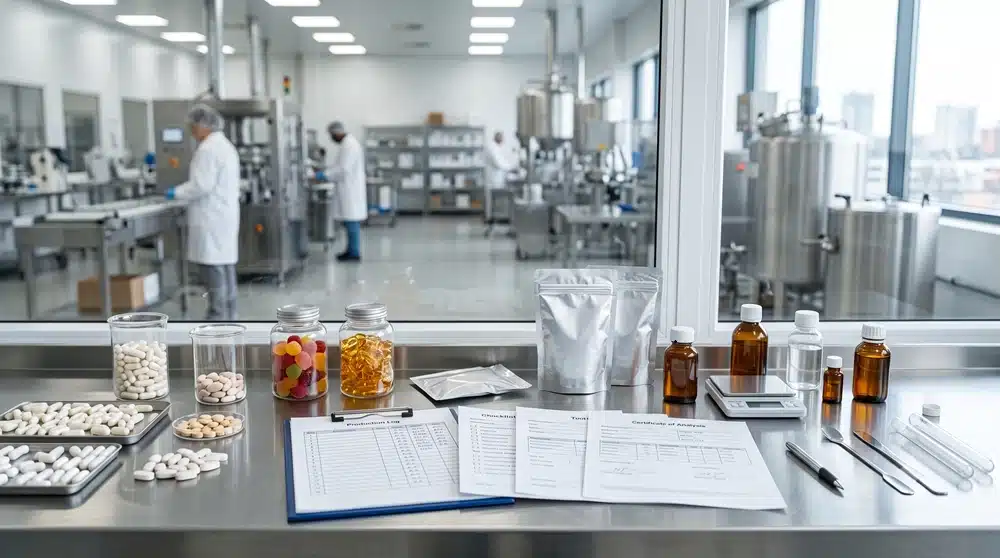
China can be a practical sourcing option for vitamins, amino acids, botanical extracts, capsules, tablets, gummies, powders, softgels, liquids, and private label products. It also creates avoidable risk when buyers select only by price, accept vague “FDA registered” language, or fail to match documents to the exact factory, dosage form, and batch.
This guide is for international supplement brands, founders, procurement teams, and formulators. Brands that need a fully customized product can also review GENSEI’s تركيبة المكملات الغذائية المخصصة capabilities while using the verification framework below.
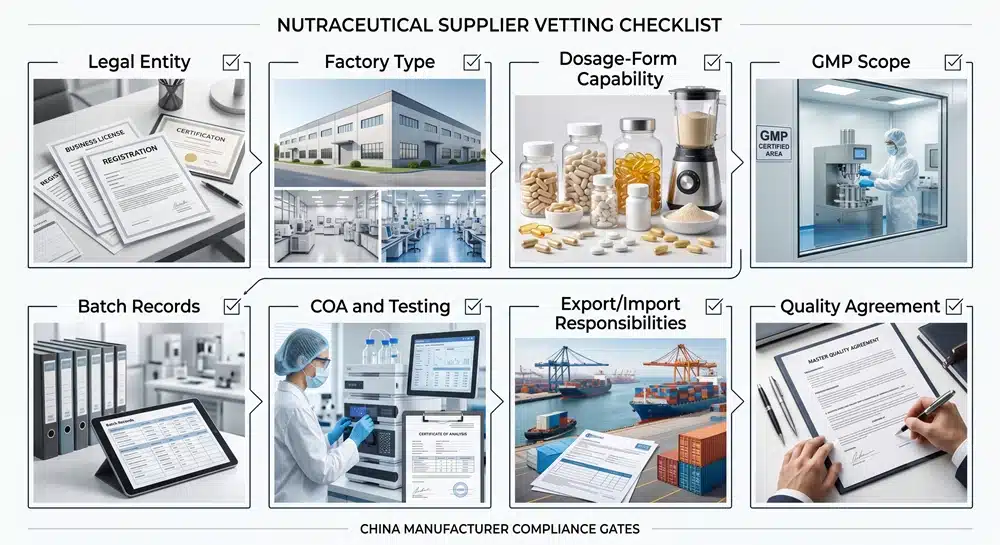
China Supplement Manufacturer Buyer Checklist
| ما الذي يجب التحقق منه | Documents or Evidence to Request | ما أهمية ذلك |
|---|---|---|
| Legal entity and business scope | Business license, production permit or other authorization applicable to the product category, and the registered facility address | Confirms who will contract, manufacture, invoice, and hold responsibility for the project |
| Manufacturer type | Factory ownership statement, production-site address, organization chart, and explanation of any trading company or subcontractor | Prevents a sales company from being mistaken for the actual manufacturer |
| Dosage-form capability | Capability list for capsules, tablets, gummies, powders, softgels, liquids, packaging, and relevant equipment | Confirms the site can make the proposed format rather than only source ingredients |
| Quality system | Current GMP or quality certificates, certificate scope, issuing body, audit report, SOP index, and quality organization chart | Shows whether controls apply to the correct site and dosage form |
| Batch control | Redacted master manufacturing record, sample batch production record, in-process controls, deviation procedure, and release workflow | Demonstrates traceability and repeatability beyond a marketing presentation |
| الاختبار | Lot-specific COA, specifications, methods, laboratory identity, accreditation details, and independent reports where appropriate | Verifies identity, potency, contaminants, and product-specific acceptance criteria |
| Export and destination-market readiness | Export documents, importer plan, label review process, allergen review, claims review, and market-specific compliance responsibilities | Manufacturing in China does not automatically make a product compliant in the destination market |
| Commercial controls | MOQ, lead time, payment terms, tooling ownership, defect policy, quality agreement, change-control terms, and complaint process | Protects the buyer before formula, packaging, trademark, and deposit are committed |
What Counts as a China Supplement Manufacturer?
The phrase “China supplement manufacturer” can describe different business models. Buyers should identify the model before comparing price, MOQ, certificates, or lead time.
- Raw ingredient supplier: supplies vitamins, minerals, amino acids, botanical extracts, collagen, sweeteners, flavors, or specialty ingredients.
- Finished-product contract manufacturer: manufactures capsules, tablets, powders, gummies, liquids, softgels, or other finished dosage forms.
- Private label supplier: offers existing or semi-custom formulas with branding and packaging options.
- OEM/ODM partner: supports custom formulas, sourcing, samples, manufacturing, packaging, and sometimes product-development services.
- Trading company or sourcing agent: coordinates suppliers but may not own the production site or control all quality records.
None of these models is automatically better. The correct choice depends on whether the project needs bulk ingredients, a custom formula, a faster private label launch, direct factory access, export coordination, or multi-supplier sourcing.
When China Manufacturing Makes Sense
China may be a practical option when a brand needs access to established ingredient supply chains, multiple dosage forms, custom packaging, export coordination, or a cost structure that supports commercial scale. It may be especially relevant for vitamin and mineral ingredients, amino acids, botanical extracts, collagen products, sports nutrition powders, gummies, and functional food formats.
It may be a poor first choice when the project requires extremely small trial quantities, unusually sensitive intellectual property, a patented ingredient with strict chain-of-custody requirements, or a destination-market launch without an importer, regulatory reviewer, or quality team. The sourcing country does not replace product-specific due diligence.
The Most Important Rule: Verify, Do Not Assume
Marketing phrases such as “GMP certified,” “FDA registered,” “export quality,” “pharmaceutical grade,” or “third-party tested” are not sufficient by themselves. Each statement must be matched to a named legal entity, physical facility, dosage form, product category, certificate scope, batch, test method, and target market.
For dietary supplements offered for import into the United States, 21 CFR Part 111 applies to covered manufacturing, packaging, labeling, and holding operations. Food-facility registration does not mean FDA approval or endorsement. Depending on the product and importer role, Foreign Supplier Verification Program requirements or modified dietary-supplement provisions may also apply. Brands should confirm the applicable pathway with qualified regulatory counsel rather than relying on a supplier’s sales claim.
Step-by-Step Process for Choosing a China Supplement Manufacturer
1. Define the Product Before Contacting Suppliers
Prepare a written product brief with the dosage form, serving size, active ingredients, target market, packaging, allergen restrictions, certification needs, claims direction, first-order quantity, expected annual volume, and launch date. A vague request such as “immune gummy” or “collagen powder” cannot produce a reliable quotation.
2. Confirm the Manufacturer Type and Production Site
Ask whether the company owns the factory, controls production, or acts as a trading company. Request the exact manufacturing-site name and address, not only the sales-office address. If subcontractors are used, define which party controls quality records, deviations, complaints, and change approvals.
3. Review Licenses and Certificates
Request current licenses and certificates and verify the legal entity, site address, scope, dosage form, issuing body, and expiration date. A certificate for another facility or product category does not qualify the proposed project. When the Chinese authorization structure is unclear, obtain a local legal or regulatory review.
4. Ask for Product-Specific Quality Evidence
A generic company presentation is not enough. Request evidence relevant to the proposed product, such as raw-material identity, potency or assay, blend uniformity, heavy metals, pesticide residues, microbiology, residual solvents, allergens, disintegration, dissolution where applicable, packaging compatibility, and stability support.
5. Verify the Laboratory and Test Methods
A COA should state the product name, batch number, specification, method, result, unit, acceptance limit, test date, and laboratory. For higher-risk or higher-value materials, compare the supplier’s COA with testing from a qualified independent laboratory. Confirm that the sample tested is traceable to the offered batch.
6. Audit the Facility or Use a Qualified Third Party
An onsite or remote audit should review receiving, quarantine, sampling, weighing, blending, compression or encapsulation, gummy cooking where relevant, packaging, label control, sanitation, pest control, water systems, calibration, deviations, complaints, returned goods, training, data integrity, and record retention.
7. Check Importer and Destination-Market Responsibilities
Define who is responsible for U.S., EU, UK, Canadian, Australian, or other destination-market requirements. The agreement should address ingredient acceptability, label review, Supplement Facts or equivalent panels, allergens, claims, product notification or registration where applicable, customs documentation, prior notice, importer duties, and adverse-event or complaint handling.
8. Lock Specifications Before Production
Approve a controlled specification before paying the commercial-production deposit. It should define active amounts, assay basis, overages, excipients, carriers, flavor, color, packaging materials, test methods, acceptance limits, sampling plan, shelf life, storage, label version, and whether substitutions are prohibited without written approval.
9. Use a Pilot Batch Before Scaling
A pilot or engineering batch can reveal problems with taste, texture, fill weight, tablet compression, capsule size, gummy stability, powder flow, packaging fit, label layout, and testing. Do not move directly to a large order when the formula, dosage form, packaging system, or supplier relationship is new.
10. Put Change Control and Failure Handling in Writing
The supplier should not change raw materials, ingredient suppliers, processing aids, capsule shells, sweeteners, flavors, packaging, methods, specifications, or production sites without documented review and buyer approval. The quality agreement should also define investigation, retesting, rejection, rework, recall support, and financial responsibility for an out-of-specification batch.
Quality Documents to Request Before You Pay a Deposit
| Document | ما يجب التحقق منه | العلم الأحمر |
|---|---|---|
| Business license | Legal entity, registered address, business scope, and consistency with the contract and bank account | Sales company only, conflicting names, or no production site disclosed |
| Production authorization | Product category, site, validity, and local scope | Scope does not match the proposed product or dosage form |
| GMP or quality certificate | Facility name, address, issuing body, scope, standard, and expiration | Expired, unverifiable, self-created, or issued for another site |
| Lot-specific COA | Batch number, methods, limits, numeric results, dates, and approver | Only “pass,” no method, no unit, or a batch that does not match the offer |
| Third-party test report | Laboratory, accreditation scope, sample ID, chain of custody, method, and report date | Report belongs to a different material, formula, or batch |
| Formula and finished-product specification | Actives, excipients, carriers, overages, serving size, packaging, and acceptance limits | Undisclosed excipients, undefined assay basis, or uncontrolled substitutions |
| Master manufacturing record | Controlled process steps, equipment, yields, in-process checks, and reconciliation | No approved record for repeat production |
| Stability support | Real-time or justified accelerated data for the actual formula and intended packaging | Only raw-material shelf life or an unsupported expiration period |
| Quality agreement | Testing, release, deviations, complaints, change control, audit rights, and failure responsibility | Quality responsibilities are left entirely to informal email discussions |
GMP, FDA Registration and Common Misunderstandings
“FDA registered” is not the same as “FDA approved.” Registration identifies a facility in the FDA system when registration is required; it does not mean that FDA has approved the factory, supplement, formula, label, or claims. Dietary supplement firms remain responsible for lawful manufacturing, labeling, safety, and substantiation.
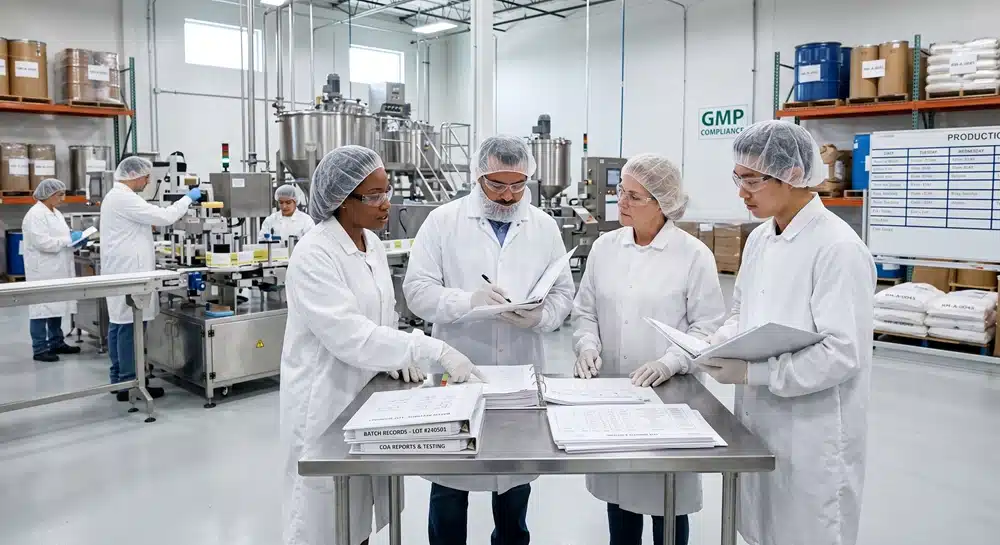
For U.S.-market projects, ask how the manufacturer supports 21 CFR Part 111 documentation, including specifications, master manufacturing records, batch production records, quality-control review, reserve samples, complaints, returned products, and recordkeeping. Also identify the U.S. importer and confirm which FSVP provisions, exemptions, or modified requirements apply to the specific product and supply chain.
Red Flags When Comparing China Supplement Manufacturers
- The quotation is far below comparable offers, but material grade, testing scope, packaging, or yield assumptions are not explained.
- The supplier will not identify the legal entity and physical production site.
- The certificate address or scope does not match the factory or dosage form.
- The COA has no test method, numeric result, unit, or batch number.
- The supplier refuses independent testing or will not preserve traceable retention samples.
- Every formula is described as “FDA approved,” “clinically proven,” “pharmaceutical grade,” or “zero risk.”
- Ingredient substitutions or site changes are permitted without written buyer approval.
- The manufacturer cannot explain label, allergen, claim, importer, or destination-market responsibilities.
- Full payment is demanded before samples, specifications, quality terms, or contracts are approved.
- Communication occurs only through a marketplace account, with no quality or factory contact.
Private Label Supplements from China
Private label manufacturing can support a faster launch when the brand accepts an existing or semi-custom formula. The trade-offs may include limited differentiation, unclear formulation ownership, shared packaging templates, and less control over future ingredient changes.
Before selecting a private label option, ask whether the formula is exclusive, what stability data support the shelf life, whether the label has been reviewed for the target market, and whether dosage, flavor, packaging, testing, or claims can later be customized. Review GENSEI’s المكملات الغذائية المخصصة ذات العلامة التجارية الخاصة page for available project models.
Bulk Supplement Ingredients from China
Bulk ingredients require a different qualification process from finished products. Focus on identity, assay, chemical form, source, impurity profile, residual solvents, pesticide residues, heavy metals, microbiology, particle size, bulk density, flow, solubility, country of origin, packaging, storage, and lot traceability.
For ingredients with adulteration, potency, contamination, or economic-substitution risk, do not rely only on supplier documents. Build a risk-based confirmation program using qualified sampling, identity testing, contaminant testing, reference standards, and independent laboratories before lot acceptance.
How GENSEI Can Support International Buyers
GENSEI supports formula development, private label projects, bulk ingredient sourcing, multiple dosage forms, packaging coordination, and project-specific مراقبة جودة المكملات الغذائية documentation. The scope of testing and documentation should be defined for each formula, market, and order rather than assumed from a general capability statement.
To receive a useful quotation, provide the target product category, dosage form, formula or ingredient concept, market, packaging format, estimated quantity, testing expectations, and launch timeline.
RFP Questions to Ask Before Requesting a Quote
- Do you own the manufacturing site, and what is the exact legal entity and factory address?
- Will any production, testing, packaging, or sourcing activity be subcontracted?
- Which licenses and certificates apply to this product and dosage form?
- Can you provide redacted examples of a master manufacturing record and batch production record?
- Which tests are performed on raw materials, in-process materials, and finished products?
- Which methods and reference standards are used, and which tests are outsourced?
- Can the buyer select an independent laboratory and approve the sampling plan?
- What are the product MOQ, packaging MOQ, tooling cost, lead time, and payment milestones?
- How are ingredient, supplier, method, packaging, and site changes controlled?
- What stability evidence supports the proposed shelf life in the final packaging?
- Who reviews labels, allergens, claims, and destination-market requirements?
- Which documents are provided before deposit, production release, and shipment?
- What happens if a batch fails testing, misses specification, or arrives damaged?
- What audit, complaint, recall, and record-access rights will be included in the quality agreement?
الأسئلة الشائعة
Are supplements from China safe?
Country of origin alone does not prove that a supplement is safe or unsafe. Quality depends on the exact facility, ingredients, specifications, manufacturing controls, testing, documentation, packaging, importer controls, and batch-specific verification.
How do I verify a China supplement manufacturer?
Verify the legal entity, factory address, production scope, current certificates, audit history, product-specific COA, methods, independent testing, batch records, stability support, export documents, references, and quality agreement. Match every item to the exact site, product, and batch.
What does FDA registered mean for a China supplement factory?
FDA registration is not FDA approval or endorsement. It does not mean that FDA has pre-approved the facility, formula, supplement, label, or claims. Buyers must still confirm cGMP, import, labeling, safety, and substantiation responsibilities.
What MOQ should I expect?
MOQ depends on dosage form, formula complexity, ingredient cost, packaging minimums, tooling, testing, and production-line requirements. Ready-to-brand products may have lower MOQs than fully custom formulas, while gummies, softgels, liquids, and custom packaging often require larger commitments.
Should I choose a trading company or a factory?
A trading company may offer sourcing and communication support, while a factory may provide more direct technical access. Either model can work if the buyer knows the actual production site and has clear control over specifications, quality records, audits, change approval, complaints, and payment responsibilities.
Can a China manufacturer make supplements for the U.S. market?
Yes, but the brand and importer must verify that the facility, product, label, claims, testing, documentation, prior notice, importer duties, and applicable FSVP or modified dietary-supplement requirements are properly managed.
الوجبات الجاهزة النهائية
The safest way to choose a China supplement manufacturer is to treat supplier selection as a documented verification project rather than a price-shopping exercise. Confirm the actual factory, legal and technical scope, GMP system, batch evidence, testing program, destination-market responsibilities, contract, and change control before commercial production.
Brands ready to review a formula, sample, COA, MOQ, or manufacturing proposal can اتصل بـ GENSEI with the product type, dosage form, target market, quantity, packaging, and launch timeline.
المراجع
- 21 CFR Part 111: Current Good Manufacturing Practice for Dietary Supplements
- FDA: Small Entity Compliance Guide for Dietary Supplement CGMP
- FDA: Registration of Food Facilities and Other Submissions
- FDA: Foreign Supplier Verification Programs—Key Requirements
- FDA: Importing Human Foods
- إدارة الغذاء والدواء الأمريكية (FDA): أسئلة وأجوبة حول المكملات الغذائية
- لجنة التجارة الفيدرالية (FTC): إرشادات الامتثال الخاصة بالمنتجات الصحية
وارن وان خبير متمرس يتمتع بخبرة واسعة في سلسلة توريد المكملات الغذائية، ولديه خبرة عملية غنية في مجالات البحث والتطوير ومراقبة العمليات والتوريد العالمي للمكونات الأساسية مثل ببتيدات الكولاجين وبروتين مرق العظام والكيراتين. وبصفته كاتب هذه الزاوية، يكرس جهوده لتجريد الموضوعات من غلافها التسويقي، وتحويل العلوم الغامضة المتعلقة بالمكونات ومعايير مراقبة جودة الإنتاج إلى معلومات علمية متعمقة وسهلة الفهم، مما يساعد القراء على فهم الحقيقة الكامنة وراء الملصقات واتخاذ خيارات صحية أكثر عقلانية.