
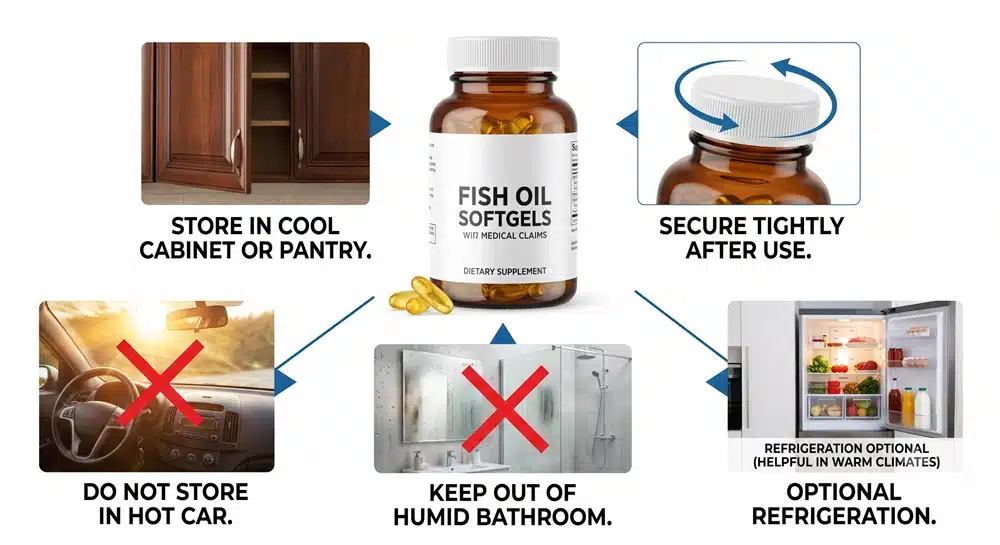
Fish oil softgels should generally be kept tightly closed, dry, protected from direct light, and away from excessive heat.
The most important rule, however, is to follow the storage instructions printed on the specific product label.
Many fish oil supplements are designed for room-temperature storage. Some labels simply specify a cool, dry place, while others provide a defined temperature range or warn against excessive heat, humidity, light or freezing.
Refrigeration is therefore not automatically required for every fish oil softgel.
If your product label recommends refrigerated storage, follow those instructions. If it is labeled for room-temperature storage, a cool cabinet away from heat and sunlight is usually a practical choice.
Quick Fish Oil Storage Guide
| Factor de almacenamiento | Practical Guidance | Por qué es importante |
|---|---|---|
| Temperatura | Follow the product label and avoid excessive heat | Heat can accelerate oxidation and may affect the softgel shell |
| Luz | Keep away from direct sunlight | Light can contribute to oxidation of sensitive oils |
| Air | Close the bottle tightly after use | Oxygen contributes to lipid oxidation |
| Humedad | Store in a dry location | Excessive humidity can affect the softgel shell and packaging |
| Frigorífico | Use when consistent with the product label | Refrigeration is not universally required |
| Freezer | Do not freeze unless the manufacturer specifically permits it | Finished softgel products may have specific temperature limitations |
Fish oil contains the long-chain omega-3 fatty acids EPA and DHA. Because these fatty acids are highly unsaturated, they are sensitive to oxidation.
Good storage therefore protects not only the physical softgel capsule but also the oil contained inside it.
¿Hay que guardar en la nevera las cápsulas blandas de aceite de pescado?
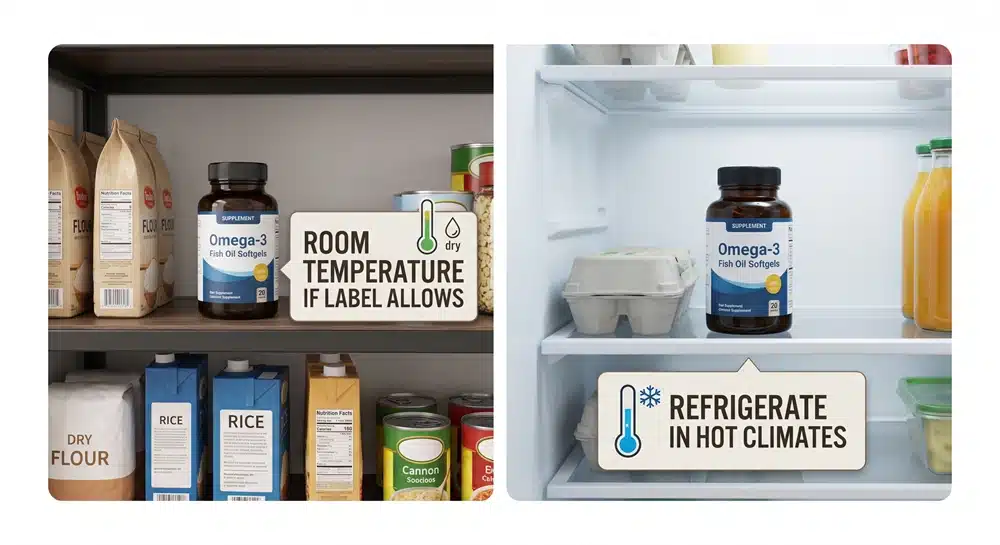
No necesariamente.
There is no universal rule that all fish oil softgels must be kept in a refrigerator.
Many commercial fish oil products are specifically designed to remain stable under labeled room-temperature conditions.
Some manufacturers instruct consumers to store their product in a cool, dry place. Others specify a room-temperature range and advise users to protect the product from excessive heat, humidity, light or freezing.
That means the simplest answer is:
Check the storage instructions on your specific fish oil product first.
If the label specifies room-temperature storage, refrigeration is usually unnecessary.
If the manufacturer specifically recommends refrigeration, follow that recommendation instead.
Is Refrigeration Better for Fish Oil?
Colder temperatures can slow many chemical reactions, including oxidation.
However, that does not mean that every finished fish oil softgel performs better when refrigerated.
A finished softgel contains more than fish oil. It also has a capsule shell, packaging system and stability profile designed around specific storage conditions.
For that reason, the finished-product label should take priority over a general rule such as:
“All fish oil should be refrigerated.”
The correct storage method depends on the actual product.
What Temperature Should Fish Oil Capsules Be Stored At?
There is no single temperature range that applies to every fish oil supplement.
Some products specify room-temperature storage. Others use broader instructions such as:
Store in a cool, dry place.
The product label should therefore be your primary reference.
Regardless of the exact temperature range on the label, avoid obvious sources of excessive heat.
Fish oil softgels should generally not be stored:
- inside a hot vehicle;
- beside an oven or stove;
- near a heater;
- on a sunny windowsill;
- in direct sunlight; or
- in another location that regularly becomes unusually hot.
Higher temperatures can accelerate oxidation reactions in omega-3 oils.
Temperature control is therefore important not only after the consumer purchases the product, but also during manufacturing, warehousing and distribution.
Where Is the Best Place to Store Fish Oil Softgels?
For fish oil softgels whose label allows room-temperature storage, a cool, dry and dark cabinet is generally a practical location.
The ideal storage location should have relatively stable conditions and should be protected from direct sunlight, excessive heat and high humidity.
Suitable locations may include:
- a pantry cabinet away from the oven;
- a closed kitchen cabinet away from major heat sources;
- a bedroom cabinet; or
- another dry storage area with stable room temperature.
Locations that may be less suitable include:
- bathroom cabinets exposed to frequent humidity;
- windowsills;
- countertops receiving direct sunlight;
- areas beside ovens or stoves; and
- vehicles.
Keep the bottle tightly closed whenever it is not being used.
Should Fish Oil Softgels Stay in the Original Container?
In most cases, yes.
The original package was selected for the finished product and contains important information, including:
- expiration date;
- lot number;
- storage instructions;
- dosage information; and
- tamper-evident or safety features.
The bottle or blister system may also provide protection from light, moisture or environmental exposure.
For routine long-term storage, keeping fish oil softgels in their original properly closed package is usually the simplest approach.
Transferring the entire product into a clear, loosely sealed or unrelated container may remove some of the protection provided by the original packaging.
Short-term use of a pill organizer is a different situation, but the main supply is generally best kept in its original package.
How Should Fish Oil Capsules Be Stored After Opening?
Opening the bottle does not automatically create a universal new expiration period.
There is no general rule that all fish oil softgels must be consumed within:
- 30 days;
- 60 days;
- 90 days; or
- another fixed period after opening.
Unless the manufacturer provides a specific after-opening instruction, continue following the labeled storage conditions and expiration date.
After opening the bottle:
- close the cap promptly after each use;
- keep the container away from excessive heat;
- avoid prolonged exposure to sunlight;
- keep the product dry;
- avoid unnecessary transfer to another container; and
- follow any additional manufacturer instructions.
The oxidative stability of a fish oil product depends on multiple factors, including the oil itself, antioxidant system, processing conditions, packaging and storage environment.
That is why one universal “after opening” rule cannot accurately describe every product.
Can You Freeze Fish Oil Softgels?
Do not assume that freezing fish oil softgels will extend their useful life.
Some omega-3 products specifically instruct users to protect the product from freezing.
Unless the manufacturer clearly states that freezing is acceptable, follow the labeled storage conditions instead.
Freezing should not be treated as a universal fish-oil storage method.
The stability of a finished softgel depends on both the oil and the capsule system surrounding it.
Why Fish Oil Freshness Depends on Heat, Light and Oxygen
Fish oil contains highly unsaturated fatty acids, particularly EPA and DHA.
The multiple double bonds in these fatty acids make them more susceptible to oxidation than many less-unsaturated fats.
During oxidation, the oil can undergo a sequence of chemical reactions.
Primary oxidation compounds form first. These compounds can then break down into secondary oxidation products that may affect odor, flavor and overall oil quality.
Three environmental factors are especially important:
heat;
light;
y
oxygen.
The goal of good fish-oil storage is therefore to reduce unnecessary exposure to conditions that can accelerate oxidative deterioration.
How Heat Affects Fish Oil
Higher temperatures generally accelerate chemical reactions, including lipid oxidation.
For consumers, the practical implication is straightforward:
Avoid excessive heat and follow the labeled storage conditions.
Do not leave a bottle of fish oil softgels for prolonged periods in an environment that becomes unusually hot.
For supplement manufacturers, heat exposure also needs to be considered during:
- raw-oil storage;
- ingredient handling;
- encapsulation;
- bulk softgel storage;
- embalaje;
- warehousing; and
- transportation.
The consumer’s cabinet is only the final stage of the product’s storage history.
How Light Affects Fish Oil
Light can contribute to oxidative deterioration of sensitive oils.
For consumers, this is another reason to avoid leaving fish oil supplements in direct sunlight.
The original bottle or package may already provide some degree of light protection.
For supplement brands, the level of light protection required can also influence packaging decisions.
Depending on the finished product, options may include:
- opaque bottles;
- tinted containers;
- blister systems;
- secondary cartons; or
- other protective packaging configurations.
The appropriate solution should be selected as part of the product’s overall stability strategy rather than by assuming that one package type is always best.
How Oxygen Affects Fish Oil
Oxygen is another major factor in lipid oxidation.
At home, the most practical action is simply to close the bottle properly after each use.
At the manufacturing level, oxygen exposure may need to be considered during:
- raw-oil handling;
- blending;
- transfer operations;
- encapsulation;
- bulk storage;
- filling; and
- final packaging.
The amount of oxygen in the package headspace and the overall packaging system may also influence the product’s oxidative stability.
Why Do Fish Oil Softgels Stick Together?
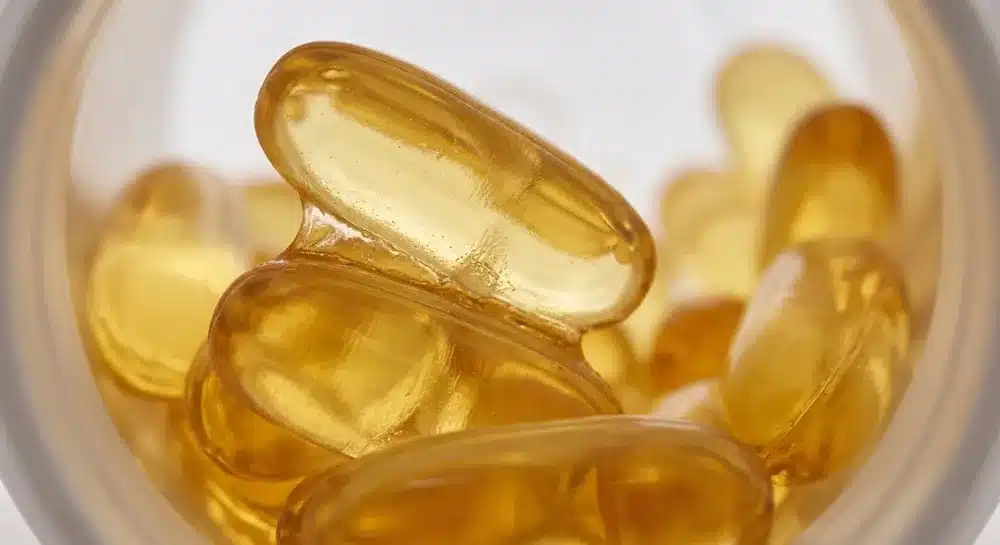
Fish oil softgels can sometimes become sticky or clump together after exposure to unsuitable environmental conditions.
Softgel shells are sensitive to temperature and humidity.
Excessive heat may soften the shell, while inappropriate moisture conditions can affect its physical properties.
Minor contact between softgels does not necessarily mean that the oil inside has become rancid.
However, if the capsules are:
- severely deformed;
- leaking;
- fused together;
- unusually soft;
- visibly damaged; or
- otherwise substantially different from their original condition,
it is better to check the manufacturer’s guidance before continuing to use the product.
For commercial manufacturers, environmental control during bulk softgel storage and packaging is also important for maintaining capsule integrity.
How Can You Tell if Fish Oil Has Oxidized?
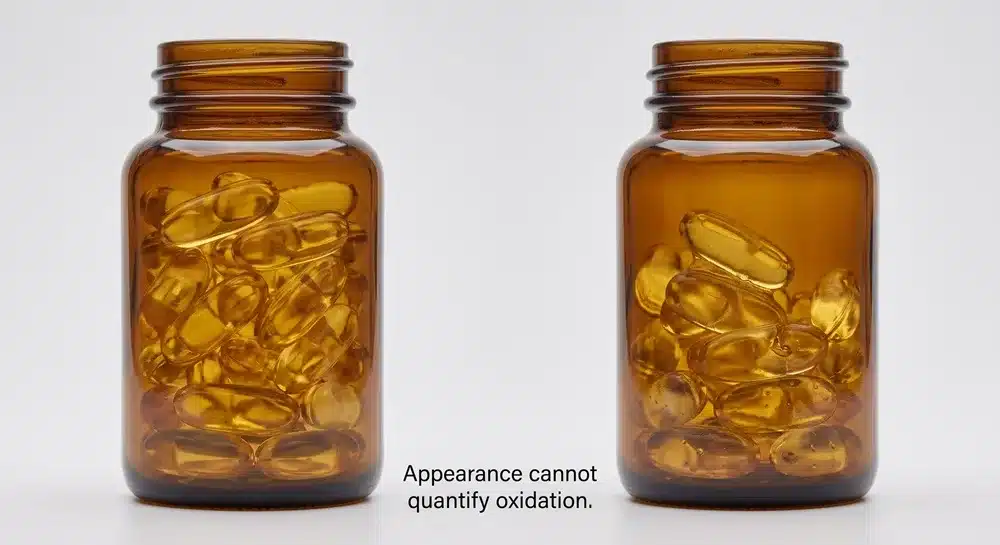
Consumers cannot accurately measure oxidation simply by looking at a fish oil softgel.
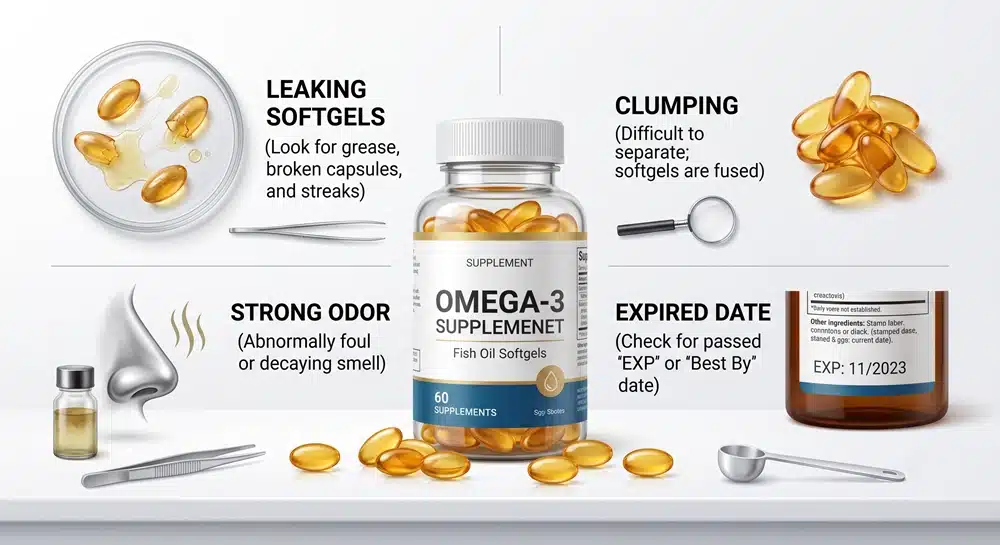
A strong, abnormal rancid or off odor may suggest that something is wrong, especially when the capsules have leaked or the product has been exposed to inappropriate storage conditions.
However, smell alone does not quantify oxidation.
Similarly, fishy burps are not a reliable test for rancidity.
Fishy aftertaste or burping can occur after taking fish oil even when the product has not been demonstrated to be spoiled.
Warning signs that justify additional caution include:
- leaking capsules;
- severe softgel deformation;
- damaged packaging;
- unusually strong off or rancid odor;
- obvious heat exposure;
- product stored outside labeled conditions; or
- an expired product.
If the product appears significantly altered, contact the manufacturer rather than trying to determine oxidation levels at home.
Technical evaluation requires analytical testing.
How Is Fish Oil Oxidation Tested?

For omega-3 manufacturers, ingredient suppliers and quality teams, oxidative quality is assessed using analytical measurements rather than only smell or appearance.
Three commonly discussed parameters are:
Peroxide Value;
p-Anisidine Value;
y
TOTOX.
Peroxide Value (PV)
Peroxide Value is used to evaluate primary oxidation products.
During the early stages of lipid oxidation, hydroperoxides can form.
PV provides an analytical indication of these primary oxidation products.
A low PV alone does not necessarily prove that an oil has never experienced oxidation because primary oxidation products can later break down into secondary compounds.
That is one reason multiple oxidation measurements may be evaluated together.
p-Anisidine Value (p-AV)
p-Anisidine Value is used to evaluate certain secondary oxidation products.
As primary oxidation products break down, compounds such as aldehydes can form.
p-AV helps provide information about this later stage of oxidative deterioration.
What Is TOTOX?
TOTOX combines information from Peroxide Value and p-Anisidine Value.
The calculation is:
TOTOX = (2 × PV) + p-AV
This provides a broader view of oxidation than using either measurement alone.
For omega-3 oils within its applicable scope, the GOED Voluntary Monograph uses the following maximum specifications:
| Oxidation Parameter | GOED Voluntary Monograph Maximum |
|---|---|
| Peroxide Value | 5 meq/kg |
| p-Anisidine Value | 20 |
| TOTOX | 26 |
These values should be understood correctly.
They are industry specifications within the GOED Voluntary Monograph, not universal FDA regulatory limits that automatically apply to every finished fish-oil supplement.
Analytical interpretation can also require additional consideration for flavored oils or products containing ingredients that interfere with a test method.
Why Softgel Encapsulation Can Help Protect Omega-3 Oil
One advantage of the softgel dosage format is that the oil is enclosed inside an individual capsule shell.
The consumer does not repeatedly open a bottle of bulk liquid oil every time a serving is taken.
This can form part of an overall oxidation-control strategy.
However, putting fish oil into a softgel does not automatically guarantee oxidative stability.
Final product quality still depends on factors such as:
- initial oil quality;
- antioxidant system;
- processing conditions;
- oxygen exposure;
- capsule integrity;
- embalaje;
- storage; and
- distribution.
The dosage form is therefore one part of the stability system rather than the entire solution.
For Supplement Brands: Fish Oil Storage Starts Before the Consumer Opens the Bottle
For an omega-3 supplement brand, storage instructions are only the final stage of product development.
Oxidation control begins much earlier.
A commercial omega-3 project should consider the entire chain from raw oil to finished product.
Raw Oil Specification
Before encapsulation, the omega-3 oil should be assessed against the applicable raw-material specification.
Depending on the project, important parameters may include:
- EPA content;
- DHA content;
- total omega-3 content;
- oxidation parameters;
- identity;
- contaminants;
- sensory characteristics; and
- supporting supplier documentation.
The quality of the starting oil influences the quality of the finished product.
Encapsulation and Process Control
Sensitive oils should not be exposed unnecessarily to conditions that may increase oxidative stress.
During production, this may involve controlling:
- temperature;
- oxygen exposure;
- light exposure;
- handling time; and
- storage conditions.
The exact process requirements depend on the formulation and production system.
Selección de envases
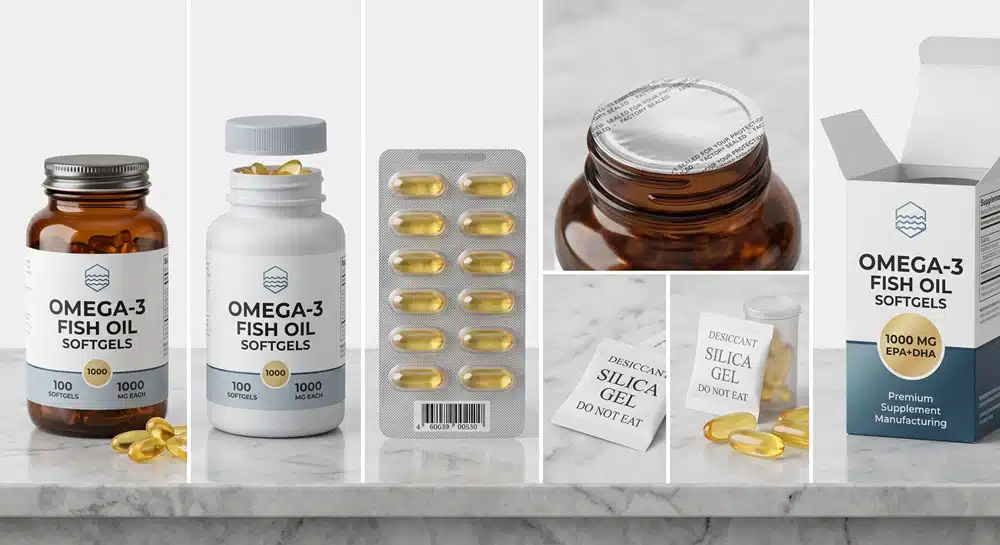
Packaging is an important part of an omega-3 stability strategy.
Depending on the formulation and target shelf life, a product-development team may evaluate factors such as:
- bottle material;
- bottle opacity;
- closure system;
- induction sealing;
- headspace;
- blister packaging;
- secondary cartons;
- oxygen-management strategies; and
- moisture control.
Packaging should not be selected only for appearance.
It should support the stability requirements of the finished product.
Stability Testing
A proposed packaging configuration and labeled storage condition should ultimately be supported by an appropriate stability program.
Afirmaciones como:
“amber bottles always solve oxidation”
or:
“refrigeration automatically doubles shelf life”
should not replace product-specific testing.
The final stability strategy should reflect the actual oil, softgel formulation, package and storage conditions.
Storage and Distribution
Finished omega-3 products may experience different environmental conditions during:
- warehousing;
- transportation;
- international shipping;
- distribution; and
- retail storage.
These conditions should be considered when developing the finished product and its labeled storage requirements.
The goal is not only to manufacture a compliant batch.
The product also needs to maintain appropriate quality throughout its intended shelf life.
Planning an Omega-3 Softgel Product?
If you are developing a fish-oil, EPA/DHA, krill-oil, algal-oil or another oil-based softgel product, storage and freshness should be considered together with:
- raw-oil specifications;
- formulation;
- oxidation control;
- softgel development;
- embalaje;
- finished-product testing; and
- commercial manufacturing.
GENSEI supports omega-3 and oil-based softgel projects for supplement brands.
Explora Omega-3 Softgel Manufacturing
Explora Fabricación de cápsulas de gelatina blanda
PREGUNTAS FRECUENTES
Why do fish oil softgels look cloudy after refrigeration?
Cold temperatures can cause some lipid components in fish oil to crystallize or become less transparent, so refrigerated softgels may sometimes appear cloudy.
Cloudiness by itself does not tell you whether the oil is oxidized or spoiled. If the appearance has changed unexpectedly, check the product’s storage instructions and contact the manufacturer if you are unsure about the specific batch.
Do not rely on appearance alone to assess oxidative quality.
Can taking a fish oil bottle in and out of the refrigerator cause condensation?
Repeated temperature changes can increase the possibility of condensation around a cold container, especially in warm or humid environments.
Because softgel shells are sensitive to moisture conditions, unnecessary cycling between cold and warm environments is best avoided.
If a product requires refrigeration, keep it consistently under the storage conditions specified by the manufacturer and close the bottle promptly after removing a serving.
What should I do if fish oil softgels were left in a hot car?
Do not assume that returning the bottle to a cool place reverses any changes caused by excessive heat.
Check the capsules for leakage, severe sticking, deformation or other visible changes, and review the manufacturer’s storage guidance.
If the bottle experienced prolonged or extreme heat exposure, contact the product manufacturer with the lot number and details of the exposure before deciding whether to continue using it.
Heat and humidity can affect both the oil and the mechanical properties of a softgel shell.
Can I store fish oil softgels in a weekly pill organizer?
A pill organizer can be convenient for short-term daily use, but it may not provide the same protection from light, moisture and environmental exposure as the original product package.
Keep the main supply in its original container and only transfer the quantity needed for a short period.
Avoid leaving a pill organizer containing fish oil softgels in a hot vehicle, direct sunlight or a humid environment.
Should I leave the desiccant or oxygen-absorber packet inside the bottle?
If the manufacturer supplied a desiccant, oxygen absorber or other freshness packet inside the bottle, leave it in place unless the label specifically tells you to remove it.
These components may be part of the packaging system used to manage moisture, oxygen or product stability.
Do not open or consume the packet.
How should I travel with fish oil softgels in hot weather?
Keep the softgels protected from prolonged heat and direct sunlight during travel.
Carrying them in your hand luggage or another temperature-controlled environment is generally preferable to leaving them for long periods in a hot parked vehicle.
Keep the bottle closed, and follow any product-specific storage instructions during the trip.
For long trips in unusually hot conditions, ask the manufacturer whether additional temperature control is recommended for that specific product.
Can refrigeration make softgel capsules harder or more brittle?
Temperature and moisture conditions can affect the physical properties of gelatin softgel shells.
This does not mean ordinary refrigeration will damage every fish oil softgel, but it is another reason not to assume that colder storage is automatically better for every product.
Use the storage conditions validated by the manufacturer of the finished softgel rather than changing storage temperature without a product-specific reason.
Conclusión
The best way to store fish oil softgels is to follow the specific product label and protect the product from inappropriate heat, light, moisture and unnecessary air exposure.
Refrigeration is not universally required.
Many fish oil supplements are intended for room-temperature or cool, dry storage, while other products may have different instructions.
Do not assume that colder storage is always better, and do not freeze fish oil softgels unless the manufacturer permits it.
For consumers, proper storage helps protect the condition of the finished product.
For supplement brands, freshness needs to be managed much earlier through:
- raw-oil specifications;
- oxidation control;
- encapsulation;
- embalaje;
- stability testing; and
- distribution planning.
If you are developing an omega-3 softgel product, GENSEI can discuss your oil specification, formulation, packaging and manufacturing requirements.
Explore Omega-3 Fabricación de cápsulas blandas →
Explore Softgel Capsule Manufacturing →
Referencias
- 1. NIH Office of Dietary Supplements — Dietary Supplement Label Database
The NIH Dietary Supplement Label Database provides examples of marketed fish-oil supplements and their manufacturer-provided storage instructions. These labels demonstrate why storage recommendations should be product-specific rather than assuming that every fish-oil softgel requires refrigeration.
Nature Made Fish Oil — NIH Dietary Supplement Label Database
Sports Research Omega-3 Fish Oil — NIH Dietary Supplement Label Database
- 2. Yenipazar H, Şahin-Yeşilçubuk N. Effect of Packaging and Encapsulation on the Oxidative and Sensory Stability of Omega-3 Supplements
Food Science & Nutrition. 2023;11:1426–1440.
This peer-reviewed study examined oxidative and sensory changes in commercial omega-3 products and evaluated the influence of product format, packaging and storage on stability.
It supports the discussion in this article regarding oxidation, packaging, encapsulation and the importance of storage conditions.
Read the study on PubMed Central
DOI: 10.1002/fsn3.3182
- 3. Global Organization for EPA and DHA Omega-3s — GOED Voluntary Monograph
The GOED Voluntary Monograph provides industry specifications and analytical requirements for omega-3 oils within its applicable scope.
The Monograph includes oxidation specifications for Peroxide Value, p-Anisidine Value and TOTOX.
Current reference values discussed in this article are:
Peroxide Value: maximum 5 meq/kg
p-Anisidine Value: maximum 20
TOTOX: maximum 26
These should be understood as GOED industry specifications rather than universal FDA limits for every finished fish-oil supplement.
- 4. GOED — Best-Practice Guidelines on Oxidation Control
GOED’s oxidation-control guidance discusses practices for reducing unnecessary exposure of omega-3 oils to oxygen, heat and light during processing, handling and storage.
This source supports the manufacturing sections of this article covering raw-oil handling, encapsulation, bulk softgel storage, packaging and environmental control.
GOED Best-Practice Guidelines on Oxidation Control
- 5. Cleveland Clinic — Fish Oil / Omega-3 Fatty Acid Capsules
This clinical consumer reference lists fishy aftertaste and burping among effects that can occur when taking fish-oil products. It supports the distinction made in this guide between ordinary fishy aftertaste and a reliable analytical determination of rancidity.
Cleveland Clinic — Fish Oil Omega-3 Fatty Acid Capsules

Warren Wan es un experto con una amplia trayectoria en la cadena de suministro de complementos alimenticios, que cuenta con una gran experiencia práctica en la investigación, el desarrollo, el control de procesos y el abastecimiento global de ingredientes clave como los péptidos de colágeno, la proteína de caldo de huesos y la queratina. Como autor de esta columna, se dedica a desmontar los argumentos de marketing, transformando la compleja ciencia de los ingredientes y las normas de control de calidad de la producción en divulgación científica rigurosa y fácil de entender, ayudando a los lectores a comprender la verdad que se esconde tras las etiquetas y a tomar decisiones más racionales en materia de salud.


