
La celulitis es frecuente y, por lo general, inofensiva. Se produce cuando la relación entre la grasa subcutánea, las bandas de tejido conectivo y la estructura de la piel da lugar a una superficie con hoyuelos o irregular. Dado que el colágeno forma parte de la piel y de la matriz del tejido conectivo, muchos consumidores buscan «péptidos de colágeno para la celulitis», «péptidos contra la celulitis» y se preguntan si «el colágeno reduce la celulitis». La respuesta requiere matizar: los péptidos de colágeno pueden contribuir a que la piel tenga un aspecto más liso, pero los resultados dependen del tipo de péptido, la dosis, la consistencia, la composición corporal, los factores relacionados con el estilo de vida y la calidad del producto.
Para las marcas de complementos alimenticios, este tema también supone un reto en materia de formulación y cumplimiento normativo. Afirmaciones como “elimina la celulitis”, “derrite la grasa”, “cura clínicamente probada” o “funciona como un tratamiento” generan un riesgo normativo innecesario. Un enfoque más adecuado consiste en explicar las pruebas científicas, establecer expectativas realistas y desarrollar un producto basado en péptidos de colágeno de calidad, una dosis adecuada, cofactores complementarios y ensayos transparentes.
¿Qué es la celulitis?
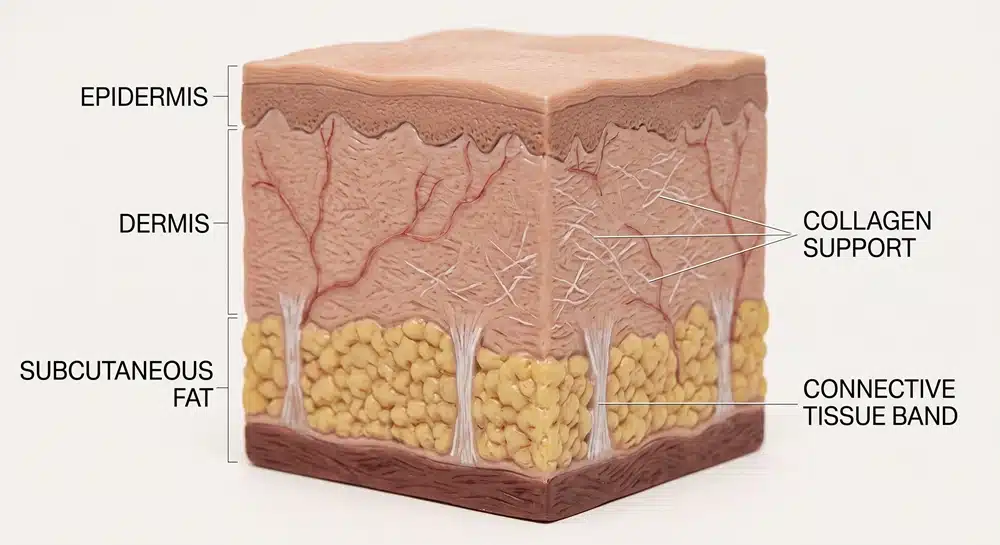
La celulitis es esa textura irregular o con hoyuelos que suele aparecer en los muslos, las caderas, las nalgas o el abdomen. No se trata simplemente de “toxinas” ni de un signo de mala salud. Está relacionada con la estructura de la piel, la capa de grasa y los septos del tejido conectivo situados debajo de la piel.
En términos sencillos, las células adiposas pueden ejercer presión hacia arriba, mientras que las bandas de tejido conectivo tiran hacia abajo. Cuando la elasticidad de la piel y el grosor de la dermis disminuyen, la superficie irregular se hace más evidente. El envejecimiento, la genética, las hormonas, la composición corporal, la circulación, el estilo de vida y el grosor de la piel pueden influir en la visibilidad de la celulitis.
¿Ayudan los péptidos de colágeno a combatir la celulitis?
Los péptidos de colágeno pueden ayudar a... aparición de la celulitis al favorecer la elasticidad, la hidratación y la densidad de la piel. La palabra clave es “aspecto”. Los péptidos de colágeno por vía oral no disuelven la grasa, no eliminan las bandas de tejido conjuntivo ni sustituyen a los procedimientos de medicina estética.
El estudio en humanos más relevante sobre este tema evaluó péptidos de colágeno bioactivos específicos en mujeres con celulitis moderada. Las participantes tomaron 2,5 g al día durante 6 meses. El estudio reveló mejoras en los parámetros relacionados con la celulitis, como la ondulación de la piel y la densidad dérmica, con efectos más pronunciados en las participantes con un IMC normal.
Esto no significa que todos los productos de colágeno vayan a producir el mismo resultado. Los distintos ingredientes de colágeno pueden variar en cuanto a su origen, distribución del peso molecular, perfil peptídico, dosis, pureza, sabor, solubilidad y fundamentación clínica. Las marcas deben evitar dar a entender que todo el “colágeno” o todos los “péptidos” son intercambiables.
¿Qué péptido es eficaz contra la celulitis?
Los datos de búsqueda suelen mostrar términos ambiguos como “péptido para la celulitis” y “el mejor péptido para la celulitis”. Estas consultas pueden referirse a varias categorías de productos diferentes, por lo que el artículo debe aclarar bien la intención del usuario.
| Tipo de péptido | Uso habitual | Cómo hablar de ello de forma responsable |
|---|---|---|
| Péptidos de colágeno para tomar por vía oral | Suplementos alimenticios, polvos para la belleza desde dentro, cápsulas, gominolas y chupitos | Puede contribuir a mantener la estructura y la elasticidad de la piel a largo plazo; no se afirma que cure ni elimine la celulitis. |
| Péptidos cosméticos de uso tópico | Sérums, cremas y lociones corporales | Puede contribuir a que la piel parezca más firme o más suave a simple vista; no es lo mismo que los péptidos de colágeno por vía oral. |
| Productos estéticos inyectables o de uso profesional | Centros de spa médico o consultas de dermatología | No se debe comparar directamente con los complementos alimenticios a menos que haya sido evaluado por equipos médicos y reguladores cualificados. |
| Medicamentos recetados para adelgazar o para tratar trastornos metabólicos, a veces denominados «péptidos» en Internet | Solo bajo supervisión médica | No presentes los complementos alimenticios como alternativas a los tratamientos con receta médica. |
Sólidez de la evidencia: lo que la investigación puede y no puede afirmar
| Área de reclamación | Nivel de evidencia | Redacción conforme a la normativa | Expresiones que deben evitarse |
|---|---|---|---|
| Aparición de la celulitis | Un estudio clínico relevante en seres humanos en el que se utilizaron péptidos de colágeno bioactivos específicos | “Puede ayudar a mejorar el aspecto de la celulitis con el tiempo”.” | “Cura la celulitis” o “elimina la celulitis”.” |
| Elasticidad e hidratación de la piel | Bibliografía más amplia sobre los péptidos de colágeno y la salud de la piel | “Puede contribuir a la elasticidad, la hidratación y la firmeza de la piel”.” | “Revertirá el envejecimiento de la piel”.” |
| Pérdida de grasa | No se trata de una afirmación sobre los péptidos de colágeno | “No está indicado para la pérdida de grasa ni como tratamiento para adelgazar”.” | “Derrite la grasa” o “quema la celulitis”.” |
| Resultados «antes y después» | Varía mucho de una persona a otra | “Los resultados varían y requieren un uso constante”.” | “Resultados visibles garantizados”.” |
Dosis recomendada y calendario de administración
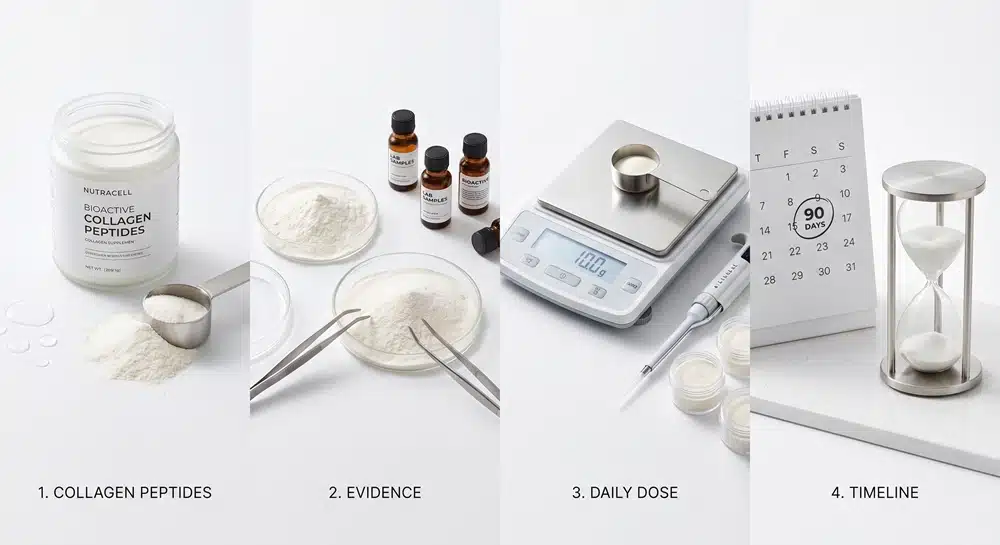
El estudio más citado sobre péptidos de colágeno específicos para la celulitis utilizó 2,5 g diarios de péptidos de colágeno bioactivos específicos durante 6 meses. Esto ofrece a las marcas un punto de referencia útil, pero no debe generalizarse a todos los ingredientes de colágeno sin una justificación adecuada.
Para los consumidores, el mensaje práctico es la constancia. Los péptidos de colágeno no son una solución rápida que se note en una misma semana. La estructura de la piel cambia lentamente. Para las marcas, el mensaje práctico es la viabilidad de la dosis. Una ración de 2,5 g puede incorporarse en polvos, cápsulas, sobres, chupitos líquidos y algunos formatos de gominolas, dependiendo del sabor, la textura, el tamaño de la ración y las limitaciones de fabricación.
| Cronología | Mensaje esperado | Cómo deberían plantearlo las marcas |
|---|---|---|
| 0-8 semanas | Fase inicial de apoyo | Establece expectativas en cuanto a la constancia, la hidratación y el apoyo en el estilo de vida. |
| 3 meses | Algunos estudios empiezan a medir los cambios visibles | Evita prometer transformaciones rápidas «antes y después». |
| 6 meses | Un criterio de valoración más adecuado para la evidencia relacionada con la celulitis | Utiliza expresiones como “uso diario a largo plazo” y “apoyo a la apariencia”. |

Los mejores formatos de producto para los péptidos de colágeno y la celulitis
En el caso de los productos para la belleza desde dentro, la elección del formato influye en la adherencia al tratamiento, la repetición de la compra y la experiencia del consumidor. Es menos probable que un producto que sabe mal o que requiere tomar demasiadas pastillas se utilice de forma constante durante un periodo de entre 3 y 6 meses.
| Formato | La mejor opción | Notas sobre la formulación |
|---|---|---|
| Paquetes de polvos en barra | Rutinas de belleza de alta gama y productos de colágeno para el día a día | Es fácil administrar 2,5 g o más. Es importante que enmascare el sabor y que se disuelva al instante. |
| Cápsulas | Regímenes orientados a la práctica clínica y fórmulas minimalistas | Es factible para 2,5 g, pero puede que se necesiten varias cápsulas dependiendo de la densidad aparente. |
| Gominolas | Marcas de belleza relacionadas con el estilo de vida y productos reutilizables | Es un formato atractivo, pero el elevado contenido en colágeno puede afectar a la textura, la actividad del agua y el sabor. |
| Chupitos líquidos | Fotografías de belleza de alta calidad y venta al por menor de productos de spa | Adecuado para cofactores como la vitamina C o el ácido hialurónico; requiere pruebas de estabilidad. |
Si tu marca está desarrollando un producto de colágeno destinado al sector de la belleza, colabora con un fabricante de suplementos de fórmula personalizada que permita evaluar la carga activa, el sabor, la estabilidad, el envase y la conformidad de las declaraciones de la etiqueta antes de la producción.
Ingredientes que combinan bien con los péptidos de colágeno
Los péptidos de colágeno suelen combinarse con ingredientes complementarios que refuerzan un enfoque más amplio de la salud de la piel. Estos ingredientes no deben utilizarse para presentar el producto como un tratamiento contra la celulitis.
- Vitamina C: favorece la formación normal de colágeno y es un cofactor lógico para las fórmulas destinadas al cuidado de la piel.
- Ácido hialurónico: Se utiliza habitualmente en fórmulas de «belleza desde dentro» para potenciar la hidratación.
- Ceramidas: puede contribuir al buen funcionamiento de la barrera cutánea cuando la evidencia y la dosis sean adecuadas.
- Antioxidantes: puede respaldar afirmaciones sobre el bienestar general de la piel cuando estén debidamente fundamentadas.
- Electrolitos o mezclas hidratantes: Útil en envases tipo stick o en formato de bebidas de belleza.
Para polvos de mayor carga, consulta fabricación de suplementos en polvo requisitos. En el caso de los productos de estilo de vida, revisa fabricación de suplementos de gominola viabilidad antes de fijar la dosis definitiva. En el caso de los diseños de cápsulas, compare el peso del relleno y el número de cápsulas con un fabricante de suplementos en cápsulas.
Especificaciones de calidad que hay que comprobar antes de adquirir péptidos de colágeno
Para los compradores B2B, la calidad de los ingredientes marca la diferencia entre un producto fiable y una afirmación en la etiqueta que entraña riesgos. Antes de elegir un proveedor de péptidos de colágeno, solicita documentación que acredite la identidad, la pureza, la seguridad y la uniformidad del producto.
| Especificación | Por qué es importante | Qué solicitar |
|---|---|---|
| Origen y trazabilidad | Facilita la transparencia en el etiquetado y la revisión de alérgenos | Documentación relativa al origen bovino, marino, porcino o avícola. |
| Distribución del peso molecular | Ayuda a evaluar la solubilidad y el perfil peptídico | Certificado de análisis (COA) o ficha técnica con el rango típico. |
| Perfil proteico y de aminoácidos | Contribuye a la revisión de la nutrición y la identidad | Análisis, método de determinación del nitrógeno y perfil de aminoácidos. |
| Contaminantes | Es necesario por motivos de seguridad y para cumplir con la normativa del mercado | Metales pesados, microbiología y contaminantes relevantes. |
| Perfil sensorial | Importante para un uso repetido | Notas sobre el sabor, el olor, el color y la solubilidad. |
| Calidad de fabricación | Protege la calidad del producto final | Documentación sobre las buenas prácticas de fabricación (GMP), registros de lotes y proceso de control de cambios. |
Guía sobre declaraciones y cumplimiento normativo para marcas de suplementos
En el caso de un complemento alimenticio, hay que tratar con cuidado cualquier referencia a la celulitis. Una estrategia de contenido más segura consiste en hablar del aspecto de la piel, su firmeza, su elasticidad y el apoyo a la belleza desde dentro, evitando al mismo tiempo cualquier referencia a enfermedades, medicamentos o tratamientos médicos.
| Formulaciones que implican un mayor riesgo | Mejor redacción |
|---|---|
| “Elimina la celulitis” | “Puede ayudar a mejorar el aspecto de la celulitis con el tiempo”.” |
| “Derrite la grasa subcutánea” | “Contribuye a mantener la estructura de la piel como parte de una rutina de belleza constante”.” |
| “Eficacia clínicamente demostrada para eliminar los hoyuelos” | “Un estudio clínico en el que se utilizaron péptidos de colágeno bioactivos específicos reveló mejoras en los parámetros relacionados con la celulitis”.” |
| “Dosis terapéutica” | “Se ha estudiado la ración diaria”.” |
| “Suplemento de colágeno aprobado por la FDA” | “Los complementos alimenticios no están autorizados por la FDA antes de su comercialización”.” |
PREGUNTAS FRECUENTES
¿De verdad reducen los péptidos de colágeno la celulitis?
Los péptidos de colágeno pueden ayudar a mejorar el aspecto de la celulitis en algunas personas, sobre todo si se utilizan de forma constante durante varios meses. No deben describirse como una cura ni como un método garantizado para eliminar la celulitis.
¿Cuánto colágeno se debe tomar para combatir la celulitis?
El estudio clave específico sobre la celulitis utilizó 2,5 g diarios de péptidos de colágeno bioactivos específicos durante 6 meses. Otros productos de colágeno pueden utilizar dosis diferentes en función de la fórmula, el formato y la evidencia disponible.
¿Qué péptido es eficaz contra la celulitis?
En el caso de los complementos alimenticios, los péptidos de colágeno hidrolizados o los péptidos de colágeno bioactivos específicos constituyen la categoría más relevante. Los péptidos cosméticos y los productos inyectables o de medicina estética son categorías diferentes y no deben confundirse con los complementos de colágeno para consumo oral.
¿Cuánto tiempo tardan los péptidos de colágeno en hacer efecto contra la celulitis?
Para obtener beneficios relacionados con la piel, suele ser necesario un uso diario constante. En cuanto al aspecto de la celulitis, es más realista fijarse un plazo de entre 3 y 6 meses que esperar cambios inmediatos.
¿Pueden los péptidos de colágeno eliminar la celulitis de forma permanente?
No. La celulitis depende de la estructura de la piel, el tejido conectivo, la genética, las hormonas y la composición corporal. Los péptidos de colágeno pueden contribuir a que la piel tenga un aspecto más suave, pero no eliminan la celulitis de forma permanente.
¿Son las gominolas de colágeno lo suficientemente eficaces para combatir la celulitis?
Es posible, pero solo si la gominola puede aportar una dosis significativa de péptidos de colágeno sin perder sabor, textura ni estabilidad. Las marcas deben comprobar la viabilidad de la concentración y realizar pruebas del producto final antes de hacer afirmaciones al respecto.
Conclusión
Los péptidos de colágeno para la celulitis deben presentarse con rigor científico y respetando la normativa vigente. El mensaje más importante no es que el colágeno “cure” la celulitis, sino que determinados péptidos de colágeno pueden favorecer la estructura, la elasticidad y la densidad de la piel, lo que puede contribuir a mejorar el aspecto de la celulitis con el tiempo.
Para las marcas de suplementos, la oportunidad radica en crear un producto creíble que promueva la belleza desde dentro: utilizar un ingrediente a base de péptidos de colágeno con eficacia demostrada, ofrecer una dosis adecuada, combinarlo con cofactores lógicos, evitar afirmaciones exageradas sobre sus efectos terapéuticos y verificar la calidad mediante el certificado de análisis (COA) y pruebas del producto final.
Si estás desarrollando un producto de péptidos de colágeno en polvo, en cápsulas, en gominolas o en forma de «beauty shot», Ponte en contacto con Collagensei para analizar el abastecimiento de ingredientes, la formulación a medida y la viabilidad de la fabricación.
Referencias
- La suplementación dietética con péptidos de colágeno específicos tiene un efecto beneficioso sobre la morfología de la celulitis que depende del índice de masa corporal
- Texto completo: Suplementación dietética con péptidos de colágeno específicos y morfología de la celulitis
- Suplementos de colágeno para el envejecimiento y las arrugas: un cambio de paradigma en la dermatología y la cosmética
- Preguntas y respuestas de la FDA sobre los complementos alimenticios
- Guía de la FTC sobre el cumplimiento normativo de los productos sanitarios

Warren Wan es un experto con una amplia trayectoria en la cadena de suministro de complementos alimenticios, que cuenta con una gran experiencia práctica en la investigación, el desarrollo, el control de procesos y el abastecimiento global de ingredientes clave como los péptidos de colágeno, la proteína de caldo de huesos y la queratina. Como autor de esta columna, se dedica a desmontar los argumentos de marketing, transformando la compleja ciencia de los ingredientes y las normas de control de calidad de la producción en divulgación científica rigurosa y fácil de entender, ayudando a los lectores a comprender la verdad que se esconde tras las etiquetas y a tomar decisiones más racionales en materia de salud.


