Bone broth powder can be as good as liquid bone broth when it is made from real broth, processed appropriately and compared at an equivalent prepared serving. However, the formats are not automatically nutritionally identical. Protein, sodium, fat, amino acids, collagen-related markers, ingredients and flavor can vary substantially by product, so the label and technical documents matter more than whether the product begins as a powder or liquid.
Consumers should compare the amount they will actually drink, not a dry scoop with an eight-ounce carton. Supplement brands and formulators should go further by confirming product identity, source tissues, manufacturing process, protein test method, amino-acid profile, sodium, microbiology, contaminants, sensory performance and finished-product stability.
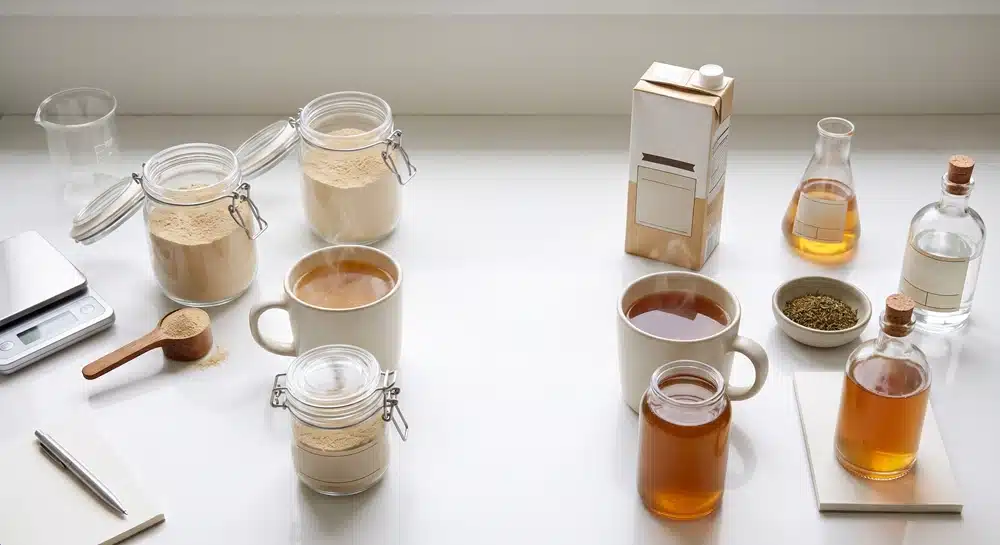
Bone Broth Powder vs Liquid at a Glance
| ファクター | ボーン・ブロス・パウダー | 液体ボーン・ブロス |
|---|---|---|
| Water content | Most water has been removed | Water is the main component |
| Best comparison basis | Prepared serving after adding the directed amount of water | One labeled serving, commonly a cup or carton portion |
| Protein and sodium | Can be concentrated, but values vary widely | Can be low or high depending on recipe and brand |
| 成分の特定 | May be dehydrated broth, hydrolyzed broth protein or a seasoning-style blend | May be homemade, refrigerated, frozen, concentrated or shelf-stable |
| テクスチャー | Depends on gelatin content and reconstitution | May be thin or gel when chilled; gelling is not a complete quality test |
| フレーバー | Convenient but may require flavor balancing | Usually offers a more familiar culinary experience |
| 保存期間 | Generally longer before opening when moisture is controlled | Usually shorter after opening and requires refrigeration unless commercially shelf-stable |
| 携帯性 | Easy to store, ship and portion | Heavier and less convenient for travel |
| Best use | Travel, single-serve drinks, protein blends and shelf-stable products | Soups, cooking, ready-to-drink use and consumers who prefer a food-like format |
The Most Important Question: What Kind of “Bone Broth Powder” Is It?
Products sold under similar names can be technically different. Before comparing powder with liquid, identify which product category is being discussed.
1. Dehydrated Whole-Broth Powder
This format begins with a cooked broth that is concentrated and dried. It may preserve a broader broth-like composition, but the finished profile still depends on the bones and tissues used, cooking conditions, filtration, fat removal, carriers, drying process and serving size.
2. Bone Broth Protein or Hydrolyzed Broth Protein
This is a more protein-focused ingredient. It may be processed to increase protein concentration or reduce molecular size. It should not automatically be described as nutritionally identical to traditional liquid broth. Buyers should request the manufacturing flow, full amino-acid profile, collagen or hydroxyproline data and confirmation of any hydrolysis claims.
3. Bouillon-Style or Flavored Broth Powder
Some instant powders are primarily seasoning systems containing salt, flavors, starches, yeast extract, fat or small amounts of broth material. These products can be useful for cooking, but they should not be evaluated as concentrated protein powders solely because the package says “broth.”
4. Bone Broth Concentrate or Paste
A concentrate retains more water than a dry powder and may include fat, gelatin and flavor compounds. Compare the concentrate after dilution according to directions, not spoon-for-spoon against a prepared liquid.
Does Drying Destroy Bone Broth Nutrients?
Drying removes water and can change flavor, color, oxidation, solubility and the behavior of heat-sensitive components. It does not automatically “kill” protein or make the product ineffective. The outcome depends on the raw broth, temperature-time exposure, oxygen, concentration step, drying method, storage conditions and packaging.
Spray drying is not inherently low quality, and freeze drying is not automatically superior for every specification. A well-controlled spray-dried ingredient may have excellent protein, moisture and microbiological results. A freeze-dried product can still be poorly sourced, high in sodium or inconsistent. Ask for measured data rather than relying on the name of the drying technology.
How to Compare Nutrition Correctly
Do not compare a dry scoop with a cup of liquid by weight alone. Use the product instructions to prepare one serving, then compare the same volume or the same intended use.
| 確認 | なぜ重要なのか | Practical Method |
|---|---|---|
| Serving basis | A dry scoop is more concentrated because water has been removed | Compare the prepared powder serving with the labeled liquid serving |
| Protein grams | Protein varies by raw materials and processing | Use grams per prepared serving and, when useful, grams per 100 calories |
| ナトリウム | Both formats can be high or low in sodium | Compare milligrams per prepared serving and percent Daily Value |
| Ingredient list | Carriers, flavors, salt and anti-caking agents change the product | Review the full list instead of judging all additives as automatically negative |
| Fat and calories | Liquid broth may retain fat; high-protein powders may be defatted | Compare the Nutrition Facts or Supplement Facts panel |
| アミノ酸組成 | Bone broth is typically collagen-rich and may be limited in essential amino acids | For sports or meal-positioned products, request a complete amino-acid analysis |
| Collagen-related evidence | “Bone broth” does not prove a specific collagen type or dose | Request collagen, hydroxyproline or source-tissue data when claims depend on them |
Published analysis has found large variability in the amino-acid content of nonstandardized bone broth preparations. This is why a generic nutrition number from one recipe, database entry or competing brand should not be presented as the standard for all powders or liquids.
Is Powder More Concentrated Than Liquid?
On a dry-weight basis, powder is concentrated because most water has been removed. That does not mean every labeled powder serving contains more protein than every liquid serving. Serving sizes can be set differently, and some powders contain salt, flavors, carriers or other ingredients.
A better consumer comparison is:
- Prepare the powder exactly as directed.
- Compare equal ready-to-consume volumes.
- Review protein, sodium, calories and ingredient lists.
- Adjust for the number of servings actually consumed.
Is Liquid Bone Broth More Bioavailable?
There is no reliable basis for saying that liquid bone broth is universally absorbed better because it is already liquid. Digestion and absorption depend on the proteins and peptides present, serving size, food matrix and the individual product. Similarly, a powder should not be called more bioavailable merely because it dissolves quickly or has a reported molecular-weight range.
If a brand wants to make a comparative absorption or bioavailability claim, it should have evidence on the relevant finished products, not only a general statement about liquids, dehydration or collagen peptides.
Does Bone Broth Powder Have the Same Benefits as Liquid?
The formats may deliver similar nutrients when they originate from comparable broth and are consumed in nutritionally matched servings. However, “same benefits” is too broad without product-specific evidence. Homemade broth, commercial liquid broth, dehydrated whole broth and hydrolyzed bone broth protein can differ in amino acids, minerals, fat, sodium, gelatin, flavor compounds and other components.
Bone broth should not be promoted as proven to heal the gut, regenerate cartilage, treat inflammation, boost immunity or provide a therapeutic dose of a specific collagen type unless those claims are supported by competent evidence for the exact product and use. Consumers can treat broth as a food or protein-containing ingredient, while brands should keep health claims narrow and substantiated.
Does Real Liquid Bone Broth Have to Gel?
No. Gelling when chilled can indicate enough gelatin is present under the storage conditions, but lack of a firm gel does not prove that a broth is fake or nutritionally poor. Gel formation depends on gelatin concentration, dilution, temperature, cooking and filtration, pH, salts and processing.
A gel test also does not measure amino-acid quality, sodium, contaminants, microbiological safety or the suitability of the product for a particular consumer. Use it as a texture observation, not as a pass-or-fail quality standard.
Powder vs Liquid: Which Is Better for Different Uses?
| ゴール | Usually More Practical | 確認すべき事項 |
|---|---|---|
| Cooking soups, sauces and grains | Liquid or concentrate | Flavor, salt level, gelatin and recipe compatibility |
| Travel and single-serve use | パウダー | Mixability, packaging, moisture protection and serving directions |
| Higher protein in a compact serving | Protein-focused powder may fit | Protein test method, amino-acid profile and serving size |
| Lower-sodium diet | Either | Compare sodium per prepared serving; do not assume one format is lower |
| Traditional food experience | 液体 | Ingredients, storage instructions and taste |
| Long shelf life and lower shipping weight | パウダー | Water activity, packaging barrier and stability |
| Muscle-building protein | Neither should be assumed complete | Essential amino acids, leucine and protein-quality strategy |
For a deeper explanation of protein quality, see whether bone broth protein powder is a complete protein.
消費者向けラベルのチェックリスト
- Product identity: Is it dried broth, broth protein, concentrate or a flavored seasoning blend?
- Prepared serving: How much powder and water make one serving?
- プロテインだ: Compare grams per prepared serving, not marketing adjectives.
- Sodium: Check milligrams and percent Daily Value per serving.
- 原材料 Review broth material, salt, flavors, fats, starches, gums, carriers and anti-caking agents.
- Animal source: Beef, chicken, turkey or another source; confirm dietary or religious requirements.
- Allergens and cross-contact: Review the label and manufacturer information.
- ストレージ: Follow refrigeration directions for liquid and moisture-protection directions for powder.
- 主張: Be cautious with “gut healing,” “joint regeneration,” “detox,” “therapeutic” or “clinically proven” language.
How Supplement Brands Should Compare Powder and Liquid Concepts
For brands, the choice is not simply a nutrition comparison. Powder and liquid products have different development, manufacturing, packaging and commercial requirements.
| Development Factor | Powder Product | Liquid Product |
|---|---|---|
| Core technical risks | Moisture pickup, clumping, flowability, segregation, flavor and dispersion | pH, microbial control, oxidation, separation, viscosity, preservation and filling |
| パッケージング | Tubs, pouches, sachets or stick packs with moisture barrier | Bottles, cartons, pouches or shots with closure and compatibility testing |
| Shipping | Lower shipping weight because water is added later | Higher weight and greater risk of leakage or temperature exposure |
| Consumer experience | Requires mixing and clear preparation directions | Ready to drink or heat, with fixed concentration per bottle |
| Shelf-life program | Moisture, water activity, flavor, oxidation and package barrier | Microbiology, pH, preservative system, oxidation, separation and package compatibility |
| Label basis | Dry serving and, where applicable, preparation instructions | Ready-to-consume serving |
Brands developing shelf-stable mixes can review 粉末サプリメント製造. Ready-to-drink, shot or bottled concepts require different controls, which are covered by 液体サプリメント製造.
Bone Broth Powder Supplier and COA Checklist
A product name and protein percentage are not enough to qualify a commercial ingredient. For a bone-broth raw-material project, request:
- Exact product name and intended regulatory category
- Animal species, country of origin and source-tissue declaration
- Broth-cooking, extraction, concentration, hydrolysis and drying flow chart
- Complete ingredient and processing-aid statement
- Protein result with method and dry-basis or as-is basis
- Full amino-acid profile and essential-amino-acid review
- Collagen, hydroxyproline or collagen-type data when used in claims
- Sodium, moisture, ash, fat and carbohydrate specifications
- Heavy metals, microbiology, veterinary, BSE/TSE and contaminant documents
- Allergen, cross-contact, GMO, Halal and Kosher documentation as applicable
- Bulk density, particle size, solubility, dispersibility and sensory data
- Current batch COA, specification, SDS, sample, MOQ, lead time and packaging
For an example of the level of technical qualification required, review the bulk chicken bone broth powder specification.
Bone Broth Powder vs Collagen Powder
Bone broth powder and collagen powder are related but not interchangeable categories. Collagen peptides are usually more narrowly standardized around hydrolyzed collagen protein, while a bone broth ingredient may include a broader or more variable composition depending on its source and process. A bone-broth product should not be described as a standardized collagen dose unless analytical evidence supports that claim.
Brands comparing these ingredient strategies can use the bone broth vs collagen technical guide.
Red Flags When Comparing Products
- Fixed claims such as “all liquid broth contains 6–10 g protein” or “all powder contains 15–20 g”
- Claims that powder is always lower in sodium or liquid is always higher in preservatives
- Statements that all chicken broth is rich in verified Type II collagen
- “Therapeutic dose” language without a defined ingredient, dose and clinical basis
- Claims that freeze drying guarantees nutrient superiority
- Claims that a product is clean or hormone-free solely because it is grass-fed or pasture-raised
- Treating “natural flavors” as proof of harmful chemicals without evaluating the actual formula
- Using gel formation as the only proof of quality
- References that do not support the cited statement or are unrelated to bone broth
よくある質問
Is bone broth powder as good as liquid bone broth?
It can be, but not automatically. A real dehydrated broth consumed at an equivalent prepared serving may provide similar protein and amino acids. Compare product identity, serving size, protein, sodium, ingredients, process and testing.
Is powdered bone broth nutritionally the same as liquid?
Not necessarily. Drying removes water, but commercial powders and liquids may use different raw materials, concentrations, flavors, salt levels, fats and processing steps. Use the actual labels and technical documents.
Does powdered bone broth lose its benefits?
Drying can affect flavor, oxidation, solubility and some components, but it does not automatically destroy protein. Broad health “benefits” still require product-specific evidence.
Which has more collagen: powder or liquid?
The format alone does not answer the question. Request a measured collagen or hydroxyproline value, or compare a verified collagen-protein specification. Do not infer collagen type or amount from the product name.
Is bone broth powder lower in sodium?
Some products are; others are not. Compare sodium per prepared serving and percent Daily Value. Both powder and liquid products can be formulated with high or low sodium.
What is the difference between bone broth powder and concentrate?
Powder has had most water removed. Concentrate or paste retains more water and may preserve different flavor, fat and gelatin characteristics. Compare both after dilution according to directions.
Are bone broth pills as good as liquid?
Capsules contain limited space and may deliver much less material than a cup of broth or a powder scoop. Compare grams of actual ingredient per daily serving rather than the dosage-form name.
Is bone broth powder Halal?
It is only Halal when the animal source, slaughter, processing, cross-contact controls and certification meet the relevant requirements. “Chicken” or “beef” on its own is not proof of Halal status.
最終的な提言
Bone broth powder is not inherently better or worse than liquid. Choose powder for portability, shelf life, compact protein delivery and lower shipping weight. Choose liquid for ready-to-use convenience, cooking and a traditional broth experience. In both cases, judge the actual product by its prepared serving, ingredient identity, protein, sodium, amino-acid profile, source documents, safety testing and sensory quality.
For brands: define whether the concept is a food-like broth, a protein-focused supplement or a savory functional ingredient before selecting the raw material and dosage form. Then qualify the exact ingredient and validate the finished product instead of relying on generic bone-broth assumptions.
参考文献
- Bone Broth Unlikely to Provide Reliable Concentrations of Collagen Precursors Compared With Supplemental Sources of Collagen Used in Collagen Research
- Plasma Amino Acid Concentrations After the Ingestion of Dairy and Collagen Proteins in Healthy Active Males
- Operational Parameters and Key Characteristics of Amino Acids and Flavor Compounds Profiles of Bovine Bone Broths
- 米国農務省 食品データセンター
- FDA: How to Understand and Use the Nutrition Facts Label
- FDA: Sodium in Your Diet
- FDA: Dietary Supplement Current Good Manufacturing Practice
- FTC:健康関連製品のコンプライアンスに関するガイダンス
Disclaimer: This article is for educational and formulation-planning purposes and is not medical advice. Product composition varies. Consumers with dietary restrictions, allergies, medical conditions or prescribed diets should review the label and consult an appropriate healthcare professional.

ウォーレン・ワン氏は、栄養補助食品のサプライチェーンにおいて豊富な経験を持つベテランの専門家であり、コラーゲンペプチド、骨スープ由来タンパク質、ケラチンといった主要成分の研究、開発、工程管理、およびグローバルな調達において、豊富な実務経験を有しています。 本コラムの執筆者として、彼はマーケティング的な装いを剥ぎ取り、難解な成分科学や製造品質管理基準を、分かりやすい本格的な科学普及記事へと変換することに尽力しています。これにより、読者がラベルの裏にある真実を理解し、より合理的な健康に関する選択を行えるよう支援しています。.