Consumers usually encounter hydrolyzed ケラチン in shampoos, conditioners, masks, leave-in products and styling treatments. Formulators should evaluate the exact INCI identity, animal source, peptide distribution, active solids, odor, solubility, microbiological quality and product-specific safety data rather than relying on the word “keratin” alone.
加水分解ケラチンとは?
Keratin is a family of structural proteins found in animal tissues such as hair, wool, horn, hooves, nails and feathers. Native keratin is highly cross-linked and relatively insoluble, which limits its use in water-based cosmetic systems. Hydrolysis breaks the protein into smaller fractions that can be dispersed or dissolved more easily and incorporated into hair, nail and skin-conditioning products.
The Cosmetic Ingredient Review definition describes 加水分解ケラチン as a hydrolysate of keratin produced by acid, enzyme or another hydrolysis method. It is used mainly as a hair-conditioning, nail-conditioning or skin-conditioning ingredient. The exact source and manufacturing process can change the amino-acid profile, molecular-weight distribution, color, odor and performance of the commercial material.
Hydrolyzed Keratin vs Keratin: What Is the Difference?
| ファクター | Native Keratin | 加水分解ケラチン |
|---|---|---|
| 構造 | Large, fibrous and strongly cross-linked protein | Smaller peptide and amino-acid fractions produced by hydrolysis |
| Water compatibility | Generally difficult to dissolve or formulate in ordinary aqueous systems | Often more water-dispersible or water-soluble, depending on grade |
| Hair interaction | Limited direct use because of size and insolubility | Lower-MW fractions may enter damaged fiber regions; larger fractions may remain closer to the surface and form a conditioning film |
| Common use | Specialty materials and research applications | Shampoos, conditioners, masks, leave-ins, styling products and selected supplement ingredients |
| Key purchase specification | Protein identity and extraction method | Source, INCI identity, molecular-weight distribution, active solids, amino-acid profile and contaminant limits |
How Is Hydrolyzed Keratin Made?
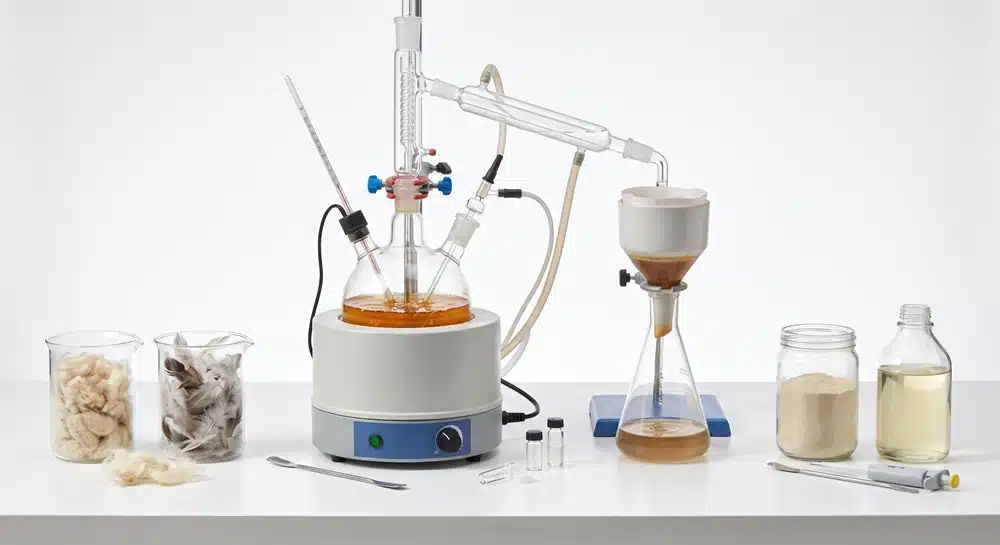
Commercial hydrolyzed keratin is typically produced from a keratin-rich animal material such as wool, feathers, horn or hoof. The material is cleaned and processed, then hydrolyzed by an acid, enzyme or another controlled method. The resulting liquid can be filtered, concentrated and supplied as a preserved solution or dried into a powder.
There is no single universal manufacturing route. Two products sold under the same broad ingredient name can differ substantially in average molecular weight, peptide distribution, active content, residual ash, odor and color. Buyers should therefore request a process summary and batch specification instead of assuming that every hydrolyzed keratin grade is interchangeable.
What Does Hydrolyzed Keratin Do for Hair?
Hydrolyzed keratin is primarily a conditioning ingredient. Research on relaxed textured hair found that lower- and mid-molecular-weight keratin fractions could penetrate more deeply into the hair fiber, while a high-molecular-weight fraction mainly adsorbed onto the surface. In the same study, some mid- and high-molecular-weight treatments improved mechanical properties and reduced breakage under the tested laboratory conditions.
These findings support a molecular-weight-dependent mechanism rather than the broad claim that every keratin product “repairs hair from the inside.” In a finished product, hydrolyzed keratin may contribute to:
- Temporary improvement in combability and surface smoothness
- Reduced rough feel in chemically or mechanically damaged hair
- Film formation that can support shine and manageability
- Improved tensile or breakage performance in some tested systems
- A protein-conditioning story for masks, conditioners and leave-in products
Results depend on hair type, damage level, peptide size, charge, product pH, deposition system and the other conditioning ingredients. For a consumer-focused application guide, see the 髪のための加水分解ケラチンガイド.
Does Hydrolyzed Keratin Straighten Hair?
No. Hydrolyzed keratin by itself is not a permanent hair-straightening agent. A shampoo, conditioner or mask containing hydrolyzed keratin may make hair feel smoother, reduce frizz temporarily or improve manageability, but it does not permanently rearrange the hair’s internal bonds.
The term “keratin treatment” is used for several very different product categories. Some salon smoothing or straightening services use heat together with reactive chemicals or aldehyde-releasing systems. Hydrolyzed keratin may be present in such a formula, but it is not the ingredient responsible for permanent or semi-permanent straightening. Brands should avoid implying that a hydrolyzed keratin raw material alone delivers salon-straightening results.
Is Hydrolyzed Keratin the Same as a Keratin Treatment?
No. Hydrolyzed keratin is an ingredient. A keratin treatment is a finished service or product system that may contain proteins, conditioning agents, silicones, polymers, acids, preservatives and other functional materials. Consumers should evaluate the complete ingredient list and product directions rather than assuming that every product marketed with the word “keratin” has the same chemistry or safety profile.
加水分解ケラチンと加水分解コムギタンパク質の比較
Hydrolyzed keratin is animal-derived and has a keratin-related amino-acid profile. Hydrolyzed wheat protein is plant-derived and is commonly selected for film formation, moisture feel and plant-based positioning. Neither name alone predicts finished-product performance. Molecular weight, charge, allergen status, sensory behavior and formula compatibility are more useful decision factors.
Brands comparing animal and plant protein systems can review the full 加水分解ケラチンと加水分解小麦タンパク質の比較 formulation guide.
Is Hydrolyzed Keratin Vegan, Halal or Kosher?
Hydrolyzed keratin is generally not vegan because true keratin is an animal protein. Products described as “vegan keratin” are usually blends of plant proteins or amino acids designed to imitate some conditioning properties of keratin; they are not animal keratin.
Halal and kosher status cannot be assumed from the ingredient name. It depends on the animal source, slaughter status where relevant, processing aids, manufacturing controls and certification. Buyers should request current certificates and source declarations for the exact production site and batch family.
加水分解ケラチンは安全か?
The Cosmetic Ingredient Review Expert Panel concluded that the assessed keratin-derived ingredients, including Hydrolyzed Keratin, are safe in cosmetics under the practices of use and concentrations described in its safety assessment. That conclusion does not eliminate the need for finished-product safety substantiation, appropriate preservation, impurity control, exposure assessment and compliant labeling.
Hydrolyzed proteins can vary widely in source and molecular weight. Consumers with a known allergy to a source material or a history of reactions to protein-containing cosmetics should review the full product label and seek professional advice when appropriate. Stop use if a product causes persistent redness, swelling, itching or eye irritation.
Can Hydrolyzed Keratin Cause Protein Buildup?
“Protein buildup” is not a standardized medical diagnosis, but some users report that frequent use of protein-rich hair products makes their hair feel stiff, dry, rough or more prone to snapping. This may reflect the combined effects of the product film, hair porosity, cleansing routine and moisture balance.
If hair feels progressively rigid or rough, reduce the frequency of the protein-containing product, use a gentle cleanser to remove residue and alternate with a moisturizing conditioner. Do not add raw hydrolyzed keratin powder directly to a home formula unless you have the necessary formulation, preservation and safety controls.
Topical Hair-Care Evidence Is Not Oral Supplement Evidence
Evidence showing that a peptide fraction can interact with a damaged hair fiber does not prove that taking the same ingredient orally produces the same cosmetic result. Oral keratin peptide products require separate identity, digestibility, dose, safety, contaminant and finished-product evidence.
Brands developing ingestible products should evaluate bulk hydrolyzed keratin peptides for supplement products as a separate use case and should not transfer topical shampoo or hair-fiber claims to a dietary supplement without relevant substantiation.
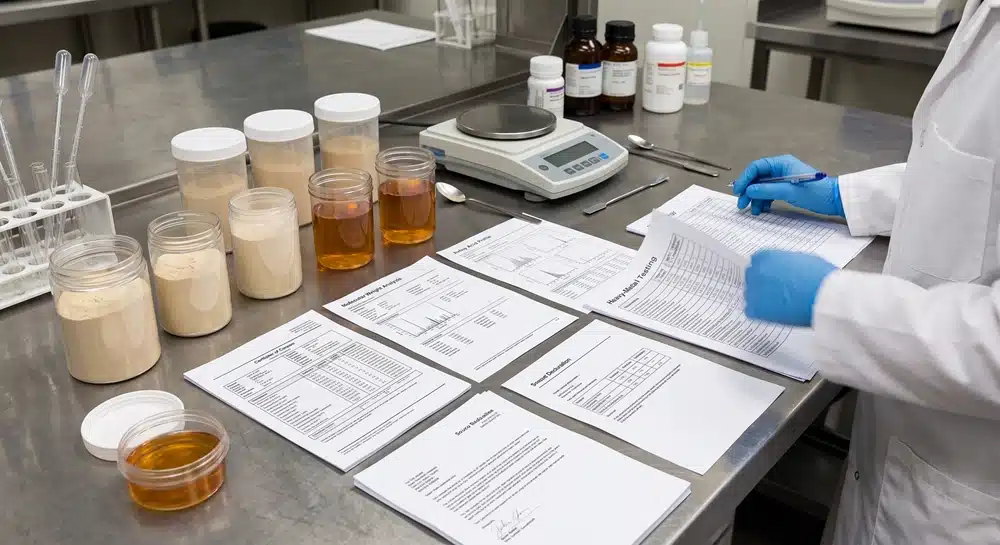
How Formulators Should Select a Hydrolyzed Keratin Grade
1. Confirm the Exact Ingredient Identity
Do not copy one CAS number across every keratin-derived ingredient. The Cosmetic Ingredient Review assessment lists Hydrolyzed Keratin and Hydrolyzed Hair Keratin as different INCI identities with different definitions and CAS references. For example, CAS 69430-36-0 is associated with Hydrolyzed Hair Keratin, not every generic hydrolyzed keratin product.
2. Define the Source Material
- Sheep or goat wool
- Bovine hoof or horn
- Bird feathers
- Other documented animal tissues
Request animal-origin, country-of-origin, BSE/TSE, human-origin exclusion and traceability documents. Human-hair-derived material can face additional market restrictions and should not be treated as equivalent to wool- or feather-derived grades.
3. Review Molecular-Weight Distribution
Average molecular weight alone is not always sufficient. Ask for the test method and, where relevant, the distribution of low-, mid- and high-molecular-weight fractions. Smaller peptides and larger film-forming fractions can behave differently on hair.
4. Verify Active Content and Physical Properties
- Active solids or protein content
- Total nitrogen and calculation method
- アミノ酸組成
- 水分または乾燥減量
- アッシュ
- pHと溶解度
- Color and odor specification
- Preservative system for liquid grades
5. Check Contaminants and Microbiology
- Heavy metals, including lead, cadmium, mercury and arsenic
- Total aerobic count, yeast and mold
- Specified pathogens appropriate to the intended product
- Residual processing chemicals when relevant
- Foreign matter and batch-to-batch sensory consistency
For commercial sourcing, request batch-level hydrolyzed keratin raw material specifications rather than relying only on marketing descriptions.
Finished-Product Formulation Checklist
| 確認 | なぜ重要なのか | Recommended Evidence |
|---|---|---|
| 数式の互換性 | Proteins can interact with surfactants, cationic conditioners, salts and preservatives | Bench stability, viscosity, pH and appearance data |
| Deposition and sensory feel | Too little may have no measurable effect; too much can create stiffness or residue | Combability, wet/dry feel and panel testing |
| Preservation | Protein-containing aqueous systems can support microbial growth | Preservative efficacy and microbial limits |
| パッケージング | Air, light and repeated contamination can affect liquid products | Container compatibility and in-use testing |
| Claim support | Ingredient data do not automatically prove finished-product performance | Product-specific instrumental, hair-tress or consumer testing |
| Market compliance | Ingredient identity and origin rules vary by market | INCI review, origin documents and regulatory assessment |
Teams that need help matching peptide specifications to dosage form, stability and quality requirements can use GENSEI’s 研究・製品開発支援.
化粧品の効能表示および表示に関する考慮事項
In the United States, cosmetic claims must be truthful and not misleading. A shampoo or conditioner can make appearance-focused claims such as “helps hair feel smoother,” “improves combability” or “reduces the appearance of damage” when supported by appropriate evidence. Claims to regrow hair, treat alopecia, repair living follicles or permanently alter body structure can cause a product to be regulated as a drug.
Do not describe a cosmetic ingredient or finished product as “FDA approved” or “FDA certified.” With limited exceptions such as certain color additives, cosmetics and cosmetic ingredients do not receive FDA premarket approval. The responsible company must maintain adequate safety substantiation and compliant labeling.
よくある質問
What is hydrolyzed keratin made of?
It is made by hydrolyzing keratin-rich animal material, commonly wool, feathers, horn or hoof. The source and process should be confirmed on supplier documentation.
加水分解ケラチンはタンパク質ですか?
Yes. It is a mixture of smaller peptides and amino-acid fragments produced from keratin protein.
Does hydrolyzed keratin permanently repair hair?
No cosmetic ingredient can restore a dead hair fiber to its original biological state. Hydrolyzed keratin can provide temporary conditioning, surface reinforcement or measurable mechanical benefits in some formulas.
Does hydrolyzed keratin straighten hair?
No. It can improve smoothness and manageability, but permanent or semi-permanent straightening depends on a complete treatment system, not hydrolyzed keratin alone.
Is hydrolyzed keratin formaldehyde?
No. Hydrolyzed keratin is a protein hydrolysate. Some salon smoothing systems may contain or release formaldehyde-related chemicals, but that is a separate issue involving the full formula.
加水分解ケラチンはヴィーガンですか?
Usually not. True keratin is animal-derived. Plant-protein products marketed as vegan keratin are keratin alternatives, not animal keratin.
What is the INCI name?
The common cosmetic INCI name is Hydrolyzed Keratin. Other keratin-derived ingredients have different INCI identities, so brands should confirm the exact material supplied.
What should buyers request from a supplier?
Request the specification, batch COA, exact INCI and CAS identity, source declaration, molecular-weight data, active content, amino-acid profile, microbiology, heavy metals, BSE/TSE documentation, allergen statement, stability information, MOQ and lead time.
結論
Hydrolyzed keratin is a versatile protein-conditioning ingredient, but it should not be reduced to the claim that it “penetrates and permanently repairs hair.” Its real performance depends on the source, molecular-weight distribution, formula system and test method. Consumers should distinguish it from salon straightening treatments, while brands should qualify the exact ingredient identity, safety documentation, contaminants, sensory profile and finished-product evidence before making performance claims.
参考文献
- 化粧品成分レビュー:化粧品に使用されるケラチンおよびケラチン由来成分の安全性評価
- PubMed:分子量の異なる加水分解ケラチンの毛髪繊維への浸透
- FDA:化粧品の表示・効能表示
- FDA: Cosmetic Ingredients
- FDA: Cosmetics and U.S. Law
Disclaimer: This article is for ingredient education and product-development reference. It is not medical advice and does not replace a finished-product safety, regulatory or claims review for the intended market.
ウォーレン・ワン氏は、栄養補助食品のサプライチェーンにおいて豊富な経験を持つベテランの専門家であり、コラーゲンペプチド、骨スープ由来タンパク質、ケラチンといった主要成分の研究、開発、工程管理、およびグローバルな調達において、豊富な実務経験を有しています。 本コラムの執筆者として、彼はマーケティング的な装いを剥ぎ取り、難解な成分科学や製造品質管理基準を、分かりやすい本格的な科学普及記事へと変換することに尽力しています。これにより、読者がラベルの裏にある真実を理解し、より合理的な健康に関する選択を行えるよう支援しています。.