
For supplement brands, Alpha Lipoic Acid (ALA) and Berberine HCl are not just two popular metabolic-health ingredients. They are a difficult co-formulation pair with very different processing risks: ALA is heat-sensitive and has a low melting point, while berberine is intensely yellow, poorly absorbed, bitter, and challenging to clean from shared powder equipment.
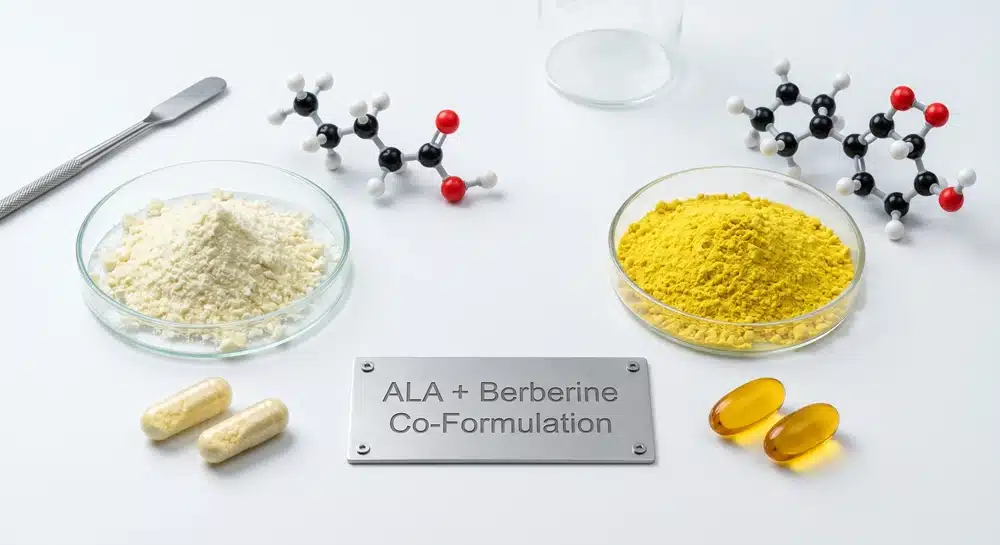
Quick Answer: Are Alpha Lipoic Acid and Berberine the Same?
Альфа-липоевая кислота and berberine are not the same. Alpha lipoic acid is a thiol-based antioxidant and mitochondrial cofactor, while berberine is an isoquinoline alkaloid derived from botanical sources. ALA is commonly positioned for antioxidant and cellular-energy support; berberine is commonly positioned for metabolic-health and glucose-metabolism support within normal ranges.
What Are Alpha Lipoic Acid and Berberine?
Alpha Lipoic Acid (CAS 1077-28-7) is a thiol-based antioxidant and mitochondrial cofactor. Berberine HCl (CAS 2086-83-1) is an isoquinoline alkaloid used in metabolic-health supplements. Together, the two ingredients are often positioned for cellular energy, glucose metabolism support, and healthy lipid-marker support within normal ranges.
Alpha Lipoic Acid at a Glance
Alpha lipoic acid is an amphiphilic antioxidant, meaning it is relevant in both water- and lipid-associated environments. In supplement formulation, ALA is valued for antioxidant defense, mitochondrial-support positioning, and its role in cellular energy metabolism. From a manufacturing perspective, the key issue is physical stability: ALA has a reported melting point near 60.5°C, which can create heat and friction challenges during tablet compression, capsule filling, and long blending cycles.
Berberine HCl at a Glance
Berberine is a yellow isoquinoline alkaloid found in several botanical materials. Berberine HCl is common in supplement formulas because it gives formulators a defined salt form and measurable assay target. The main formulation challenges are poor oral bioavailability, intense bitterness, yellow staining, and powder-room cross-contamination risk.
ALA vs Berberine: Mechanism, Formulation Role, and Label Positioning
Alpha lipoic acid and berberine should not be described as interchangeable ingredients. ALA is best positioned as an antioxidant and mitochondrial-support ingredient, while berberine is more commonly used as a botanical alkaloid for metabolic-health formulas. For a compliant dietary supplement page, avoid disease terms such as “treats diabetes” or “lowers cholesterol.” Use structure/function language such as “supports glucose metabolism,” “supports healthy lipid biomarkers already within normal range,” and “supports cellular energy metabolism.”
Can You Take Berberine With Alpha Lipoic Acid?
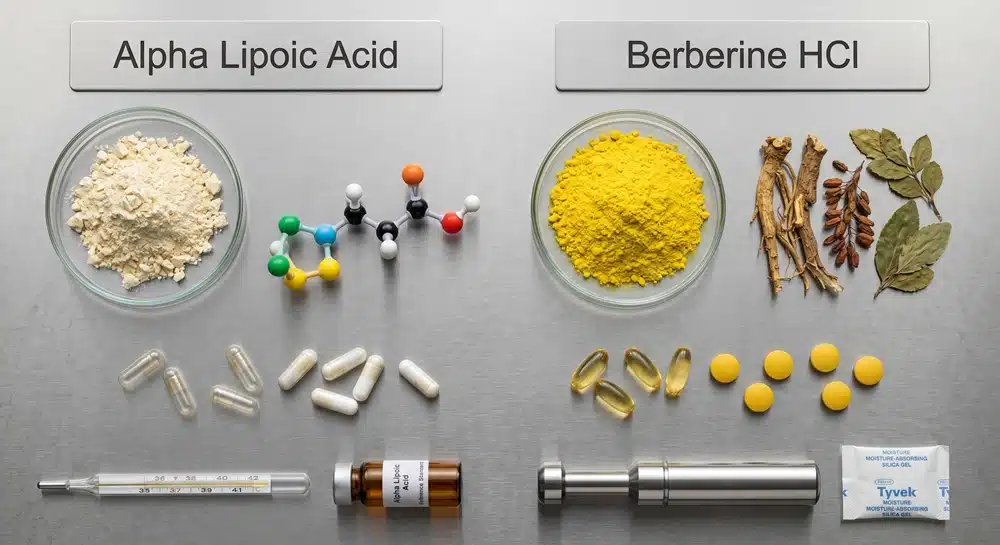
Berberine and alpha lipoic acid can appear in the same dietary supplement formula, but the combination should be designed conservatively. Both ingredients are commonly positioned for metabolic-health support, so finished-product labels should include responsible use directions and avoid implying drug-like glucose or cholesterol treatment. Consumers using prescription medication, pregnant or breastfeeding individuals, and people with complex medical conditions should consult a qualified healthcare professional before use.
For brands, the more important question is not only “can they be taken together?” but “which delivery format keeps the formula stable, compliant, and manufacturable?” A combined capsule is usually easier to control than a powder drink because berberine is intensely bitter and yellow, while ALA can be sensitive to heat and light during processing.
Industrial Co-Formulation and Manufacturing Specifications for Brand Owners
ALA low-melting behavior: the hidden tableting and capsule-filling risk
Alpha lipoic acid has a low reported melting point near 60.5°C, which creates practical problems during high-speed solid-dose manufacturing. Friction heat from tablet tooling, capsule-filling tamping pins, or long blending cycles can soften ALA and cause sticking, poor flow, and content-uniformity drift. For high-ALA formulas, an experienced manufacturer should evaluate low-temperature blending, optimized lubricant systems, microencapsulation, or softgel delivery.
Brands developing heat-sensitive ALA formulas should evaluate automated capsule supplement manufacturing services or oxidation-protective производство мягких гелевых капсул before selecting a final dosage form.Berberine bioavailability: formulation is not just a marketing claim
Berberine is known for poor oral bioavailability in the literature. One pharmacokinetic study reported very low absolute bioavailability in an animal model, and later reviews discuss first-pass effects and intestinal limitations as major barriers. From a formulation standpoint, this means particle size, salt form, excipient selection, and serving format matter.
For powder systems, micronization above 120 mesh can improve dispersion, but it also increases dusting and cleaning requirements. For capsule and tablet products, flow agents and bitter-taste containment become more important than flavor masking. If the product is planned as a sachet, stick pack, or functional drink powder, prototype it first through производство порошковых добавок to test taste, dispersion, and moisture behavior.Yellow pigment and cross-contamination control
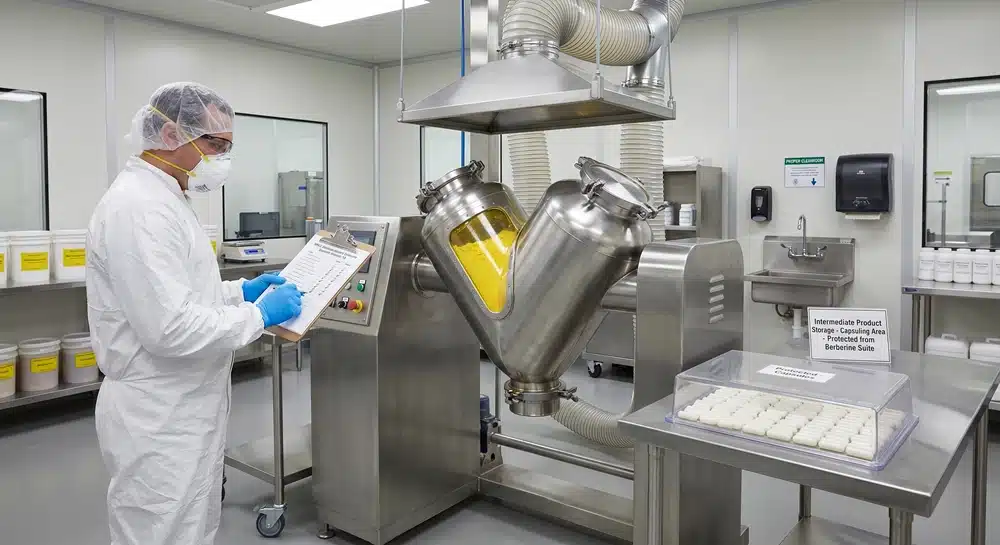
Berberine HCl is a strong yellow material. In a shared supplement facility, yellow dust can contaminate white-label powders, capsules, and clean-label botanical blends if cleaning verification is weak. A B2B manufacturer should isolate weighing, pre-blending, and post-blending steps, then confirm cleaning effectiveness using visual inspection plus validated analytical methods such as HPLC where appropriate.
Best Dosage Form for ALA + Berberine
Капсула
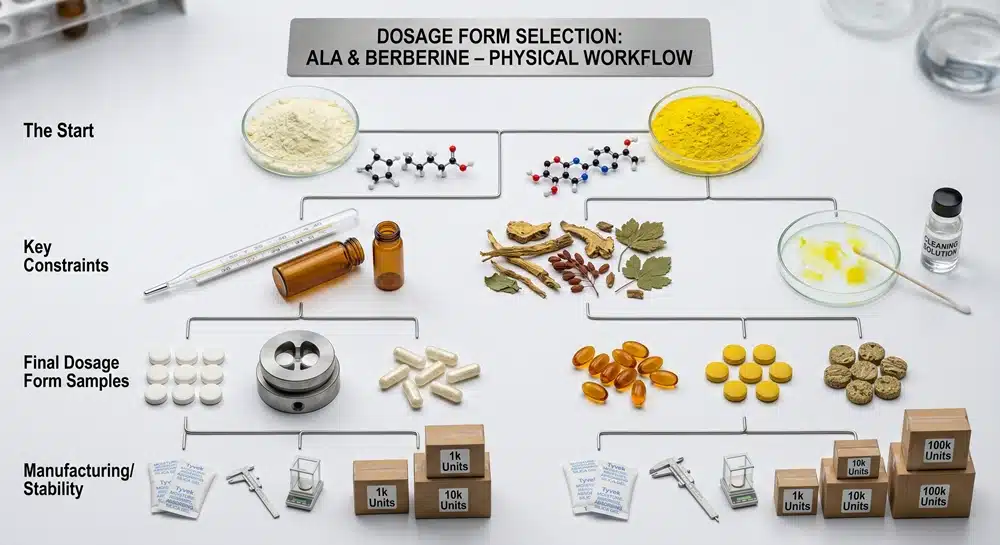
Capsules are usually the most practical launch format for ALA + Berberine HCl formulas. Capsules contain berberine’s bitter taste and yellow color, reduce the need for flavor masking, and simplify a two-ingredient metabolic-health concept. The main limitations are capsule fill weight, powder flow, and consumer serving size.
Мягкая капсула
Softgels can be considered when ALA stability, oxidation control, or premium positioning is more important than lowest unit cost. Softgels may also allow better protection from oxygen exposure depending on the carrier system and packaging strategy.
Планшет
Tablets can be commercially attractive, but ALA requires careful evaluation due to low-melting behavior and compression heat. Tablet projects should evaluate sticking risk, lubricant balance, tablet hardness, disintegration, and accelerated stability before scale-up. Brands choosing this route should work with производство таблетированных добавок teams that can test tooling and compression parameters during pilot batches.Powder or Stick Pack
Powder formats can support higher serving sizes but are usually the hardest format for ALA + berberine because berberine is bitter and yellow. Powder developers must address flavor masking, dispersion, staining, moisture, and consumer compliance.
Market Positioning and DSHEA-Compliant Claim Language
For U.S. dietary supplement labels, Alpha Lipoic Acid and Berberine formulas should be positioned with structure/function language rather than disease-treatment claims. Avoid phrases such as “treats diabetes,” “lowers cholesterol,” “reverses insulin resistance,” or “drug alternative.” Safer commercial language includes:
- Supports glucose metabolism already within the normal range.
- Supports cellular energy and mitochondrial antioxidant defense.
- Supports healthy lipid biomarkers within normal ranges.
- Supports weight-management programs when combined with diet and exercise.
Brand owners should keep substantiation files for any claim and follow the FDA structure/function claim notification process where applicable.
Quality Control Checklist for ALA + Berberine Products
A manufacturer producing an ALA + berberine supplement should define quality controls before scale-up, not after the first commercial batch.
- Raw material identity: supplier qualification, botanical identity for berberine, CAS verification for ALA.
- Assay method: HPLC or validated equivalent method for active content.
- Particle size: especially important for berberine dispersion and blending uniformity.
- Heavy metals and microbiology: required for botanical inputs and finished products.
- Moisture and water activity: important for capsule shell compatibility and powder stability.
- Cleaning validation: especially important after berberine due to yellow powder contamination risk.
- Stability program: label-claim retention, packaging compatibility, and accelerated stability where relevant.
These controls should be documented under a 21 CFR Part 111-aligned dietary supplement quality system.
Вопросы и ответы
Build an ALA + Berberine Formula With Manufacturing Controls
A commercially successful ALA + berberine supplement requires more than ingredient sourcing. It requires heat-aware processing for ALA, cleaning validation for yellow berberine dust, assay testing, compliant claims review, and dosage-form selection that fits the brand’s price point and serving-size target.
Gensei Global Industries supports custom private label supplement projects from raw-material sourcing and prototype development to capsule, tablet, powder, and softgel manufacturing. For brands planning an ALA + Berberine HCl formula, request a formulation review to compare capsule fill weight, excipient system, flavor-masking needs, MOQ, packaging, and stability-test requirements before production.
ссылки
- PubChem: Alpha-Lipoic Acid / CAS 1077-28-7 / melting point: https://pubchem.ncbi.nlm.nih.gov/compound/alpha-Lipoic-acid
- PubChem: Berberine Chloride / CAS 2086-83-1: https://pubchem.ncbi.nlm.nih.gov/compound/Berberine-chloride
- FDA: Structure/Function Claims: https://www.fda.gov/food/nutrition-food-labeling-and-critical-foods/structurefunction-claims
- FDA: Structure/Function Claim Notification for Dietary Supplements: https://www.fda.gov/food/information-industry-dietary-supplements/notifications-structurefunction-and-related-claims-dietary-supplement-labeling
- eCFR: 21 CFR Part 111, Current Good Manufacturing Practice in Manufacturing, Packaging, Labeling, or Holding Operations for Dietary Supplements: https://www.ecfr.gov/current/title-21/chapter-I/subchapter-B/part-111
- PubMed: Bioavailability study of berberine and enhancing effects: https://pubmed.ncbi.nlm.nih.gov/21637946/
- PMC Review: Berberine pharmacokinetic properties and bioavailability limitations: https://pmc.ncbi.nlm.nih.gov/articles/PMC8964367/
- PMC Review: Alpha-Lipoic Acid biological mechanisms and antioxidant/chelation discussion: https://pmc.ncbi.nlm.nih.gov/articles/PMC11505271/
- NCCIH: Berberine safety and interactions: https://www.nccih.nih.gov/health/in-the-news-berberine
- NCBI Bookshelf: Alpha-Lipoic Acid safety overview: https://www.ncbi.nlm.nih.gov/books/NBK564301/
- TCI Chemicals: Berberine chloride hydrate storage/hygroscopic note: https://www.tcichemicals.com/IN/en/p/B0450

Уоррен Ван — опытный специалист с обширным стажем работы в сфере цепочки поставок пищевых добавок, обладающий богатым практическим опытом в области исследований, разработки, контроля производственных процессов и глобального поиска поставщиков ключевых ингредиентов, таких как коллагеновые пептиды, белок костного бульона и кератин. Как автор этой рубрики, он стремится развенчать маркетинговую мистификацию, преобразуя малоизвестные научные факты об ингредиентах и стандарты контроля качества производства в доступные и достоверные научно-популярные материалы, помогая читателям понять правду, скрытую за этикетками, и делать более рациональный выбор в вопросах здоровья.


