For brands and formulators, the most important questions are not only “Does bilberry benefit skin?” but also “Which plant part was studied, was the ingredient used topically or orally, how was the extract standardized, and does the supplier documentation match the material used in the formula?” This guide separates those questions so the evidence is easier to interpret.
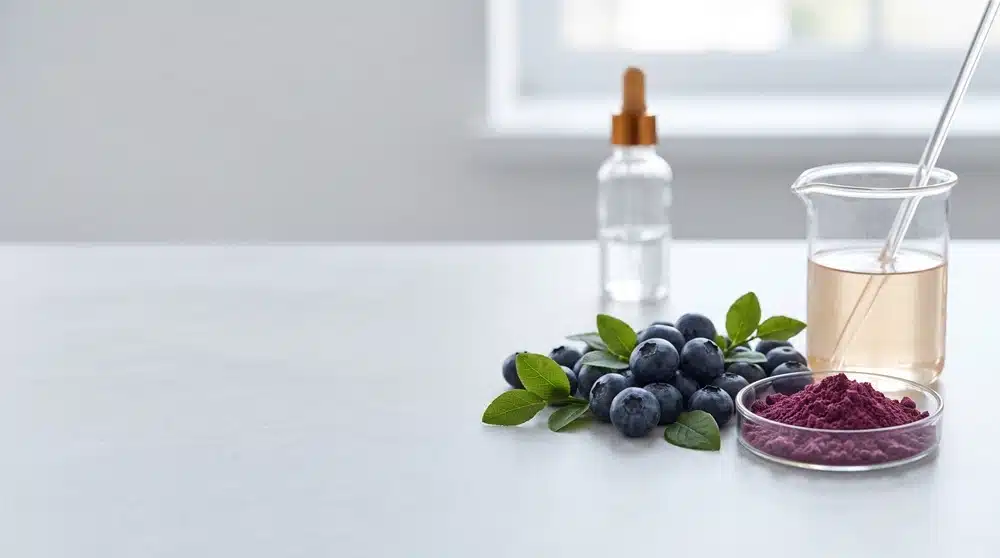
สารสกัดจากผลไม้ Vaccinium Myrtillus คืออะไร?
วัคคิเนียม มิร์ติลลัส is the botanical name for bilberry, a dark blue-purple berry native to parts of Europe and northern Asia. The fruit contains anthocyanins and other phenolic compounds that contribute to its color and antioxidant capacity. In ingredient documentation, the fruit extract may also be described as bilberry fruit extract.
If you are sourcing the ingredient for a formulation, review the specification for the exact สารสกัดจากผลวัคคิเนียม มิร์ติลลัส rather than assuming that every bilberry powder or extract has the same composition. Extraction solvent, concentration ratio, carrier system, anthocyanin specification, raw-material origin, and storage conditions can all change the finished material.
What Compounds in Bilberry Matter for Skin-Related Formulation?
Bilberry fruit is best known for anthocyanins, including glycosides derived from anthocyanidins such as delphinidin, cyanidin, petunidin, peonidin, and malvidin. The fruit also contains other polyphenols. These compounds are relevant because oxidative stress is one of the mechanisms studied in skin-aging and UV-exposure models.
However, antioxidant activity in a chemical assay or cell model is not the same as a proven cosmetic result in people. The concentration, delivery system, stability of the anthocyanins, product pH, and the rest of the formula all influence whether an extract performs as expected in a finished product.
Vaccinium Myrtillus Fruit Extract for Skin: What Does the Evidence Show?
| Evidence type | Preparation studied | What was observed | What it can reasonably support |
|---|---|---|---|
| Human randomized trial | Oral fermented bilberry extract | Changes in measured wrinkle depth, smoothness, firmness, elasticity, complexion parameters and skin antioxidant capacity after 84 days | Evidence for that specific oral preparation; not proof that any topical bilberry extract gives the same result |
| Human topical study | Topical formulation containing bilberry leaf extract plus bilberry seed oil | Skin-performance and hydration-related improvements were reported in healthy volunteers | Support for the tested multi-ingredient bilberry leaf/seed preparation; not direct evidence for fruit extract alone |
| Human keratinocyte cell study | Water-soluble bilberry fruit extract | Reduced several markers of UVA- and UVB-related cellular damage under laboratory conditions | Mechanistic antioxidant evidence; not a clinical anti-aging or sunscreen claim |
| In vitro formulation research | Bilberry fruit extracts prepared with different solvents | Antioxidant and enzyme-inhibition activities varied with extract type and test conditions | Useful for formulation screening, but clinical significance remains uncertain |
The key takeaway is that “bilberry extract” is not one standardized intervention across all studies. Fruit, leaf, seed oil, fermented oral extract, and differently extracted laboratory samples should not be treated as interchangeable evidence.
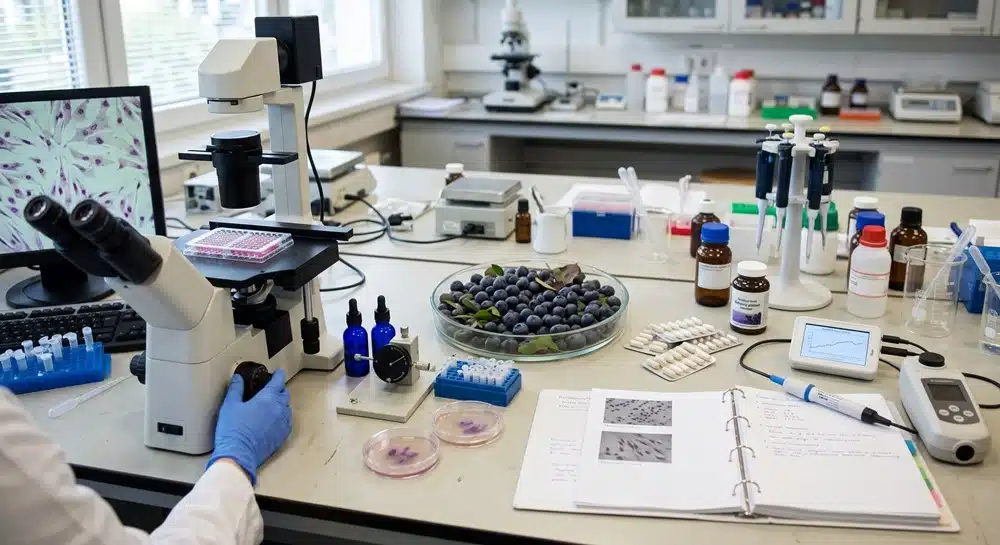
Potential Skin Benefits: A Claim-by-Claim Review
1. Antioxidant support: the strongest mechanistic case
Bilberry fruit extract has the clearest scientific rationale as a source of polyphenols with antioxidant activity. In a human keratinocyte model, a water-soluble V. myrtillus extract reduced several markers associated with UVA- and UVB-induced damage. This makes antioxidant positioning reasonable when it is appropriately qualified and supported by the ingredient and finished-formula data.
It should not be marketed as a replacement for sunscreen. Cell-protection findings do not establish an SPF value or demonstrate that a bilberry-containing product prevents UV-related disease.
2. Appearance of skin aging: promising, but route-specific
A randomized, double-blind, placebo-controlled study of an orally consumed fermented bilberry extract reported statistically significant changes in several skin-aging and complexion measurements after 84 days. This is useful evidence for nutricosmetic development, but the route matters: oral supplementation is not equivalent to applying a cosmetic serum containing a different bilberry extract.
Brands developing oral beauty products should confirm that the dose, extract standardization, processing method, study population, and finished formula are sufficiently comparable before extrapolating study results. If an oral beauty concept is being developed, a สูตรอาหารเสริมตามความต้องการ review should include dosage feasibility, evidence matching, stability, claims, and market-specific compliance.
3. Brightening and pigmentation: mainly preliminary evidence
Some laboratory studies of bilberry extracts report activity in assays related to tyrosinase, an enzyme involved in melanin production. That is not the same as demonstrating that a finished skincare product fades hyperpigmentation in people. A safer editorial description is that bilberry-derived polyphenols are being studied for pathways relevant to complexion and oxidative stress, while direct clinical evidence for topical fruit extract remains limited.
4. Collagen, firmness and elasticity: avoid direct topical promises
The current evidence does not justify a broad statement that topical Vaccinium myrtillus fruit extract “stimulates collagen synthesis” in consumers. Firmness and elasticity changes reported in the fermented bilberry trial came from an oral preparation, while other bilberry research uses different plant parts or laboratory models. Cosmetic claims should reflect the evidence for the specific finished product rather than borrow outcomes from a different route or extract.
5. Redness, acne and rosacea: do not turn mechanistic evidence into disease claims
Bilberry polyphenols are studied in inflammation-related models, but this does not establish that a cosmetic product treats acne, rosacea, dermatitis, or another disease. In the United States, claims that a topical product treats disease or affects the structure or function of the skin can move the product into drug territory. Use appearance-focused, substantiated cosmetic language instead of disease-treatment wording.
Topical Bilberry Extract vs Oral Bilberry Extract
| ปัจจัย | Topical cosmetic use | Oral supplement use |
|---|---|---|
| Typical objective | Skin conditioning, antioxidant positioning, appearance-focused formulas | Beauty-from-within or healthy-aging supplement concepts |
| Most relevant evidence | Skin-cell studies and limited human topical research using specific bilberry preparations | Human trial data are available for a specific fermented bilberry extract |
| Major formulation questions | Color, odor, pH, solubility, oxidation, preservative compatibility, staining risk, packaging | Serving size, extract specification, anthocyanin stability, excipients, dosage form, interactions and label claims |
| Claims caution | Avoid drug claims such as treating acne or increasing collagen production unless the regulatory category supports them | Match benefit wording to the exact evidence, dose and target population; avoid disease claims |
How Is Vaccinium Myrtillus Fruit Extract Used in Formulations?
Bilberry extracts may be used in cosmetic or oral-product development, but the appropriate grade and specification depend on the application. Cosmetic formulators may evaluate aqueous or hydroalcoholic extracts for compatibility with serums, lotions, masks, cleansers, or other leave-on and rinse-off systems. Oral-product developers may use standardized botanical extracts in capsules, tablets, powders, liquids, or blended beauty formulas.
When comparing suppliers, start with a broader bulk botanical extract portfolio and then narrow the selection by botanical identity, plant part, extraction process, active-marker specification, intended market, and finished-product format.
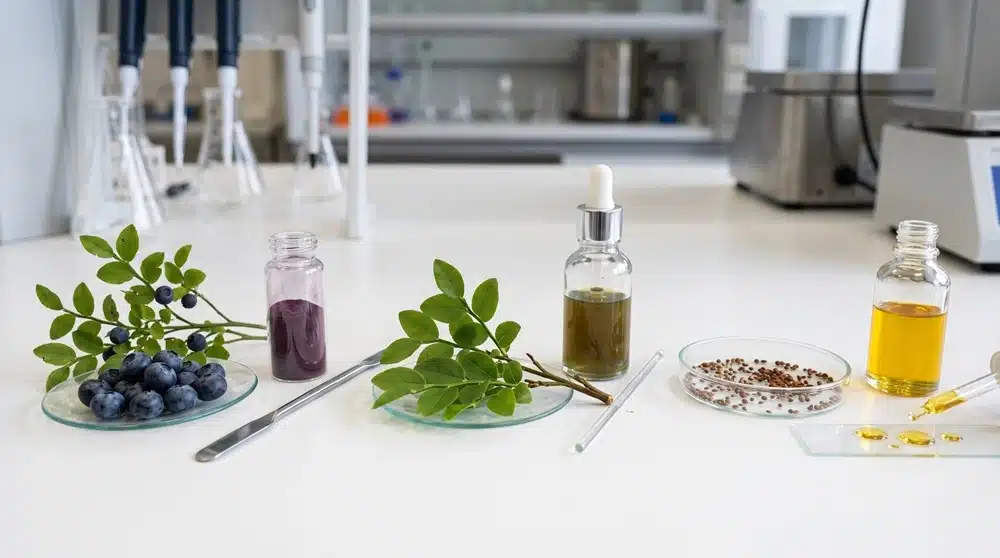
Quality Specifications Brands Should Check
- Botanical identity: ยืนยัน วัคคิเนียม มิร์ติลลัส and the plant part. Fruit, leaf and seed-derived materials are not interchangeable.
- Extract type: Record extraction solvent, extract ratio, carrier or excipient system, and drying method.
- Anthocyanin or polyphenol specification: If the formula is positioned around anthocyanins, define the test method and acceptance range rather than using a vague “antioxidant-rich” specification.
- Identity testing: Bilberry extracts have a documented adulteration risk. A robust identity program may include chromatographic fingerprinting in addition to basic marker testing.
- Contaminants: Review heavy metals, pesticide residues, microbiology, residual solvents, and any market-specific contaminant limits that apply to the finished product category.
- ความเสถียร: Anthocyanins can be sensitive to pH, oxygen, heat and light. Confirm storage, shelf-life, packaging and finished-formula stability.
- เอกสารประกอบ: Request COA, specification sheet, SDS/TDS where applicable, allergen and GMO statements, origin information and traceability documents.
Is Vaccinium Myrtillus Fruit Extract Safe for Skin?
Botanical extracts can be well tolerated in many formulas, but “natural” does not guarantee that every user will tolerate every product. Finished-product safety depends on concentration, extraction system, preservatives, fragrance, other ingredients and intended use. People with sensitive skin or known berry-related sensitivities may prefer a patch test before broader topical use.
For EU cosmetic development, an ingredient name appearing in the European Commission’s CosIng database should not be described as an “approval.” CosIng is an informational database, and the finished cosmetic remains subject to the applicable regulatory and safety-assessment requirements. For U.S. marketing, cosmetic labeling and advertising claims must be truthful and should not imply disease treatment or an unapproved drug function.
Bilberry Fruit Extract vs Bilberry Leaf or Seed Ingredients
This distinction matters because research is often cited across plant parts:
- Fruit extract: Rich in anthocyanins; central to most bilberry antioxidant and oral-extract discussions.
- Leaf extract: Has a different phytochemical profile and appears in some topical research.
- Seed oil: Lipid-rich material with a very different composition from a fruit polyphenol extract.
If a study uses leaf extract plus seed oil, it should not be presented as direct clinical proof for a fruit extract. This single clarification can substantially improve scientific accuracy and regulatory defensibility.
How Should Supplement and Ingredient Buyers Evaluate a Bilberry Extract Supplier?
A practical supplier review should answer five questions:
- Is the botanical species and plant part authenticated?
- What is the extraction process and what active markers are standardized?
- Does the COA include fit-for-purpose identity, potency and contaminant testing?
- Is there stability data or packaging guidance for the intended dosage form or cosmetic system?
- Can the supplier provide traceability and technical documents needed for the target market?
For evidence-led product development, the goal is not simply to buy “bilberry powder.” The goal is to select a defined material whose composition, documentation and intended claims fit the final product.
คำถามที่พบบ่อย
What are the main bilberry benefits for skin?
Bilberry fruit extract is best supported as an antioxidant-rich botanical ingredient. Laboratory data suggest activity against oxidative-stress pathways in skin-cell models. Human evidence is more limited and depends on the exact bilberry preparation and whether it is used topically or orally.
สารสกัดจากบิลเบอร์รี่ดีต่อผิวหนังหรือไม่?
It can be a useful skin-conditioning and antioxidant ingredient in a well-designed formula. However, it should not automatically be expected to treat acne, rosacea, pigmentation disorders, or wrinkles, because those stronger outcomes require product-specific clinical and regulatory support.
Is Vaccinium myrtillus the same as blueberry?
No. Bilberry is วัคคิเนียม มิร์ติลลัส. Common cultivated blueberries are usually other Vaccinium species, such as วัคคิเนียม คอริมโบซัม. Their phytochemical profiles can overlap, but they are not interchangeable botanical identities.
What is the difference between Vaccinium myrtillus fruit extract and leaf extract?
They come from different plant parts and have different chemical profiles. Research using leaf extract should not be cited as if it were a study of fruit extract.
Does bilberry extract brighten skin?
Some in vitro studies suggest bilberry extracts can affect pathways related to pigmentation, but direct human clinical evidence for topical fruit extract is limited. “Supports a more even-looking complexion” may be more defensible than promising that the ingredient removes dark spots.
How long does bilberry extract take to work?
There is no universal timeline because results depend on the exact ingredient, route, concentration, formula and endpoint. The 2024 human trial of oral fermented bilberry extract measured outcomes over 84 days; that timeline should not be generalized to unrelated topical products.
เอกสารอ้างอิง
- Antiaging, Brightening, and Antioxidant Efficacy of Fermented Bilberry Extract (Vaccinium myrtillus): A Randomized, Double-Blind, Placebo-Controlled Trial
- Protective effect of Vaccinium myrtillus extract against UVA- and UVB-induced damage in a human keratinocyte cell line
- Anti-Aging Properties of Chitosan-Based Hydrogels Rich in Bilberry Fruit Extract
- Preliminary Analysis of Bilberry NaDES Extracts as Versatile Active Ingredients of Natural Dermocosmetic Products
- Pharmacopeial HPLC identification methods are not sufficient to detect adulterations in commercial bilberry extracts
- European Commission: Cosmetic ingredient database (CosIng)
- FDA: Cosmetics Labeling Claims
- FTC: แนวทางปฏิบัติตามข้อกำหนดสำหรับผลิตภัณฑ์สุขภาพ
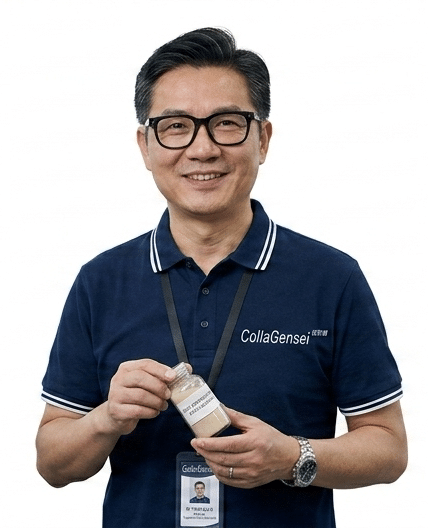
Warren Wan เป็นผู้เชี่ยวชาญที่มีประสบการณ์ยาวนานในห่วงโซ่อุปทานของผลิตภัณฑ์เสริมอาหาร โดยมีความรู้และประสบการณ์ทางปฏิบัติอย่างลึกซึ้งด้านการวิจัย พัฒนา การควบคุมกระบวนการผลิต และการจัดหาวัตถุดิบหลักจากทั่วโลก เช่น เปปไทด์คอลลาเจน โปรตีนจากน้ำซุปกระดูก และเคราติน ในฐานะผู้เขียนคอลัมน์นี้ เขามุ่งมั่นที่จะลอกเปลือกการตลาดออก และแปลงความรู้ทางวิทยาศาสตร์เกี่ยวกับส่วนผสมที่เข้าใจยาก รวมถึงมาตรฐานการควบคุมคุณภาพการผลิต ให้กลายเป็นเนื้อหาวิทยาศาสตร์ที่เข้าใจง่ายและเข้าถึงได้สำหรับทุกคน เพื่อช่วยให้ผู้อ่านเข้าใจความจริงที่ซ่อนอยู่เบื้องหลังฉลากผลิตภัณฑ์ และตัดสินใจเลือกผลิตภัณฑ์เพื่อสุขภาพได้อย่างมีเหตุผลมากขึ้น.