快速回答
Borage oil and flaxseed oil are not interchangeable. Borage oil is selected mainly for gamma-linolenic acid (GLA), an omega-6 fatty acid, while flaxseed oil is selected mainly for alpha-linolenic acid (ALA), a plant omega-3. The better option depends on the target fatty acid, serving size, oxidation plan, safety documentation and finished-product format.For consumers, neither oil should be presented as a treatment for arthritis, eczema, hormonal disorders, cardiovascular disease or cognitive problems. For supplement brands, the practical comparison is GLA or ALA per serving, batch fatty-acid profile, PA testing for 琉璃苣油, oxidation indicators, packaging and stability.
Brands developing plant-oil supplements can compare raw-material grades, calculate fill weight and request a project review before selecting a supplier or softgel format.
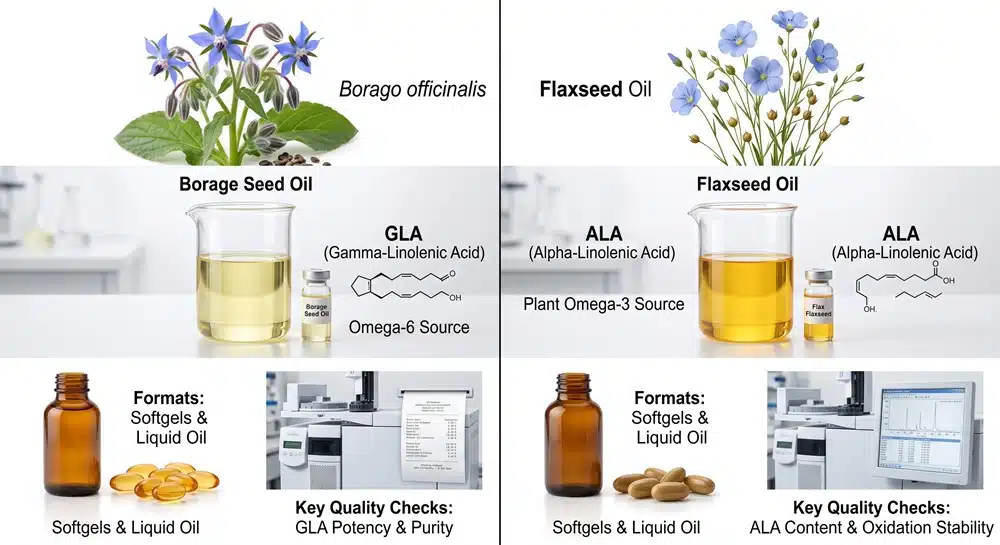
Borage Oil vs Flaxseed Oil at a Glance
| 決策因素 | 琉璃苣油 | 亞麻籽油 | 為何重要 |
|---|---|---|---|
| 植物來源 | 藥用琉璃苣種子 | 亞麻籽 | Source identity and traceability must match the specification |
| Main commercial fatty acid | GLA, an omega-6 fatty acid | ALA, an omega-3 fatty acid | They support different formulation targets |
| Common procurement question | How much GLA is confirmed by the batch assay? | How much ALA is confirmed by the batch assay? | Total oil weight does not equal active fatty-acid amount |
| Key safety file | PA method, analytes, reporting limit and batch result | Identity, oxidation, contaminants and medicine-use review | “Natural” or “cold pressed” is not a complete safety specification |
| Primary formulation risk | PA control, oxidation, odor and GLA label accuracy | Oxidation, rancidity, ALA loss and sensory change | Both oils are sensitive to oxygen, heat and light |
| 常見格式 | Softgels, liquid fills, oil blends and microencapsulated powders | Softgels, liquid oils, oil blends and microencapsulated powders | Format affects serving size, packaging and shelf life |
何謂琉璃苣油?
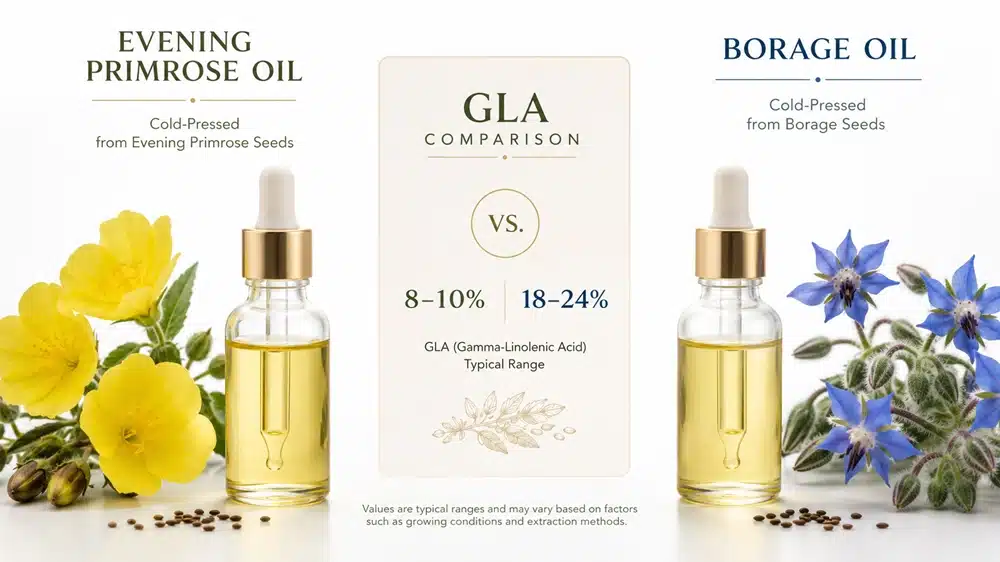
Borage oil is obtained from the seeds of 婆羅米. In dietary-supplement sourcing, it is commonly selected because it contains GLA. Commercial grades may differ by seed origin, extraction and refining process, GLA percentage, fatty-acid profile, color, odor, antioxidant system and oxidation status.
A brand should not buy borage oil only by the total milligram amount. Review the actual GLA assay, full fatty-acid profile, peroxide value, p-anisidine value, acid value, storage conditions and PA documentation. Available specifications and quality files can be reviewed in the 琉璃苣油成分規格.
什麼是亞麻籽油?
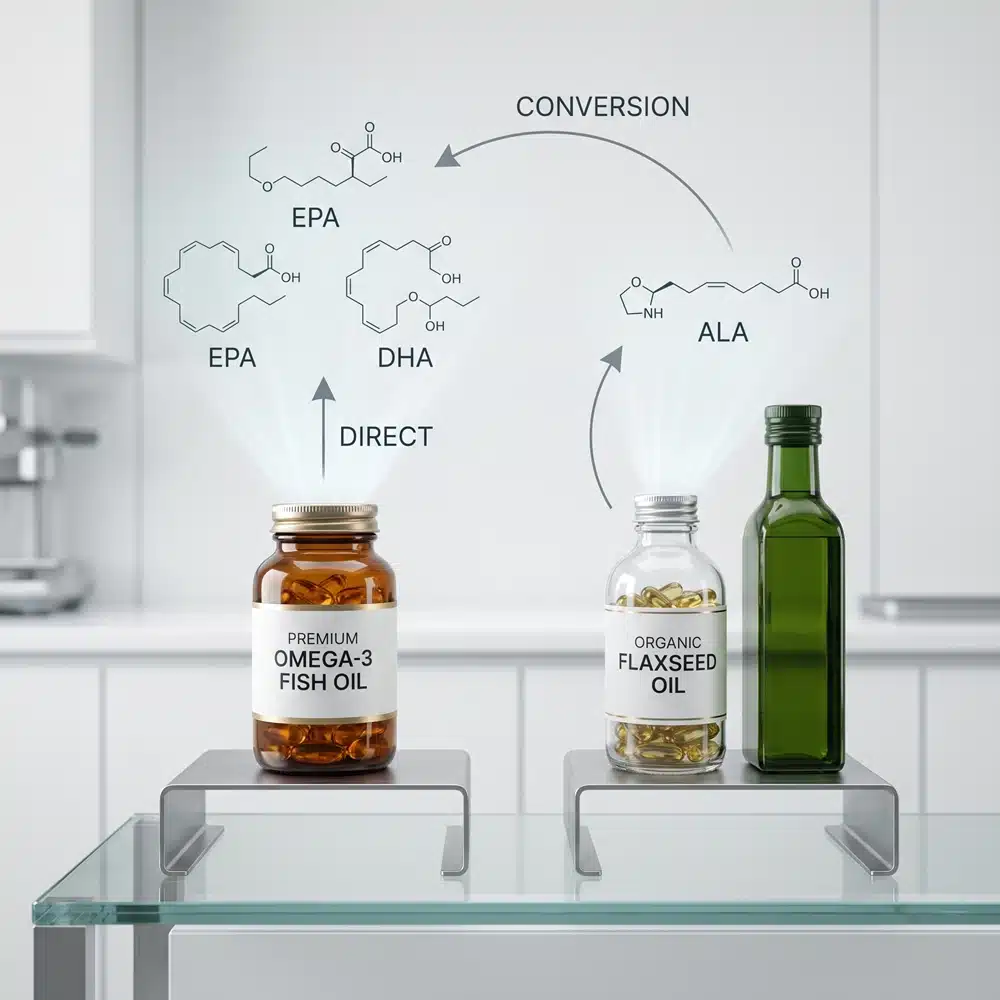
Flaxseed oil is obtained from 亞麻 seeds and is commonly selected as a plant source of ALA. ALA is an essential omega-3 fatty acid, but it is not the same molecule as EPA or DHA. Human conversion of ALA to EPA and especially DHA is limited, so a flaxseed oil formula should not imply that it delivers the same fatty-acid profile as fish oil or algal EPA/DHA.
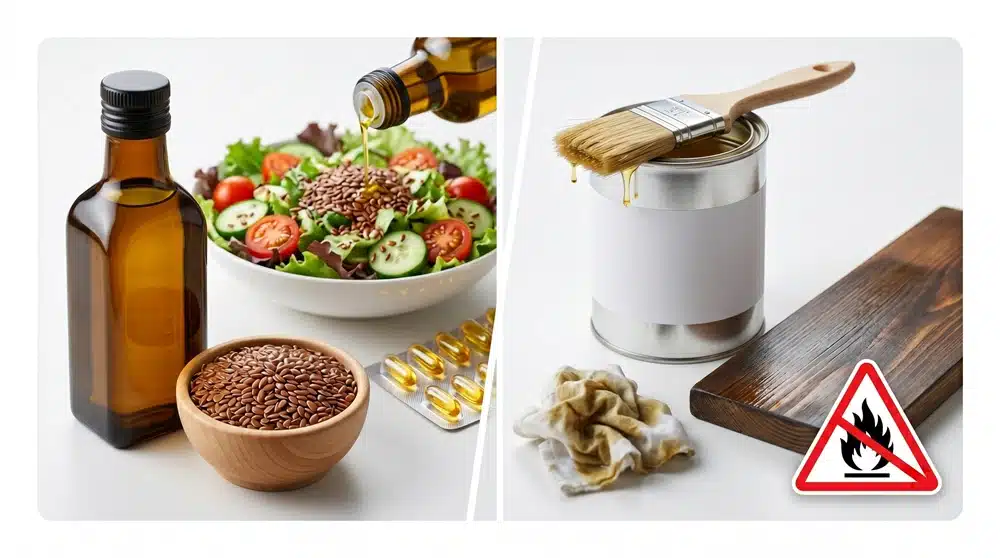
Flaxseed oil also differs from whole or ground flaxseed. Standard flaxseed oil does not provide the same fiber and lignan profile as the whole seed. Buyers can compare ALA percentage, processing method, oxidation values and application formats in the flaxseed oil supplier guide.
GLA vs ALA: The Main Difference
GLA and ALA are both 18-carbon polyunsaturated fatty acids, but they belong to different omega families and should not be treated as substitutes.
| Fatty Acid | 全名 | Family | Primary Source in This Comparison | 術語定義 |
|---|---|---|---|---|
| GLA | Gamma-linolenic acid | Omega-6 | 琉璃苣油 | Use the batch GLA percentage to calculate oil input |
| ALA | Alpha-linolenic acid | 奧米加-3 | 亞麻籽油 | Use the batch ALA percentage to calculate plant omega-3 input |
| EPA/DHA | Long-chain omega-3 fatty acids | 奧米加-3 | Fish or selected algal oils, not ordinary flaxseed oil | Do not infer EPA/DHA delivery from total ALA alone |
The names “gamma-linolenic” and “alpha-linolenic” sound similar, but their metabolic roles, evidence and label positioning are different. The formula should name the actual fatty acid and amount rather than relying on a generic “omega 3-6-9” headline.
Does Flaxseed Oil Contain GLA?
Flaxseed oil is not normally selected as a meaningful GLA source. Its commercial marker is ALA. A complete fatty-acid analysis may report many minor fatty acids, but formulators should not assume that flaxseed oil can replace a standardized GLA-rich oil.
When a label or supplier claims a specific GLA amount from flaxseed oil, request the batch fatty-acid method, chromatogram or COA and confirm the reporting basis. For a defined GLA target, calculate the input from a documented GLA oil such as borage oil or another qualified source.
Illustrative Fill-Weight Calculations
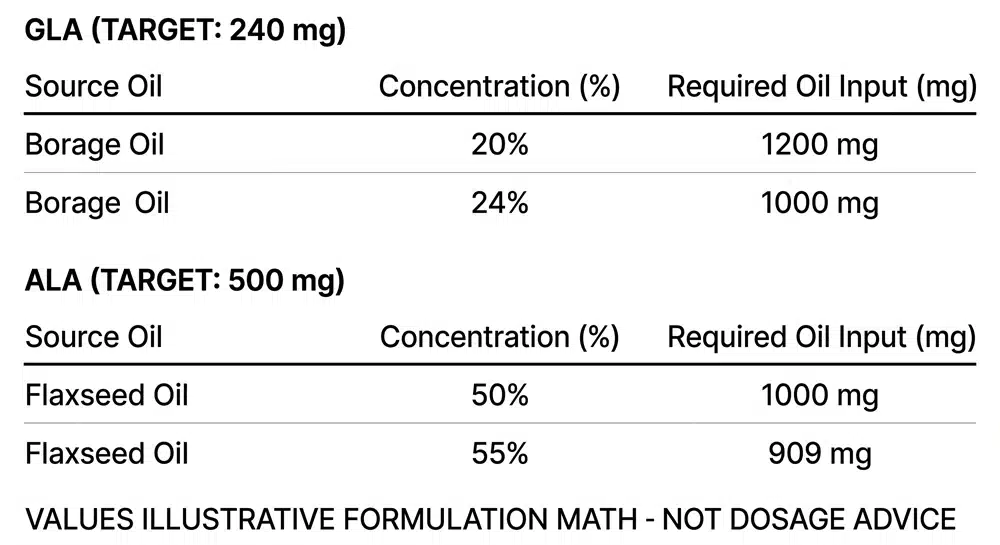
These examples show formulation math only. They are not consumer dose recommendations. Final input must use the actual batch assay, serving size, overage policy, capsule capacity and applicable label rules.
| 公式目標 | Raw-Material Assay | Illustrative Oil Input | 計算 |
|---|---|---|---|
| 240 mg GLA | 20% GLA 琉璃苣油 | 1,200 毫克油 | 240 ÷ 0.20 |
| 240 mg GLA | 24% GLA borage oil | 1,000 毫克油 | 240 ÷ 0.24 |
| 500 mg ALA | 50% ALA flaxseed oil | 1,000 毫克油 | 500 ÷ 0.50 |
| 500 mg ALA | 55% ALA flaxseed oil | about 909 mg oil | 500 ÷ 0.55 |
A higher assay can reduce fill weight or capsule count, but it does not automatically mean better clinical outcomes. It is a formulation-efficiency decision that must be balanced with oil freshness, specification, cost, supply continuity and finished-product stability.
Which Oil Is Better for a Supplement Formula?
Choose Borage Oil When the Formula Needs a Defined GLA Input
Borage oil is generally the more direct choice when the product concept requires a documented GLA amount. Compare GLA percentage, PA testing, oxidation values, processing method, odor and softgel compatibility.
Choose Flaxseed Oil When the Formula Needs a Plant ALA Input
Flaxseed oil is generally the more direct choice for plant-derived ALA positioning. Do not describe it as a direct EPA/DHA replacement, and do not copy health claims established for fish oil or pharmaceutical omega-3 products.
Consider a Blend Only When Each Oil Has a Defined Role
A borage-and-flaxseed blend can provide both GLA and ALA, but the label should state the actual amounts rather than implying that a blend is automatically balanced or superior. Formulators must account for total oil load, capsule size, oxidation, taste, odor, antioxidant system and serving count.
What About Fish, Flaxseed and Borage Oil Blends?
Searches for fish, flaxseed and borage oil usually reflect interest in omega-3, omega-6 and omega-9 combination softgels. The three oils should not be treated as interchangeable ingredients:
- Fish oil may provide EPA and DHA, depending on its grade.
- Flaxseed oil mainly provides ALA.
- Borage oil mainly provides GLA.
A meaningful blend specification should state EPA, DHA, ALA and GLA per serving, not only the total milligrams of each oil. It should also define fish species or source, oxidation limits, contaminants, PA testing for borage oil, allergens, capsule shell and stability. Brands developing single- or multi-oil softgels can review plant-oil and omega softgel manufacturing.
證據與健康宣稱的界線
Borage oil and flaxseed oil have been studied in different settings, and one controlled study compared their effects on selected skin measurements in women. A study on a particular oil, dose, population and endpoint does not prove that every commercial grade will produce the same result.
Brands should avoid disease-treatment claims such as treating eczema, rheumatoid arthritis, high cholesterol, hypertension, depression or hormonal disorders. Safer structure/function positioning may be possible for a finished product when it is truthful, not misleading and supported by evidence that matches the ingredient, amount, format and target population.
Do not use “anti-inflammatory” as a blanket product promise. Describe the fatty-acid composition and the evidence level, and have claims reviewed for the destination market.
Safety and Label Considerations
琉璃苣油與吡咯里西啶生物鹼
Borage plant material can contain pyrrolizidine alkaloids (PAs), and borage seed oil may contain small amounts unless processing and testing control them. “PA-free” should not be accepted as a marketing phrase alone. Request the analytical method, analyte list, reporting limit or LOQ, specification and lot-specific result.
Pregnant or breastfeeding people, children, people with liver conditions and people taking medicines should obtain professional guidance before using botanical oil supplements. Do not use borage leaf or flower evidence as if it were equivalent to a tested seed-oil ingredient.
Flaxseed Oil Safety
Higher amounts of flaxseed or flaxseed oil may cause digestive symptoms such as bloating, fullness or diarrhea. Potential medicine interactions should be reviewed, including anticoagulant or antiplatelet therapy. Pregnancy and breastfeeding safety data are limited.
Allergen, Vegan and Source Claims
Both seed oils are plant-derived, but a finished product is not automatically vegan or allergen-free. Review processing aids, carriers, antioxidants, cross-contact statements and the softgel shell. Avoid absolute “allergen-free” claims unless the finished-product controls and applicable market rules support them.
Oxidation, Storage and Packaging
Both borage oil and flaxseed oil are rich in polyunsaturated fatty acids and are sensitive to oxygen, heat and light. Oxidation can change odor, taste, fatty-acid potency and shelf-life performance.
| 優質商品 | 應提出哪些要求 | 為何重要 |
|---|---|---|
| 過氧化值 | Method, specification and batch result | Indicates primary oxidation |
| p-Anisidine value | Method and batch result where applicable | Indicates secondary oxidation |
| TOTOX or broader oxidation review | Calculation basis or supplier report | Supports a broader freshness assessment |
| 酸值/游離脂肪酸 | Specification and result | Helps assess hydrolytic degradation and handling |
| Antioxidant system | Identity and label declaration | Supports oxidation-control planning |
| 包裝 | Light barrier, oxygen control, nitrogen strategy and closure | Protects the oil through distribution and use |
| 穩定性 | Finished product in the final package | Confirms potency and sensory quality through shelf life |
Cold pressing can support source and process positioning, but it does not automatically prove superior freshness, purity or shelf life. A refined oil may be selected when odor, clarity, PA removal or stability requirements justify the process.
Quality Specifications Supplement Brands Should Check
| 規格範圍 | 琉璃苣油 | 亞麻籽油 |
|---|---|---|
| 身分 | Botanical source and oil identity | Botanical source and food/supplement grade |
| 有效標記 | GLA percentage and full fatty-acid profile | ALA percentage and full fatty-acid profile |
| Natural toxins | PA method, analytes, limit and batch result | Risk-based contaminant and adulteration review |
| 氧化 | PV, p-AV, acid value and storage | PV, p-AV, acid value and storage |
| 污染物 | Heavy metals, microbiology, pesticides where applicable | Heavy metals, microbiology, pesticides where applicable |
| 文件 | COA, specification, SDS, TDS, flow chart and PA report | COA, specification, SDS, TDS, flow chart and origin statement |
| Finished-product fit | Oil fill, shell compatibility, odor and stability | Oil fill, shell compatibility, odor and stability |
Buyer Checklist
- Confirm the botanical name, plant part and country of origin.
- Confirm whether the material is cold pressed, refined, winterized, deodorized or microencapsulated.
- Request the batch fatty-acid profile and active-marker percentage.
- For borage oil, verify the PA method, analytes, LOQ and lot result.
- Review PV, p-AV, acid value, free fatty acids and sensory condition.
- Confirm heavy metals, microbiology, pesticides and residual solvents where applicable.
- Review antioxidants, carriers, processing aids and label declarations.
- Confirm packaging, nitrogen protection, storage temperature and shelf life.
- Calculate active fatty acid per serving from the actual assay.
- Request finished-product stability in the final package.
針對石油供應商或軟膠囊製造商的 RFP 提問
- Which borage and flaxseed oil grades are available, and what is the batch GLA or ALA assay?
- Which analytical method is used for the fatty-acid profile?
- For borage oil, which PAs are tested, what is the LOQ and what is the acceptance specification?
- What are the current PV, p-AV, acid value and TOTOX results?
- How are oxidation and oxygen exposure controlled during storage, transfer and encapsulation?
- 其中含有哪些抗氧化劑、載體或加工輔助劑?
- Can the formula deliver the target GLA or ALA in one practical serving?
- Which softgel shell, capsule size and fill weight are feasible?
- What finished-product tests and stability data are available?
- Can you provide lot-specific COAs, specifications, SDS, TDS, flow chart and origin statements?
- 最低訂購量、樣品數量、包裝選項及交貨期分別為何?
- How will structure/function, omega and “PA-free” claims be reviewed for the target market?
常見問題
Which is better, borage oil or flaxseed oil?
Neither is universally better. Choose borage oil for a documented GLA target and flaxseed oil for a documented plant ALA target. Compare the batch assay, serving size, safety files, oxidation and finished-product format.
Is borage oil an omega-3 oil?
Borage oil is primarily selected for GLA, an omega-6 fatty acid. It should not be marketed as a substitute for ALA, EPA or DHA without a formula that separately supplies those fatty acids.
Does flaxseed oil provide EPA and DHA?
Flaxseed oil mainly provides ALA. The body can convert some ALA to EPA and DHA, but conversion is limited. The label should not state an EPA or DHA amount unless the finished product actually contains and verifies it.
Can borage oil and flaxseed oil be combined?
Yes, they can be combined when the formula has a clear GLA and ALA target. The blend must still meet practical fill weight, oxidation, safety, label and stability requirements.
What does PA-free borage oil mean?
It should mean that a defined list of pyrrolizidine alkaloids was tested using an appropriate method and met a stated specification. Buyers should request the analytes, LOQ and lot-specific result.
What should a fish, flax and borage oil label show?
A useful label and specification should identify EPA, DHA, ALA and GLA per serving where claimed, together with the source oils, serving size, allergens and other required information.
最終心得
Borage oil and flaxseed oil solve different formulation problems. Borage oil is a GLA ingredient; flaxseed oil is an ALA ingredient. The right decision is based on the intended fatty-acid amount, batch assay, PA control, oxidation, serving size, delivery format and evidence-supported claims—not on a generic statement that one oil is healthier.
For a quotation, sample, COA, specification review or custom oil-softgel project, 聯絡 GENSEI with the target GLA or ALA amount, serving size, dosage form, order quantity and destination market.
參考資料
- NIH Office of Dietary Supplements: Omega-3 Fatty Acids Fact Sheet for Health Professionals
- NCCIH: Flaxseed and Flaxseed Oil – Usefulness and Safety
- NCBI LactMed:琉璃苣
- European Medicines Agency: Pyrrolizidine Alkaloids Public Statement
- EFSA: Pyrrolizidine Alkaloids in Food
- Intervention with Flaxseed and Borage Oil Supplements Modulates Skin Condition in Women
- Conversion of Alpha-Linolenic Acid to Longer-Chain Polyunsaturated Fatty Acids in Human Adults
- 美國食品藥物管理局(FDA):結構/功能宣稱
- 聯邦貿易委員會(FTC):健康產品合規指引
Gensei Global Industries 是一家膠原蛋白、骨湯、隔離牛肉蛋白、水解角蛋白和蛋殼膜的生產商,在美國、加拿大、澳洲等地都有存貨。Gensei Global Industries 是一家全球服務型製造商,將原料分銷給世界各地的客戶。