Risposta rapida
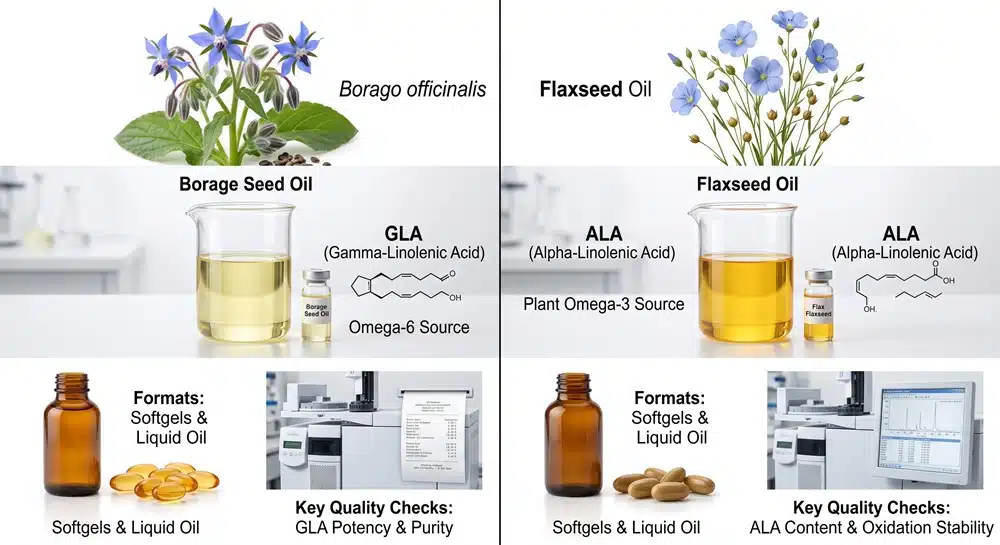
L'olio di borragine e l'olio di semi di lino non sono intercambiabili. L'olio di borragine viene scelto principalmente per l'acido gamma-linolenico (GLA), un acido grasso omega-6, mentre l'olio di semi di lino viene scelto principalmente per l'acido alfa-linolenico (ALA), un omega-3 di origine vegetale. La scelta migliore dipende dall’acido grasso desiderato, dalla dose consigliata, dal piano di ossidazione, dalla documentazione relativa alla sicurezza e dal formato del prodotto finito.Per i consumatori, nessuno dei due oli dovrebbe essere presentato come trattamento per l’artrite, l’eczema, i disturbi ormonali, le malattie cardiovascolari o i problemi cognitivi. Per i marchi di integratori, il confronto pratico riguarda il contenuto di GLA o ALA per porzione, il profilo degli acidi grassi del lotto e i test PA per olio di borragine, indicatori di ossidazione, confezionamento e stabilità.
I marchi che sviluppano integratori a base di oli vegetali possono confrontare le qualità delle materie prime, calcolare il peso di riempimento e richiedere una valutazione del progetto prima di scegliere un fornitore o il formato in capsule molli.
Olio di borragine vs olio di semi di lino: una panoramica
| Fattore decisionale | Olio di borragine | Olio di semi di lino | Perché è importante |
|---|---|---|---|
| Origine botanica | Semi di Borago officinalis | Semi di Linum usitatissimum | L'identità e la tracciabilità della fonte devono corrispondere alle specifiche |
| Principale acido grasso commerciale | GLA, un acido grasso omega-6 | ALA, un acido grasso omega-3 | Supportano diversi obiettivi di formulazione |
| Domanda frequente sugli appalti | Qual è la quantità di GLA confermata dall'analisi del lotto? | Qual è la quantità di ALA confermata dall'analisi del lotto? | Il peso totale dell'olio non corrisponde alla quantità di acidi grassi attivi |
| Documento chiave sulla sicurezza | Metodo PA, analiti, limite di rilevabilità e risultato del lotto | Identificazione, ossidazione, contaminanti e revisione dell’uso dei farmaci | “Le diciture ”naturale“ o ”spremuto a freddo” non costituiscono una specifica di sicurezza completa |
| Rischio legato alla formulazione primaria | Controllo del PA, ossidazione, odori e accuratezza delle etichette GLA | Ossidazione, irrancidimento, perdita di ALA e alterazioni sensoriali | Entrambi gli oli sono sensibili all'ossigeno, al calore e alla luce |
| Formati comuni | Capsule molli, prodotti liquidi, miscele di oli e polveri microincapsulate | Capsule molli, oli liquidi, miscele di oli e polveri microincapsulate | Il formato influisce sulle porzioni, sulla confezione e sulla durata di conservazione |
Che cos'è l'olio di borragine?
L'olio di borragine si ricava dai semi di Borago officinalis. Nell'ambito dell'approvvigionamento di integratori alimentari, viene comunemente scelto perché contiene GLA. I prodotti in commercio possono differire per origine dei semi, processo di estrazione e raffinazione, percentuale di GLA, profilo degli acidi grassi, colore, odore, sistema antiossidante e stato di ossidazione.
Un marchio non dovrebbe acquistare l'olio di borragine basandosi esclusivamente sulla quantità totale in milligrammi. È necessario verificare il contenuto effettivo di GLA, il profilo completo degli acidi grassi, l'indice di perossido, l'indice di p-anisidina, l'indice di acidità, le condizioni di conservazione e la documentazione relativa alla PA. Le specifiche disponibili e i documenti relativi alla qualità possono essere consultati nel Specifiche relative agli ingredienti dell'olio di borragine.
Che cos'è l'olio di semi di lino?
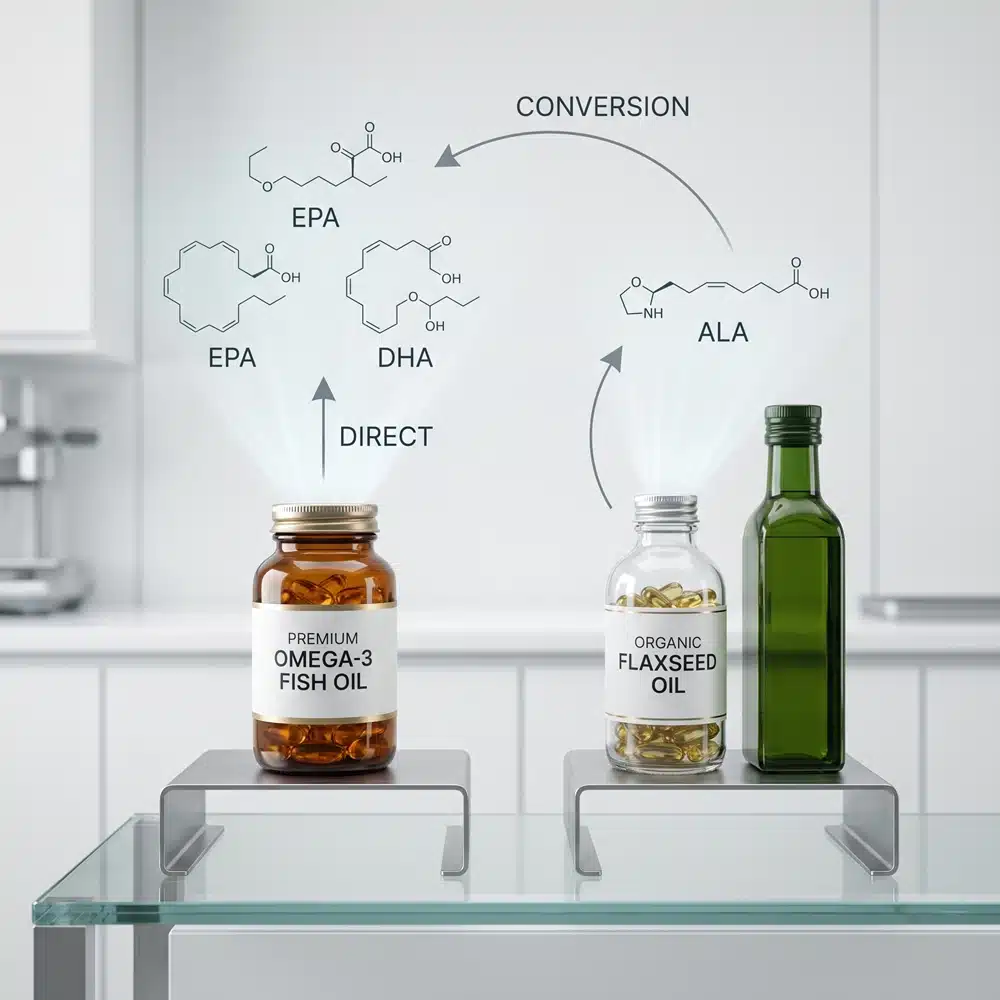
L'olio di semi di lino si ricava da Linum usitatissimum semi ed è comunemente scelta come fonte vegetale di ALA. L’ALA è un acido grasso omega-3 essenziale, ma non è la stessa molecola dell’EPA o del DHA. La conversione dell’ALA in EPA e, soprattutto, in DHA da parte dell’organismo umano è limitata, pertanto una formula a base di olio di semi di lino non dovrebbe implicare che fornisca lo stesso profilo di acidi grassi dell’olio di pesce o dell’EPA/DHA di origine algale.
L'olio di semi di lino si differenzia inoltre dai semi di lino interi o macinati. L'olio di semi di lino standard non presenta lo stesso profilo di fibre e lignani dei semi interi. Gli acquirenti possono confrontare la percentuale di ALA, il metodo di lavorazione, i valori di ossidazione e i formati di applicazione nella Guida ai fornitori di olio di semi di lino.
GLA vs ALA: la differenza principale
Il GLA e l'ALA sono entrambi acidi grassi polinsaturi a 18 atomi di carbonio, ma appartengono a diverse famiglie di acidi grassi omega e non dovrebbero essere considerati sostituti l'uno dell'altro.
| Acido grasso | Nome completo | Famiglia | Fonte primaria in questo confronto | Significato della formulazione |
|---|---|---|---|---|
| GLA | Acido gamma-linolenico | Omega-6 | Olio di borragine | Utilizzare la percentuale di GLA in lotto per calcolare la quantità di olio da aggiungere |
| ALA | Acido alfa-linolenico | Omega-3 | Olio di semi di lino | Utilizzare la percentuale di ALA nel lotto per calcolare l'apporto di omega-3 di origine vegetale |
| EPA/DHA | Acidi grassi omega-3 a catena lunga | Omega-3 | Oli di pesce o di alghe selezionate, non il comune olio di semi di lino | Non si deve dedurre l’apporto di EPA/DHA solo dal valore totale di ALA |
I termini “gamma-linolenico” e “alfa-linolenico” sembrano simili, ma i loro ruoli metabolici, le evidenze scientifiche e la loro collocazione sull’etichetta sono diversi. La formulazione dovrebbe indicare il nome specifico dell’acido grasso e la quantità, anziché ricorrere a una dicitura generica del tipo “omega 3-6-9”.
L'olio di semi di lino contiene GLA?
L'olio di semi di lino non viene solitamente considerato una fonte significativa di GLA. Il suo indicatore commerciale è l'ALA. Un'analisi completa degli acidi grassi può evidenziare la presenza di numerosi acidi grassi minori, ma i formulatori non dovrebbero dare per scontato che l'olio di semi di lino possa sostituire un olio standardizzato ricco di GLA.
Quando un'etichetta o un fornitore dichiara un determinato contenuto di GLA nell'olio di semi di lino, richiedere il metodo di analisi degli acidi grassi del lotto, il cromatogramma o il certificato di analisi (COA) e verificare la base di riferimento utilizzata. Per un obiettivo di GLA ben definito, calcolare l'apporto derivante da un olio con contenuto di GLA documentato, come l'olio di borragine o un'altra fonte qualificata.
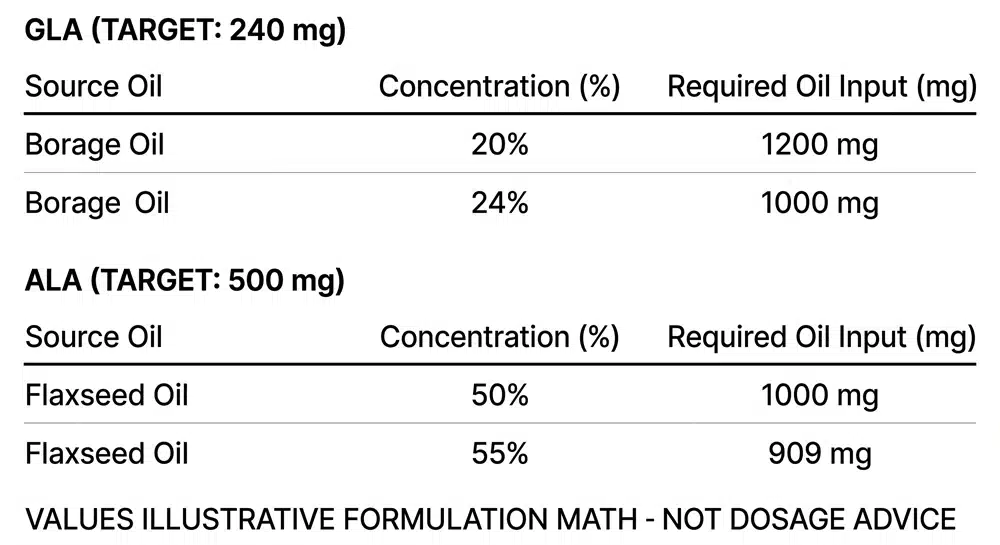
Esempi di calcolo del peso di riempimento
Questi esempi illustrano esclusivamente i calcoli relativi alla formulazione. Non costituiscono raccomandazioni sul dosaggio per i consumatori. I dati finali devono tenere conto dei risultati analitici effettivi del lotto, della dimensione della porzione, della politica di sovramisurazione, della capacità delle capsule e delle norme applicabili in materia di etichettatura.
| Formula Target | Analisi delle materie prime | Esempio di immissione dati relativi al petrolio | Calcolo |
|---|---|---|---|
| 240 mg di GLA | 20% GLA olio di borragine | 1.200 mg di olio | 240 ÷ 0,20 |
| 240 mg di GLA | 24% GLA olio di borragine | 1.000 mg di olio | 240 ÷ 0,24 |
| 500 mg di ALA | 50% ALA olio di semi di lino | 1.000 mg di olio | 500 ÷ 0,50 |
| 500 mg di ALA | 55% ALA olio di semi di lino | circa 909 mg di olio | 500 ÷ 0,55 |
Un titolo più elevato può ridurre il peso del riempimento o il numero di capsule, ma ciò non implica automaticamente risultati clinici migliori. Si tratta di una scelta relativa all’efficienza della formulazione che deve essere valutata tenendo conto della freschezza dell’olio, delle specifiche, dei costi, della continuità dell’approvvigionamento e della stabilità del prodotto finito.
Quale olio è più indicato per una formula integrativa?
Scegli l'olio di borragine quando la formula richiede un apporto specifico di GLA
L'olio di borragine è in genere la scelta più ovvia quando il concetto di prodotto richiede un contenuto documentato di GLA. Confronta la percentuale di GLA, i test PA, i valori di ossidazione, il metodo di lavorazione, l'odore e la compatibilità con le capsule molli.
Scegli l'olio di semi di lino quando la formula richiede un apporto di ALA di origine vegetale
L'olio di semi di lino è generalmente la scelta più immediata per l'apporto di ALA di origine vegetale. Non descriverlo come un sostituto diretto dell'EPA/DHA e non riprendere le indicazioni sulla salute stabilite per l'olio di pesce o per i prodotti farmaceutici a base di omega-3.
Si dovrebbe prendere in considerazione una miscela solo quando ogni olio ha un ruolo ben definito
Una miscela di borragine e semi di lino può fornire sia GLA che ALA, ma l’etichetta dovrebbe indicare le quantità effettive anziché suggerire che una miscela sia automaticamente equilibrata o superiore. I formulatori devono tenere conto del contenuto totale di olio, delle dimensioni delle capsule, dell’ossidazione, del sapore, dell’odore, del sistema antiossidante e del numero di dosi.
E le miscele a base di pesce, semi di lino e olio di borragine?
Le ricerche relative a olio di pesce, olio di semi di lino e olio di borragine riflettono solitamente l'interesse per le capsule molli contenenti una combinazione di omega-3, omega-6 e omega-9. Questi tre oli non devono essere considerati ingredienti intercambiabili:
- L'olio di pesce può fornire EPA e DHA, a seconda della sua qualità.
- L'olio di semi di lino apporta principalmente ALA.
- L'olio di borragine è una fonte principale di GLA.
Una specifica di formulazione significativa dovrebbe indicare i valori di EPA, DHA, ALA e GLA per porzione, non solo il totale in milligrammi di ciascun olio. Dovrebbe inoltre specificare la specie ittica o la provenienza, i limiti di ossidazione, i contaminanti, i test PA per l’olio di borragine, gli allergeni, il rivestimento delle capsule e la stabilità. I marchi che sviluppano capsule molli a base di uno o più oli possono consultare produzione di capsule molli a base di oli vegetali e omega.
Prove scientifiche e limiti delle indicazioni sulla salute
L'olio di borragine e l'olio di semi di lino sono stati oggetto di studi in contesti diversi, e uno studio controllato ha messo a confronto i loro effetti su alcuni parametri cutanei nelle donne. Uno studio incentrato su un particolare olio, una dose specifica, una popolazione e un endpoint non dimostra che ogni prodotto in commercio produca lo stesso risultato.
I marchi dovrebbero evitare di avanzare affermazioni relative al trattamento di patologie quali l’eczema, l’artrite reumatoide, il colesterolo alto, l’ipertensione, la depressione o i disturbi ormonali. Per un prodotto finito è possibile adottare un posizionamento più sicuro in termini di struttura/funzione, purché sia veritiero, non fuorviante e supportato da prove che corrispondano all’ingrediente, alla quantità, alla forma di presentazione e alla popolazione di riferimento.
Non utilizzare il termine “antinfiammatorio” come promessa generica del prodotto. Descrivere la composizione in acidi grassi e il livello di evidenza scientifica, e far verificare le indicazioni in base al mercato di destinazione.
Considerazioni relative alla sicurezza e all'etichettatura
Olio di borragine e alcaloidi pirrolizidinici
Il materiale vegetale della borragine può contenere alcaloidi pirrolizidinici (PA), e l'olio di semi di borragine può contenerne piccole quantità, a meno che la lavorazione e i test non ne garantiscano il controllo. La dicitura “senza PA” non dovrebbe essere accettata come semplice slogan pubblicitario. Richiedete il metodo analitico, l'elenco degli analiti, il limite di quantificazione (LOQ), le specifiche e i risultati relativi al lotto specifico.
Le donne in gravidanza o in allattamento, i bambini, le persone affette da patologie epatiche e coloro che assumono farmaci dovrebbero consultare un medico prima di assumere integratori a base di oli vegetali. Non utilizzare le foglie o i fiori di borragine come se fossero equivalenti a un ingrediente a base di olio di semi testato.
Sicurezza dell'olio di semi di lino
Dosi elevate di semi di lino o di olio di semi di lino possono causare sintomi digestivi quali gonfiore, senso di pienezza o diarrea. È opportuno valutare le potenziali interazioni con i farmaci, compresa la terapia anticoagulante o antiaggregante piastrinica. I dati sulla sicurezza in caso di gravidanza e allattamento sono limitati.
Dichiarazioni relative ad allergeni, prodotti vegani e provenienza
Entrambi gli oli di semi sono di origine vegetale, ma un prodotto finito non è automaticamente vegano o privo di allergeni. Verificare gli coadiuvanti tecnologici, i veicoli, gli antiossidanti, le indicazioni relative alla contaminazione incrociata e l’involucro delle capsule molli. Evitare di utilizzare affermazioni assolute del tipo “privo di allergeni”, a meno che non siano supportate dai controlli sul prodotto finito e dalle norme di mercato applicabili.
Ossidazione, conservazione e confezionamento
Sia l'olio di borragine che quello di semi di lino sono ricchi di acidi grassi polinsaturi e sono sensibili all'ossigeno, al calore e alla luce. L'ossidazione può alterarne l'odore, il sapore, il contenuto di acidi grassi e la durata di conservazione.
| Articolo di qualità | Cosa richiedere | Perché è importante |
|---|---|---|
| Indice di perossido | Metodo, specifiche e risultati del lotto | Indica l'ossidazione primaria |
| Valore p-anisidina | Metodo e risultato del lotto, se del caso | Indica un'ossidazione secondaria |
| TOTOX o analisi più ampia dell'ossidazione | Base di calcolo o rapporto del fornitore | Consente una valutazione più ampia della freschezza |
| Indice di acidità / acidi grassi liberi | Specifiche e risultati | Aiuta a valutare la degradazione idrolitica e la maneggevolezza |
| Sistema antiossidante | Dichiarazione di identità e di etichettatura | Supporta la pianificazione del controllo dell'ossidazione |
| Imballaggio | Barriera alla luce, controllo dell’ossigeno, strategia dell’azoto e chiusura | Protegge l'olio durante la distribuzione e l'utilizzo |
| Stabilità | Prodotto finito nella confezione definitiva | Conferma l'efficacia e la qualità sensoriale per tutta la durata di conservazione |
La spremitura a freddo può favorire l'identificazione della provenienza e del processo di lavorazione, ma non garantisce automaticamente una maggiore freschezza, purezza o durata di conservazione. È possibile optare per un olio raffinato qualora i requisiti relativi all'odore, alla limpidezza, alla rimozione degli acidi fenolici o alla stabilità giustifichino tale processo.
Specifiche di qualità che i marchi di integratori dovrebbero verificare
| Area delle specifiche | Olio di borragine | Olio di semi di lino |
|---|---|---|
| Identità | Origine botanica e composizione dell'olio | Origine botanica e qualità alimentare/per integratori |
| Indicatore attivo | Percentuale di GLA e profilo completo degli acidi grassi | Percentuale di ALA e profilo completo degli acidi grassi |
| Tossine naturali | Metodo PA, analiti, limite e risultato del lotto | Analisi basata sul rischio relativa a contaminanti e adulterazioni |
| Ossidazione | PV, p-AV, indice di acidità e conservazione | PV, p-AV, indice di acidità e conservazione |
| Sostanze contaminanti | Metalli pesanti, microbiologia, pesticidi, ove applicabile | Metalli pesanti, microbiologia, pesticidi, ove applicabile |
| Documentazione | COA, scheda tecnica, SDS, TDS, diagramma di flusso e rapporto PA | Certificato di analisi (COA), scheda tecnica, scheda di sicurezza (SDS), scheda tecnica del prodotto (TDS), diagramma di flusso e dichiarazione di origine |
| Vestibilità del prodotto finito | Riempimento dell'olio, compatibilità con il guscio, odore e stabilità | Riempimento dell'olio, compatibilità con il guscio, odore e stabilità |
Lista di controllo per l'acquirente
- Verificare il nome botanico, la parte della pianta e il paese di origine.
- Verificare se il materiale è stato sottoposto a spremitura a freddo, raffinazione, winterizzazione, deodorizzazione o microincapsulazione.
- Richiedere il profilo degli acidi grassi del lotto e la percentuale di marcatori attivi.
- Per l'olio di borragine, verificare il metodo PA, gli analiti, il limite di quantificazione (LOQ) e i risultati del lotto.
- Verificare il PV, il p-AV, l'indice di acidità, gli acidi grassi liberi e le caratteristiche sensoriali.
- Verificare la presenza di metalli pesanti, microrganismi, pesticidi e solventi residui, ove applicabile.
- Esaminare gli antiossidanti, i veicoli, i coadiuvanti tecnologici e le indicazioni riportate sull'etichetta.
- Verificare l'imballaggio, la protezione con azoto, la temperatura di conservazione e la durata di conservazione.
- Calcolare la quantità di acidi grassi attivi per porzione sulla base dei risultati effettivi dell'analisi.
- Richiedere la stabilità del prodotto finito nella confezione finale.
Domande da porre in una richiesta di offerta (RFP) a un fornitore di olio o a un produttore di capsule molli
- Quali tipi di olio di borragine e di semi di lino sono disponibili e qual è il contenuto di GLA o ALA per lotto?
- Quale metodo analitico viene utilizzato per determinare il profilo degli acidi grassi?
- Per l'olio di borragine, per il quale vengono analizzati i PA, qual è il limite di quantificazione (LOQ) e qual è la specifica di accettazione?
- Quali sono i valori attuali di PV, p-AV, indice di acidità e TOTOX?
- In che modo vengono controllati l'ossidazione e l'esposizione all'ossigeno durante lo stoccaggio, il trasferimento e l'incapsulamento?
- Quali antiossidanti, eccipienti o coadiuvanti tecnologici sono presenti?
- La formula è in grado di fornire la dose giornaliera raccomandata di GLA o ALA in una singola porzione pratica?
- Quali tipi di involucro per capsule molli, dimensioni delle capsule e peso del contenuto sono disponibili?
- Quali test sul prodotto finito e quali dati di stabilità sono disponibili?
- Potete fornirci i certificati di analisi (COA), le specifiche tecniche, le schede di sicurezza (SDS), le schede tecniche (TDS), il diagramma di flusso e le dichiarazioni di origine relativi a ogni singolo lotto?
- Quali sono il quantitativo minimo d'ordine (MOQ), il numero di campioni, le opzioni di imballaggio e i tempi di consegna?
- In che modo verranno valutate le indicazioni relative a struttura/funzione, omega e “senza PA” per il mercato di riferimento?
Domande frequenti
Qual è il migliore, l'olio di borragine o l'olio di semi di lino?
Nessuno dei due è universalmente migliore. Scegliete l’olio di borragine se cercate un apporto documentato di GLA e l’olio di semi di lino se cercate un apporto documentato di ALA di origine vegetale. Confrontate i risultati delle analisi di lotto, la dimensione della porzione, i dati sulla sicurezza, il grado di ossidazione e il formato del prodotto finito.
L'olio di borragine è un olio ricco di omega-3?
L'olio di borragine viene scelto principalmente per il GLA, un acido grasso omega-6. Non dovrebbe essere commercializzato come sostituto dell'ALA, dell'EPA o del DHA senza una formulazione che fornisca separatamente tali acidi grassi.
L'olio di semi di lino contiene EPA e DHA?
L'olio di semi di lino fornisce principalmente ALA. L'organismo è in grado di convertire una parte dell'ALA in EPA e DHA, ma tale conversione è limitata. L'etichetta non dovrebbe indicare la quantità di EPA o DHA a meno che il prodotto finito non ne contenga effettivamente e non ne sia stata verificata la presenza.
È possibile combinare l'olio di borragine e l'olio di semi di lino?
Sì, possono essere combinati quando la formula prevede un obiettivo ben definito per il GLA e l’ALA. La miscela deve comunque soddisfare i requisiti pratici relativi al peso di riempimento, all’ossidazione, alla sicurezza, all’etichettatura e alla stabilità.
Cosa significa “olio di borragine senza PA”?
Ciò dovrebbe significare che un elenco definito di alcaloidi pirrolizidinici è stato analizzato utilizzando un metodo appropriato e ha soddisfatto le specifiche indicate. Gli acquirenti dovrebbero richiedere l'elenco degli analiti, il limite di quantificazione (LOQ) e i risultati specifici per ogni lotto.
Cosa dovrebbe riportare l'etichetta di un olio di pesce, di lino e di borragine?
Un'etichetta e una scheda tecnica adeguate dovrebbero indicare il contenuto di EPA, DHA, ALA e GLA per porzione, qualora dichiarato, insieme agli oli di origine, alla dimensione della porzione, agli allergeni e alle altre informazioni obbligatorie.
Conclusione
L'olio di borragine e l'olio di semi di lino risolvono problemi di formulazione diversi. L'olio di borragine è una fonte di GLA; l'olio di semi di lino è una fonte di ALA. La scelta corretta si basa sulla quantità di acidi grassi desiderata, sull’analisi del lotto, sul controllo del PA, sull’ossidazione, sulla dimensione della porzione, sulla forma di somministrazione e sulle indicazioni supportate da prove scientifiche — non su un’affermazione generica secondo cui un olio sarebbe più salutare dell’altro.
Per un preventivo, un campione, un certificato di analisi (COA), una revisione delle specifiche o un progetto personalizzato di capsule molli a base di olio, contatta GENSEI indicando la quantità prevista di GLA o ALA, la porzione, la forma farmaceutica, la quantità ordinata e il mercato di destinazione.
Riferimenti
- Ufficio degli integratori alimentari del NIH: Scheda informativa sugli acidi grassi omega-3 per gli operatori sanitari
- NCCIH: Semi di lino e olio di semi di lino – Utilità e sicurezza
- NCBI LactMed: Borragine
- Agenzia europea per i medicinali: Dichiarazione pubblica sugli alcaloidi pirrolizidinici
- EFSA: Alcaloidi pirrolizidinici negli alimenti
- L'integrazione con semi di lino e olio di borragine influisce positivamente sulle condizioni della pelle nelle donne
- Conversione dell'acido alfa-linolenico in acidi grassi polinsaturi a catena più lunga negli adulti
- FDA: Dichiarazioni relative alla struttura e alla funzione
- FTC: Linee guida sulla conformità dei prodotti per la salute
Gensei Global Industries è un produttore di collagene, brodo d'ossa, proteine isolate di manzo, cheratina idrolizzata e membrana di guscio d'uovo con stock negli Stati Uniti, in Canada, in Australia ecc. Gensei Global Industries è un'azienda che opera a livello globale e distribuisce gli ingredienti ai propri clienti in tutto il mondo.