Respuesta rápida
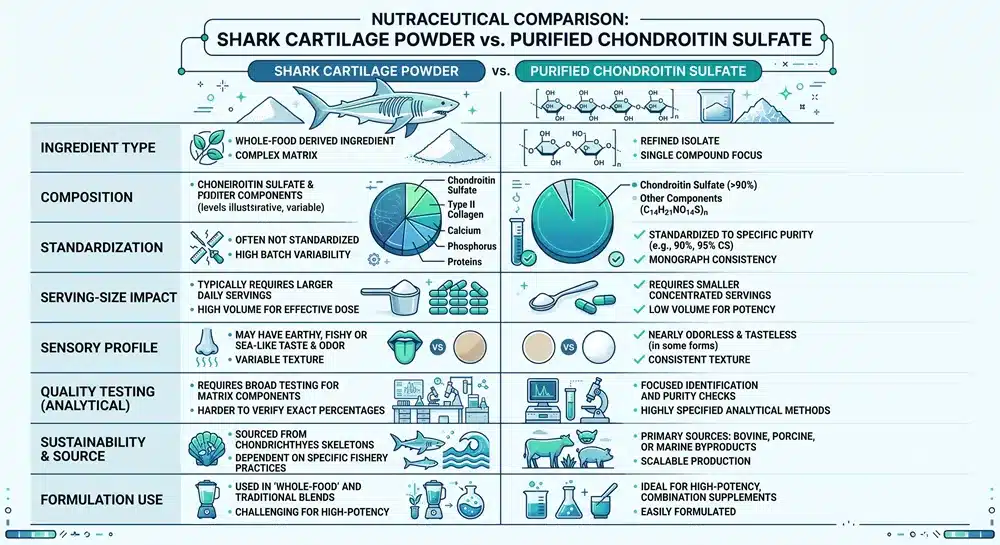
Shark cartilage powder and chondroitin sulfate are not interchangeable ingredients. Shark cartilage powder is a multi-component tissue-derived material that may contain collagen, protein, chondroitin sulfate, other glycosaminoglycans, minerals, moisture, and ash. Chondroitin sulfate is a more purified and standardized glycosaminoglycan ingredient that can be measured, specified, and labeled separately.
For a supplement brand that needs a defined chondroitin amount, purified chondroitin sulfate is usually easier to qualify and formulate. Polvo de cartílago de tiburón may fit a whole-cartilage or marine-source concept, but its composition, species identity, legal trade status, contaminants, sustainability, sensory properties, and actual chondroitin content require detailed verification.
Neither ingredient should be marketed as a treatment for cancer, rheumatoid arthritis, osteoarthritis, cartilage loss, or another disease.
What Is Shark Cartilage Powder?
Shark cartilage powder is produced from cleaned, processed, dried, and milled cartilage tissue obtained from a declared shark species and anatomical source. It is a complex biological material rather than a single purified compound.
Depending on the species, tissue and manufacturing process, the powder may contain:
- cartilage-derived proteins and collagen;
- chondroitin sulfate and other glycosaminoglycans;
- proteoglycan-related material;
- calcium, phosphorus and other mineral matter;
- water, ash and naturally occurring residual components;
- processing aids or carriers when used by the manufacturer.
Processed shark cartilage powder should not be described as a meaningful source of living chondrocytes. Chondrocytes are cartilage cells in living tissue; drying, milling and other commercial processing do not make viable cartilage cells a practical active component of the finished powder.
The phrase “shark cartilage powder” does not establish a fixed amount of collagen or chondroitin sulfate. Brands should request batch-specific analytical data instead of relying on a generic composition claim.
For bulk raw-material information, review our shark cartilage powder ingredient page.
¿Qué es el sulfato de condroitina?
Chondroitin sulfate, also spelled chondroitin sulphate, is a sulfated linear glycosaminoglycan made of repeating disaccharide units. Commercial supplement material is commonly supplied as chondroitin sulfate sodium.
Traditional chondroitin sulfate can be extracted and purified from bovine, porcine, chicken, shark, fish, or other animal cartilage. Non-animal production routes may also be available, but they must be separately evaluated for identity, structure, specifications, regulatory suitability, and label claims.
Chondroitin sulfate is a polymeric material rather than one small molecule with a single uniform structure. Source and processing can affect:
- molecular-weight distribution;
- the relative amounts of chondroitin-4-sulfate and chondroitin-6-sulfate;
- other sulfation patterns;
- protein and related glycosaminoglycan residues;
- color, odor, solubility and viscosity;
- assay results obtained with different test methods.
Brands sourcing a standardized active can review our bulk chondroitin sulfate powder and specification page.
Shark Cartilage Powder vs. Chondroitin Sulfate: Key Differences
| Factor | Cartílago de tiburón en polvo | Sulfato de condroitina |
|---|---|---|
| Tipo de ingrediente | Whole or partially processed cartilage matrix | Purified and standardized glycosaminoglycan ingredient |
| Fuente primaria | Declared shark species and cartilage tissue | Bovine, porcine, avian, shark, fish, other marine, or qualified non-animal route |
| Main composition | Variable mixture of protein, collagen, glycosaminoglycans, minerals, moisture and ash | Predominantly chondroitin sulfate in a declared salt form and assay range |
| Chondroitin amount | Variable and must be measured by batch | Usually purchased to a defined assay specification |
| Estandarización | More difficult because multiple components vary | Easier to define by identity, assay, molecular weight and related specifications |
| Serving-size impact | Often requires more material when the goal is to deliver a stated chondroitin amount | More concentrated and easier to fit into a defined serving |
| Perfil sensorial | May have stronger marine odor, taste and color | Purified grades are typically lighter and more neutral, subject to source and grade |
| Key quality risks | Species identity, variable composition, minerals, contaminants, odor, microbiology and trade legality | Assay specificity, adulteration, source identity, molecular characteristics, residual proteins and contaminants |
| Clinical evidence | Evidence for oral shark cartilage products is limited and does not establish general health benefits | Osteoarthritis evidence is inconsistent and depends on the exact grade, study and joint site |
| Sostenibilidad | Requires shark-species, fishery, trade, by-product and chain-of-custody verification | Depends on the selected animal or non-animal source |
| Mejor uso en el ámbito B2B | Whole-cartilage or marine-matrix concepts with complete sourcing and composition documentation | Products requiring a defined chondroitin sulfate amount and standardized specifications |
How Much Chondroitin Is in Shark Cartilage Powder?
There is no universal percentage. Chondroitin content varies with the shark species, anatomical tissue, cleaning, demineralization, extraction, concentration, drying, particle size, carrier use, and analytical method.
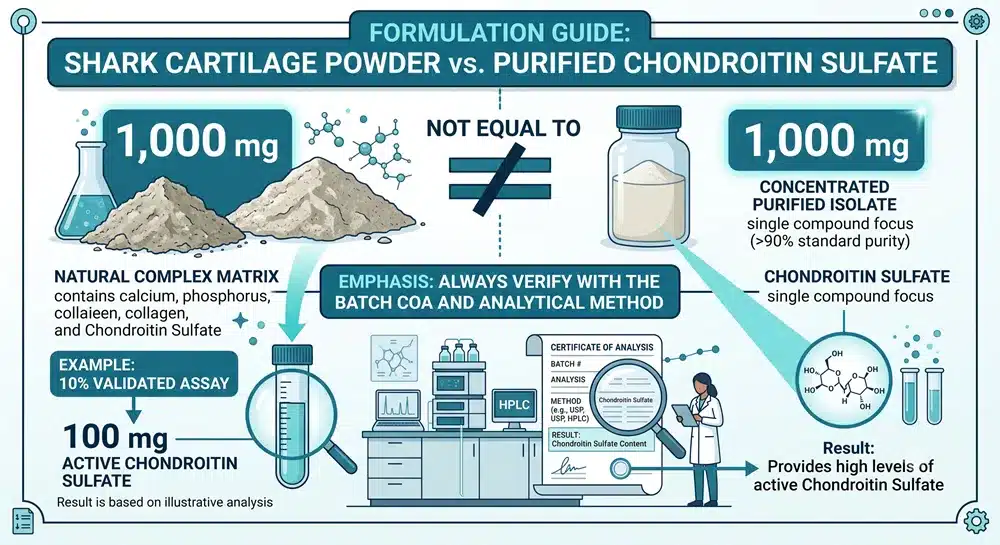
For example, a 1,000 mg serving of shark cartilage powder does not provide 1,000 mg of chondroitin sulfate. If a validated batch test reported 10% chondroitin sulfate, the theoretical contribution would be 100 mg per 1,000 mg of powder. That calculation is valid only when:
- the percentage is supported by the actual batch COA;
- the analytical method is sufficiently specific;
- the result is reported on a clearly defined as-is or dry basis;
- the finished-product manufacturing process does not materially change the result;
- the label calculation uses the correct serving amount.
Total glycosaminoglycans, a colorimetric response, or a supplier’s estimated natural composition should not automatically be labeled as chondroitin sulfate.
| COA Result | Con qué es compatible | What It Does Not Automatically Support |
|---|---|---|
| Proteína total | Overall protein content | Type II collagen quantity or native collagen structure |
| Hidroxiprolina | A marker that can help estimate collagen-related material | A specific collagen type or clinical effect |
| Total glycosaminoglycans | Total GAG-related material under the selected method | Pure chondroitin sulfate content |
| Chondroitin sulfate assay | Chondroitin amount under the stated validated method | Clinical efficacy or equivalence to another source |
| Calcium and phosphorus | Aporte de minerales | Improved bone or joint outcomes |
Does the Source of Chondroitin Sulfate Matter?
Source does not by itself determine which product is clinically superior, but it affects identity, molecular characteristics, allergen review, religious suitability, sustainability, traceability, regulatory documentation, sensory performance, and brand positioning.
Shark or Marine Chondroitin Sulfate
Shark-derived chondroitin is a purified material obtained from shark cartilage. It should not be confused with unstandardized shark cartilage powder. Buyers should verify:
- scientific and common species name;
- cartilage source and country of origin;
- CITES or other trade status;
- fishery and landing documentation;
- whether the material is genuinely a by-product;
- marine or fish allergen statements;
- heavy metals and other marine contaminants;
- molecular-weight and sulfation profile;
- odor, color and solubility.
Bovine, Porcine, or Avian Chondroitin
Land-animal sources may be commercially established and may avoid shark-conservation concerns, but they require their own species, country-of-origin, BSE/TSE, halal, kosher, disease-control, traceability and allergen review.
Non-Animal Chondroitin Options
Non-animal or fermentation-related options may support vegan-positioned concepts when the complete production route and finished formula qualify. Buyers should not assume that a non-animal source is clinically equivalent, environmentally superior, or approved in every market. Identity, structure, assay, residuals, safety, and regulatory status must be reviewed separately.
What Does the Evidence Show?
Evidence for Shark Cartilage Powder
Shark cartilage has been promoted for cancer, arthritis, inflammation, skin conditions, and other uses. Human research has not established that oral shark cartilage treats cancer or provides reliable benefits for these conditions.
Laboratory findings involving cartilage proteins, glycosaminoglycans, angiogenesis, enzymes, or inflammatory pathways should not be converted into consumer disease claims. A processed powder is also not equivalent to a purified compound evaluated in a separate experiment.
Evidence for Chondroitin Sulfate
Research on chondroitin sulfate for osteoarthritis has produced inconsistent results. Outcomes differ by study quality, source and grade, assay, dose, joint site, comparator, duration, and whether the product was a pharmaceutical-grade preparation or a general dietary supplement.
Some reviews report potential benefits from well-characterized preparations, while major U.S. guidance does not recommend chondroitin for knee or hip osteoarthritis. A conditional recommendation has been made for hand osteoarthritis based on limited evidence.
Why the Evidence Cannot Be Transferred
| Study Material | Can the Result Be Applied to Shark Cartilage Powder? | Can the Result Be Applied to Every Chondroitin Product? |
|---|---|---|
| Purified chondroitin sulfate | No. The dose and composition are different. | No. Source, grade, assay and study product must match. |
| Shark cartilage extract | Not automatically. Extraction can create a different composition. | No. It is not necessarily purified chondroitin sulfate. |
| Animal or cell study | No direct clinical conclusion | No direct clinical conclusion |
| Human cancer study | Does not support joint, skin or general wellness claims | Does not support chondroitin supplement claims |
| Osteoarthritis study using a specified CS grade | Does not validate whole cartilage powder | Supports only conclusions appropriate to the tested preparation and population |
Claims vs. Evidence
| Reclamación habitual | Evaluación de la evidencia | Responsible Content Direction |
|---|---|---|
| Repairs or rebuilds cartilage | Not established for either generic ingredient | No utilices |
| Treats osteoarthritis or rheumatoid arthritis | Disease-treatment claim | Do not use for a dietary supplement |
| Reduces inflammation and pain | Overgeneralizes laboratory and inconsistent clinical evidence | Do not present as an established outcome |
| Slows joint degeneration | Evidence is inconsistent and product-specific | Do not use as a generic claim |
| Treats or prevents cancer | Unsupported and high-risk disease claim | Explicitly state that shark cartilage has not been shown to treat cancer |
| Supports normal joint structure | May be a structure/function direction only when adequately substantiated | Complete a product-specific claim review |
| Contains natural chondroitin | Possible for shark cartilage powder | State only the tested amount or avoid a quantitative implication |
| More effective because it contains more bioactives | More components do not prove better performance | Describe the matrix without implying superiority |
Seguridad y efectos secundarios
Safety depends on the exact raw material, source species, composition, serving amount, manufacturing process, other formula ingredients, contaminants, medications, and individual health status.
Cartílago de tiburón en polvo
Reported or potential concerns include gastrointestinal discomfort, unpleasant taste or odor, allergic reactions, variable mineral exposure, and contaminants. Long-term safety has not been systematically established for every shark-cartilage product.
People with fish allergy, kidney disease, abnormal calcium levels, pregnancy or breastfeeding, cancer treatment, immune conditions, or prescription medication use should seek professional advice before using a shark-derived product.
Sulfato de condroitina
Chondroitin is generally reported to cause mild gastrointestinal effects in some users. Chondroitin and glucosamine–chondroitin products have been associated with increased bleeding risk in people taking warfarin.
Source-related proteins or cross-contact may also matter for people with animal or fish allergies. A purified ingredient should not automatically be described as allergen-free.
Stop-Use and Medical Review
Stop the product and seek medical advice for persistent gastrointestinal symptoms, rash, facial swelling, breathing difficulty, unusual bleeding, severe dizziness, or other concerning reactions. This article does not provide individual treatment or dosing advice.
Sustainability and Shark Species Traceability
“Marine,” “ocean sourced,” “wild harvested,” and “by-product” are not sufficient sustainability documentation.
Before purchasing shark cartilage powder or shark-derived chondroitin sulfate, request:
- scientific species name and common name;
- country and fishery of origin;
- catch, landing or aquaculture documentation where applicable;
- CITES status and permits when required;
- national export and import documents;
- chain-of-custody records;
- evidence supporting any by-product claim;
- supplier sustainability policy and audit records;
- species-verification method, such as DNA testing where appropriate;
- change-notification requirements if the species or source changes.
A sustainability certification or supplier statement does not replace species identification and legal-trade review. The acceptability of shark-sourced ingredients can also vary by retailer, country, certification program, brand policy, and consumer audience.
¿Qué es mejor para los consumidores?
Neither ingredient is universally better.
- For a clearly labeled chondroitin amount: a standardized chondroitin sulfate product is easier to understand than an unstandardized cartilage powder.
- For a whole-cartilage concept: shark cartilage powder provides a broader matrix, but the actual composition and health relevance are uncertain.
- For people avoiding shark-derived products: consider a verified bovine, porcine, avian, other marine, or non-animal chondroitin option according to dietary, ethical and medical needs.
- For joint pain or diagnosed arthritis: seek a healthcare evaluation rather than substituting either product for evidence-based care.
- For cancer: shark cartilage should not be used as an alternative to medical treatment.
Which Is Better for Supplement Brands?
For most brands that need a defined Supplement Facts amount, reproducible testing, lower serving volume, and clearer supplier specifications, purified chondroitin sulfate is generally the more practical ingredient.
Shark cartilage powder may be considered only when the product concept specifically requires a whole marine-cartilage matrix and the brand can substantiate:
- species and tissue identity;
- legal and sustainable sourcing;
- batch composition;
- chondroitin and collagen statements;
- heavy-metal and microbiological controls;
- sensory acceptability;
- serving-size feasibility;
- lawful, non-disease claims.
For custom joint-support products, review our joint supplement manufacturing services y asistencia en la elaboración de fórmulas a medida.
Quality Specifications and COA Requirements
Cartílago de tiburón en polvo
| Área de especificaciones | Qué solicitar |
|---|---|
| Identidad de la fuente | Scientific species, tissue, country, fishery, processing site and lot traceability |
| Trade legality | CITES status, permits, export/import documents and supplier legal declaration |
| Composición | Total protein, collagen or hydroxyproline, chondroitin sulfate, total GAG, calcium, phosphorus, moisture, ash and carriers |
| Método de ensayo | Method name, specificity, validation, calculation basis and laboratory accreditation |
| Propiedades físicas | Appearance, odor, particle size, bulk density, tapped density, flow and dispersibility |
| Contaminantes | Lead, arsenic, cadmium, mercury, microbiology, pathogens and risk-based marine contaminants |
| Allergen | Fish/marine source statement, cross-contact and finished-product label review |
| Estabilidad | Retest period, packaging, odor, moisture, microbiological and composition stability |
Sulfato de condroitina
| Área de especificaciones | Qué solicitar |
|---|---|
| Identidad | Chondroitin sulfate sodium identity, source declaration and suitable identification methods |
| Ensayo | Assay percentage, method, dry/as-is basis and calculation details |
| Method specificity | CPC, chromatographic, enzymatic or disaccharide-analysis information appropriate to the grade |
| Molecular properties | Molecular-weight distribution, sulfation pattern and related GAG profile where relevant |
| Pureza | Protein residues, loss on drying, residue on ignition, chloride, sulfate and related substances |
| Propiedades físicas | Particle size, density, flow, solubility, viscosity, color and odor |
| Contaminantes | Heavy metals, microbiology, pathogens, residual solvents and source-specific contaminants |
| Documentación | COA, specification, SDS, TDS, flow chart, source statement, allergen statement and stability |
Más información sobre nuestro complementar el proceso de control de calidad.
Formulation and Dosage-Form Considerations
| Forma farmacéutica | Cartílago de tiburón en polvo | Sulfato de condroitina |
|---|---|---|
| Cápsulas | Serving size and low density may require multiple capsules | More concentrated, but density and flow still require testing |
| Tabletas | Mineral content, compressibility, abrasion and odor need review | Particle size, compressibility, disintegration and active uniformity need review |
| Mezclas de polvos | Marine odor, sediment, texture and serving volume may be limiting | Taste, viscosity, solubility and hygroscopicity may require flavor work |
| Gominolas | High loading, texture, color, odor and heat exposure can be difficult | More feasible, but pH, heat, moisture, texture and assay retention require validation |
| Líquidos | Suspension, sedimentation and microbial control are major considerations | Solubility and viscosity may be manageable, but stability and preservation must be tested |
| Pet products | Requires separate animal-food legality, species, contaminant, palatability and claim review | Requires separate animal-use legality and formulation review; human-supplement status is not sufficient |
For dosage-form development, see our fabricación de cápsulas, fabricación de tabletasy fabricación de suplementos en polvo capacidades.
Aspectos a tener en cuenta sobre el etiquetado y las declaraciones en EE. UU.
Dietary supplements are not approved by FDA before marketing. The company marketing the finished product is responsible for ingredient legality, identity, safety, current good manufacturing practice, labeling, and truthful claims.
Para productos de EE. UU.:
- do not claim that shark cartilage or chondroitin treats, cures, mitigates, or prevents cancer, osteoarthritis, rheumatoid arthritis, inflammation, pain, or cartilage degeneration;
- do not imply that laboratory angiogenesis findings prove anticancer effects in people;
- do not transfer studies on purified chondroitin sulfate to shark cartilage powder;
- do not label total cartilage powder weight as chondroitin sulfate;
- substantiate every quantitative chondroitin, collagen, mineral and source statement;
- verify the legality of the shark species and international trade;
- support “sustainable,” “traceable,” “by-product,” “wild,” or “responsibly sourced” claims with specific documentation;
- review fish or marine allergen implications;
- follow applicable 21 CFR Part 111 manufacturing and quality requirements.
Claims such as “clinically proven to rebuild cartilage,” “stops joint breakdown,” “natural cancer treatment,” “anti-angiogenic supplement,” and “FDA-approved shark cartilage” should not be used.
Preguntas sobre la solicitud de propuestas a proveedores
- Is the material whole cartilage powder, cartilage extract, hydrolyzed cartilage, or purified chondroitin sulfate?
- What is the exact scientific species and anatomical tissue?
- How is species identity verified?
- What are the country, fishery, landing and processing locations?
- Is the species listed under CITES or another trade-control system?
- Which permits and chain-of-custody documents are available?
- What evidence supports a by-product or sustainability claim?
- What are the cleaning, demineralization, extraction, hydrolysis and drying steps?
- What is the batch-tested chondroitin sulfate content?
- Which analytical method is used for the chondroitin assay?
- Is the result reported on an as-is or dry basis?
- What are the total protein, collagen or hydroxyproline, total GAG, calcium, phosphorus, moisture and ash specifications?
- For purified chondroitin, what are the molecular-weight and sulfation specifications?
- How are adulterants and other glycosaminoglycans detected?
- What heavy-metal and marine-contaminant limits apply?
- What microbiological and pathogen specifications apply?
- What allergen and cross-contact statements are available?
- What stability data support the retest period or shelf life?
- Which dosage forms have been successfully tested?
- What clinical evidence uses the exact material and specification?
- Which claims can be substantiated for the intended market?
- What are the sample, MOQ, lead time, packaging, change-control and recall terms?
To request a shark cartilage or chondroitin sulfate COA, specification, sample, MOQ, or formulation review, contact Gensei with the intended source, dosage form, serving size, target market, quantity, and claim direction.
Preguntas frecuentes
Is shark cartilage powder the same as chondroitin sulfate?
No. Shark cartilage powder is a multi-component cartilage matrix. Chondroitin sulfate is one glycosaminoglycan that may be present in the powder and can also be extracted and purified as a separate ingredient.
Does shark cartilage powder contain chondroitin sulfate?
It may contain chondroitin sulfate, but the amount is not fixed. The actual content should be measured by a suitable method and reported on the batch COA.
How much chondroitin is in shark cartilage powder?
There is no universal percentage. Species, tissue and processing affect the result. Do not calculate a finished-product chondroitin amount without batch-specific analytical data.
Is shark chondroitin better than bovine chondroitin?
Clinical superiority has not been established by source alone. Compare identity, assay method, molecular properties, purity, contaminants, allergen requirements, sustainability, documentation and product-specific evidence.
Is shark cartilage powder more natural than purified chondroitin?
It is less purified and contains more cartilage-matrix components, but “more natural” does not mean more effective, safer, cleaner, or more sustainable.
Does shark cartilage help joint pain?
Reliable human evidence has not established that oral shark cartilage powder relieves joint pain. It should not replace evaluation and treatment for a joint condition.
Does chondroitin sulfate help osteoarthritis?
Research is inconsistent. Some studies of specified preparations report benefits, while major U.S. guidance does not recommend it for knee or hip osteoarthritis. Results should not be generalized to every product.
Can shark cartilage treat cancer?
No reliable evidence shows that shark cartilage treats or cures cancer. It should not be used instead of evidence-based cancer care.
What are the side effects of shark cartilage powder?
Possible concerns include gastrointestinal discomfort, unpleasant taste or odor, allergic reactions, mineral exposure and contaminants. Long-term safety data are limited.
Can chondroitin interact with warfarin?
Chondroitin and glucosamine–chondroitin products have been associated with increased bleeding risk in people taking warfarin. A healthcare professional should review the exact product.
Is shark cartilage sustainable?
Sustainability cannot be determined from the ingredient name. Verify species, fishery, CITES status, permits, chain of custody, by-product documentation and supplier practices.
Can shark cartilage powder be used in dog supplements?
Potential animal-food use must be reviewed separately for ingredient legality, intended species, safety, contaminants, serving directions, claims and target-market feed regulations. Human dietary-supplement status does not automatically establish lawful pet use.
Which ingredient is easier to formulate?
Purified chondroitin sulfate is generally easier to standardize and fit into a defined active serving. Shark cartilage powder may require a larger serving and more work on odor, taste, mineral content, composition and sustainability.
What should brands request before purchasing?
Request identity, source, species, trade documents, assay and method, composition, molecular properties where relevant, heavy metals, microbiology, allergen information, stability, COA, specification, sample, MOQ and change-control terms.
Referencias
- National Center for Complementary and Integrative Health. Glucosamine and Chondroitin for Osteoarthritis.
- National Center for Complementary and Integrative Health. Osteoarthritis: In Depth.
- Institute of Medicine. Shark Cartilage: Prototype Monograph Summary.
- Memorial Sloan Kettering Cancer Center. Shark Cartilage.
- Federal Trade Commission. Operation Cure.All and Shark Cartilage Claims.
- U.S. Food and Drug Administration. Warning Letter Involving Shark Cartilage Disease Claims.
- Kolasinski SL, et al. American College of Rheumatology/Arthritis Foundation Guideline for Osteoarthritis.
- Sim JS, et al. Evaluation of Chondroitin Sulfate in Shark Cartilage Powder as a Dietary Supplement.
- Volpi N. Analytical Aspects of Pharmaceutical-Grade Chondroitin Sulfates.
- United States Pharmacopeia. Chondroitin Sulfate Sodium Dietary Supplement Monograph Information.
- CITES and FAO. International Trade and CITES-Listed Shark Species.
- CITES. Non-Detriment Findings Guidance for Shark Species.
- Administración de Alimentos y Medicamentos de EE. UU. Preguntas y respuestas sobre los complementos alimenticios.
- Electronic Code of Federal Regulations. 21 CFR Part 111.
- Comisión Federal de Comercio. Directrices sobre el cumplimiento normativo de los productos sanitarios.
Medical, sourcing, and regulatory disclaimer: This article is for general education and supplement-development planning. It does not diagnose, treat, cure, mitigate, or prevent disease and does not replace medical, legal, conservation, trade, or regulatory advice. Ingredient legality, species identity, sourcing, safety, specifications, claims, labeling, and lawful use must be reviewed for the exact raw material, finished formula, target consumer, and destination market.

Warren Wan es un experto con una amplia trayectoria en la cadena de suministro de complementos alimenticios, que cuenta con una gran experiencia práctica en la investigación, el desarrollo, el control de procesos y el abastecimiento global de ingredientes clave como los péptidos de colágeno, la proteína de caldo de huesos y la queratina. Como autor de esta columna, se dedica a desmontar los argumentos de marketing, transformando la compleja ciencia de los ingredientes y las normas de control de calidad de la producción en divulgación científica rigurosa y fácil de entender, ayudando a los lectores a comprender la verdad que se esconde tras las etiquetas y a tomar decisiones más racionales en materia de salud.