
La presente guida è destinata ai marchi di integratori alimentari, ai team di acquisto e ai formulatori che stanno valutando un progetto relativo alla produzione di compresse. Illustra i controlli di processo e i documenti da esaminare prima di presentare una richiesta Servizi di produzione di integratori in compresse.
Che cos’è la produzione di integratori in compresse?
Produzione di integratori in compresse è il processo controllato di produzione di un integratore alimentare mediante la compressione di una polvere o di una miscela granulata idonea tra punzoni e matrici. La formulazione di una compressa comprende solitamente ingredienti alimentari ed eccipienti funzionali selezionati per favorire la scorrevolezza, la compressione, la disgregazione, il rivestimento, l’aspetto e la stabilità.
La produzione non si limita semplicemente a “mescolare e pressare”. Una formula che sulla carta sembra accettabile può rivelarsi un fallimento perché la miscela si separa, si attacca alle attrezzature, forma delle capsule dopo la compressione, diventa troppo grande per essere ingerita, perde efficacia durante la lavorazione o non soddisfa i requisiti di disgregazione o dissoluzione.
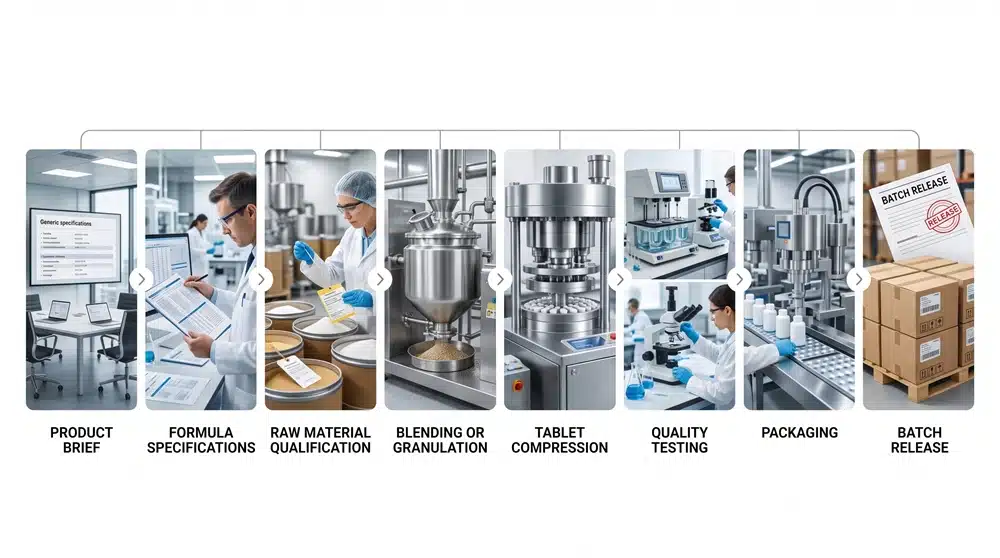
Schema sintetico del processo
| Palcoscenico | Decisione principale | Risultato tipico |
|---|---|---|
| 1. Scheda tecnica del prodotto | Dose per porzione, indicazioni, mercato e forma di somministrazione | Documento programmatico approvato |
| 2. Formula e specifiche | Forme degli ingredienti, quantità previste e requisiti di prova | Bozza delle specifiche relative alle formule e ai componenti |
| 3. Selezione del percorso di processo | Compressione diretta, granulazione a secco o granulazione a umido | Processo di sviluppo |
| 4. Sviluppo del progetto pilota | Flusso, comprimibilità, dimensioni delle compresse e stabilità | Dati relativi a prototipi e progetti pilota |
| 5. Produzione commerciale | Controlli di dosaggio, miscelazione, granulazione e compressione | Registro della produzione in lotti |
| 6. Test e rilascio | Identità, potenza, prove fisiche e contaminanti | Lotto approvato e certificato di autenticità (COA) |
| 7. Confezionamento e stabilità | Protezione dall'umidità, dall'ossigeno, dalla luce e dai rischi legati alla distribuzione | Prodotto finito destinato alla vendita al dettaglio |
Fase 1: Definizione delle specifiche del prodotto prima della formulazione
Il produttore ha bisogno di qualcosa di più di un semplice elenco di ingredienti. Il brief di sviluppo dovrebbe identificare il mercato di riferimento, il consumatore target, la dimensione della porzione, il numero di compresse per porzione, il tipo di compressa, il posizionamento sull’etichetta, il formato della confezione, l’obiettivo relativo alla durata di conservazione e i test richiesti.
- Dose target: Verificare la quantità di ciascun ingrediente alimentare per porzione e per compressa.
- Esperienza con il tablet: Stabilire i limiti relativi al peso, alle dimensioni, alla forma, al rivestimento, alla linea di rottura e alla deglutibilità del tablet.
- Richieste: Distinguere le indicazioni relative a sostanze nutritive o alla struttura/funzione autorizzate dalle indicazioni relative alle malattie.
- Mercato: Verificare i requisiti relativi agli ingredienti, all’etichettatura e alla qualità previsti dal mercato di destinazione.
- Esigenze commerciali: Definire il MOQ target, il numero di unità per confezione, la data di lancio e la fascia di prezzo.
I marchi dovrebbero risolvere questi aspetti prima di dare l'approvazione formulazione personalizzata degli integratori. Eventuali modifiche apportate in fase avanzata al dosaggio, alle indicazioni o alla confezione possono richiedere una nuova fase pilota, un adeguamento delle attrezzature o una valutazione di stabilità.
Fase 2: Qualificazione delle materie prime e degli eccipienti
Ogni componente dovrebbe disporre di una scheda tecnica approvata che ne rifletta il ruolo nella formula. Lo stesso nome di un ingrediente può riferirsi a diverse qualità, eccipienti, granulometrie, densità apparenti, livelli di umidità e concentrazioni di principio attivo.
| Categoria di materiale | Cosa verificare | Perché è importante |
|---|---|---|
| Ingredienti alimentari | Identità, dosaggio, forma, veicolo, contaminanti e stabilità | Supporta la compatibilità tra quantità indicate sull'etichetta e formulazione |
| Diluenti o riempitivi | Grado, densità apparente e comprimibilità | Aumenta la massa del compresso e ne influisce sulla resistenza |
| Raccoglitori | Tipo, livello e metodo di attivazione | Garantisce l'integrità dei granuli o delle compresse |
| Agenti disgreganti | Tipo, livello e impiego intragranulare/extragranulare | Aiuta la compressa a frantumarsi durante il test specificato |
| Agenti scivolanti e lubrificanti | Livello, ordine di aggiunta e tempo di miscelazione | Influisce sul flusso, sull’espulsione e su un’eventuale lubrificazione eccessiva |
| Materiali di rivestimento | Composizione, allergeni, colore e aumento di peso | Influisce sull'aspetto, sul mascheramento del sapore e sulla protezione |
La qualificazione dei fornitori, la quarantena delle merci in entrata, il campionamento rappresentativo, le prove di identità e il rilascio in base ai controlli di qualità devono avvenire prima che i componenti entrino in produzione. Un certificato di analisi (COA) del fornitore è utile, ma non sostituisce la responsabilità del produttore di stabilire e verificare le specifiche appropriate.
Fase 3: Scegliere il processo di produzione
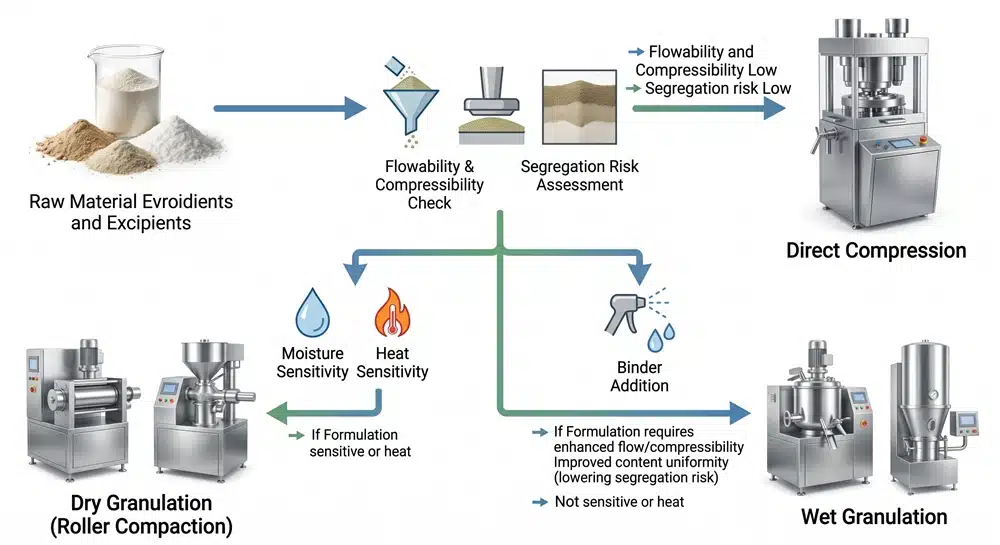
Il processo di produzione deve essere scelto in base ai dati di sviluppo. La compressione diretta è efficiente quando la miscela finale presenta già una fluidità e una comprimibilità adeguate. La granulazione viene utilizzata quando la formulazione richiede una maggiore fluidità, una minore segregazione o una migliore compattazione.
| Percorso | La taglia più adatta | Vantaggi principali | Principali rischi da controllare |
|---|---|---|---|
| Compressione diretta | Ingredienti sfusi e comprimibili o premiscele appositamente formulate | Meno passaggi; evita un maggiore consumo di calore e acqua | Segregazione, flusso insufficiente, scarsa uniformità della dose e capping |
| Granulazione a secco | Formule sensibili all'umidità o al calore che richiedono una densificazione | Nessun legante liquido né fase di essiccazione | Eccesso di fine polvere, durezza compatta e qualità variabile del nastro |
| Granulazione a umido | Formule che richiedono granuli più resistenti o una maggiore uniformità | Può migliorare il flusso e la compressione | Esposizione all’umidità, variabilità dell’essiccazione e degrado attivo |
Non esiste un metodo universalmente migliore. Una combinazione di vitamine, minerali ed estratti vegetali può richiedere un processo diverso rispetto a una compressa a dosaggio elevato contenente un unico ingrediente, anche quando entrambi i prodotti vengono prodotti con la stessa pressa per compresse.
Fase 4: Condurre studi di preformulazione e prove pilota
Le prove di sviluppo dovrebbero tradurre la formula su carta in parametri di processo misurabili e specifiche di prodotto. Il team potrà valutare la distribuzione granulometrica, la densità apparente e la densità battuta, la scorrevolezza, l’umidità, il comportamento in miscelazione, la compattabilità, la forza di espulsione, le dimensioni delle compresse, la forza di rottura, la friabilità e la disintegrazione.
Un progetto pilota dovrebbe inoltre verificare se la compressa proposta sia commercialmente praticabile. Una formulazione può essere chimicamente accettabile, ma dare comunque origine a una compressa troppo pesante, troppo larga, difficile da rivestire o costosa da confezionare. Gli ingredienti a basso dosaggio potrebbero richiedere una strategia di premiscelazione convalidata per garantire una distribuzione uniforme.
Fase 5: Creazione della scheda tecnica di produzione
Prima dell'avvio della produzione commerciale, il processo approvato deve essere documentato in un registro di produzione di riferimento relativo alla formula specifica e alle dimensioni del lotto. Tale documento deve indicare le quantità dei componenti, la resa teorica, le attrezzature, le istruzioni di lavorazione, i punti di controllo, il campionamento, il confezionamento e le approvazioni richieste.
Il registro di produzione in lotti commerciali documenta quindi ciò che è effettivamente avvenuto, compresi i numeri di lotto dei componenti, le pesature, l'identificazione delle attrezzature, i tempi, le rese, i risultati delle verifiche in corso di lavorazione, le deviazioni e le decisioni relative al controllo qualità.
Fase 6: Erogazione, verifica e predisposizione dei componenti
I componenti approvati vengono prelevati in base alla scheda di lotto. La verifica indipendente, l’etichettatura indicante lo stato, lo svuotamento della linea di produzione e lo stoccaggio controllato riducono il rischio di utilizzo di ingredienti errati, errori di pesatura e confusioni.
Gli ingredienti in quantità dell'ordine dei microgrammi o dei milligrammi richiedono un'attenzione particolare. Un premiscelato geometricamente diluito o una diluizione standardizzata dal fornitore possono rivelarsi più pratici rispetto al tentativo di distribuire una quantità molto piccola direttamente in un lotto di grandi dimensioni.
Fase 7: Frullare o granulare la miscela
Miscelazione a compressione diretta
Gli ingredienti vengono aggiunti secondo una sequenza prestabilita e miscelati per un tempo ben definito. Una miscelazione eccessiva dopo l’aggiunta del lubrificante può ridurre l’adesione delle compresse in alcune formulazioni, mentre una miscelazione insufficiente può causare variazioni di peso, potenza o aspetto.
Granulazione a secco
La miscela viene compattata, solitamente mediante compattazione a rullo, e successivamente macinata fino a ottenere una distribuzione granulometrica controllata. Il processo deve garantire un equilibrio tra la densificazione, la produzione di particelle fini e la comprimibilità dei granuli finali.
Granulazione a umido
In condizioni controllate viene aggiunta una soluzione legante o un liquido di granulazione, seguita da lavorazione a umido, vagliatura o trattamento a letto fluido, essiccazione e macinazione. Il punto finale dell’essiccazione dovrebbe essere determinato in base al prodotto e al metodo utilizzati, piuttosto che a una percentuale di umidità universale.
Fase 8: Miscelazione finale e lubrificazione
Dopo la granulazione o la fase principale di miscelazione, è possibile aggiungere disintegranti esterni, agenti antiagglomeranti, aromi, coloranti o lubrificanti. È necessario controllare l’ordine di aggiunta e il tempo di miscelazione, poiché questi materiali possono influire sulla fluidità, sull’espulsione, sulla resistenza delle compresse e sulla disintegrazione.
La miscela finale deve essere valutata alla luce dei requisiti di controllo di processo approvati prima dell’inizio della compressione.
Passaggio 9: Comprimere le compresse
Una pressa rotativa per compresse dosa la miscela nelle cavità dello stampo e la comprime tra il punzone superiore e quello inferiore. Gli operatori regolano la profondità di riempimento e i parametri di compressione entro i limiti previsti dal processo approvato, monitorando al contempo il prodotto e le attrezzature.
| Controllo in corso di lavorazione | Cosa rileva | Possibile risposta |
|---|---|---|
| Peso medio e peso individuale | Variazioni della consistenza del riempimento e della scorrevolezza della polvere | Regolare la profondità di riempimento; verificare il funzionamento della tramoggia o del telaio di alimentazione |
| Spessore e dimensioni | Modifiche alla compressione o al riempimento | Verificare la forza di compressione e il peso delle compresse |
| Forza di rottura | Resistenza meccanica | Regolare la compressione o valutare eventuali modifiche alla formula o al processo |
| Aspetto | Formazione di creste, laminazione, incollaggio, formazione di grumi o macchiatura | Fermarsi e verificare gli utensili, l'umidità, il flusso o la lubrificazione |
| Disintegrazione, quando utilizzata nel processo | Se il tablet si rompe come previsto | Analisi degli effetti della compressione, del lubrificante, del legante e del disgregante |
Fase 10: Applicare il rivestimento o la stampa, se necessario
Il rivestimento filmogeno può migliorare la deglutibilità, l'aspetto, il controllo degli odori o la mascheratura del sapore e può fornire una protezione limitata dagli agenti esterni. Non si deve presumere che garantisca un rilascio controllato, a meno che la formulazione e il sistema di rivestimento non siano stati specificatamente progettati e testati a tale scopo.
I controlli relativi al rivestimento possono includere la temperatura in ingresso e quella del prodotto, la portata di spruzzatura, l’atomizzazione, la velocità del nastro trasportatore, l’aspetto visivo e la percentuale di aumento di peso. È necessario verificare la leggibilità e l’uniformità delle etichette stampate o impresse a rilievo.
Passaggio 11: Provare il tablet finito
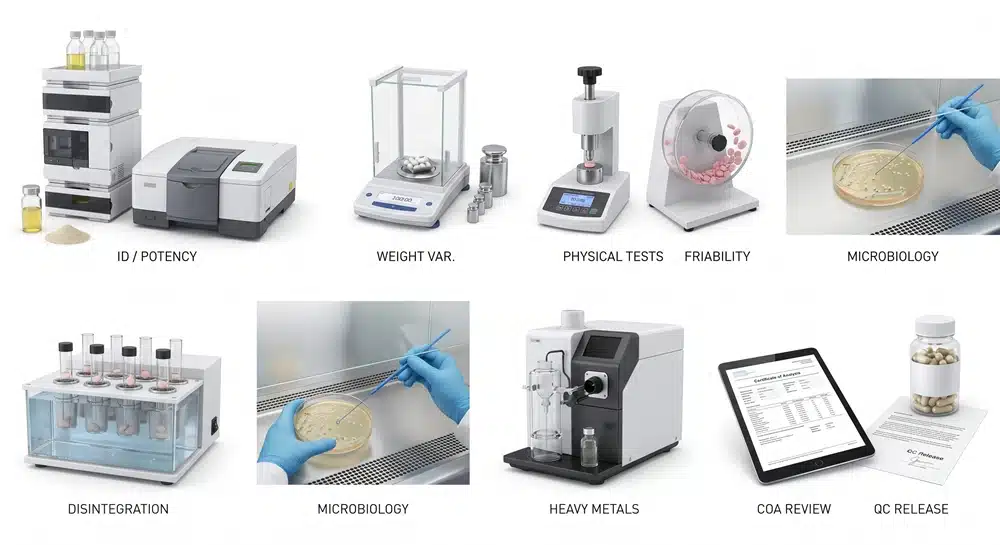
Le specifiche del prodotto finito devono essere specifiche per ciascun prodotto. A seconda della formulazione e delle norme applicabili, le prove possono includere:
- Identificazione e analisi degli ingredienti alimentari
- Variazione di peso o uniformità delle unità di dosaggio
- Aspetto, dimensioni e forza di rottura delle compresse
- Friabilità delle compresse compatte interessate
- Disintegrazione o dissoluzione, a seconda dei casi
- Umidità o attività dell’acqua, se pertinente
- Qualità microbiologica e contaminanti specificati
- Metalli pesanti, pesticidi, solventi residui o altri test specifici per la formulazione
Un significativo controllo di qualità degli integratori Il programma mette in relazione le specifiche approvate, i metodi convalidati o scientificamente adeguati, il campionamento rappresentativo, i registri dei lotti, le deviazioni, i campioni di riserva e il rilascio da parte dell'unità di qualità. Una singola dichiarazione generica di “conformità” non è sufficiente.
Fase 12: Confezionare, etichettare e sottoporre il prodotto a prove di stabilità
La confezione deve proteggere la compressa per tutta la durata di conservazione prevista e nelle condizioni di distribuzione previste. La scelta del contenitore adeguato dipende dalla sensibilità della formulazione all’umidità, all’ossigeno, alla luce, all’abrasione e alle ripetute aperture.
| Opzioni di confezionamento | Vantaggi potenziali | Domande chiave |
|---|---|---|
| Bottiglia con tappo | Efficiente per volumi elevati e formati di vendita al dettaglio comuni | È necessaria una chiusura essiccante o a induzione? L’apertura compromette la stabilità? |
| Blister | Protezione individuale delle cavità e visibilità della dose | Il film/la lamina selezionata garantisce la barriera richiesta? |
| Monodose o bustina | Portabilità ed esposizione controllata | È stata verificata l'integrità del sigillo e il formato è praticabile dal punto di vista commerciale? |
La revisione dell'etichetta deve confermare le informazioni nutrizionali, l'elenco degli ingredienti, le istruzioni per l'uso, le avvertenze, le indicazioni e la dichiarazione di non responsabilità obbligatoria. I test di stabilità devono essere effettuati utilizzando la formula definitiva nella confezione commerciale proposta.
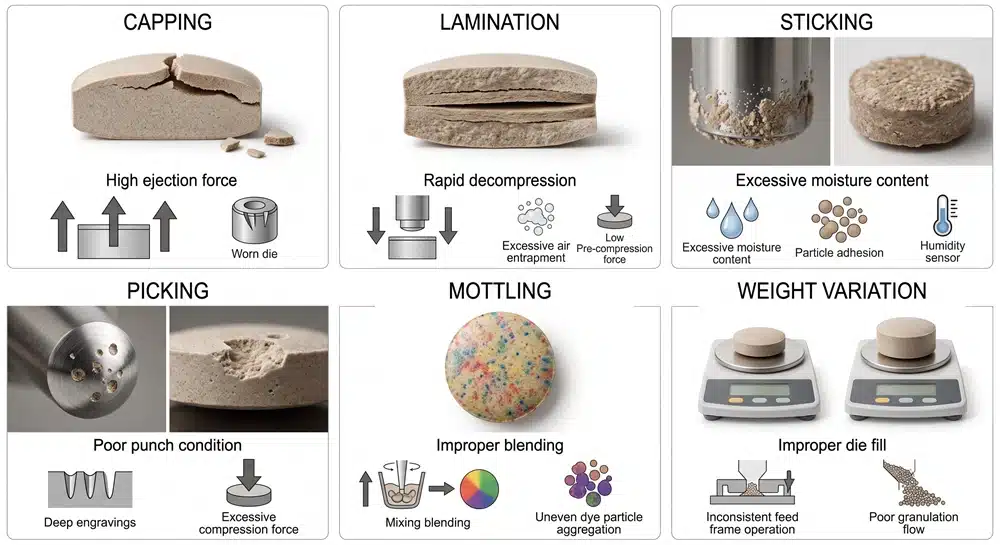
Difetti comuni nella produzione di tablet
| Difetto | Come si presenta | Fattori da esaminare |
|---|---|---|
| Limitazione | La parte superiore o inferiore si stacca dal tablet | Intrappolamento d'aria, particelle fini, velocità, umidità, utensili e profilo di compressione |
| Laminazione | Il tablet si separa in strati | Aria, sovracompressione, elasticità della formulazione e tempo di permanenza |
| Attaccare o staccare | Il materiale aderisce alle superfici dei punzoni | Umidità, ingredienti a basso punto di fusione, lubrificazione, utensili e temperatura |
| Macchiettatura | Colore o aspetto non uniforme | Distribuzione del colore, colore degli ingredienti, essiccazione e migrazione |
| Variazione di peso | Le singole compresse hanno massa diversa | Portata, segregazione, impostazioni del telaio di alimentazione e velocità della pressa |
| Elevata friabilità | Eccessiva scheggiatura o abrasione | Livello del legante, compressione, qualità dei granuli e lubrificazione eccessiva |
| Lenta disintegrazione | La compressa non si frantuma entro i limiti specificati | Prestazioni relative a compressione, rivestimento, legante, lubrificante e disgregante |
Produzione di compresse di vitamina C: un quadro di riferimento più efficace
Una compressa di vitamina C non dovrebbe essere presentata con una formula universale o con un programma di sviluppo garantito di una settimana. Il team di sviluppo dovrebbe innanzitutto confermare la forma dell’acido ascorbico, il dosaggio, il peso della compressa, l’aroma, il rivestimento, la sensibilità all’umidità e le indicazioni riportate sull’etichetta.
Poiché l'acido ascorbico può essere sensibile all'umidità, al calore e all'ossidazione, è possibile prendere in considerazione la compressione diretta o la granulazione a secco qualora le proprietà del materiale e la compressa desiderata lo consentano. La granulazione a umido può comunque essere praticabile, ma il sistema liquido, l'esposizione all'essiccazione e l'impatto sulla stabilità richiedono una valutazione specifica per ciascun prodotto.
Le specifiche definitive dovrebbero includere un intervallo di potenza giustificato e prove fisiche e di contaminanti pertinenti. È necessario valutare l’imballaggio barriera, l’uso di essiccanti e la stabilità nella confezione finale, anziché dare per scontata una durata di conservazione standard di due anni. Le diciture di marketing quali “sostiene la normale funzione immunitaria” richiedono un’adeguata dimostrazione scientifica e una revisione dell’etichetta; il processo di produzione di per sé non dimostra un effetto benefico sulla salute.
Produzione di compresse rispetto ad altre forme farmaceutiche
| Formato | Spesso scelto quando | Principale vincolo allo sviluppo |
|---|---|---|
| Tavoletta | Dosaggio solido preciso, produzione efficiente su larga scala o formulazione rivestita | Flusso, comprimibilità, dimensioni delle compresse e disgregazione |
| Capsula | La formula è più adatta alla riempitura che alla compressione | Volume di riempimento, compatibilità del guscio e scorrevolezza della polvere |
| Polvere | La dimensione della porzione è troppo grande per compresse di uso pratico | Sapore, solubilità, precisione del misurino e controllo dell'umidità |
| Gommoso | L'esperienza del consumatore e il gusto sono fondamentali | Esposizione al calore, attività dell’acqua, perdita di potenza e sistema degli zuccheri |
| Liquido | Esperienza di servizio flessibile o ingredienti compatibili con i liquidi | Microbiologia, conservazione, somministrazione della dose e stabilità |
I confronti tra le diverse forme farmaceutiche non dovrebbero suggerire che i prodotti liquidi o le capsule vengano automaticamente assorbiti meglio. La forma dell’ingrediente, la progettazione del prodotto, il comportamento di disgregazione o dissoluzione e i dati relativi al prodotto finito sono tutti fattori rilevanti.
Come i marchi dovrebbero valutare un produttore di tablet
- Verificare l’esperienza relativa alla dose dell’ingrediente proposta, al peso della compressa e al tipo di rivestimento.
- Chiedete in che modo il produttore sceglie tra compressione diretta, granulazione a secco o granulazione a umido.
- Esaminare le specifiche dei componenti, la qualificazione dei fornitori e le procedure di verifica dell'identità.
- Prima di fornire un preventivo di produzione, richiedere i controlli in corso d’opera proposti e le specifiche del prodotto finito.
- Verificare in che modo vengono controllati gli ingredienti a basso dosaggio, le premiscele e l’uniformità della miscela.
- Chiedete di fornirvi esempi di documenti di lotto, gestione delle non conformità e procedure di controllo delle modifiche.
- Verificare gli stampi, le dimensioni delle compresse, le capacità di rivestimento, i formati di confezionamento e la documentazione relativa alla stabilità.
- Verificare quali certificazioni si applicano alla struttura e alla linea di produzione in questione.
Domande relative alla richiesta di offerta (RFP) per un produttore di integratori in compresse
- Quale processo di produzione consigliate per questa formula e quali dati di sviluppo giustificano tale scelta?
- Quali sono il peso e le dimensioni stimati del compresso, in base alle quantità di ingredienti richieste?
- Quali tipi di ingredienti o premiscele sono necessari per garantire fluidità, compressione e uniformità?
- Come si effettuano la qualificazione dei fornitori e la verifica dell’identità dei componenti?
- Quali attività di sperimentazione o di ampliamento della produzione sono previste prima della produzione commerciale?
- Quali controlli in corso di lavorazione vengono registrati durante le fasi di miscelazione, granulazione, compressione e rivestimento?
- Quali collaudi sul prodotto finito sono inclusi nel preventivo e quali sono facoltativi?
- Come vengono stabilite le specifiche relative alla variazione di peso, alla friabilità, alla forza di rottura e alla disintegrazione?
- Quale programma di barriera e stabilità del confezionamento consigliate?
- Quali sono il quantitativo minimo d'ordine (MOQ), i costi di attrezzaggio, il quantitativo di produzione pilota, i costi di collaudo e i quantitativi minimi di imballaggio?
- Qual è la tempistica realistica del progetto una volta ottenute le approvazioni relative alla formula, all’etichetta, ai componenti e al confezionamento?
- Come vengono gestiti gli scostamenti, i risultati fuori specifica, il ritrattamento e il controllo delle modifiche?
Domande frequenti
Quali sono le fasi principali della produzione di integratori in compresse?
Le fasi principali sono: definizione del prodotto, formulazione, qualificazione delle materie prime, selezione del percorso di lavorazione, sviluppo pilota, dosaggio, miscelazione o granulazione, lubrificazione finale, compressione, rivestimento (facoltativo), collaudo del prodotto finito, confezionamento e rilascio di qualità.
La granulazione è sempre necessaria prima della compressione delle compresse?
No. La compressione diretta può essere indicata quando la miscela presenta fluidità, uniformità e comprimibilità accettabili. Si ricorre alla granulazione a secco o a umido quando la formulazione richiede una maggiore fluidità, una migliore densificazione, una minore segregazione o una compattazione più forte.
Quanto tempo occorre per produrre un integratore in compresse personalizzato?
Non esiste una tempistica universale attendibile. Lo sviluppo dipende dalla maturità della formula, dall’approvvigionamento degli ingredienti, dai risultati delle sperimentazioni pilota, dalla realizzazione degli stampi, dai test, dall’approvazione dell’etichetta, dalla disponibilità degli imballaggi e dai requisiti di stabilità. I marchi dovrebbero richiedere un calendario delle tappe fondamentali piuttosto che una promessa basata esclusivamente sulla forma farmaceutica.
Quali test di qualità vengono effettuati sulle compresse degli integratori?
I test sono specifici per ciascun prodotto e possono riguardare l’identità e la concentrazione degli ingredienti, la variazione di peso o l’uniformità delle unità di dosaggio, l’aspetto, le dimensioni, la forza di rottura, la friabilità, la disintegrazione o la dissoluzione, l’analisi microbiologica, i metalli pesanti e la stabilità.
Quali sono le cause che provocano l'incollaggio o l'attaccamento delle compresse durante la compressione?
La formazione di croste e l’adesione possono essere causate dalle proprietà del materiale, dall’umidità, dalle particelle fini, dall’aria intrappolata, dagli utensili, dalla velocità della pressa, dalla temperatura, dalla lubrificazione e dalle impostazioni di compressione. Il produttore dovrebbe analizzare la formula e il processo, anziché limitarsi a correggere le impostazioni della pressa.
Un produttore di compresse può garantire l'assorbimento?
No. I controlli di produzione consentono di verificare specifiche quali la potenza, la disintegrazione o la dissoluzione, ove applicabile, ma di per sé non determinano l’assorbimento nell’organismo umano, la biodisponibilità o l’efficacia clinica.
Conclusione
Un progetto affidabile per la produzione di compresse parte da una formula realizzabile e da specifiche tecniche relative al prodotto. Il processo di produzione, gli eccipienti, i parametri di compressione, i test e il confezionamento devono essere sviluppati come un unico sistema. I marchi dovrebbero valutare i produttori in base ai controlli tecnici e alla documentazione, non in base a generiche dichiarazioni di conformità alle GMP o a un elenco di macchinari.
Per la revisione di un progetto, indica la formula, la dose prevista, il tipo di compressa, il mercato di destinazione, il concept di confezionamento, i documenti richiesti e il volume previsto quando contatta GENSEI.
Riferimenti
- FDA — Guida alla conformità per le piccole imprese: Buone pratiche di fabbricazione (GMP) per gli integratori alimentari
- Codice elettronico dei regolamenti federali — 21 CFR Parte 111
- FDA — Buone pratiche di fabbricazione (GMP) per alimenti e integratori alimentari
- Capitolo generale USP–NF Pratiche di produzione degli integratori alimentari
- Capitolo generale USP–NF Disintegrazione e dissoluzione degli integratori alimentari
- Capitolo generale USP–NF Variazioni di peso degli integratori alimentari
- Capitolo generale USP–NF Friabilità delle compresse
- Capitolo generale USP–NF Resistenza alla frantumazione delle compresse
- FTC — Linee guida sulla conformità dei prodotti per la salute
- FDA - Indicazioni sulla struttura/funzione
- Google Search Central — Dati strutturati degli articoli

Warren Wan è un esperto di grande esperienza nel settore della filiera degli integratori alimentari, con una vasta esperienza pratica nella ricerca, nello sviluppo, nel controllo dei processi e nell’approvvigionamento globale di ingredienti fondamentali quali i peptidi di collagene, le proteine del brodo d’ossa e la cheratina. In qualità di autore di questa rubrica, si impegna a smascherare le strategie di marketing, trasformando la complessa scienza degli ingredienti e gli standard di controllo della qualità della produzione in una divulgazione scientifica approfondita e di facile comprensione, aiutando i lettori a comprendere la verità che si cela dietro le etichette e a compiere scelte più razionali in materia di salute.


