簡単な回答
Natural eggshell membrane is the thin, protein-rich layer between an eggshell and the egg white. Commercial supplement ingredients may contain collagen-associated proteins and glycosaminoglycans, but the exact composition depends on the source and processing method. Human studies have evaluated selected standardized products, so their findings should not be generalized to every eggshell membrane powder.Consumers should consider egg allergy, product-specific evidence and professional guidance. Supplement brands should verify identity, processing, residual shell, microbiology, contaminants, allergen controls, stability and the lot-specific certificate of analysis before using the ingredient.
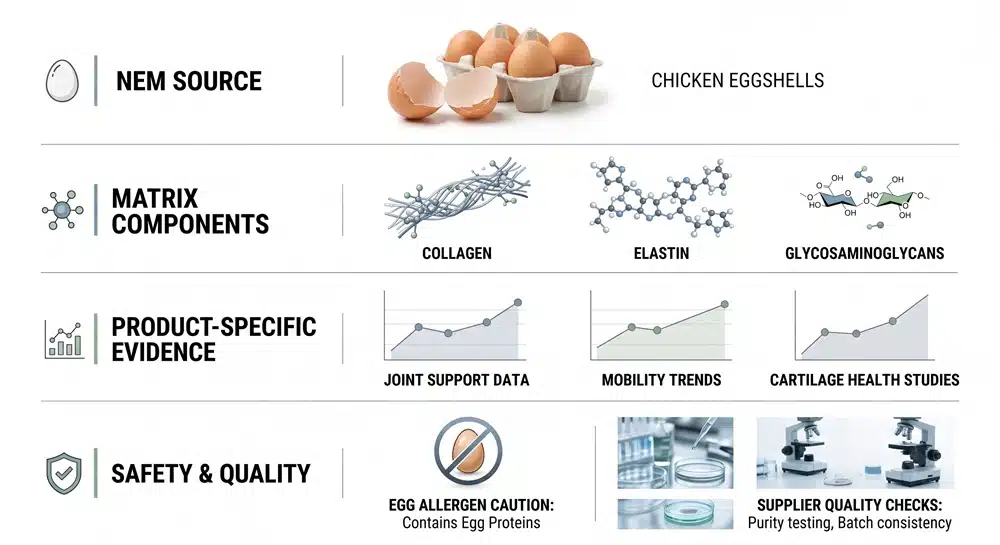
Natural Eggshell Membrane at a Glance
| 質問 | Practical Answer |
|---|---|
| それは何ですか? | The fibrous membrane located inside a chicken eggshell, separated and processed into a supplement ingredient. |
| What can it contain? | Protein and collagen-associated material, plus glycosaminoglycans such as hyaluronic-acid- and chondroitin-associated components. Exact amounts require testing. |
| What has been studied? | Selected standardized or hydrolyzed products have been studied for joint comfort, mobility and skin or hair appearance. Evidence is product- and endpoint-specific. |
| Is 500 mg the universal dose? | No. Several trials used 300–500 mg per day, but that is study context, not a universal recommendation for every product or person. |
| Is it safe for people with egg allergy? | It is egg-derived and requires allergen review. People with egg allergy should not assume it is safe. |
| Is homemade membrane equivalent? | No. Household membrane is not standardized, tested or controlled for identity, microbial quality, residual shell or dose. |
What Is Eggshell Membrane?
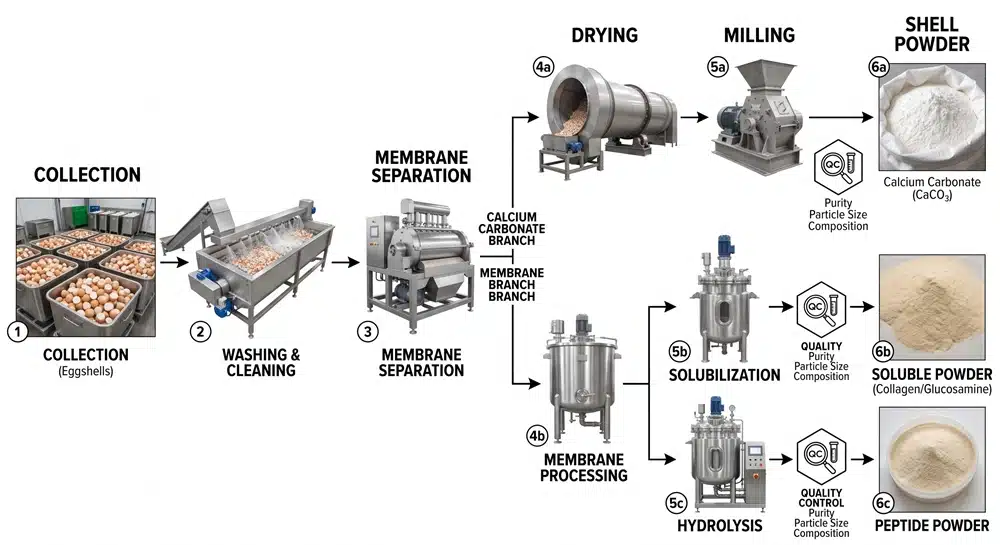
Eggshell membrane is a multilayered fibrous structure found directly beneath the mineral shell of a bird egg. Most dietary-supplement ingredients are sourced from chicken eggshells generated by the food industry. The membrane is separated from shell material, cleaned, dried and milled; some products undergo additional hydrolysis or solubilization.
The ingredient should not be described as pure collagen. Eggshell membrane is a complex biological matrix. Its composition varies with raw material, separation efficiency, hydrolysis, drying and analytical method. Brands evaluating a commercial ingredient should review the exact eggshell membrane ingredient specifications rather than relying on generic percentages.
What Does Eggshell Membrane Contain?
Scientific analyses describe eggshell membrane as a protein-rich material containing structural proteins and collagen-associated components. Glycosaminoglycan-associated constituents, including hyaluronic acid and chondroitin-related material, may also be present. However, the presence of a constituent does not establish a guaranteed amount, bioavailability or finished-product benefit.
| Component or Attribute | What Can Be Said Responsibly | What Must Be Verified |
|---|---|---|
| 総タンパク質 | Eggshell membrane is protein-rich. | Assay method, specification and lot result. |
| Collagen-associated proteins | Multiple collagen-related proteins have been identified in eggshell membrane research. | Whether the commercial ingredient has a validated collagen assay or type-specific claim. |
| グリコサミノグリカン | Hyaluronic-acid- and chondroitin-associated constituents may occur in the matrix. | Quantitative method, result and whether the claim applies to the finished ingredient. |
| Residual mineral shell | Separation may leave calcium-rich shell material. | Calcium, ash or residual-shell specification. |
| Solubility and particle size | Processing can materially change dispersibility and handling. | Particle-size distribution, solubility/dispersibility method and application data. |
Do not copy composition percentages from a branded study or review into a generic supplier specification. The label and marketing claims must match the ingredient actually purchased and tested.
Natural, Hydrolyzed and Solubilized Eggshell Membrane
Commercial terms are not always used consistently. “Natural eggshell membrane” may describe mechanically separated and milled material, while “hydrolyzed” or “solubilized” products have undergone additional processing to reduce particle size or alter dispersibility. Processing may affect handling, taste, color, molecular profile and the evidence package.
| フォーム | Typical Processing Concept | Formulation Consideration | Evidence Boundary |
|---|---|---|---|
| Milled membrane powder | Separation, cleaning, drying and milling | Flow, particle size, capsule or tablet suitability, limited water dispersibility | Do not assume findings from a hydrolyzed branded product apply. |
| Hydrolyzed membrane | Additional enzymatic or chemical hydrolysis | May change dispersibility, taste and analytical profile | “Hydrolyzed” does not automatically prove superior absorption or efficacy. |
| Solubilized membrane | Processing designed to increase soluble fractions | Potential use in different delivery formats; stability must be verified | Regulatory status and evidence may be product-specific. |
What Do Human Studies Suggest?
Joint Comfort and Mobility
Randomized studies and a recent systematic review have evaluated selected eggshell membrane preparations for self-reported joint pain, stiffness or physical function. The studies used specific products, doses and populations, and the pooled effects were generally modest. This evidence may support carefully substantiated joint-comfort or mobility positioning for a matching finished product, but it does not establish that every eggshell membrane powder treats osteoarthritis or repairs cartilage.
Skin and Hair Appearance
One randomized controlled trial evaluated a hydrolyzed eggshell membrane product at 450 mg per day for 12 weeks and reported changes in selected skin and hair appearance outcomes. The result should be attributed to the studied ingredient and protocol. It should not be converted into guaranteed wrinkle removal, hair-growth or anti-aging claims for a generic material.
Gut, Bone and Other Claims
Laboratory, animal or review literature may discuss possible biological mechanisms or biomaterial applications. Those sources do not establish that oral eggshell membrane treats digestive disease, rebuilds bone, reduces systemic inflammation or prevents injury in humans. Broad “whole-body repair” claims should be removed unless a finished product has appropriate human evidence.
Eggshell Membrane Dosage: Study Context, Not a Universal Recommendation
Human trials have commonly evaluated approximately 300–500 mg per day of particular standardized products, including 450 mg in a skin and hair study. This range is useful for understanding published protocols, but it is not a universal dosage recommendation.
A responsible serving-size decision should consider the identity of the ingredient, the product-specific evidence, intended population, delivery format, label directions, allergen review and applicable regulatory requirements. Brands should not call 500 mg “the clinically effective dose” unless the exact ingredient and claim are supported by relevant studies.
Eggshell Membrane Side Effects, Egg Allergy and Safety
- Egg allergy: eggshell membrane is egg-derived. The manufacturing process does not justify an automatic allergen-free claim.
- Tolerability: clinical studies of selected products have generally reported limited adverse events, but product-specific findings do not prove universal safety.
- Pregnancy, breastfeeding and children: evidence is limited. Professional review is appropriate before use.
- Medical conditions and medicines: people managing a medical condition or using medicines should discuss supplementation with a qualified healthcare professional.
- Cross-contact: suppliers and manufacturers should document allergen controls, sanitation and shared-equipment procedures.
Safety statements should distinguish between a tested proprietary ingredient, a generic powder and the final supplement formula. A manufacturer must also evaluate other ingredients, dosage form, contaminants and label directions.
Can You Make Eggshell Membrane at Home?
The inner membrane can be physically removed from an eggshell, but homemade membrane is not equivalent to a commercial supplement ingredient. Household preparation does not establish microbial quality, allergen control, membrane identity, residual shell, particle size, composition, dose or stability. Raw or undercooked eggs can also carry foodborne-pathogen risk.
For that reason, this guide does not recommend consuming homemade eggshell membrane or provide a preparation protocol. Consumers seeking a supplement should choose a properly labeled product from a qualified manufacturer. Brands should use documented, food- or supplement-grade material rather than household or unqualified shell waste.
Eggshell Membrane vs Collagen Peptides
| ファクター | 卵殻膜 | コラーゲンペプチド |
|---|---|---|
| ソース | Egg-derived membrane matrix | Hydrolyzed collagen, commonly bovine, porcine, marine or chicken-derived |
| 構成 | Complex membrane proteins plus other matrix-associated constituents | Primarily collagen-derived peptides with a defined protein or peptide specification |
| Typical serving format | Often lower milligram servings in capsules or tablets | Often gram-level servings in powders, beverages, capsules or tablets |
| Allergen/dietary issue | Egg-derived; requires egg-allergen assessment | Source-specific; fish allergy and animal-source suitability may apply |
| エビデンス | Selected standardized products studied for specific endpoints | Broader research base, but still source-, product-, dose- and endpoint-specific |
| Can one replace the other? | Not automatically. They have different compositions, serving sizes, sensory profiles and evidence packages. | |
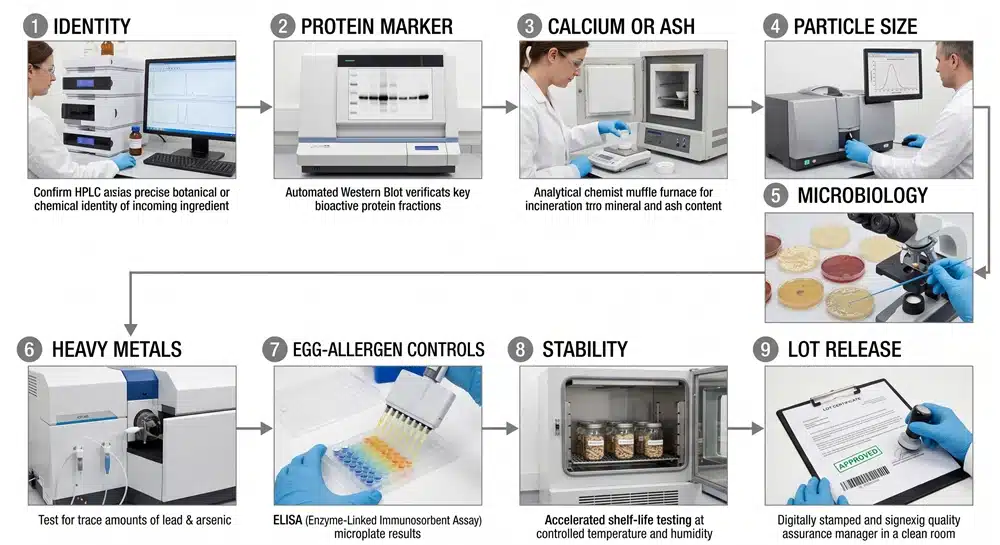
確認すべき品質仕様
| 仕様 | 何を依頼すべきか | なぜ重要なのか |
|---|---|---|
| 身元と出所 | Chicken eggshell membrane identity, raw-material origin and traceability | Confirms the intended ingredient and supply chain. |
| 加工 | Separation, cleaning, hydrolysis/solubilization, drying and milling description | Explains differences in composition and performance. |
| Protein or marker assay | Validated method, specification and lot result | Supports identity, potency and label accuracy. |
| Residual shell | Calcium, ash or residual-shell limit | Measures separation efficiency and formula impact. |
| 物理的性質 | Particle size, bulk density, color, odor, flow and dispersibility | Affects encapsulation, tableting, blending and sensory quality. |
| 微生物学 | Total counts, yeast/mold and specified organisms | Supports raw-material and finished-product release. |
| 汚染物質 | Heavy metals and other risk-based contaminants | Supports safety and target-market requirements. |
| Allergen controls | Egg-allergen statement, cross-contact controls and labeling guidance | Critical for consumer safety and compliant labeling. |
| 安定性 | Retest period, storage conditions and finished-product data | Supports potency and quality through shelf life. |
| ドキュメント | Specification, lot COA, TDS, SDS, origin, GMO and regulatory statements | Supports supplier qualification and audit readiness. |
Brands should involve サプリメント品質管理 before finalizing a supplier or claim set.
製剤および製造上の考慮事項
- カプセル: verify powder flow, bulk density, target fill weight and capsule size.
- タブレット: evaluate compressibility, disintegration, lubricants and potential color variation.
- Powders and beverages: test dispersibility, sedimentation, taste, odor and serving-size practicality.
- Blends: confirm whether other collagen, glucosamine, chondroitin, minerals or botanicals create duplicate claims or serving-size constraints.
- 安定性がある: monitor relevant markers, microbiology, moisture, physical appearance and package performance.
- 主張: match every structure/function statement to the exact ingredient, dose, final formula and evidence.
For brands developing joint-positioned products, 関節サプリメントの製造 should include formulation feasibility, allergen labeling, pilot production and finished-product testing.
Eggshell Membrane Buyer Checklist
- Confirm species, source material and country of origin.
- Define whether the ingredient is milled, hydrolyzed or solubilized.
- 当該ロットに関する直近のCOAを少なくとも3通提出してください。.
- Verify the identity and protein or marker assay method.
- Review calcium, ash or residual-shell limits.
- Review particle size, flow, color, odor and dispersibility.
- Set microbiological and heavy-metal specifications.
- Obtain egg-allergen and cross-contact documentation.
- Confirm storage conditions, packaging and retest period.
- Match claims and serving size to the exact evidence package.
- Verify cGMP controls, change control and lot traceability.
- Complete finished-product stability and label review.
RFP Questions for an Eggshell Membrane Supplier or Manufacturer
- What is the exact ingredient identity, species and raw-material source?
- How is the membrane separated from the mineral shell?
- Is the material milled, hydrolyzed or solubilized, and which processing aids are used?
- Which identity, protein, collagen-associated or glycosaminoglycan tests are included?
- What are the calcium, ash and residual-shell specifications?
- What microbiological, heavy-metal and other contaminant limits apply?
- How are egg-allergen labeling and cross-contact controlled?
- Can you provide recent lot COAs, specifications, TDS, SDS and traceability documents?
- What human studies apply to this exact ingredient, dose and claim?
- What are the MOQ, sample quantity, packaging and lead time?
- Can you support capsule, tablet or powder pilot production and stability testing?
- How are joint, skin, hair, collagen and “anti-aging” claims reviewed?
GENSEIの活用シーン
GENSEI supports ingredient qualification, custom formulation, capsule and tablet development, packaging and quality planning for eggshell membrane supplements. Brands can GENSEIへのお問い合わせ with the intended ingredient specification, serving size, dosage form, target market, certification needs and order quantity.
よくある質問
What is natural eggshell membrane?
It is the thin fibrous layer inside an eggshell. Commercial ingredients are separated, cleaned, dried and processed into a powder or other standardized form.
What are the benefits of eggshell membrane?
Selected standardized products have been studied for joint comfort, mobility and skin or hair appearance. Results are product-specific and do not prove that every eggshell membrane supplement has the same effects.
What are the side effects of eggshell membrane?
Published studies of selected products generally report limited adverse events, but eggshell membrane is egg-derived and may be unsuitable for people with egg allergy. Individual tolerability and the complete formula also matter.
Is natural eggshell membrane safe?
Safety depends on the specific ingredient, allergen status, dose, manufacturing controls and user. People with egg allergy, pregnant or breastfeeding people, children and people with medical conditions should obtain professional advice.
How much eggshell membrane should I take?
Studies have used different products and doses, often around 300–500 mg per day. That is study context, not a universal recommendation. Follow the product label and professional guidance.
Can I make an eggshell membrane supplement at home?
Homemade membrane is not standardized or tested for microorganisms, allergens, residual shell, composition or dose. It should not be treated as equivalent to a qualified commercial supplement ingredient.
卵殻膜はコラーゲンと同じですか?
No. It contains collagen-associated proteins as part of a broader membrane matrix, while collagen peptides are hydrolyzed collagen ingredients with different composition, serving size and specifications.
Is eggshell membrane vegetarian or vegan?
It is egg-derived and is not vegan. It may fit some ovo-vegetarian preferences, but brands should not use a broad “vegetarian-friendly” claim without defining the intended standard and market.
最終的な収穫
Natural eggshell membrane is a complex egg-derived matrix, not a generic form of pure collagen. Selected products have human research, but benefits, dose and safety cannot be generalized across all powders. A responsible supplement requires product-specific evidence, egg-allergen controls, a complete COA, residual-shell and contaminant specifications, finished-product stability and conservative claims.
参考文献
- FDA:食物アレルギー
- FDA: Frequently Asked Questions—Food Allergen Labeling Guidance for Industry
- FDA:構造・機能に関する主張
- FTC:健康関連製品のコンプライアンスに関するガイダンス
- 21 CFR 第111部:栄養補助食品の適正製造規範(cGMP)
- Chemical Composition of Chicken Eggshell and Shell Membranes
- Advances in Eggshell Membrane Separation and Solubilization Technologies
- Efficacy of Eggshell Membrane in Knee Osteoarthritis: Systematic Review and Meta-Analysis
- Hydrolyzed Eggshell Membrane Randomized Trial for Skin and Hair Appearance
- Safety Evaluation of a Natural Eggshell Membrane Product

ウォーレン・ワン氏は、栄養補助食品のサプライチェーンにおいて豊富な経験を持つベテランの専門家であり、コラーゲンペプチド、骨スープ由来タンパク質、ケラチンといった主要成分の研究、開発、工程管理、およびグローバルな調達において、豊富な実務経験を有しています。 本コラムの執筆者として、彼はマーケティング的な装いを剥ぎ取り、難解な成分科学や製造品質管理基準を、分かりやすい本格的な科学普及記事へと変換することに尽力しています。これにより、読者がラベルの裏にある真実を理解し、より合理的な健康に関する選択を行えるよう支援しています。.