
If you are comparing regular creatine monohydrate with micronized creatine, the difference is simpler than the labels can make it sound. In most products, micronized creatine is still creatine monohydrate; the powder has simply been processed into smaller particles.
That usually makes it easier to mix and less gritty to drink. It does not automatically make the creatine more effective once you swallow it. For most people, the real choice is whether that smoother mixing experience is worth paying a little more for.
The answer becomes less obvious when labels start talking about faster absorption, better bioavailability, less bloating, or better gains. Those claims need to be separated from the one advantage micronization clearly can provide: changing how the powder behaves in your drink.
So the comparison comes down to two things: how the powder behaves in everyday use, and whether any claimed performance benefit is actually supported by evidence.
What Is Micronized Creatine?
“Creatine monohydrate” describes the chemical form of creatine. “Micronized” describes a physical processing step: the powder has been milled into smaller particles. A product can therefore be both creatine monohydrate and micronized at the same time.
That is different from comparing monohydrate with another chemical form such as creatine nitrate. Micronization changes particle size; it does not create a new creatine molecule. So when two tubs both contain pure creatine monohydrate, the word micronized is mainly telling you something about the powder, not giving you a different active ingredient.
This is also why the price difference should be judged carefully. A micronized product may genuinely feel better to use, but a more technical-sounding label does not automatically mean more creatine per gram or a stronger physiological effect.
In practical terms, “micronized” is mainly a description of how the powder has been processed and how it behaves in a drink, not a different active ingredient.
Why Micronized Creatine Usually Mixes Better
Smaller particles expose more surface area to the liquid around them. That generally helps the powder wet, disperse, and dissolve faster, which is why micronized creatine often feels smoother and leaves less obvious grit in a shaker.
There is an important distinction, though: dissolving faster is not the same as being able to dissolve more. Particle size can improve the dissolution rate, but the equilibrium solubility of creatine monohydrate is still mainly determined by the compound itself, temperature, and the liquid environment. A finer grind helps the powder reach that limit faster; it does not remove the limit.
That is why even a well-micronized creatine can leave a little material at the bottom of the glass, especially when you use cold water or a small liquid volume. Sediment by itself is not proof that a product is low quality or not micronized.
The difference is usually more noticeable when creatine is mixed in a small amount of water than when it is added to a larger shake or thicker food.
Water Temperature Matters Too
Creatine monohydrate becomes much more soluble as water gets warmer. Published data put its approximate solubility at about 6 g/L at 4°C, 14 g/L at 20°C, 34 g/L at 50°C, and 45 g/L at 60°C.
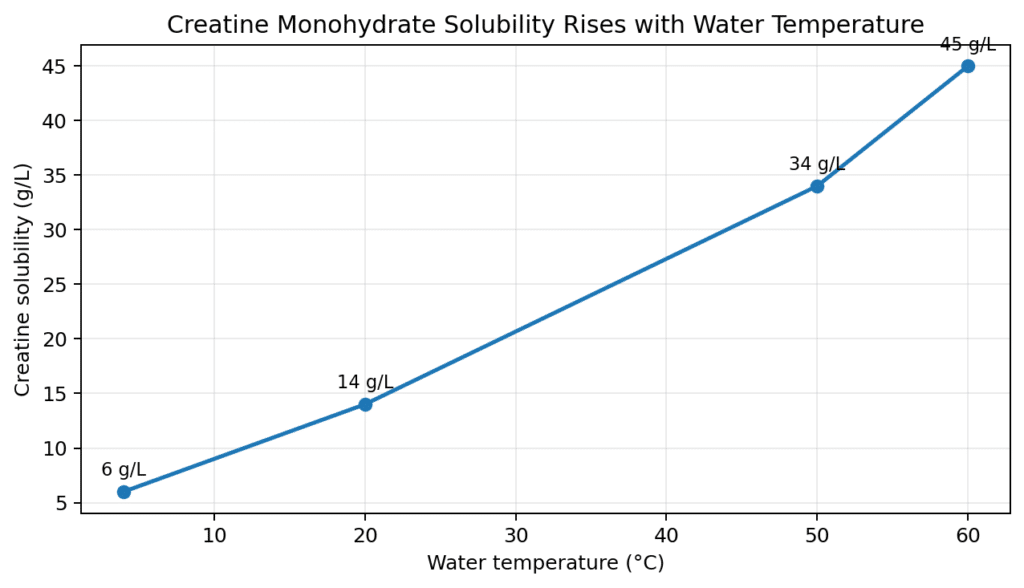
Figure 1. Approximate creatine monohydrate solubility rises sharply as water temperature increases.
Put that into a normal serving and the practical reason for sediment becomes clearer. At about 20°C, 250 mL of water can hold roughly 3.5 g of creatine monohydrate at the cited equilibrium solubility. If you add a 5 g serving to a small room-temperature glass, some undissolved material is therefore not surprising. More water or warmer liquid can make the same dose look very different.
Warm liquid can help with mixing, but there is no need to use very hot water for “better absorption.” Once creatine is dissolved, temperature, pH, and storage time matter more for stability. For everyday use, mixing it in a drink you like and consuming it reasonably soon is simpler than trying to make the drink perfectly clear.
Preparation can change how creatine feels to use without changing the ingredient itself.
Does Better Mixing Mean Better Absorption?
Not necessarily. Better mixing and better absorption are separate questions.
Dissolution is what happens to the powder in the liquid. Absorption is what happens after you swallow it. Muscle uptake is another step again. A powder can disperse more quickly without meaningfully increasing how much creatine eventually reaches and is retained by muscle.
That matters because standard creatine monohydrate is already very well absorbed. Reviews of the creatine literature have repeatedly cautioned against treating better water solubility or faster dissolution as proof of greater muscle uptake or better training outcomes.
So if micronized creatine mixes more smoothly, count that as a usability advantage. Claims about superior absorption, muscle gain, or strength need their own human evidence rather than being assumed from particle size alone.
In practical terms, the clearest reason to choose micronized creatine is easier mixing, not a guaranteed change in absorption.
Does Micronized Creatine Work Better for Muscle or Strength?
At this point, there is not enough independent evidence to say that micronization as a category produces greater muscle or strength gains than an equivalent dose of standard creatine monohydrate. The strongest evidence base still belongs to creatine monohydrate itself, which has been studied extensively for increasing muscle creatine stores and supporting repeated high-intensity exercise and training adaptations.
If two products provide the same reliable daily dose of creatine monohydrate, a finer powder should not be assumed to create a larger training effect simply because it mixes better.
One newer study is worth mentioning. In 2026, researchers compared a micronized creatine monohydrate ingredient with a standard creatine monohydrate comparator. In a small pharmacokinetic crossover phase involving 10 healthy men, the micronized product produced a higher reported peak plasma creatine concentration, reached that peak sooner, and showed higher calculated relative bioavailability. A separate eight-week phase with 52 active men also reported differences in several body-composition and exercise outcomes.
The study is interesting, but it is still evidence about one specific tested formulation rather than micronized creatine as a whole. The pharmacokinetic phase was small, the study included active men only, and the paper disclosed industry funding and an author employment relationship. It also did not directly measure intramuscular creatine.
So the study gives us a reason to keep watching the evidence; it does not yet justify treating every micronized creatine as more bioavailable or more effective than standard monohydrate. Independent replication with larger and more diverse samples would make that conclusion much stronger.
For now, the study is best treated as an interesting early signal rather than a reason to change the overall recommendation.
What About Bloating or Stomach Comfort?
Some people prefer micronized creatine because it feels smoother and less gritty to drink. That can make the product more comfortable to use. What is less certain is whether micronization itself consistently reduces bloating, diarrhea, or other gastrointestinal symptoms.
Dose size can matter independently of particle size. In one controlled study of athletes, a single 10 g serving produced more diarrhea than splitting the same daily amount into two 5 g servings. That does not mean everyone needs to split a normal maintenance dose; it simply shows why stomach comfort cannot be explained by particle size alone.
If regular creatine bothers your stomach, look at the serving size, how concentrated the drink is, what you take it with, and your own tolerance. If a micronized product feels better for you, that is a reasonable reason to use it. It just should not be turned into a universal claim that micronized creatine is always gentler on the gut.
Individual tolerance varies, so one person’s experience should not be treated as a universal effect of micronization.
Is Micronized Creatine Worth the Extra Cost?
For most shoppers, this is the question that matters more than the particle-size terminology. If two products both provide a reliable dose of creatine monohydrate, the extra money for the micronized one is usually buying a better mixing experience rather than a guaranteed performance advantage.
Micronized creatine makes more sense if you dislike gritty powders, usually mix your creatine in a small amount of liquid, or find sediment annoying enough that it affects how consistently you take it. Convenience is a real benefit if it makes a product easier to use every day.
Standard monohydrate is usually the better value if texture does not bother you, you mix creatine into a protein shake or thicker food, or your main goal is simply to get a well-studied dose for the lowest reasonable cost.
I would therefore treat the extra price as a usability premium. I would not pay more solely because a label says “faster absorption” unless that specific product has credible evidence to support the claim.
The size of the price gap matters too. If the micronized option costs only a little more, the smoother experience may be an easy upgrade. If it costs much more, the case is harder to justify unless you already know the texture difference matters to you.
How to Choose Between Them
If you are buying creatine for the first time, a reputable standard creatine monohydrate product is still the easiest starting point. You are not choosing an inferior form simply because the powder is not marketed as micronized.
If you already know you dislike the texture of regular creatine, or you value a powder that disperses more smoothly, micronized creatine monohydrate is a reasonable upgrade.
Either way, look beyond the word micronized. Check the actual amount of creatine per serving, the ingredient list, manufacturing quality, and credible third-party testing when that matters to you. For competitive athletes, certification that verifies label contents and screens for banned substances can matter more than particle size.
The simplest approach is to choose a product that fits how you actually use creatine and that you can take consistently.
Perguntas mais frequentes
Do I need a different dose if my creatine is micronized?
No. Micronization changes particle size, not the amount of creatine needed. For many adults, a common creatine monohydrate maintenance intake is about 3–5 g per day.
Do I need a loading phase with micronized creatine?
No. Loading is optional whether your creatine is micronized or not. A loading phase can raise muscle creatine stores faster, while a consistent lower daily dose reaches a similar level more gradually.
What matters more: micronized powder or third-party testing?
They answer different questions. Micronization mainly tells you about particle size and mixing behavior. Independent certification can verify label claims, test for contaminants, and — in sport-focused programs — screen for banned substances. If product-quality assurance is your priority, credible testing is usually a more meaningful signal than the word “micronized.”
Em conclusão
Micronized creatine is usually creatine monohydrate processed into smaller particles. The difference you are most likely to notice is practical: it tends to disperse more easily and feel smoother in a drink.
What is not established is a reliable, category-wide advantage for absorption, muscle gain, or strength. The 2026 branded-product study is worth following, but it is not enough to make that claim for every micronized creatine on the market.
For most people, standard creatine monohydrate remains the better-value choice. Micronized monohydrate makes sense when better mixing and mouthfeel are worth the extra cost.
For Supplement Brands: Particle Size Should Fit the Dosage Form
For formulators, smaller particles are not automatically better in every finished product. In drink powders and stick packs, particle size can influence dispersion, suspension, mouthfeel, dusting, and flow. In capsules and tablets, bulk density, fill consistency, flowability, and compression behavior may matter just as much. In gummies and liquid systems, sensory performance and finished-product stability can become the more important constraints.
The useful formulation question is not “How fine can we make it?” It is “What particle-size profile works best for this dosage form, process, and consumer experience?”
Referências
- Analysis of the efficacy, safety, and regulatory status of novel forms of creatine
- State of the Art and Development Trends in Obtaining Fast-Dissolving Forms of Creatine Monohydrate
- 2026 randomized controlled clinical study of micronized creatine monohydrate in active men
- NIH Office of Dietary Supplements — Dietary Supplements for Exercise and Athletic Performance
- NSF Certified for Sport® Program

Warren Wan é um especialista experiente com vasta experiência na cadeia de abastecimento de suplementos alimentares, possuindo uma rica experiência prática na investigação, desenvolvimento, controlo de processos e aquisição global de ingredientes essenciais, tais como peptídeos de colagénio, proteína de caldo de ossos e queratina. Como autor desta coluna, dedica-se a ir além do discurso de marketing, transformando a ciência obscura dos ingredientes e as normas de controlo de qualidade da produção numa divulgação científica rigorosa e de fácil compreensão, ajudando os leitores a compreender a verdade por trás dos rótulos e a fazer escolhas mais racionais em matéria de saúde.