Berberine HCl vs Glycine
Berberine is not an amino acid. Berberine HCl is a salt form of berberine, a plant-derived isoquinoline alkaloid. Glycine is the simplest proteinogenic amino acid. They are chemically different ingredients with different biological roles, evidence bases, safety considerations, manufacturing behavior, and supplement applications.
They are also not proven to have a special clinical synergy when combined. A formula may contain both ingredients, but that does not mean glycine improves berberine absorption, reduces berberine side effects, or makes berberine more effective. Each ingredient and each proposed claim should be evaluated separately.
Is Berberine an Amino Acid?
No. Berberine belongs to the alkaloid family. It is found in several botanicals and is widely supplied in supplement manufacturing as Berberine HCl, also referred to as berberine hydrochloride or berberine chloride.
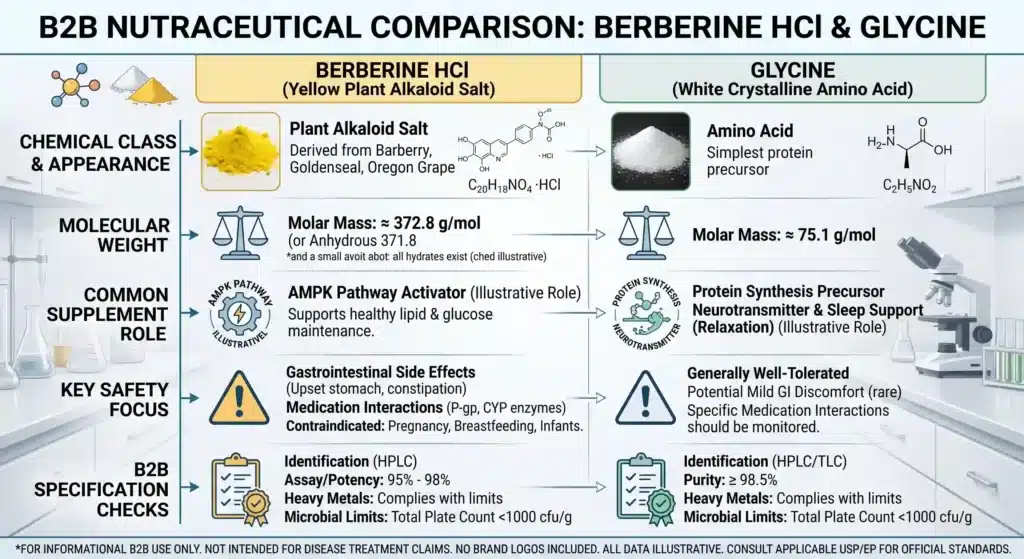
Glycine is an amino acid with the molecular formula C2H5NO2 and a molecular weight of 75.07 g/mol. It is incorporated into proteins and is especially abundant in collagen. The words “berberine,” “glycine,” and “glycinate” may appear in the same supplement marketplace, but they do not describe the same chemical category.
Berberine, Berberine HCl, Glycine and Glycinate Are Not the Same Thing
|
Termo |
What It Actually Is |
Common Mistake |
|
Berberina |
A plant-derived isoquinoline alkaloid |
Calling it an amino acid or assuming all berberine materials are identical |
|
Berberina HCl |
A hydrochloride/chloride salt form of berberine |
Assuming HCl automatically proves higher human absorption or better performance |
|
Berberine botanical extract |
A botanical material that may be standardized for berberine |
Treating it as chemically identical to purified Berberine HCl |
|
Glicina |
The simplest proteinogenic amino acid |
Confusing it with a glycinate compound |
|
Glicinato |
A salt, chelate, or compound involving glycine |
Assuming every glycinate is simply a glycine supplement |
Berberine HCl vs Glycine: Key Differences
|
Fator |
Berberina HCl |
Glicina |
|
Chemical class |
Salt form of an isoquinoline alkaloid |
Proteinogenic amino acid |
|
Typical molecular weight |
About 371.8 g/mol for anhydrous berberine chloride; hydrated forms differ |
75,07 g/mol |
|
Typical appearance |
Yellow to orange-yellow powder |
Pó cristalino branco |
|
Primary biological context |
Studied in metabolic and cellular signaling contexts |
Protein synthesis, collagen structure, neurotransmission, and intermediary metabolism |
|
Common supplement positioning |
Metabolic-wellness and healthy glucose/lipid metabolism concepts |
Amino-acid nutrition, collagen-related, recovery, and sleep-positioned formulas |
|
Key safety focus |
Medication interactions, gastrointestinal effects, pregnancy/breastfeeding, infant exposure |
Outcome-specific evidence, serving level, tolerability, and overall formula context |
|
Key B2B checks |
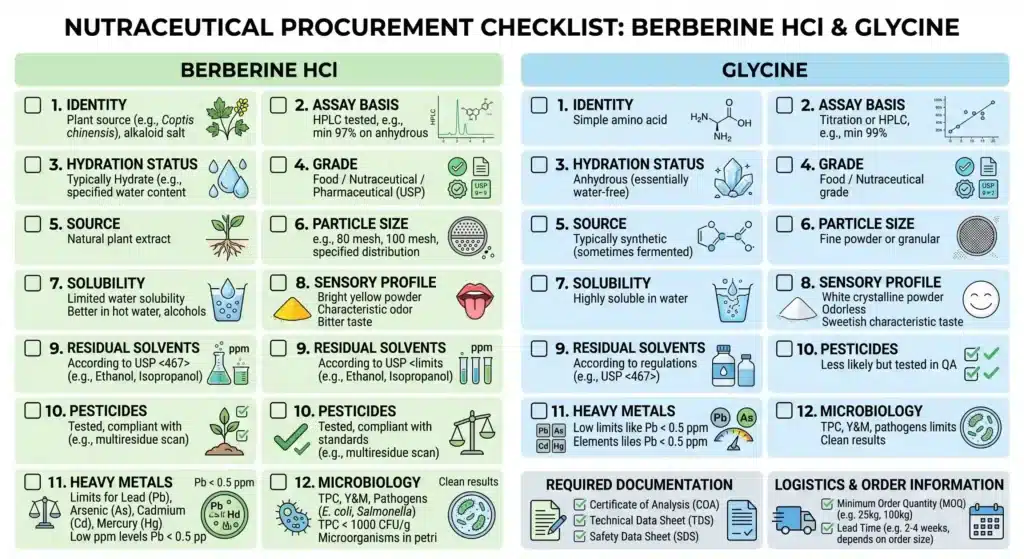
Salt form, hydration status, assay basis, source, related substances, residual solvents, pesticides, heavy metals, microbiology, particle size |
Identity, assay, grade, manufacturing route, solubility, taste, particle size, heavy metals, microbiology |
O que é o cloridrato de berberina?
Berberine HCl is the commercially common hydrochloride/chloride salt form of berberine. PubChem lists berberine chloride, also called berberine hydrochloride, under CID 12456 and CAS 633-65-8, with a molecular weight of approximately 371.8 g/mol for the anhydrous form.
For supplement procurement, “Berberine HCl” is still not a complete specification. Buyers should confirm the botanical or manufacturing source, salt identity, hydration status, assay method, assay basis, related substances, particle size, color, taste profile, heavy metals, residual solvents, pesticide residues, microbiology, and batch documentation.
For commercial sourcing, review the actual Berberine HCl powder specification and current lot COA.
Does “HCl” Mean Berberine Is Better Absorbed?
Not necessarily. The HCl designation identifies a chemical salt form. It may affect physicochemical properties, but the label alone does not prove superior human bioavailability, better safety, or stronger clinical performance.
Absorption and finished-product performance can also be influenced by particle size, formulation, excipients, dosage form, delivery technology, hydration state, and the specific material used in the study. Brands should avoid turning “HCl” into a blanket marketing claim for enhanced absorption unless they have evidence that matches the actual product.
For a deeper technical comparison without duplicating this article, see the berberine vs Berberine HCl guide.
O que é a glicina?
Glycine is the simplest proteinogenic amino acid and the only achiral standard amino acid. PubChem lists its molecular formula as C2H5NO2 and molecular weight as 75.07 g/mol. Glycine participates in protein synthesis, is a major amino-acid component of collagen, and is involved in several metabolic pathways and neurotransmitter functions.
These biochemical roles should not be converted automatically into broad clinical claims. “Glycine is part of collagen” does not mean free glycine has the same clinical evidence as collagen peptides. Likewise, a neurotransmitter role does not prove that every glycine supplement improves sleep or cognition.
For B2B qualification, compare the actual glicina em pó specification, including identity, assay, grade, manufacturing route, solubility, taste, particle size, heavy metals, microbiology, and supporting documents.
What Does Human Evidence Say About Berberine?
Berberine has a larger human research base than glycine for glucose- and lipid-related outcomes. Randomized trials and meta-analyses have reported changes in fasting glucose, HbA1c, insulin-related measures, and lipid markers in populations with metabolic disorders.
However, evidence strength should not be overstated. Study populations, formulas, doses, durations, geographic settings, and methodological quality vary. NCCIH notes that some berberine research suggests potential benefit for blood-glucose control, but the overall literature has important limitations and does not justify replacing established diabetes treatment with a supplement.
- Human metabolic research exists.
- Results vary by population and study design.
- Disease-population research does not authorize a dietary supplement to claim that it treats diabetes, obesity, dyslipidemia, or cardiovascular disease.
- The exact ingredient form used in a trial should be matched as closely as possible to the commercial raw material.
What Does Human Evidence Say About Glycine?
A systematic review of glycine administration in human adults evaluated studies across multiple physiological systems. The evidence varied substantially by outcome and population.
Some small studies in healthy adults reported sleep-related benefits, but the review noted small sample sizes and a high risk of bias in that evidence base. Other studies involved clinical populations and should not be generalized to healthy consumers or to every glycine product.
For content and claims, avoid turning normal glycine biochemistry into statements such as “clinically proven to improve sleep, cognition, skin elasticity, joint pain, insulin sensitivity, and mental health.” Each outcome needs its own evidence review.
Do Berberine HCl and Glycine Work Better Together?
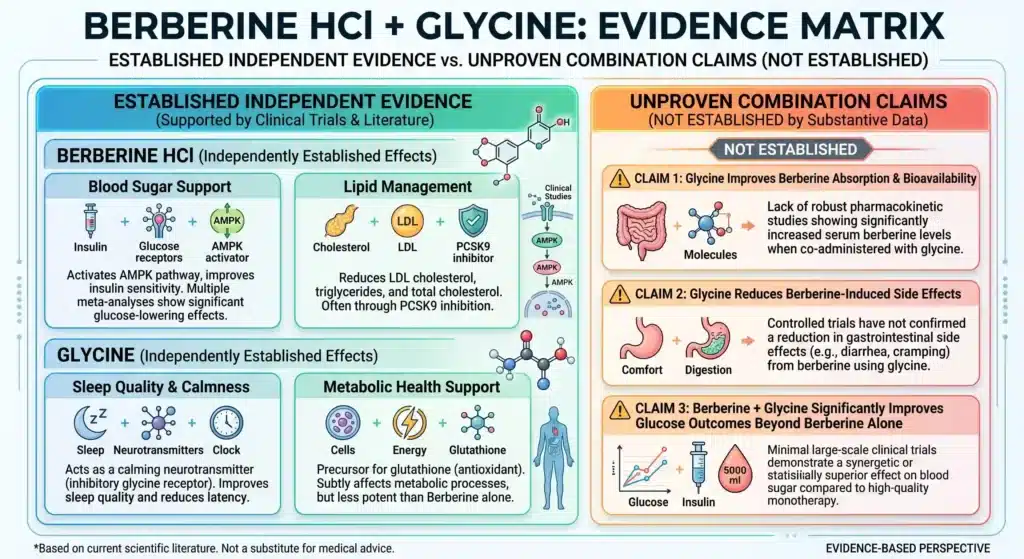
No strong human clinical evidence establishes a unique berberine-plus-glycine synergy. They can appear in the same formula, but independent biological roles do not prove that the combination is more effective than either ingredient alone.
|
Combination Claim |
Evidence Status |
How to Write It |
|
Berberine has metabolic research |
Supported by human research |
Describe the specific outcome and study population |
|
Glycine has independent physiological roles |
Sim |
Keep biochemical roles separate from clinical claims |
|
Both can be used in one supplement |
Technically possible |
Evaluate total serving, dosage form, safety, and claims |
|
Glycine improves berberine absorption |
Not established |
Do not claim without direct evidence |
|
Glycine reduces berberine gastrointestinal side effects |
Not established |
Do not claim without direct evidence |
|
The combination improves glucose outcomes beyond berberine alone |
Not established |
Do not imply synergy |
Can You Take Glycine With Berberine?
There is limited direct clinical research on the specific combination. The larger practical safety issue comes from berberine because it can cause gastrointestinal effects and interact with medicines.
NCCIH advises people taking medicines to discuss berberine with a healthcare professional. It also advises against berberine use during pregnancy or breastfeeding and states that berberine should not be given to infants.
For finished-product development, “no known pair-specific contraindication” should not be rewritten as “safe for everyone.” The full formula, serving levels, target population, medication interaction potential, warnings, and destination-market requirements should be reviewed.
Safety, Medication Interactions and Special Populations
|
User or Situation |
Berberine HCl Consideration |
Glycine Consideration |
|
Prescription medication use |
Interaction review is important |
Review the full formula and individual health context |
|
Gastrointestinal sensitivity |
Nausea, diarrhea, bloating, constipation, or abdominal discomfort may occur |
Tolerability depends on serving level and formula |
|
Gravidez |
Avoid berberine |
Obtain individualized guidance for supplements |
|
Breastfeeding |
Avoid berberine |
Obtain individualized guidance for supplements |
|
Infants |
Do not give berberine |
Not a consumer-use category for this article |
|
Metabolic disease |
Do not replace medical treatment with a supplement |
Disease-management claims require separate clinical and regulatory review |
Which Ingredient Fits Different Supplement Goals?
|
Objetivo do produto |
More Direct Fit |
Nota sobre a formulação |
|
Metabolic-wellness capsule or tablet |
Berberina HCl |
Use compliant structure/function positioning and careful interaction review |
|
Amino-acid nutrition formula |
Glicina |
Confirm grade, taste, serving size, and rationale |
|
Collagen-related concept |
Glycine may complement the formula |
Free glycine is not a substitute for collagen peptides |
|
Sleep-positioned formula |
Glycine may be considered |
Human evidence exists but remains limited; avoid guaranteed outcomes |
|
Multi-ingredient metabolic formula |
Potentially both |
Do not imply pair-specific synergy without finished-formula evidence |
|
Pregnancy or breastfeeding formula |
Do not use berberine |
Target-population review still required |
Berberine HCl vs Glycine in Supplement Manufacturing
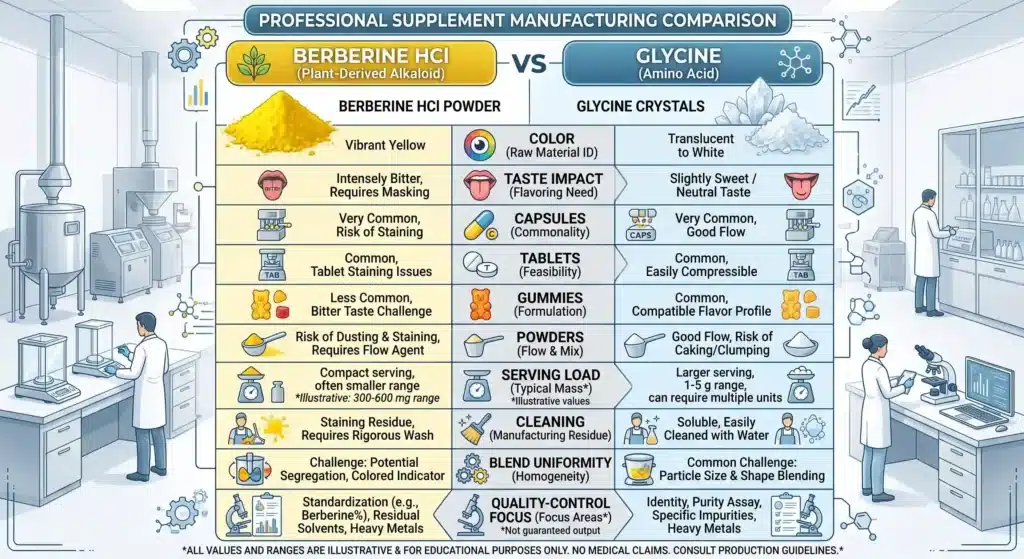
This is where the two ingredients differ most clearly for formulators. The manufacturing question is not only “what do they do?” but also “what do they do to the dosage form?”
|
Manufacturing Variable |
Berberina HCl |
Glicina |
|
Cor |
Yellow to orange-yellow; can visibly influence the finished blend |
Pó cristalino branco |
|
Taste / sensory impact |
Taste profile requires review and may complicate flavored formats |
Slightly sweet and generally easier to position in powders |
|
Cápsulas |
Common and practical; confirm bulk density, particle size, and serving load |
Practical; total gram-level loading can influence capsule count |
|
Comprimidos |
Possible with flowability, compression, color, and excipient review |
Generally practical with suitable compression design |
|
Gomas |
Possible in selected formulas, but color, taste, serving size, and stability require review |
Potentially more formulation-friendly, depending on active load and sensory target |
|
Powders/stick packs |
Color, taste, dispersion, and claim positioning need attention |
Good water solubility and mild sweetness can be useful, but serving load matters |
|
Cleaning/line changeover |
Strong yellow color makes visual carryover and cleaning controls especially important |
Standard amino-acid line-clearance and cleaning controls |
Brands developing a metabolic-wellness formula can review blood sugar supplement manufacturing requirements for dosage-form selection, ingredient sourcing, testing, packaging, and claim review.
Do Not Copy a Universal Dose From Another Product
There is no single universal Berberine HCl or glycine dose that should be copied across all supplement concepts. Study doses are evidence examples, not automatic formulation recommendations.
For Berberine HCl, commercial calculations should consider the exact salt form, hydration status, assay basis, target claim, study match, dosage form, co-ingredients, tolerability, and interaction review. For glycine, serving level should reflect the intended product objective, evidence, dosage form, sensory impact, total active load, and target population.
B2B Quality Specifications to Check
|
Especificação |
Berberina HCl |
Glicina |
|
Identidade |
Confirm Berberine HCl / chloride identity and applicable CAS |
Confirm glycine identity and CAS 56-40-6 |
|
Ensaio |
Define method, assay target, dry/as-is basis, and hydration status |
Define purity target, grade, and assay method |
|
Source/manufacturing route |
Confirm botanical source and processing route where applicable |
Confirm manufacturing route and grade documentation |
|
Substâncias relacionadas |
Review impurity profile and related alkaloids |
Review process-related impurities as applicable |
|
Residual solvents/pesticides |
Important for botanical/extraction-derived materials |
Review according to process and destination market |
|
Particle size/bulk density |
Important for blend uniformity, capsules, and tablets |
Important for blend flow, powders, and capsule loading |
|
Solubility/sensory |
Review color, taste, dispersion, and finished-formula impact |
Review solubility, sweetness, odor, and serving-load impact |
|
Metais pesados |
Confirm batch limits and destination-market requirements |
Confirm batch limits and destination-market requirements |
|
Microbiologia |
Confirm total counts and pathogen limits |
Confirm total counts and pathogen limits |
|
Documentos |
COA, specification/TDS, SDS, source, allergen/non-GMO, origin documents as required |
COA, specification/TDS, SDS, grade, source/manufacturing, allergen/non-GMO documents as required |
Como as marcas de suplementos devem escolher
- Define the product objective. Decide whether the formula is metabolic wellness, amino-acid nutrition, collagen-related support, sleep-positioned wellness, or a multi-ingredient concept.
- Confirm exact ingredient identity. Do not use berberine, Berberine HCl, botanical extract, glycine, and glycinate interchangeably.
- Match evidence to the exact raw material. Avoid borrowing outcomes from a different chemical form, branded ingredient, or disease population.
- Review safety before claims. Berberine requires medication-interaction and special-population review.
- Evaluate dosage-form reality. Color, taste, powder flow, capsule count, tablet size, gummy stability, and total daily serving can determine whether a concept is practical.
- Approve the supplier package. Review current COA, specification/TDS, SDS, contaminants, source, assay method, and change-control expectations.
- Run a claim review before artwork approval. Objective health claims should be truthful, not misleading, and adequately substantiated.
FAQ
Is berberine an amino acid?
No. Berberine is an isoquinoline alkaloid. Berberine HCl is a salt form of berberine, while glycine is an amino acid.
Is Berberine HCl the same as berberine?
Berberine HCl is a specific salt form of berberine. The terms are closely related, but technical sourcing should distinguish the exact salt, hydration status, assay basis, source, and specification.
Is glycine the same as berberine?
No. Glycine is a proteinogenic amino acid, while berberine is a plant alkaloid. They differ in chemistry, biological roles, evidence, safety, and formulation behavior.
Can you take glycine with berberine?
There is limited direct clinical research on the specific combination. The larger safety issue comes from berberine because of medication interactions, gastrointestinal effects, and special-population restrictions.
Does glycine make berberine work better?
There is no strong human evidence showing that glycine improves berberine absorption or makes berberine more effective.
Does glycine reduce berberine side effects?
This has not been established in human clinical research. Do not use glycine as a side-effect mitigation claim without direct evidence.
Is Berberine HCl more bioavailable because it contains HCl?
The HCl label identifies a salt form but does not by itself prove superior human bioavailability. Finished-product absorption depends on the actual material and formulation.
Can berberine be used during pregnancy or breastfeeding?
NCCIH advises against berberine use during pregnancy and breastfeeding and states that it should not be given to infants.
What should B2B buyers check before ordering?
Review exact identity, assay basis, salt or grade, source or manufacturing route, particle size, sensory properties, contaminants, COA, specification/TDS, SDS, MOQ, packaging, lead time, shelf life, and destination-market requirements.
Conclusão
Berberine HCl and glycine should not be grouped together simply because both are sold as supplement ingredients. Berberine HCl is a salt form of a plant alkaloid with a substantial but context-dependent metabolic research base and important interaction considerations. Glycine is a proteinogenic amino acid with very different biochemical functions and a more outcome-specific human evidence base.
The most useful comparison is therefore not “which is better?” but “which ingredient matches the product objective, evidence, safety profile, dosage form, and claim strategy?” For multi-ingredient formulas, do not assume a special synergy unless the finished combination has direct evidence.
For raw-material qualification or finished-product development, request a COA, sample, or formulation review before approving the commercial formula.
Referências
- PubChem. Berberine chloride (Berberine hydrochloride), CID 12456.
- PubChem. Glycine, CID 750.
- NCCIH. Berberine and Weight Loss: What You Need To Know.
- NCCIH. Diabetes and Dietary Supplements: What You Need To Know.
- Zhao JV, et al. Overall and Sex-Specific Effect of Berberine on Glycemic and Insulin-Related Traits: a Systematic Review and Meta-Analysis of Randomized Controlled Trials. J Nutr. 2023.
- Soh J, et al. The effect of glycine administration on the characteristics of physiological systems in human adults: A systematic review. GeroScience. 2024.
- U.S. Food and Drug Administration. Structure/Function Claims.
- Comissão Federal do Comércio. Orientações sobre a conformidade dos produtos de saúde.

Warren Wan é um especialista experiente com vasta experiência na cadeia de abastecimento de suplementos alimentares, possuindo uma rica experiência prática na investigação, desenvolvimento, controlo de processos e aquisição global de ingredientes essenciais, tais como peptídeos de colagénio, proteína de caldo de ossos e queratina. Como autor desta coluna, dedica-se a ir além do discurso de marketing, transformando a ciência obscura dos ingredientes e as normas de controlo de qualidade da produção numa divulgação científica rigorosa e de fácil compreensão, ajudando os leitores a compreender a verdade por trás dos rótulos e a fazer escolhas mais racionais em matéria de saúde.