Walnut peptide powder can fit plant-derived peptide supplements, drink powders, capsules, tablets, gummies, and custom premixes. It should not be marketed as a proven treatment for memory disorders, Alzheimer’s disease, hypertension, anxiety, insomnia, cardiovascular disease, or other medical conditions.
What Is Walnut Peptide?
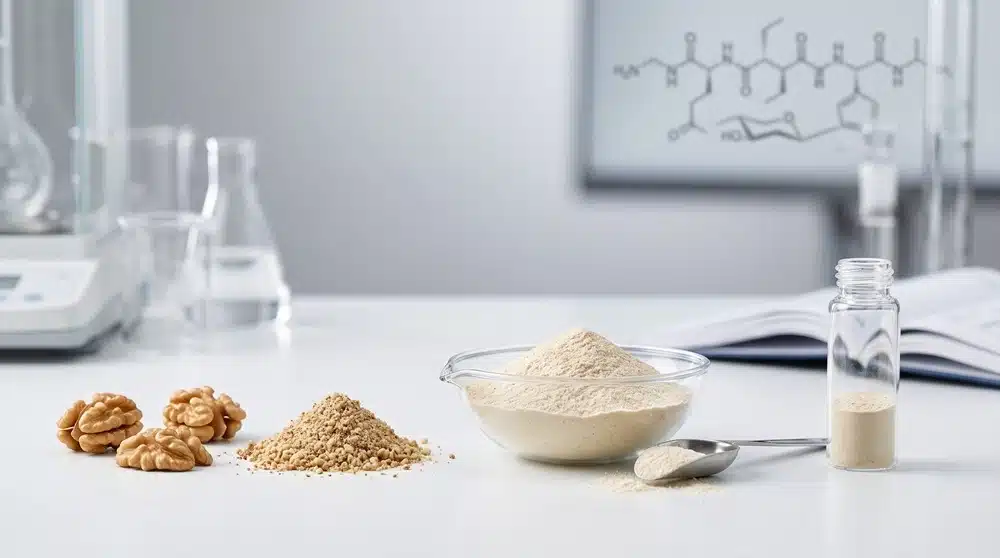
Walnut peptide is a mixture of shorter amino-acid chains produced from walnut protein, usually from walnut kernels, defatted walnut meal, or a walnut protein fraction. The typical manufacturing route includes protein extraction, controlled enzymatic hydrolysis, enzyme inactivation, filtration or membrane separation, concentration, drying, and final powder standardization.
Walnut peptide is also searched as walnut peptide powder, walnut protein hydrolysate, hydrolyzed walnut protein, walnut oligopeptide, walnut protein peptide, e Juglans regia peptide. These names can overlap, but a buyer should not assume that every product has the same peptide content, molecular-weight distribution, degree of hydrolysis, or bioactivity.
Marcas em avaliação bulk walnut peptide powder should compare the current specification and batch COA rather than relying only on the product name.
Walnut Peptide vs Walnut Protein vs Walnut Extract
| Material | How It Is Produced | What It Mainly Contains | Key B2B Question |
|---|---|---|---|
| Péptido de noz | Walnut protein is hydrolyzed into shorter peptide fractions | Peptides, residual intact protein, and free amino acids depending on process | What are the peptide assay, MW distribution, protein result, and degree of hydrolysis? |
| Walnut protein | Protein is extracted/concentrated without the same degree of hydrolysis | Larger walnut protein fractions | What is the protein assay, amino-acid profile, digestibility, and dispersibility? |
| Walnut extract | Walnut material is extracted for selected soluble or marker compounds | Depends on extraction solvent, carrier, ratio, and target compounds | What exactly is extracted, what is the marker, and what is the extract ratio? |
Hydrolyzed walnut extract is an ambiguous commercial term. If the material is produced by hydrolyzing walnut protein, it may be functionally closer to walnut protein hydrolysate. If it is a botanical or cosmetic extract, its composition can be very different. The supplier specification should define the starting material, processing route, protein/peptide content, and intended use.
How Is Walnut Peptide Powder Made?
- Walnut raw-material preparation: kernels, press cake, or defatted walnut meal are cleaned and qualified.
- Oil reduction: residual walnut oil may be removed to improve protein concentration and process consistency.
- Protein extraction: pH, temperature, and separation conditions are used to recover a walnut protein fraction.
- Enzymatic hydrolysis: selected proteases break larger proteins into peptide mixtures.
- Separação: centrifugation, membrane filtration, or ultrafiltration may be used to select peptide-size fractions.
- Concentration and drying: the peptide solution is concentrated and converted to powder, often by spray drying or another validated drying process.
- Standardization and QC: peptide/protein assays, molecular-weight distribution, moisture, contaminants, microbiology, sensory properties, and allergen documentation are reviewed.
The process matters because hydrolysis conditions can change peptide sequence distribution, bitterness, solubility, free-amino-acid content, and biological activity. “Walnut peptide” is therefore a category of hydrolysates, not one single chemical substance.
Are Smaller Walnut Peptides Always Better Absorbed?
Not necessarily. Shorter peptides can change solubility and digestion behavior, but “smaller molecular weight” should not be treated as automatic proof of superior human bioavailability or clinical efficacy.
A 2020 simulated gastrointestinal digestion study compared defatted walnut meal with an Alcalase-prepared walnut meal hydrolysate. After digestion, the non-prehydrolyzed walnut meal also generated substantial amounts of peptides below 3,000 Da and free amino acids. The authors reported no significant difference between the digested preparations for the tested ACE-inhibitory and DPPH radical-scavenging activities. This suggests that pre-hydrolysis is not automatically necessary to create small peptides during digestion, at least under the conditions studied.
Other research has identified individual walnut-derived peptides that can be detected after administration in animal models. For example, a 2024 mouse study reported that the specific peptide TWLPLPR (TW-7) reached plasma and brain tissue after oral gavage. That is useful mechanistic evidence for that peptide in mice; it does not prove that every commercial walnut peptide powder crosses the human blood-brain barrier or has the same pharmacokinetics.

Walnut Peptide Benefits: What Does the Evidence Actually Show?
| Claim Area | Evidence Type | What Can Be Said | What Should Not Be Claimed |
|---|---|---|---|
| Cognition / memory | Small human trial + multiple animal/cell studies | Specific walnut oligopeptide preparations have been studied for memory/cognitive outcomes | Do not claim treatment or prevention of dementia, Alzheimer’s disease, or cognitive impairment |
| Dormir | One small walnut-oligopeptide human trial; newer combination trial with theanine | Early human evidence exists, but product identity and co-ingredients matter | Do not claim that generic walnut peptide treats insomnia |
| Antioxidant activity | Extensive in-vitro/animal peptide research | Specific hydrolysates and peptide sequences show antioxidant activity in experimental models | Do not translate DPPH/ABTS or cell assays into proven disease prevention |
| Blood pressure / ACE inhibition | In-vitro peptide screening + animal research | Walnut-derived peptides with ACE-inhibitory activity have been identified | Do not claim generic walnut peptide lowers blood pressure or treats hypertension |
| Efeitos anti-inflamatórios | Mostly preclinical | Some specific walnut peptide models affect inflammatory pathways | Do not claim treatment of inflammatory disease |
| Skin / anti-aging | Indirect/mechanistic and ingredient-category evidence | Protein peptides may be used in beauty formulations, but product-specific evidence is needed | Do not claim wrinkle reversal, skin repair, or anti-aging efficacy without direct substantiation |

Walnut Peptide for Brain Health and Memory: Human vs Animal Evidence
Human evidence: promising but very small
A 2022 randomized, double-blind, placebo-controlled trial evaluated a specific walnut oligopeptide in 18 teenagers and 18 older adults. Participants were assigned to placebo, 170 mg/day, or 340 mg/day for 90 days, with only six participants initially assigned to each dose group within each age population. The study reported improvements in several cognitive test scores and Pittsburgh Sleep Quality Index scores.
This study is relevant because it directly tested oral walnut oligopeptide in humans. However, it was small, short, and product-specific. It should be treated as preliminary human evidence rather than proof that any walnut peptide powder improves memory, intelligence, or sleep.
Animal and mechanistic evidence: much larger research base
Multiple mouse, rat, zebrafish, cell, and peptide-identification studies have explored walnut-derived peptides for learning, memory, oxidative stress, synaptic signaling, and neuroprotection. Recent studies have reported effects from specific peptide sequences such as TW-7 and other isolated peptides in animal models.
This is useful for research and ingredient development, but it is lower-level evidence for consumer health claims than replicated randomized human trials using the same commercial ingredient.
What Does the 2026 Walnut Peptide + Theanine Human Trial Mean?
A 2026 Food & Function study used an eight-week randomized, placebo-controlled human trial as part of a multi-species research program. The intervention was a combination of walnut peptide and theanine. The study reported improvements in sleep duration and subjective sleep-quality scores in adults with sleep disturbances.
This does not establish the effect of walnut peptide alone because the intervention contained theanine. Supplement brands should not cite a combination trial as proof that a single-ingredient walnut peptide powder produces the same outcome.
Walnut Peptide Antioxidant and Blood-Pressure Research
Walnut protein hydrolysates and isolated walnut peptides have produced antioxidant and ACE-inhibitory activity in laboratory studies. Individual ACE-inhibitory peptide sequences have been isolated and characterized, and newer research continues to optimize walnut protein hydrolysis for these activities.
The main compliance limitation is the evidence level. An in-vitro ACE-inhibition percentage or IC50 value is not the same as a demonstrated reduction in human blood pressure. Likewise, DPPH or ABTS radical-scavenging capacity is not proof that a finished supplement prevents cardiovascular disease, cancer, neurodegenerative disease, or biological aging.
For product development, the correct approach is to connect a proposed claim to the exact walnut peptide material, human dose, finished dosage form, and relevant clinical endpoint.
Walnut Peptide Powder Uses in Supplement Formulation
Walnut peptide can be considered for:
- single-ingredient plant peptide powders;
- capsules and tablets;
- sachets and stick packs;
- functional drink powders;
- plant-protein and peptide premixes;
- beauty-from-within or healthy-aging concepts;
- cognitive or sleep-support formulas where the full claim package is appropriately substantiated;
- multi-ingredient formulas developed through formulação de suplementos personalizados.
Walnut peptide is not simply a high-protein replacement for soy, pea, rice, or whey protein. Depending on grade, it may be used at much lower quantities and positioned around hydrolyzed plant peptides rather than bulk daily protein intake.
Is Walnut Peptide Vegan?
Walnut peptide is plant-derived, so the active raw material can fit a vegan formulation. However, a final vegan claim still depends on processing aids, carriers, excipients, capsule shell, flavors, cross-contact controls, and manufacturing documentation. Verify the full formula and manufacturing process rather than assuming that a walnut-derived raw material automatically makes the finished product vegan.
Walnut Allergy: The Most Important Safety and Labeling Issue
Walnut is a tree nut and is a major food allergen in the United States. FDA allergen guidance requires the specific type of tree nut to be declared, meaning a walnut-derived protein or peptide ingredient cannot simply be treated as an unspecified “plant peptide.”
Hydrolysis does not automatically make a walnut-protein-derived ingredient non-allergenic. Unless a valid exemption or specific regulatory basis applies, brands should maintain walnut/tree-nut allergen declarations, supplier allergen statements, cross-contact controls, and finished-product label review.
People with walnut or tree-nut allergy should avoid walnut-peptide products unless the specific product has been evaluated by an appropriately qualified healthcare professional and its labeling supports use.
Walnut Peptide Powder B2B Quality Specifications
| Especificação | O que solicitar | Porque é que é importante |
|---|---|---|
| Identidade botânica | Juglans regia or other declared walnut species/source | Identity, traceability, allergen and sourcing consistency |
| Starting material | Kernel, defatted meal, press cake, or extracted protein fraction | Affects composition and process consistency |
| Peptide assay | Peptide content, analytical method, acceptance range | Separates peptide-oriented grade from ordinary walnut protein |
| Determinação da concentração de proteínas | Protein %, test method, nitrogen conversion basis where relevant | Needed for composition and label calculations |
| Distribuição do peso molecular | Percent below defined Da ranges plus method | More useful than a vague “low molecular weight” claim |
| Degree of hydrolysis | DH or supplier-defined hydrolysis process data where available | Influences peptide size, bitterness and solubility |
| Perfil de aminoácidos | Full profile and free-amino-acid contribution | Supports nutrition and batch consistency review |
| Solubilidade / dispersibilidade | Water solubility, sedimentation, pH response | Critical for beverages and powders |
| Perfil sensorial | Color, odor, bitterness, walnut notes | Determines flavor-masking requirements |
| Alérgeno | Walnut/tree-nut allergen statement and cross-contact declaration | Required for U.S. label and risk review |
| Contaminantes | Lead, cadmium, arsenic, mercury, microbiology and source-specific risks | Supplement raw-material safety |
| Physical specs | Moisture, ash, mesh/particle size, bulk density | Manufacturing and shelf-life performance |
| Documentos | COA, specification, SDS/TDS, process flow, source statement, allergen statement, GMO/vegan documents as applicable | Procurement, regulatory and formulation review |

How to Buy Walnut Peptide Powder: Supplier Checklist
For buyers searching for walnut peptide for sale, the lowest price per kilogram is not enough. Ask the supplier:
- Is this walnut peptide, walnut protein hydrolysate, or a walnut extract?
- What is the walnut species and starting material?
- What is the peptide assay and test method?
- What is the molecular-weight distribution, not just the average MW?
- What percentage is below 1,000 Da, 3,000 Da, or another relevant cutoff?
- What is the total protein and free-amino-acid content?
- What enzymes and processing aids are used?
- Is the product spray-dried, freeze-dried, or produced by another method?
- How soluble is it at the target serving concentration and pH?
- What are the bitterness and flavor-masking requirements?
- What walnut/tree-nut allergen documentation is supplied?
- Which heavy-metal and microbiological methods and limits are used?
- Are the clinical or functional claims based on this exact grade or only on unrelated walnut-peptide studies?
- What are MOQ, sample availability, packaging, lead time, shelf life, and storage conditions?
For a broader comparison of plant peptides and protein hydrolysates, buyers can review plant-based peptide ingredients and compare source, peptide content, MW, allergen status, solubility, and intended dosage form before final selection.
How Supplement Brands Should Position Walnut Peptide
The strongest defensible positioning is ingredient-specific:
- walnut-derived plant protein hydrolysate;
- defined peptide content and molecular-weight distribution;
- water-soluble or low-molecular-weight grade when supported by the specification;
- plant-derived peptide source;
- researched in cognitive, sleep, antioxidant, and ACE-inhibition models, with evidence level clearly stated;
- supported by batch COA, allergen and quality documentation.
Avoid phrases such as “treats Alzheimer’s disease,” “prevents dementia,” “lowers blood pressure,” “cures insomnia,” “reduces chronic inflammation,” “repairs neurons,” or “crosses the blood-brain barrier in humans” unless the exact product and claim meet the applicable regulatory and scientific standard.
FAQ
What is walnut peptide?
Walnut peptide is a walnut-protein hydrolysate containing shorter peptide chains produced through controlled protein extraction and hydrolysis. Commercial products vary in peptide content, MW distribution, protein content, solubility, taste, and bioactivity.
What is walnut peptide powder used for?
It is used as a specialty plant-derived peptide ingredient in supplements, capsules, tablets, sachets, drink powders, gummies, and functional nutrition premixes. The permitted finished-product claim depends on the exact formulation and evidence.
What are the benefits of walnut peptide?
Specific walnut peptides have been studied for cognitive, sleep, antioxidant, ACE-inhibitory, and neuroprotective effects. Most evidence is preclinical. A small 2022 human trial tested one walnut oligopeptide preparation, so broad benefits should be described cautiously.
Does walnut peptide improve memory?
A very small 90-day randomized trial reported improvements in several cognitive measures with a specific walnut oligopeptide preparation, and animal studies are more numerous. The current evidence is not strong enough to claim that generic walnut peptide prevents or treats memory disorders.
Does walnut peptide cross the blood-brain barrier?
A specific walnut-derived peptide, TW-7, was detected in mouse brain tissue after oral administration. This is animal evidence for one peptide and should not be generalized to every commercial walnut peptide powder or to humans.
Is walnut peptide good for sleep?
Early evidence exists. A small 2022 human trial evaluated walnut oligopeptide alone, and a 2026 randomized trial evaluated a walnut-peptide-plus-theanine combination. The combination study cannot prove that walnut peptide alone produces the same sleep effect.
Is walnut peptide the same as walnut protein?
No. Walnut peptide is produced by hydrolyzing walnut protein into shorter chains. Walnut protein generally contains larger intact protein fractions. Compare peptide assay, MW distribution, protein content and solubility on the COA.
Is hydrolyzed walnut extract the same as walnut peptide?
Not always. “Hydrolyzed walnut extract” is an ambiguous name. Confirm whether the product is a hydrolyzed walnut protein, a botanical extract, or a cosmetic ingredient by checking the starting material, process, protein/peptide assay, and supplier specification.
Is walnut peptide vegan?
The walnut-derived ingredient is plant-based, but a finished vegan claim also depends on processing aids, carriers, capsule shells, flavors, and manufacturing controls.
Is walnut peptide safe for people with nut allergies?
Walnut is a major tree-nut allergen. People with walnut/tree-nut allergy should avoid walnut-peptide products unless a qualified healthcare professional and the specific product labeling support otherwise.
What should buyers check before purchasing walnut peptide powder?
Verify source identity, peptide and protein assays, MW distribution, amino-acid profile, solubility, sensory data, allergen statement, heavy metals, microbiology, processing route, COA, MOQ, packaging, lead time and evidence relevant to the intended claim.
Referências
- Walnut (Juglans regia L.) Oligopeptide Effects on Memory, Cognition and Sleep Quality in a Randomized Double-Blind Controlled Trial
- Walnut peptide and theanine combination ameliorates sleep disorders: a multi-species study including a human trial
- Production, bioactivities and bioavailability of bioactive peptides derived from walnut origin by-products: a review
- Walnut proteolysis after simulated digestion: ACE inhibition and DPPH radical-scavenging activities
- Walnut-derived peptide TW-7 crosses the blood-brain barrier in a mouse model
- Purification and identification of an ACE inhibitory peptide from walnut protein
- ACE-inhibiting peptides from walnut protein isolate: in-silico and in-vitro study
- FDA: What is a Major Food Allergen?
- FDA: Declaring Specific Tree Nuts in Allergen Labeling
- FDA: Alegações relativas à estrutura e função
- FTC: Orientações sobre a conformidade dos produtos de saúde

Warren Wan é um especialista experiente com vasta experiência na cadeia de abastecimento de suplementos alimentares, possuindo uma rica experiência prática na investigação, desenvolvimento, controlo de processos e aquisição global de ingredientes essenciais, tais como peptídeos de colagénio, proteína de caldo de ossos e queratina. Como autor desta coluna, dedica-se a ir além do discurso de marketing, transformando a ciência obscura dos ingredientes e as normas de controlo de qualidade da produção numa divulgação científica rigorosa e de fácil compreensão, ajudando os leitores a compreender a verdade por trás dos rótulos e a fazer escolhas mais racionais em matéria de saúde.