
При знакомстве с миром натуральных масел часто встречаются термины “льняное масло” и “льняное масло”, вызывающие большую путаницу. Являются ли они одним и тем же, или есть важные различия, о которых следует знать? Хотя и то, и другое получают из растения льна (Linum usitatissimum), разница в их названиях, как правило, свидетельствует о принципиальной разнице в их предназначении. Одно из них - высоко ценимая пищевая добавка, богатая омега-3 жирными кислотами, а другое - популярный выбор для промышленных и домашних работ. В этой статье мы разберем ключевые различия между льняным и льняным маслом и поможем вам понять, какое из них следует использовать и почему.
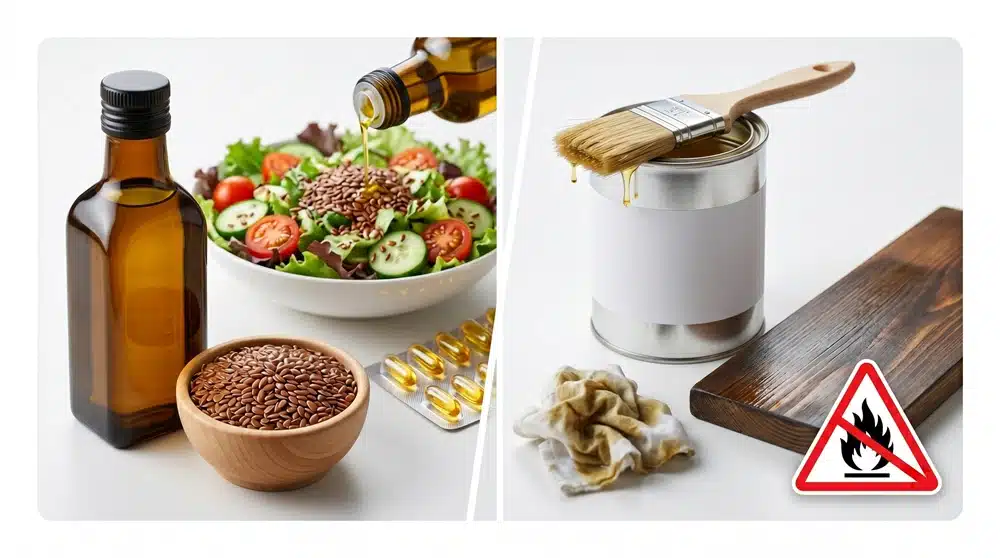
Quick answer: Linseed oil and flaxseed oil come from the same flax plant (Linum usitatissimum), but they are not interchangeable in most consumer contexts. Food-grade flaxseed oil is made for human consumption and omega-3 ALA nutrition, while industrial or boiled linseed oil is processed for drying, wood finishing, paints, and varnishes.
Are Linseed Oil and Flaxseed Oil the Same?
Botanically, yes. Commercially, not always. Both oils can be derived from the seeds of the flax plant, Linum usitatissimum. The Codex standard for named vegetable oils even treats “flaxseed (linseed) oil” as the oil from cultivated flax seeds. However, product labels often use the two names differently: “flaxseed oil” usually signals a food-grade or dietary supplement oil, while “linseed oil” is commonly used for industrial, woodworking, painting, or varnish products.
The safest rule is to judge the grade and label, not the botanical name. If a bottle is sold as a dietary supplement or edible oil and clearly states food-grade, cold-pressed, and intended for human consumption, it may be suitable for food use. If it is sold in a hardware store, labeled boiled linseed oil, wood finish, paint medium, drying oil, or contains metallic driers/solvents, do not consume it and do not use it on food-contact surfaces.
Что такое семена льна и льняные семена?
Это отличный вопрос, и он затрагивает суть путаницы, связанной с этими двумя терминами. Семена льна и льняные семена - это, по сути, одно и то же. Они оба происходят от одного и того же растения, Linum usitatissimum. Разница в названиях - это, прежде всего, вопрос региональной терминологии и, что более важно, различие, основанное на их предназначении.
- В США и Канаде термин “семена льна” используется почти исключительно, особенно в контексте продуктов питания и диетических добавок.
- В Великобритании и других частях света более распространен термин “семена льна”, особенно когда речь идет о семенах, используемых в промышленных целях.
Так, хотя сами семена идентичны, термин “семена льна” обычно относится к кулинарному, пищевому варианту, в то время как “семена льна” часто обозначают промышленные семена, используемые для производства таких продуктов, как краски, лаки и линолеум. Это различие крайне важно, поскольку методы обработки для промышленного использования могут сделать масло и семена небезопасными для употребления человеком.
Terminology matters: seed, oil, and grade
| Term on label | What it usually means | What to check before use |
|---|---|---|
| Flaxseed oil / flax oil | Usually food-grade oil or supplement oil | Food-grade label, cold-pressed process, dark bottle, batch COA, peroxide value, acid value |
| Edible linseed oil | Food-grade name used in some regions | Must clearly state edible/food-grade and be processed for human consumption |
| Raw linseed oil | May be pure oil for wood or paint, but not necessarily produced under food standards | Do not assume edible; verify label, supplier, and food-contact suitability |
| Boiled linseed oil | Industrial drying oil, often with metal driers | Not for ingestion; not for cutting boards or food-contact surfaces unless the manufacturer specifically certifies food-contact safety |
как сделать льняное масло
Наиболее распространенный и предпочтительный метод производства пищевых продуктов льняное масло это холодное прессование. Этот процесс включает в себя:
- Очистка семян: В первую очередь необходимо тщательно очистить семена льна от посторонних примесей, пыли и других загрязнений.
- Механическое прессование: Затем очищенные семена поступают в механический пресс, чаще всего шнековый. Машина оказывает сильное давление на семена, выдавливая из них масло.
- Контроль температуры: Это самая важная часть “холодного прессования”. При этом процессе выделяется некоторое количество тепла от трения, но оно тщательно контролируется, чтобы температура не превышала определенного порога (обычно около 49°C или 120°F). Такой низкотемпературный метод жизненно важен для сохранения нежных жирных кислот омега-3 (ALA) в масле, которые очень чувствительны к нагреву и могут разрушаться, становясь прогорклыми или менее эффективными.
- Фильтрация: Затем масло фильтруется для удаления оставшихся твердых частиц или осадка.
- Упаковка: Наконец, масло разливают по бутылкам, часто в темные непрозрачные емкости, а иногда промывают азотом, чтобы удалить кислород. Это делается для защиты масла от света и окисления, что позволяет сохранить его свежесть и питательную ценность.
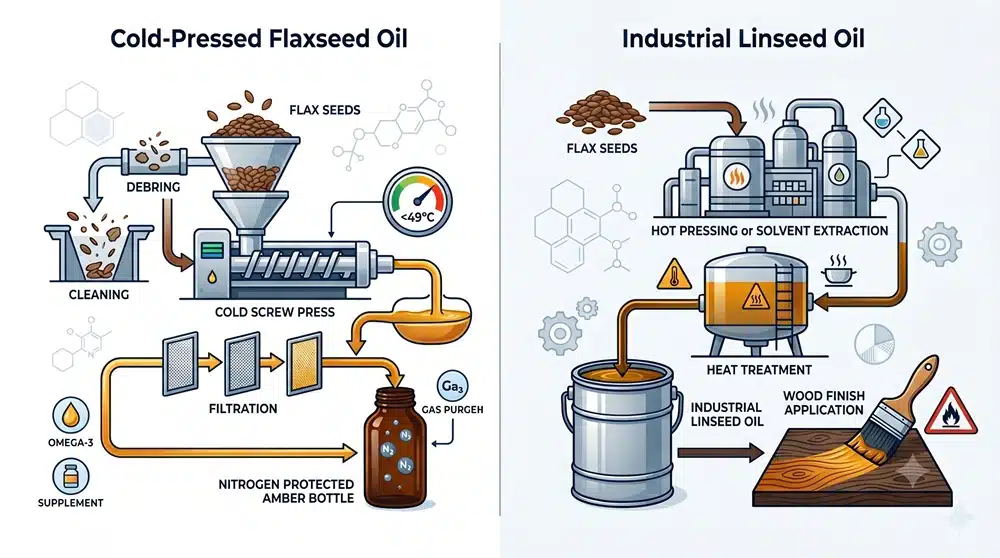
В результате такого “холодного прессования” получается высококачественное, богатое питательными веществами масло, которое можно найти в магазинах здорового питания и которое предназначено для употребления человеком в качестве пищевой добавки или пищевого ингредиента.
Food-grade quality indicators suppliers should verify
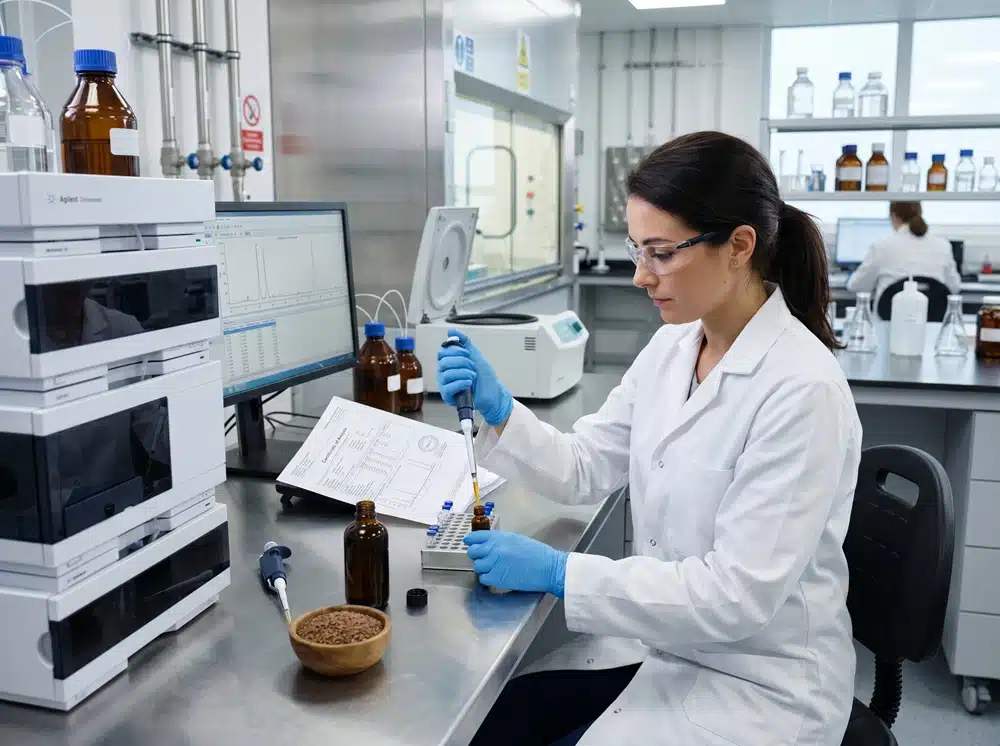
For supplement brands, “cold-pressed” is only the starting point. A food-grade flaxseed oil should be backed by a specification sheet and a certificate of analysis (COA). Key checks include fatty acid profile, peroxide value, acid value, iodine value, trace metals, and packaging protection from oxygen and light.
| Quality check | Why it matters | Practical target or note |
|---|---|---|
| Fatty acid profile | Confirms the oil is rich in alpha-linolenic acid (ALA) | USP-style monographs list alpha-linolenic acid around 50-65% for flax seed oil |
| Peroxide value | Indicates early oxidation and rancidity risk | Lower is better; supplement buyers should request current COA values |
| Acid value / free fatty acids | Shows hydrolytic rancidity and poor seed/oil handling | Use as a freshness and process-control marker |
| Iodine value | Reflects high unsaturation; also explains why linseed oil can act as a drying oil | High iodine values mean the oil is reactive with oxygen and requires careful storage |
| Упаковка | ALA-rich oils oxidize quickly when exposed to heat, light, and oxygen | Use dark bottles, nitrogen flushing when possible, tight closures, and refrigerated storage after opening |
В отличие от этого, льняное масло промышленного качества часто изготавливается с помощью различных методов, таких как горячее прессование или экстракция растворителем, при которых используется высокая температура и/или химические вещества. Эти методы направлены на получение максимального количества масла и не заботятся о сохранении питательной ценности, поскольку масло предназначено для использования, например, для отделки древесины, а не для употребления в пищу.
Преимущества: Льняное масло и льняное масло
Хотя эти два масла получают из одного и того же растения, их полезные свойства совершенно различны, что обусловлено их обработкой и назначением.
Flaxseed Oil: A Focus on ALA Omega-3 Nutrition
Food-grade flaxseed oil is valued mainly because it is a concentrated plant source of alpha-linolenic acid (ALA), an essential omega-3 fatty acid. According to the NIH Office of Dietary Supplements, ALA is found mainly in plant oils such as flaxseed, soybean, and canola oils, but conversion from ALA to EPA and DHA is limited. For this reason, flaxseed oil is best positioned as a plant-based ALA source, not as a direct replacement for fish oil EPA/DHA.Рыбий жир против льняного масла
- Plant-based omega-3 support: Useful for vegan, vegetarian, or fish-allergy formulations that need a plant-sourced omega-3 claim.
- Heart-health positioning: Mayo Clinic notes that some research suggests flaxseed and flaxseed oil may help with blood pressure and heart-health markers, but claims should remain conservative and compliant.
- No fiber or lignans in standard oil: Whole or ground flaxseed contains fiber and lignans; standard flaxseed oil usually does not. Do not transfer every whole-flaxseed benefit to the oil unless the product is specifically lignan-enriched.
- Use limitations: Flaxseed oil should not be used for high-heat cooking because ALA-rich oils oxidize easily. It is better used in capsules, smoothies, salad dressings, or cold applications.
Льняное масло: Промышленная мощь
С другой стороны, “льняное масло” - это, как правило, термин, обозначающий переработанный, промышленный продукт. Польза этого масла совершенно не диетическая, оно ценится за свои уникальные физические и химические свойства.
- “Высушивающее” масло: Это самое значительное преимущество льняного масла. Под воздействием воздуха масло полимеризуется и затвердевает, образуя прочную, водостойкую пленку. Например, вы можете использовать прокипяченное льняное масло для отделки новой деревянной разделочной доски, палубы или мебели, защищая ее от влаги и придавая ей более насыщенный цвет.
- Связка красок: На протяжении веков льняное масло использовалось в качестве связующего для масляных красок. Именно благодаря ему традиционные краски для художников и домашние краски наносятся гладко и высыхают, образуя прочное, эластичное и долговечное покрытие.
- Сохранение и защита: Образуя защитный барьер, льняное масло отлично подходит для сохранения различных материалов, включая дерево и даже металл. Его часто используют для покрытия металлических инструментов, чтобы предотвратить появление ржавчины, или для герметизации и защиты поверхности чугунной сковороды (так называемая “приправа”).
Why Industrial or Boiled Linseed Oil Is Not Food-Grade
The issue is not the flax plant itself; it is the processing standard. Industrial linseed oil is optimized for drying performance, surface penetration, paint binding, or wood finishing. To achieve faster curing, some products are heat-treated, solvent-extracted, polymerized, or blended with metallic drying agents. These choices are useful for a wood finish, but they are not the same as a food-grade, cold-pressed supplement oil.
In bulk supplement sourcing, we treat edible flaxseed oil as a sensitive omega oil: it needs oxidation control, COA verification, suitable packaging, and clear food-grade documentation. Hardware-store linseed oil should never be substituted for dietary supplement manufacturing, even if the botanical source is similar.
Льняное масло против льняного масла: Сравнительная таблица
| Характеристика | Food-Grade Flaxseed Oil | Industrial / Boiled Linseed Oil |
|---|---|---|
| Botanical source | Flax seeds from Linum usitatissimum | Also usually derived from flax seeds |
| Primary purpose | Dietary supplement, cold food use, plant-based omega-3 ALA | Wood finishing, paint binder, varnish, putty, linoleum, industrial coatings |
| Processing goal | Preserve freshness, ALA content, and food safety | Improve drying, penetration, hardening, and film formation |
| Typical process | Cold pressing, filtration, oxidation-controlled packaging | Heat processing, polymerization, solvent extraction, or added drying agents depending on product |
| Key nutritional value | High in ALA omega-3; standard oil has no fiber and little/no lignans | Not formulated for nutrition |
| Food safety | Yes, if clearly labeled food-grade and intended for human consumption | No, unless specifically certified as food-grade or food-contact safe by the manufacturer |
| Quality documents | COA, fatty acid profile, peroxide value, acid value, trace metals, microbial/contaminant checks | SDS, application instructions, drying time, VOC/safety guidance |
| Хранение | Dark, tightly sealed container; refrigerate after opening; protect from oxygen, light, and heat | Follow product label; keep away from heat/flame; handle oily rags as a fire hazard |
| Best answer to “Can I eat it?” | Only if the label says food-grade/edible | No for hardware-store, boiled, wood finish, paint, or industrial products |
Supply Chain Checklist for Supplement Brands
From a supplement manufacturing perspective, the biggest risk is not confusing two plant names; it is sourcing an oil that was never produced for ingestion. Before using flaxseed oil in capsules, softgels, liquids, or private label formulas, brands should request:
- Full specification sheet and recent COA for the exact batch
- Fatty acid profile confirming ALA content
- Peroxide value and acid value for freshness and oxidation control
- Heavy metal and contaminant testing appropriate for the target market
- Packaging details such as dark bottles, oxygen control, and shelf-life/stability data
- Clear confirmation that the oil is food-grade and suitable for dietary supplement use
If the product is described mainly as a wood finish, paint medium, varnish ingredient, boiled linseed oil, or drying oil, it should be rejected for supplement use.
заключение
В конечном счете, ответ на вопрос “Можно ли их использовать как взаимозаменяемые?” - однозначное "нет". Различие между льняным маслом и маслом из семян льна - это вопрос безопасности и эффективности. Понимая, что льняное масло предназначено для здоровья, а льняное - для ремонта дома, вы сможете избежать потенциально опасной ошибки и убедиться, что используете правильный продукт для правильной работы. Хотите ли вы увеличить потребление Омега-3 или защитить свою любимую деревянную разделочную доску, всегда выбирайте масло, специально обозначенное для этой цели. Эта простая привычка убережет вас от путаницы и потенциального вреда.
Вопросы и ответы
Что лучше, льняное семя или семя льна?
Ни один из них не является “лучшим” - у них разное назначение. Льняное масло предназначено для потребления человеком и пользы для здоровья, в то время как льняное масло для промышленных целей, например, для отделки древесины.
Можно ли есть льняное масло людям?
Only if it is clearly labeled food-grade or edible. Do not eat hardware-store linseed oil, boiled linseed oil, wood finish, paint medium, or any product containing drying agents or solvents.
Безопасно ли льняное масло во время беременности?
Do not start flaxseed oil during pregnancy or breastfeeding without medical advice. Mayo Clinic advises avoiding flaxseed and flaxseed oil during pregnancy or breastfeeding.
В чем самый большой недостаток семян льна?
Главный недостаток - они могут быстро прогоркнуть. Чтобы сохранить свежесть и питательные свойства, их нужно правильно хранить - целыми или в холодильнике.
Каковы недостатки льняного масла?
Самый большой недостаток заключается в том, что оно небезопасно для употребления человеком. Кроме того, тряпки, пропитанные льняным маслом, могут самовозгораться, поэтому их следует утилизировать с осторожностью.
Как использовать льняное семя при болях в суставах?
Льняное масло содержит противовоспалительные омега-3 жирные кислоты, которые могут помочь уменьшить боль в суставах. Вы можете принимать его в качестве добавка в капсулах или добавлять его в такие блюда, как смузи и салаты.
Чем полезно льняное семя для женского организма?
Льняное семя богато лигнанами, которые могут помочь сбалансировать гормоны и уменьшить симптомы менопаузы. Содержание клетчатки также способствует здоровью пищеварительной системы и сердца.
Кому не следует принимать льняное масло?
Лицам, принимающим препараты, разжижающие кровь, или тем, кто имеет определенные медицинские показания, следует проконсультироваться с врачом перед приемом льняного масла.
Полезно ли льняное семя при болях в коленях?
Да, противовоспалительные свойства омега-3, содержащихся в льняном семени, помогают уменьшить воспаление и боль в суставах, в том числе в коленях.
Что произойдет, если я буду есть льняное семя каждый день?
Ежедневное употребление льняного семени может улучшить пищеварение, поддержать здоровье сердца, а также стать хорошим источником клетчатки и омега-3. Только начните с небольшого количества и запивайте большим количеством воды.
Какой сорт льняного семени самый полезный?
Самые полезные виды льняного семени - золотые или коричневые семена льна. Оба вида имеют схожий питательный профиль. Наиболее важным фактором является то, как они обрабатываются и хранятся, чтобы сохранить их свежесть.
Is flaxseed oil the same as ground flaxseed?
No. Ground flaxseed contains fiber and lignans, while standard flaxseed oil mainly provides fat, especially ALA omega-3. Choose the form based on the desired nutrient profile.
Can I use boiled linseed oil on a cutting board?
No, not unless the manufacturer explicitly certifies it for food-contact use. Standard boiled linseed oil is an industrial drying oil and may contain metallic drier
Why does linseed oil dry but flaxseed oil is sold as food?
The drying behavior comes from high unsaturation and oxidation. Industrial linseed oils are optimized to oxidize and polymerize into a surface film; food-grade flaxseed oils are protected from oxidation to preserve freshness and nutrition.
What should supplement brands check before buying bulk flaxseed oil?
Ask for a COA, fatty acid profile, peroxide value, acid value, trace metals, packaging protection, shelf-life data, and explicit food-grade documentation.
ссылки
- NIH Office of Dietary Supplements – Omega-3 Fatty Acids Fact Sheet: https://ods.od.nih.gov/factsheets/Omega3FattyAcids-HealthProfessional/
- Mayo Clinic – Flaxseed and flaxseed oil: https://www.mayoclinic.org/drugs-supplements-flaxseed-and-flaxseed-oil/art-20366457
- FDA GRN No. 256 – High linolenic acid flaxseed oil: https://hfpappexternal.fda.gov/scripts/fdcc/index.cfm?id=256&set=GRASNotices
- Codex Alimentarius CXS 210-1999 – Standard for Named Vegetable Oils: https://www.fao.org/fao-who-codexalimentarius/
- USP Flax Seed Oil monograph mirror: https://www.drugfuture.com/Pharmacopoeia/usp38/data/v38332/usp38nf33s2_m33191.html
- Klean-Strip Boiled Linseed Oil SDS: https://images.thdstatic.com/catalog/pdfImages/5c/5caa37df-3ea9-4b49-83a7-b602de97da9e.pdf
- East Sussex Fire & Rescue Service – The Fire Hazards of Linseed Oil: https://www.esfrs.org/the-fire-hazards-of-linseed-oil
- Flax Farm – Linseed or Flax: what’s the difference?: https://www.flaxfarm.co.uk/health/linseed-or-flax-whats-the-difference/
- Treeboard – Nine Myths About Linseed Oil and Flaxseed Oil: https://treeboard.com/blog/nine-myths-about-linseed-oil-and-flaxseed-oil/
- Range Products – Linseed Oil vs Flaxseed Oil: https://www.rangeproducts.com.au/linseed-oil-vs-flaxseed-oil/
- PureFlax – Linseed Oil vs Flax Seed Oil: https://pureflax.co.uk/linseed-oil-of-flax-seed-oil/

W. Wenyang is a seasoned expert with extensive experience in the dietary supplement supply chain, possessing rich practical experience in the research, development, process control, and global sourcing of core ingredients such as collagen peptides, bone broth protein, and keratin. As the author of this column, he is dedicated to stripping away the marketing packaging, transforming obscure ingredient science and production quality control standards into easy-to-understand, hardcore science popularization, helping readers understand the truth behind the labels and make more rational health choices.
