
When exploring the world of natural oils, the terms “linseed oil” and “flaxseed oil” often appear, causing a great deal of confusion. Are they the same thing, or are there important distinctions to be aware of? While both are derived from the flax plant (Linum usitatissimum), the difference in their names typically signals a crucial difference in their intended use. One is a highly-regarded health food supplement rich in omega-3 fatty acids, while the other is a popular choice for industrial and home improvement projects. This article will break down the key differences between linseed oil and flaxseed oil, helping you understand which one you should be using and why.

Quick answer: Linseed oil and flaxseed oil come from the same flax plant (Linum usitatissimum), but they are not interchangeable in most consumer contexts. Food-grade flaxseed oil is made for human consumption and omega-3 ALA nutrition, while industrial or boiled linseed oil is processed for drying, wood finishing, paints, and varnishes.
Are Linseed Oil and Flaxseed Oil the Same?
Botanically, yes. Commercially, not always. Both oils can be derived from the seeds of the flax plant, Linum usitatissimum. The Codex standard for named vegetable oils even treats “flaxseed (linseed) oil” as the oil from cultivated flax seeds. However, product labels often use the two names differently: “flaxseed oil” usually signals a food-grade or dietary supplement oil, while “linseed oil” is commonly used for industrial, woodworking, painting, or varnish products.
The safest rule is to judge the grade and label, not the botanical name. If a bottle is sold as a dietary supplement or edible oil and clearly states food-grade, cold-pressed, and intended for human consumption, it may be suitable for food use. If it is sold in a hardware store, labeled boiled linseed oil, wood finish, paint medium, drying oil, or contains metallic driers/solvents, do not consume it and do not use it on food-contact surfaces.
What are flax seeds and linseeds?
That’s a great question, and it gets to the heart of the confusion surrounding these two terms. Flax seeds and linseeds are, in fact, the same thing. They both come from the same plant, Linum usitatissimum. The difference in naming is primarily a matter of regional terminology and, more importantly, a distinction based on their intended use.
- In the United States and Canada, the term “flax seeds” is almost exclusively used, especially in the context of food and dietary supplements.
- In the United Kingdom and other parts of the world, “linseeds” is the more common term, particularly when referring to the seeds used for industrial purposes.
So, while the seed itself is identical, the term “flax seeds” typically refers to the culinary, food-grade version, while “linseeds” often denotes the industrial-grade seeds used for manufacturing products like paints, varnishes, and linoleum. This distinction is crucial because the processing methods for industrial use can render the oil and seeds unsafe for human consumption.
Terminology matters: seed, oil, and grade
| Term on label | What it usually means | What to check before use |
|---|---|---|
| Flaxseed oil / flax oil | Usually food-grade oil or supplement oil | Food-grade label, cold-pressed process, dark bottle, batch COA, peroxide value, acid value |
| Edible linseed oil | Food-grade name used in some regions | Must clearly state edible/food-grade and be processed for human consumption |
| Raw linseed oil | May be pure oil for wood or paint, but not necessarily produced under food standards | Do not assume edible; verify label, supplier, and food-contact suitability |
| Boiled linseed oil | Industrial drying oil, often with metal driers | Not for ingestion; not for cutting boards or food-contact surfaces unless the manufacturer specifically certifies food-contact safety |
how do you make flaxseed oil
The most common and preferred method for producing food-grade flaxseed oil is cold pressing. This process involves:
- Cleaning the Seeds: The first step is to thoroughly clean the flax seeds to remove any foreign materials, dust, or other impurities.
- Mechanical Pressing: The cleaned seeds are then fed into a mechanical press, often a screw-type expeller. The machine applies intense pressure to the seeds, squeezing the oil out.
- Temperature Control: This is the most crucial part of “cold pressing.” The process generates some heat from friction, but it is carefully controlled to keep the temperature below a certain threshold (typically around 49°C or 120°F). This low-heat method is vital for preserving the delicate omega-3 fatty acids (ALA) in the oil, which are highly susceptible to heat and can degrade, becoming rancid or less effective.
- Filtering: The oil is then filtered to remove any remaining solid particles or sediment.
- Packaging: Finally, the oil is bottled, often in dark, opaque containers, and sometimes flushed with nitrogen to remove oxygen. This is done to protect the oil from light and oxidation, further preserving its freshness and nutritional integrity.
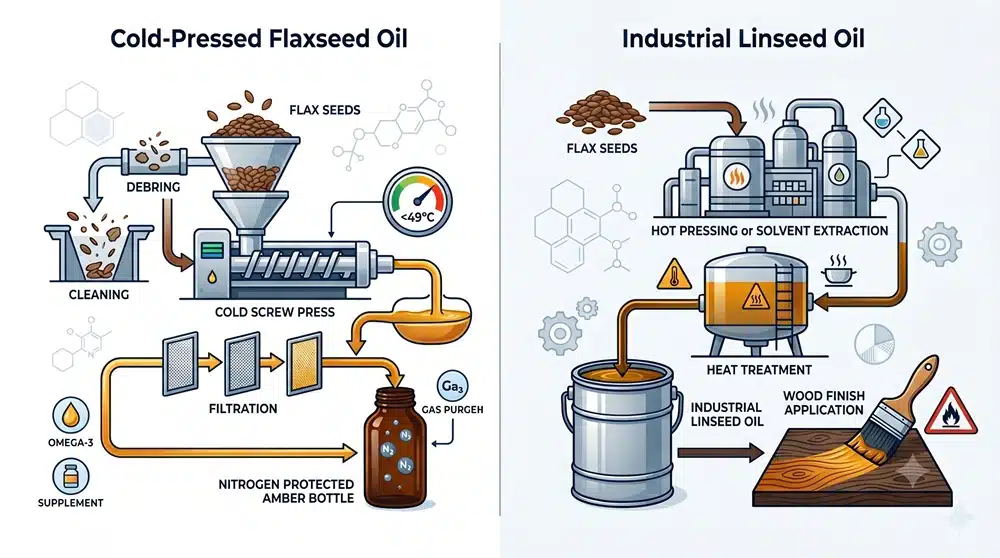
This “cold pressing” process produces the high-quality, nutrient-rich oil you find in health food stores, which is intended for human consumption as a dietary supplement or food ingredient.
Food-grade quality indicators suppliers should verify
For supplement brands, “cold-pressed” is only the starting point. A food-grade flaxseed oil should be backed by a specification sheet and a certificate of analysis (COA). Key checks include fatty acid profile, peroxide value, acid value, iodine value, trace metals, and packaging protection from oxygen and light.
| Quality check | Why it matters | Practical target or note |
|---|---|---|
| Fatty acid profile | Confirms the oil is rich in alpha-linolenic acid (ALA) | USP-style monographs list alpha-linolenic acid around 50-65% for flax seed oil |
| Peroxide value | Indicates early oxidation and rancidity risk | Lower is better; supplement buyers should request current COA values |
| Acid value / free fatty acids | Shows hydrolytic rancidity and poor seed/oil handling | Use as a freshness and process-control marker |
| Iodine value | Reflects high unsaturation; also explains why linseed oil can act as a drying oil | High iodine values mean the oil is reactive with oxygen and requires careful storage |
| Packaging | ALA-rich oils oxidize quickly when exposed to heat, light, and oxygen | Use dark bottles, nitrogen flushing when possible, tight closures, and refrigerated storage after opening |
In contrast, industrial-grade linseed oil is often made using different methods, such as hot pressing or solvent extraction, which use high heat and/or chemicals. These methods are designed to maximize oil yield and are not concerned with preserving the nutritional value, as the oil is intended for uses like wood finishing, not eating.

The Benefits: Linseed Oil vs Flaxseed Oil
While the two oils come from the same plant, their benefits are completely different, dictated by their processing and intended use.
Flaxseed Oil: A Focus on ALA Omega-3 Nutrition
Food-grade flaxseed oil is valued mainly because it is a concentrated plant source of alpha-linolenic acid (ALA), an essential omega-3 fatty acid. According to the NIH Office of Dietary Supplements, ALA is found mainly in plant oils such as flaxseed, soybean, and canola oils, but conversion from ALA to EPA and DHA is limited. For this reason, flaxseed oil is best positioned as a plant-based ALA source, not as a direct replacement for fish oil EPA/DHA.Fish Oil vs Flaxseed Oil
- Plant-based omega-3 support: Useful for vegan, vegetarian, or fish-allergy formulations that need a plant-sourced omega-3 claim.
- Heart-health positioning: Mayo Clinic notes that some research suggests flaxseed and flaxseed oil may help with blood pressure and heart-health markers, but claims should remain conservative and compliant.
- No fiber or lignans in standard oil: Whole or ground flaxseed contains fiber and lignans; standard flaxseed oil usually does not. Do not transfer every whole-flaxseed benefit to the oil unless the product is specifically lignan-enriched.
- Use limitations: Flaxseed oil should not be used for high-heat cooking because ALA-rich oils oxidize easily. It is better used in capsules, smoothies, salad dressings, or cold applications.
Linseed Oil: An Industrial Powerhouse
On the other hand, “linseed oil” is typically a term for a processed, industrial product. The benefits of this oil are entirely non-dietary and are prized for their unique physical and chemical properties.
- A “Drying” Oil: This is the most significant benefit of linseed oil. When exposed to air, the oil polymerizes and hardens, creating a tough, water-resistant film. For example, you can use boiled linseed oil to finish a new wooden cutting board, a deck, or a piece of furniture, protecting it from moisture and enriching its color.
- Paint Binder: For centuries, linseed oil has been used as a binder for oil paints. It’s the reason traditional artist paints and house paints can be applied smoothly and dry into a durable, flexible, and long-lasting finish.
- Preservation and Protection: Because it forms a protective barrier, linseed oil is excellent for preserving various materials, including wood and even metal. It is often used to coat metal tools to prevent rust or to seal and protect the surface of a cast-iron skillet (known as “seasoning” it).
Why Industrial or Boiled Linseed Oil Is Not Food-Grade
The issue is not the flax plant itself; it is the processing standard. Industrial linseed oil is optimized for drying performance, surface penetration, paint binding, or wood finishing. To achieve faster curing, some products are heat-treated, solvent-extracted, polymerized, or blended with metallic drying agents. These choices are useful for a wood finish, but they are not the same as a food-grade, cold-pressed supplement oil.
In bulk supplement sourcing, we treat edible flaxseed oil as a sensitive omega oil: it needs oxidation control, COA verification, suitable packaging, and clear food-grade documentation. Hardware-store linseed oil should never be substituted for dietary supplement manufacturing, even if the botanical source is similar.
Linseed Oil vs Flaxseed Oil: A Comparative Table
| Feature | Food-Grade Flaxseed Oil | Industrial / Boiled Linseed Oil |
|---|---|---|
| Botanical source | Flax seeds from Linum usitatissimum | Also usually derived from flax seeds |
| Primary purpose | Dietary supplement, cold food use, plant-based omega-3 ALA | Wood finishing, paint binder, varnish, putty, linoleum, industrial coatings |
| Processing goal | Preserve freshness, ALA content, and food safety | Improve drying, penetration, hardening, and film formation |
| Typical process | Cold pressing, filtration, oxidation-controlled packaging | Heat processing, polymerization, solvent extraction, or added drying agents depending on product |
| Key nutritional value | High in ALA omega-3; standard oil has no fiber and little/no lignans | Not formulated for nutrition |
| Food safety | Yes, if clearly labeled food-grade and intended for human consumption | No, unless specifically certified as food-grade or food-contact safe by the manufacturer |
| Quality documents | COA, fatty acid profile, peroxide value, acid value, trace metals, microbial/contaminant checks | SDS, application instructions, drying time, VOC/safety guidance |
| Storage | Dark, tightly sealed container; refrigerate after opening; protect from oxygen, light, and heat | Follow product label; keep away from heat/flame; handle oily rags as a fire hazard |
| Best answer to “Can I eat it?” | Only if the label says food-grade/edible | No for hardware-store, boiled, wood finish, paint, or industrial products |
Supply Chain Checklist for Supplement Brands
From a supplement manufacturing perspective, the biggest risk is not confusing two plant names; it is sourcing an oil that was never produced for ingestion. Before using flaxseed oil in capsules, softgels, liquids, or private label formulas, brands should request:
- Full specification sheet and recent COA for the exact batch
- Fatty acid profile confirming ALA content
- Peroxide value and acid value for freshness and oxidation control
- Heavy metal and contaminant testing appropriate for the target market
- Packaging details such as dark bottles, oxygen control, and shelf-life/stability data
- Clear confirmation that the oil is food-grade and suitable for dietary supplement use
If the product is described mainly as a wood finish, paint medium, varnish ingredient, boiled linseed oil, or drying oil, it should be rejected for supplement use.

conclusion
Ultimately, the answer to “Can you use them interchangeably?” is a resounding no. The distinction between linseed oil and flaxseed oil is a matter of safety and efficacy. By understanding that flaxseed oil is for your health and linseed oil is for your home improvement projects, you can avoid a potentially dangerous mistake and ensure you’re using the right product for the right job. Whether you’re looking to boost your Omega-3 intake or protect your favorite wooden cutting board, always choose the oil specifically labeled for that purpose. This simple habit will save you from confusion and potential harm.
FAQs
Which is better, flaxseed or linseed?
Neither is “better”—they have different uses. Flaxseed oil is for human consumption and health benefits, while linseed oil is for industrial purposes like wood finishing.
Can humans eat linseed oil?
Only if it is clearly labeled food-grade or edible. Do not eat hardware-store linseed oil, boiled linseed oil, wood finish, paint medium, or any product containing drying agents or solvents.
Is flaxseed oil safe during pregnancy?
Do not start flaxseed oil during pregnancy or breastfeeding without medical advice. Mayo Clinic advises avoiding flaxseed and flaxseed oil during pregnancy or breastfeeding.
What is the biggest disadvantage of flax seeds?
The main disadvantage is that they can go rancid quickly. They must be stored correctly, either whole or in the refrigerator, to maintain freshness and nutritional quality.
What are the disadvantages of linseed oil?
The biggest disadvantage is that it is not safe for human consumption. Additionally, rags soaked in linseed oil can spontaneously combust and must be disposed of with caution.
How to use flaxseed for joint pain?
Flaxseed oil contains anti-inflammatory omega-3 fatty acids that may help reduce joint pain. You can take it as a supplement in capsule form or add it to foods like smoothies and salads.
What does flaxseed do for the female body?
Flaxseed is rich in lignans, which may help balance hormones and reduce symptoms of menopause. Its fiber content also supports digestive and heart health.
Who should not take flaxseed oil?
Individuals taking blood-thinning medication or those with certain medical conditions should consult their doctor before taking flaxseed oil.
Is flaxseed good for knee pain?
Yes, the anti-inflammatory properties of the omega-3s in flaxseed can help reduce inflammation and pain in joints, including the knees.
What happens if I eat flaxseed every day?
Eating flaxseed every day can improve digestive health, support heart health, and provide a good source of fiber and omega-3s. Just be sure to start with a small amount and drink plenty of water.
What’s the healthiest type of flaxseed?
The healthiest types of flaxseed are either golden or brown flax seeds. Both have a similar nutritional profile. The most important factor is how they are processed and stored to maintain their freshness.
Is flaxseed oil the same as ground flaxseed?
No. Ground flaxseed contains fiber and lignans, while standard flaxseed oil mainly provides fat, especially ALA omega-3. Choose the form based on the desired nutrient profile.
Can I use boiled linseed oil on a cutting board?
No, not unless the manufacturer explicitly certifies it for food-contact use. Standard boiled linseed oil is an industrial drying oil and may contain metallic drier
Why does linseed oil dry but flaxseed oil is sold as food?
The drying behavior comes from high unsaturation and oxidation. Industrial linseed oils are optimized to oxidize and polymerize into a surface film; food-grade flaxseed oils are protected from oxidation to preserve freshness and nutrition.
What should supplement brands check before buying bulk flaxseed oil?
Ask for a COA, fatty acid profile, peroxide value, acid value, trace metals, packaging protection, shelf-life data, and explicit food-grade documentation.
references
- NIH Office of Dietary Supplements – Omega-3 Fatty Acids Fact Sheet: https://ods.od.nih.gov/factsheets/Omega3FattyAcids-HealthProfessional/
- Mayo Clinic – Flaxseed and flaxseed oil: https://www.mayoclinic.org/drugs-supplements-flaxseed-and-flaxseed-oil/art-20366457
- FDA GRN No. 256 – High linolenic acid flaxseed oil: https://hfpappexternal.fda.gov/scripts/fdcc/index.cfm?id=256&set=GRASNotices
- Codex Alimentarius CXS 210-1999 – Standard for Named Vegetable Oils: https://www.fao.org/fao-who-codexalimentarius/
- USP Flax Seed Oil monograph mirror: https://www.drugfuture.com/Pharmacopoeia/usp38/data/v38332/usp38nf33s2_m33191.html
- Klean-Strip Boiled Linseed Oil SDS: https://images.thdstatic.com/catalog/pdfImages/5c/5caa37df-3ea9-4b49-83a7-b602de97da9e.pdf
- East Sussex Fire & Rescue Service – The Fire Hazards of Linseed Oil: https://www.esfrs.org/the-fire-hazards-of-linseed-oil
- Flax Farm – Linseed or Flax: what’s the difference?: https://www.flaxfarm.co.uk/health/linseed-or-flax-whats-the-difference/
- Treeboard – Nine Myths About Linseed Oil and Flaxseed Oil: https://treeboard.com/blog/nine-myths-about-linseed-oil-and-flaxseed-oil/
- Range Products – Linseed Oil vs Flaxseed Oil: https://www.rangeproducts.com.au/linseed-oil-vs-flaxseed-oil/
- PureFlax – Linseed Oil vs Flax Seed Oil: https://pureflax.co.uk/linseed-oil-of-flax-seed-oil/

Warren Wan is a seasoned expert with extensive experience in the dietary supplement supply chain, possessing rich practical experience in the research, development, process control, and global sourcing of core ingredients such as collagen peptides, bone broth protein, and keratin. As the author of this column, he is dedicated to stripping away the marketing packaging, transforming obscure ingredient science and production quality control standards into easy-to-understand, hardcore science popularization, helping readers understand the truth behind the labels and make more rational health choices.