In the world of natural health and skincare, Evening Primrose Oil (EPO) and Borage Oil are two of the most popular oils known for their therapeutic and beautifying properties. Both oils are derived from plants and are rich in essential fatty acids that promote skin health, reduce inflammation, and support overall wellbeing. However, while they share some similarities, they also have distinct differences in their composition and effects. This article compares Evening Primrose Oil and Borage Oil, helping you understand their benefits and how each oil can contribute to better health.
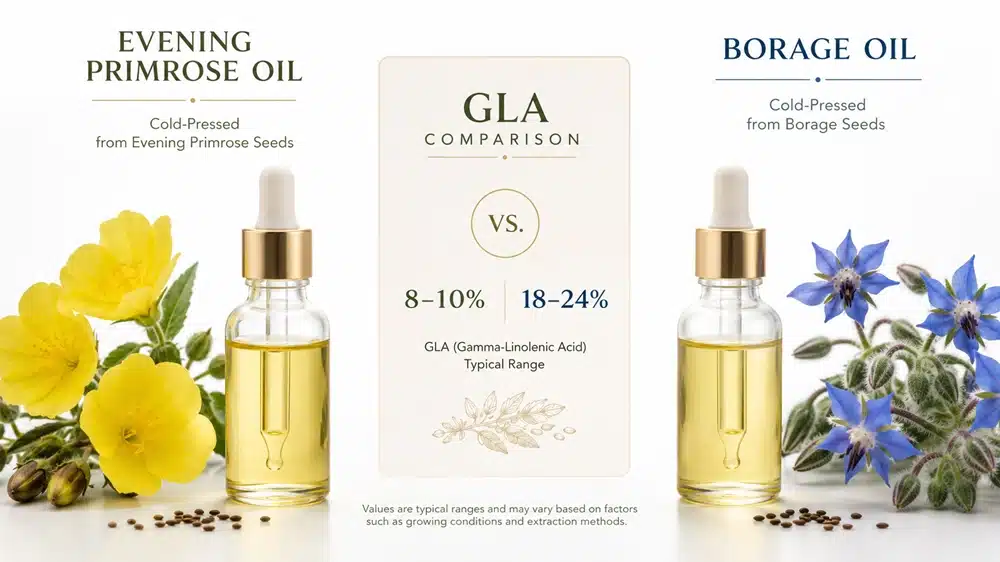
Quick verdict: Borage oil usually delivers more gamma-linolenic acid (GLA) per capsule because borage seed oil commonly contains about 18-27% GLA, while evening primrose oil is typically lower in GLA. Evening primrose oil is often chosen for gentle daily skin and women’s wellness formulas, while borage oil is preferred when a higher-GLA, more concentrated softgel formula is required. For borage oil, buyers should always verify PA-free status and oxidation-control testing.
Evening Primrose Oil vs Borage Oil at a Glance
| Comparison point | Evening Primrose Oil | Borage Oil |
|---|---|---|
| Botanical source | Seeds of Oenothera biennis | Seeds of Borago officinalis |
| Main active fatty acid | Gamma-linolenic acid (GLA), an omega-6 fatty acid | Gamma-linolenic acid (GLA), usually at a higher level |
| Typical GLA range | Commonly around 7-14% of total fatty acids | Commonly around 18-27% of total fatty acids |
| Best-fit formula positioning | Gentle daily skin, beauty-from-within and women’s wellness formulas | High-GLA skin, joint comfort and premium beauty oil softgel formulas |
| Common dosage format | 500 mg or 1000 mg softgels; topical oil blends and creams | 500 mg or 1000 mg softgels; higher-GLA oil blends |
| Key quality concern | Oxidation control, accurate GLA assay and clean-label carrier system | PA-free verification, oxidation control and accurate GLA assay |
| Buyer takeaway | Choose when brand story focuses on gentle skin hydration and women’s wellness. | Choose when the formula needs more GLA per serving and strong quality documentation. |
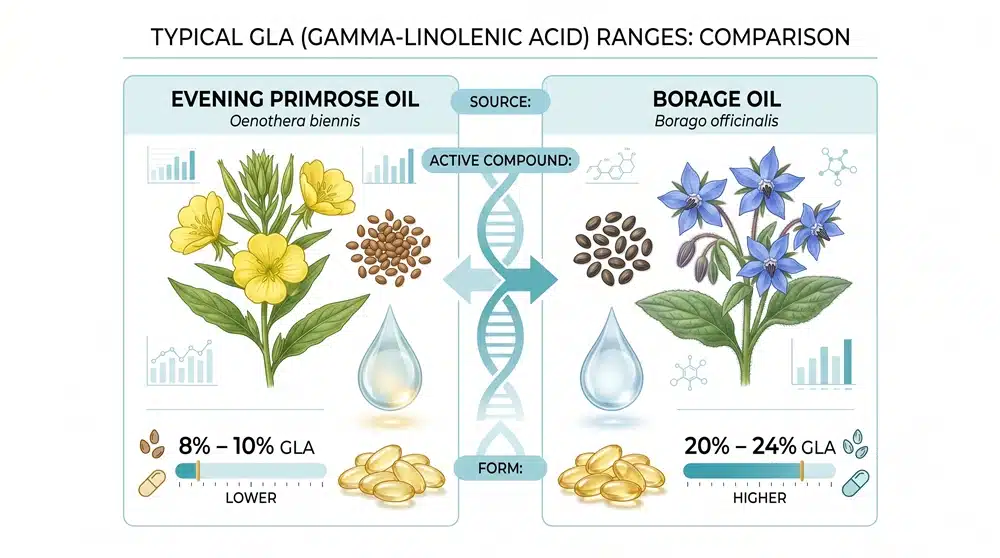
Evening Primrose Oil: The Hormonal Balancer and Skin Soother
Evening Primrose Oil is extracted from the seeds of the Oenothera biennis plant, which is native to North America. The oil is most notable for its high content of gammalinolenic acid (GLA), an omega6 fatty acid that plays a crucial role in maintaining the health of skin cells and reducing inflammation. EPO has been used for centuries to support hormonal balance, treat various skin conditions, and relieve symptoms related to menopause and PMS.
One of the key benefits of Evening Primrose Oil is its antiinflammatory properties. EPO is commonly used to alleviate conditions like eczema, psoriasis, and acne. Its GLA content helps to reduce redness, irritation, and swelling, promoting smoother, healthier skin. EPO also enhances the skin’s ability to retain moisture, which is especially beneficial for dry or sensitive skin types. Regular use can result in softer skin and may help reduce the appearance of fine lines and wrinkles over time.
Beyond its effects on skin health, Evening Primrose Oil is especially useful for managing hormonal imbalances. Women experiencing PMS or menopausal symptoms often use EPO to alleviate symptoms like mood swings, hot flashes, and skin breakouts. The oil works by regulating hormone levels and supporting the production of prostaglandins, which help control various bodily functions.
Borage Oil: The AntiInflammatory and Healing Oil
Borage Oil is derived from the seeds of the Borago officinalis plant, which is known for its bright blue flowers. Borage Oil is another excellent source of gammalinolenic acid (GLA), but it contains a significantly higher concentration of GLA compared to Evening Primrose Oil, making it one of the richest natural sources of this essential fatty acid. Borage Oil also contains other beneficial fatty acids, including linoleic acid and oleic acid, which support the skin’s barrier function and help maintain moisture.
Due to its high GLA content, Borage Oil is particularly effective at reducing inflammation and promoting the healing of inflamed or irritated skin. It is widely used to treat eczema, psoriasis, and dermatitis, as well as conditions like rosacea. Borage Oil’s ability to enhance the skin’s moisture barrier makes it an excellent choice for individuals with dry or mature skin. It can help reduce the appearance of fine lines and wrinkles by improving skin elasticity and moisture retention.
One of the most powerful benefits of Borage Oil is its healing properties. It is often used in skincare products aimed at treating wounds, scars, and stretch marks, as it promotes faster skin regeneration. In addition to its topical uses, Borage Oil is sometimes taken as a supplement to support joint health and inflammation reduction, especially for conditions like rheumatoid arthritis.
Key Differences Between Evening Primrose Oil and Borage Oil
| Dimension | Evening Primrose Oil | Borage Oil | What this means for brands and consumers |
|---|---|---|---|
| GLA concentration | Usually lower; often used as a gentle GLA source. | Usually higher; borage oil is one of the richest natural sources of GLA. | Borage oil can deliver more GLA in the same capsule size, while EPO may fit a softer women’s wellness positioning. |
| Skin positioning | Often used for dry, sensitive and barrier-support skincare concepts. | Often used for higher-GLA skin comfort and premium beauty oil formulas. | For topical claims, keep language around hydration, barrier support and skin comfort rather than disease treatment. |
| Women’s wellness positioning | Commonly associated with PMS and menopause support, although evidence is mixed. | Less commonly positioned as a hormonal-support oil. | EPO may match women’s wellness branding, but claims should be evidence-based and compliant. |
| Joint comfort positioning | Can be included in general wellness formulas, but it is not usually the strongest GLA option. | Often selected when a high-GLA oil is needed for joint comfort positioning. | Use structure/function language such as “supports joint comfort” rather than disease claims. |
| Safety focus | Generally focused on oxidation, allergens and medication cautions. | Must include PA-free verification because borage plants can contain pyrrolizidine alkaloids. | For B2B purchasing, require a COA confirming PA-free status and fatty acid profile. |
| Manufacturing focus | Protect from heat, light and oxygen; suitable for softgels and topical oils. | Same oxidation controls, plus stronger raw-material qualification for PA control. | Nitrogen flushing, amber packaging and peroxide/anisidine testing help preserve oil quality. |
Evidence and Safety: What Research Actually Shows
Both evening primrose oil and borage oil are valued because they provide gamma-linolenic acid (GLA), but the strength of evidence differs by use case. For consumer education and compliant supplement marketing, it is important to separate “skin comfort and barrier support” from disease-treatment claims.
For eczema, a Cochrane review concluded that oral evening primrose oil and oral borage oil did not show meaningful benefit compared with placebo in the reviewed trials. Therefore, brands should avoid presenting either oil as a treatment for eczema, psoriasis, dermatitis or rheumatoid arthritis. A more compliant approach is to describe these oils as sources of essential fatty acids that may help support normal skin barrier function, skin hydration and general wellness.
Evening primrose oil has also been studied for PMS, menopause symptoms and other health concerns, but NCCIH notes that evidence is insufficient for many of these uses. This does not make EPO irrelevant; it means the article should use careful language such as “traditionally used,” “studied for,” or “may support,” instead of promising symptom relief.
For borage oil, the most important safety point is pyrrolizidine alkaloid (PA) control. Borage leaves and flowers can contain PAs, and high-quality borage seed oil used in dietary supplements should be refined and verified as PA-free. For B2B buyers, the supplier should provide a current COA showing fatty acid profile, GLA percentage, peroxide value, anisidine value, heavy metals, microbiology and PA-free status.
Which One Should You Choose?
The decision between Evening Primrose Oil and Borage Oil largely depends on your specific health and skincare needs.
If you are dealing with mild skin irritation, dryness, or hormonal imbalances like PMS or menopause, Evening Primrose Oil might be the better choice. Its antiinflammatory properties and ability to balance hormones make it a great option for women with these concerns.
If you are looking to treat more severe skin conditions, such as eczema, rosacea, or dermatitis, or if you want a more potent antiinflammatory oil for conditions like rheumatoid arthritis, Borage Oil is a stronger option. Its higher concentration of GLA makes it especially effective for skin healing and reducing joint inflammation.
Both oils can be used together for a comprehensive skincare routine, with Evening Primrose Oil offering hormonal support and general skin benefits, while Borage Oil provides a more targeted treatment for inflammation and skin regeneration.
From a Softgel Manufacturer’s View: How to Protect GLA Oil Quality
As a manufacturer of oil-based softgel supplements, the key challenge with both evening primrose oil and borage oil is not only choosing the right botanical oil. It is protecting the GLA-rich oil from oxidation during sourcing, encapsulation, drying, packaging and storage.
GLA oils are polyunsaturated and can be sensitive to oxygen, heat and light. For this reason, premium EPO and borage oil softgels should be produced with controlled processing temperatures, oxygen exposure control, nitrogen flushing when appropriate, and packaging that protects the oil from light and air. Antioxidant systems such as mixed tocopherols may also be used depending on the formula and market requirements.
For private label brands, the most important manufacturing documents include the raw material COA, fatty acid profile, GLA assay, peroxide value, anisidine value, heavy metal test, microbiology report, allergen statement and stability data. For borage oil formulas, PA-free documentation should be treated as a non-negotiable specification.
If you are developing a beauty-from-within or joint-comfort softgel formula with evening primrose oil, borage oil or a blended GLA oil system, work with a softgel manufacturer that can review capsule size, fill weight, antioxidant system, shell type, label claims and packaging from the beginning of the project.
Conclusion
Evening primrose oil and borage oil are both valuable sources of GLA, but they are not identical ingredients. Evening primrose oil is a familiar choice for gentle skin and women’s wellness positioning, while borage oil is usually selected when a formula needs a higher GLA concentration in a smaller serving size.
For consumers, the best choice depends on the goal: daily skin hydration and comfort may fit evening primrose oil, while a higher-GLA supplement may point toward borage oil. For brands, the decision should also include quality documentation, PA-free verification for borage oil, oxidation control, softgel stability and compliant label language.
In short: choose evening primrose oil for gentle, familiar wellness positioning; choose borage oil for high-GLA potency; and choose a qualified softgel manufacturer when product stability, documentation and market-ready formulation matter.
FAQ: Evening Primrose Oil vs Borage Oil
Which has more GLA, evening primrose oil or borage oil?
Borage oil usually has more GLA. Borage seed oil is commonly standardized around 18-27% GLA, while evening primrose oil is typically lower.
Is borage oil better than evening primrose oil?
Not always. Borage oil is better when the formula needs more GLA per serving. Evening primrose oil may be better for gentle daily skin and women’s wellness positioning.
Can evening primrose oil and borage oil be used together?
They can be blended in some softgel or topical formulas, but total GLA intake, label claims and target users should be reviewed by a qualified formulator.
Is borage oil safe?
High-quality borage seed oil should be refined and verified as PA-free. Buyers should ask for a COA confirming fatty acid profile, oxidation values, heavy metals, microbiology and PA-free status.
Can these oils treat eczema or psoriasis?
They should not be marketed as treatments for eczema, psoriasis or any disease. Evidence for oral evening primrose oil and borage oil in eczema is not strong, so compliant content should focus on essential fatty acid support, skin barrier support and general wellness.
Which oil is better for private label softgels?
For a familiar beauty and women’s wellness product, evening primrose oil may be easier to position. For a high-GLA product, borage oil may be more efficient, provided PA-free and oxidation-control specifications are verified.
reference
- NCCIH: Evening Primrose Oil – Usefulness and Safety
- FDA: Structure/Function Claims
- EFSA: Risks related to pyrrolizidine alkaloids in food
- USP: Evening Primrose Oil Capsules Monograph Preview

Warren Wan is a seasoned expert with extensive experience in the dietary supplement supply chain, possessing rich practical experience in the research, development, process control, and global sourcing of core ingredients such as collagen peptides, bone broth protein, and keratin. As the author of this column, he is dedicated to stripping away the marketing packaging, transforming obscure ingredient science and production quality control standards into easy-to-understand, hardcore science popularization, helping readers understand the truth behind the labels and make more rational health choices.