En el mundo de la salud natural y el cuidado de la piel, el aceite de onagra (EPO) y el aceite de borraja son dos de los aceites más conocidos por sus propiedades terapéuticas y embellecedoras. Ambos aceites proceden de plantas y son ricos en ácidos grasos esenciales que favorecen la salud de la piel, reducen la inflamación y contribuyen al bienestar general. Sin embargo, aunque comparten algunas similitudes, también presentan claras diferencias en su composición y efectos. Este artículo compara el aceite de onagra y el de borraja, ayudándole a comprender sus beneficios y cómo cada uno de ellos puede contribuir a mejorar la salud.
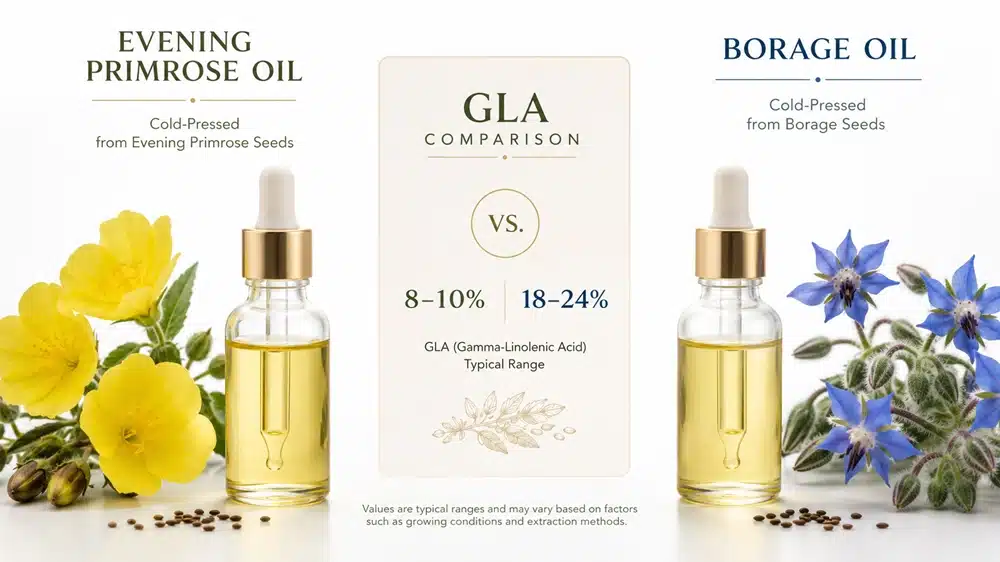
Quick verdict: Borage oil usually delivers more gamma-linolenic acid (GLA) per capsule because borage seed oil commonly contains about 18-27% GLA, while evening primrose oil is typically lower in GLA. Onagra oil is often chosen for gentle daily skin and women’s wellness formulas, while borage oil is preferred when a higher-GLA, more concentrated softgel formula is required. For borage oil, buyers should always verify PA-free status and oxidation-control testing.
Evening Primrose Oil vs Borage Oil at a Glance
| Comparison point | Aceite de onagra | Aceite de borraja |
|---|---|---|
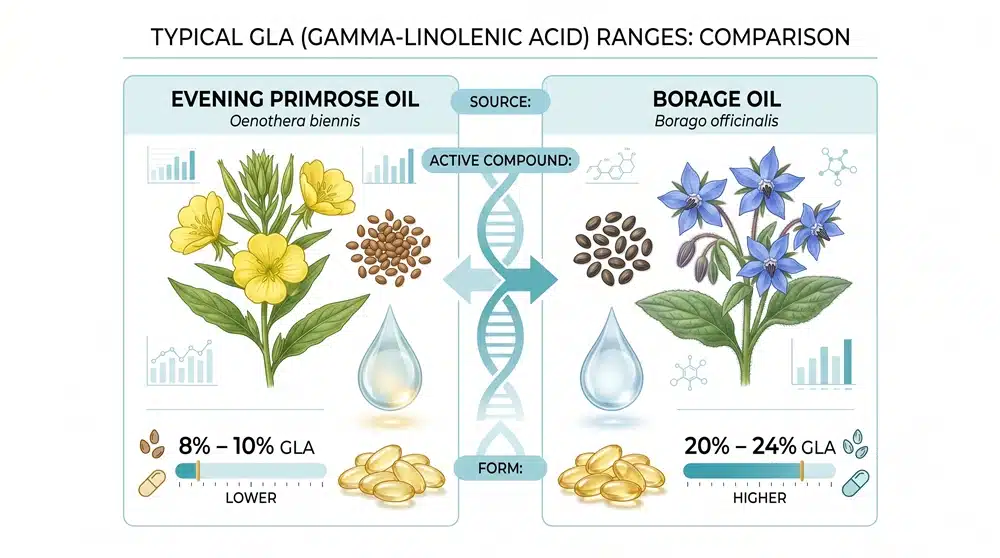
| Origen botánico | Seeds of Oenothera biennis | Seeds of Borago officinalis |
| Main active fatty acid | Ácido gamma-linolénico (GLA), un ácido graso omega-6 | Gamma-linolenic acid (GLA), usually at a higher level |
| Typical GLA range | Commonly around 7-14% of total fatty acids | Commonly around 18-27% of total fatty acids |
| Best-fit formula positioning | Gentle daily skin, beauty-from-within and women’s wellness formulas | High-GLA skin, joint comfort and premium beauty oil softgel formulas |
| Common dosage format | 500 mg or 1000 mg softgels; topical oil blends and creams | 500 mg or 1000 mg softgels; higher-GLA oil blends |
| Key quality concern | Oxidation control, accurate GLA assay and clean-label carrier system | PA-free verification, oxidation control and accurate GLA assay |
| Buyer takeaway | Choose when brand story focuses on gentle skin hydration and women’s wellness. | Choose when the formula needs more GLA per serving and strong quality documentation. |
Aceite de onagra: El equilibrador hormonal y calmante de la piel
El aceite de onagra se extrae de las semillas de la planta Oenothera biennis, originaria de Norteamérica. El aceite destaca sobre todo por su alto contenido en ácido gammalinolénico (GLA), un ácido graso omega6 que desempeña un papel crucial en el mantenimiento de la salud de las células de la piel y la reducción de la inflamación. El GLA se ha utilizado durante siglos para favorecer el equilibrio hormonal, tratar diversas afecciones cutáneas y aliviar los síntomas relacionados con la menopausia y el síndrome premenstrual.
Uno de los principales beneficios del aceite de onagra son sus propiedades antiinflamatorias. El EPO se utiliza habitualmente para aliviar afecciones como el eccema, la psoriasis y el acné. Su contenido en GLA ayuda a reducir el enrojecimiento, la irritación y la hinchazón, favoreciendo una piel más suave y sana. La EPO también mejora la capacidad de la piel para retener la humedad, lo que resulta especialmente beneficioso para las pieles secas o sensibles. Su uso regular puede dar como resultado una piel más suave y puede ayudar a reducir la aparición de líneas finas y arrugas con el tiempo.
Más allá de sus efectos sobre la salud de la piel, el aceite de onagra es especialmente útil para controlar los desequilibrios hormonales. Las mujeres con síndrome premenstrual o síntomas menopáusicos suelen utilizar EPO para aliviar síntomas como cambios de humor, sofocos y erupciones cutáneas. El aceite regula los niveles hormonales y favorece la producción de prostaglandinas, que ayudan a controlar diversas funciones corporales.
Aceite de borraja: El aceite antiinflamatorio y cicatrizante
Aceite de borraja se obtiene de las semillas de la planta Borago officinalis, conocida por sus flores de color azul brillante. El aceite de borraja es otra excelente fuente de ácido gammalinolénico (GLA), pero contiene una concentración significativamente mayor de GLA en comparación con el aceite de onagra, lo que lo convierte en una de las fuentes naturales más ricas de este ácido graso esencial. El aceite de borraja también contiene otros ácidos grasos beneficiosos, como el ácido linoleico y el ácido oleico, que favorecen la función de barrera de la piel y ayudan a mantener la hidratación.
Por su alto contenido en GLA, el aceite de borraja es especialmente eficaz para reducir la inflamación y favorecer la cicatrización de la piel inflamada o irritada. Se utiliza ampliamente para tratar eczemas, psoriasis y dermatitis, así como afecciones como la rosácea. La capacidad del aceite de borraja para mejorar la barrera hidratante de la piel lo convierte en una excelente opción para las personas con piel seca o madura. Puede ayudar a reducir la aparición de líneas finas y arrugas al mejorar la elasticidad de la piel y la retención de humedad.
Uno de los beneficios más potentes del aceite de borraja son sus propiedades cicatrizantes. Se utiliza a menudo en productos para el cuidado de la piel destinados a tratar heridas, cicatrices y estrías, ya que favorece una regeneración más rápida de la piel. Además de sus usos tópicos, el aceite de borraja se toma a veces como suplemento para favorecer la salud de las articulaciones y reducir la inflamación, especialmente en afecciones como la artritis reumatoide.
Principales diferencias entre el aceite de onagra y el aceite de borraja
| Dimensión | Aceite de onagra | Aceite de borraja | What this means for brands and consumers |
|---|---|---|---|
| GLA concentration | Usually lower; often used as a gentle GLA source. | Usually higher; borage oil is one of the richest natural sources of GLA. | Borage oil can deliver more GLA in the same capsule size, while EPO may fit a softer women’s wellness positioning. |
| Skin positioning | Often used for dry, sensitive and barrier-support skincare concepts. | Often used for higher-GLA skin comfort and premium beauty oil formulas. | For topical claims, keep language around hydration, barrier support and skin comfort rather than disease treatment. |
| Women’s wellness positioning | Commonly associated with PMS and menopause support, although evidence is mixed. | Less commonly positioned as a hormonal-support oil. | EPO may match women’s wellness branding, but claims should be evidence-based and compliant. |
| Joint comfort positioning | Can be included in general wellness formulas, but it is not usually the strongest GLA option. | Often selected when a high-GLA oil is needed for joint comfort positioning. | Use structure/function language such as “supports joint comfort” rather than disease claims. |
| Safety focus | Generally focused on oxidation, allergens and medication cautions. | Must include PA-free verification because borage plants can contain pyrrolizidine alkaloids. | For B2B purchasing, require a COA confirming PA-free status and fatty acid profile. |
| Manufacturing focus | Protect from heat, light and oxygen; suitable for softgels and topical oils. | Same oxidation controls, plus stronger raw-material qualification for PA control. | Nitrogen flushing, amber packaging and peroxide/anisidine testing help preserve oil quality. |
Evidence and Safety: What Research Actually Shows
Both evening primrose oil and borage oil are valued because they provide gamma-linolenic acid (GLA), but the strength of evidence differs by use case. For consumer education and compliant supplement marketing, it is important to separate “skin comfort and barrier support” from disease-treatment claims.
For eczema, a Cochrane review concluded that oral evening primrose oil and oral borage oil did not show meaningful benefit compared with placebo in the reviewed trials. Therefore, brands should avoid presenting either oil as a treatment for eczema, psoriasis, dermatitis or rheumatoid arthritis. A more compliant approach is to describe these oils as sources of essential fatty acids that may help support normal skin barrier function, skin hydration and general wellness.
Evening primrose oil has also been studied for PMS, menopause symptoms and other health concerns, but NCCIH notes that evidence is insufficient for many of these uses. This does not make EPO irrelevant; it means the article should use careful language such as “traditionally used,” “studied for,” or “may support,” instead of promising symptom relief.
For borage oil, the most important safety point is pyrrolizidine alkaloid (PA) control. Borage leaves and flowers can contain PAs, and high-quality borage seed oil used in dietary supplements should be refined and verified as PA-free. For B2B buyers, the supplier should provide a current COA showing fatty acid profile, GLA percentage, peroxide value, anisidine value, heavy metals, microbiology and PA-free status.
¿Cuál elegir?
La decisión entre el aceite de onagra y el de borraja depende en gran medida de sus necesidades específicas de salud y cuidado de la piel.
Si padece irritación cutánea leve, sequedad o desequilibrios hormonales como el síndrome premenstrual o la menopausia, el aceite de onagra puede ser la mejor opción. Sus propiedades antiinflamatorias y su capacidad para equilibrar las hormonas lo convierten en una gran opción para las mujeres con estos problemas.
Si desea tratar afecciones cutáneas más graves, como eccemas, rosácea o dermatitis, o si desea un aceite antiinflamatorio más potente para afecciones como la artritis reumatoide, el aceite de borraja es una opción más potente. Su mayor concentración de GLA lo hace especialmente eficaz para curar la piel y reducir la inflamación de las articulaciones.
El aceite de onagra ofrece apoyo hormonal y beneficios generales para la piel, mientras que el aceite de borraja proporciona un tratamiento más específico para la inflamación y la regeneración de la piel.
From a Softgel Manufacturer’s View: How to Protect GLA Oil Quality
As a manufacturer of oil-based softgel supplements, the key challenge with both evening primrose oil and borage oil is not only choosing the right botanical oil. It is protecting the GLA-rich oil from oxidation during sourcing, encapsulation, drying, packaging and storage.
GLA oils are polyunsaturated and can be sensitive to oxygen, heat and light. For this reason, premium EPO and borage oil softgels should be produced with controlled processing temperatures, oxygen exposure control, nitrogen flushing when appropriate, and packaging that protects the oil from light and air. Antioxidant systems such as mixed tocopherols may also be used depending on the formula and market requirements.
For private label brands, the most important manufacturing documents include the raw material COA, fatty acid profile, GLA assay, peroxide value, anisidine value, heavy metal test, microbiology report, allergen statement and stability data. For borage oil formulas, PA-free documentation should be treated as a non-negotiable specification.
If you are developing a beauty-from-within or joint-comfort softgel formula with evening primrose oil, borage oil or a blended GLA oil system, work with a softgel manufacturer that can review capsule size, fill weight, antioxidant system, shell type, label claims and packaging from the beginning of the project.
Conclusión
Evening primrose oil and borage oil are both valuable sources of GLA, but they are not identical ingredients. Evening primrose oil is a familiar choice for gentle skin and women’s wellness positioning, while borage oil is usually selected when a formula needs a higher GLA concentration in a smaller serving size.
For consumers, the best choice depends on the goal: daily skin hydration and comfort may fit evening primrose oil, while a higher-GLA supplement may point toward borage oil. For brands, the decision should also include quality documentation, PA-free verification for borage oil, oxidation control, softgel stability and compliant label language.
In short: choose evening primrose oil for gentle, familiar wellness positioning; choose borage oil for high-GLA potency; and choose a qualified softgel manufacturer when product stability, documentation and market-ready formulation matter.
FAQ: Evening Primrose Oil vs Borage Oil
Which has more GLA, evening primrose oil or borage oil?
Borage oil usually has more GLA. Borage seed oil is commonly standardized around 18-27% GLA, while evening primrose oil is typically lower.
Is borage oil better than evening primrose oil?
Not always. Borage oil is better when the formula needs more GLA per serving. Evening primrose oil may be better for gentle daily skin and women’s wellness positioning.
Can evening primrose oil and borage oil be used together?
They can be blended in some softgel or topical formulas, but total GLA intake, label claims and target users should be reviewed by a qualified formulator.
¿Es seguro el aceite de borraja?
High-quality borage seed oil should be refined and verified as PA-free. Buyers should ask for a COA confirming fatty acid profile, oxidation values, heavy metals, microbiology and PA-free status.
Can these oils treat eczema or psoriasis?
They should not be marketed as treatments for eczema, psoriasis or any disease. Evidence for oral evening primrose oil and borage oil in eczema is not strong, so compliant content should focus on essential fatty acid support, skin barrier support and general wellness.
Which oil is better for private label softgels?
For a familiar beauty and women’s wellness product, evening primrose oil may be easier to position. For a high-GLA product, borage oil may be more efficient, provided PA-free and oxidation-control specifications are verified.
referencia
- NCCIH: Evening Primrose Oil – Usefulness and Safety
- FDA: Declaraciones sobre estructura y función
- EFSA: Risks related to pyrrolizidine alkaloids in food
- USP: Evening Primrose Oil Capsules Monograph Preview

Warren Wan es un experto con una amplia trayectoria en la cadena de suministro de complementos alimenticios, que cuenta con una gran experiencia práctica en la investigación, el desarrollo, el control de procesos y el abastecimiento global de ingredientes clave como los péptidos de colágeno, la proteína de caldo de huesos y la queratina. Como autor de esta columna, se dedica a desmontar los argumentos de marketing, transformando la compleja ciencia de los ingredientes y las normas de control de calidad de la producción en divulgación científica rigurosa y fácil de entender, ayudando a los lectores a comprender la verdad que se esconde tras las etiquetas y a tomar decisiones más racionales en materia de salud.