Trong lĩnh vực sức khỏe tự nhiên và chăm sóc da, Dầu hoa anh thảo (EPO) và Dầu cây borage là hai loại dầu phổ biến nhất, được biết đến với các đặc tính trị liệu và làm đẹp. Cả hai loại dầu này đều được chiết xuất từ thực vật và giàu axit béo thiết yếu, giúp cải thiện sức khỏe làn da, giảm viêm và hỗ trợ sức khỏe tổng thể. Tuy nhiên, mặc dù có một số điểm tương đồng, chúng cũng có những khác biệt rõ rệt về thành phần và tác dụng. Bài viết này so sánh Dầu hoa anh thảo và Dầu cây borage, giúp bạn hiểu rõ hơn về lợi ích của chúng và cách mỗi loại dầu có thể góp phần cải thiện sức khỏe.
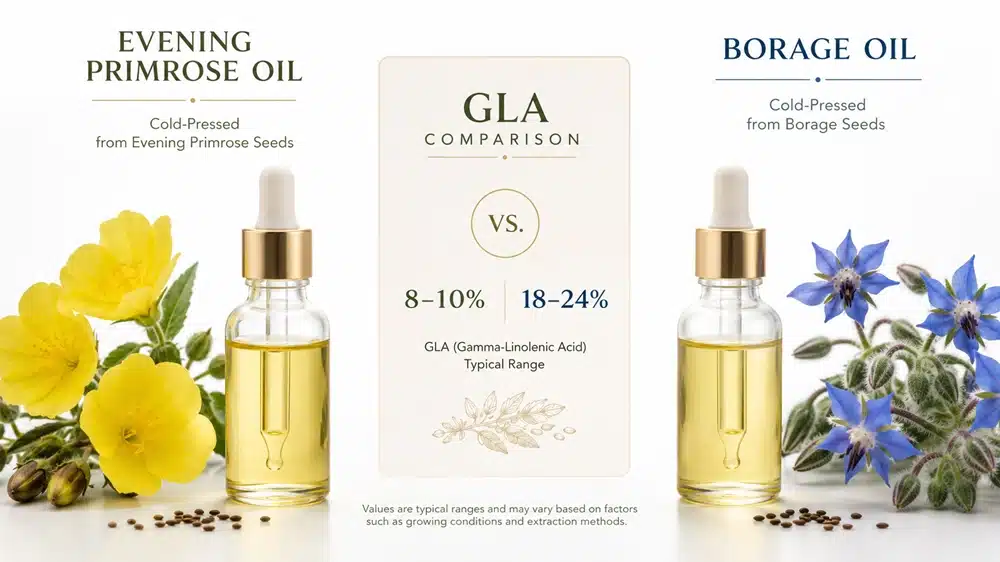
Đánh giá nhanh: Borage oil usually delivers more gamma-linolenic acid (GLA) per capsule because borage seed oil commonly contains about 18-27% GLA, while evening primrose oil is typically lower in GLA. Hoa anh thảo Dầu thường được lựa chọn cho các công thức chăm sóc da hàng ngày nhẹ nhàng và các sản phẩm chăm sóc sức khỏe dành cho phụ nữ, trong khi dầu borage lại được ưa chuộng hơn khi cần một công thức viên nang mềm có hàm lượng GLA cao hơn và nồng độ đậm đặc hơn. Đối với dầu borage, người mua nên luôn kiểm tra xem sản phẩm có chứa PA hay không và kết quả kiểm tra khả năng chống oxy hóa.
So sánh nhanh giữa dầu hoa anh thảo và dầu cây borage
| Điểm so sánh | Dầu hoa anh thảo | Dầu hoa borage |
|---|---|---|
| Nguồn gốc thực vật | Hạt giống của Cây hoa anh thảo hai năm | Hạt giống của Borago officinalis |
| Axit béo hoạt tính chính | Axit gamma-linolenic (GLA), một loại axit béo omega-6 | Axit gamma-linolenic (GLA), thường có hàm lượng cao hơn |
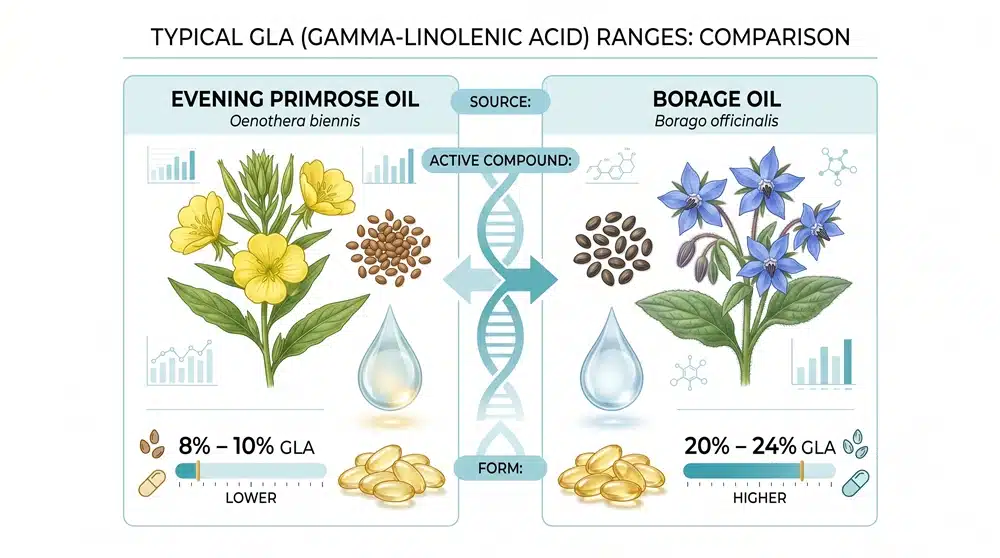
| Phạm vi hoạt động tiêu biểu của GLA | Thông thường, hàm lượng axit béo tổng cộng dao động trong khoảng 7–141 TP3T | Thông thường, hàm lượng axit béo tổng cộng nằm trong khoảng 18-27% |
| Xác định vị trí công thức phù hợp nhất | Các công thức chăm sóc da hàng ngày nhẹ nhàng, làm đẹp từ bên trong và chăm sóc sức khỏe phụ nữ | Các công thức viên nang mềm chứa dầu làm đẹp cao cấp, giúp chăm sóc da và mang lại sự thoải mái cho khớp với hàm lượng GLA cao |
| Hình thức liều lượng thông thường | Viên nang mềm 500 mg hoặc 1000 mg; hỗn hợp dầu bôi ngoài da và kem bôi | Viên nang mềm 500 mg hoặc 1000 mg; các hỗn hợp dầu có hàm lượng GLA cao hơn |
| Vấn đề chất lượng chính | Kiểm soát quá trình oxy hóa, phương pháp định lượng GLA chính xác và hệ thống chất mang “clean-label” | Xác minh không chứa PA, kiểm soát quá trình oxy hóa và định lượng GLA chính xác |
| Điểm chính dành cho người mua | Hãy lựa chọn những lúc câu chuyện thương hiệu tập trung vào việc dưỡng ẩm nhẹ nhàng cho làn da và sức khỏe của phụ nữ. | Hãy lựa chọn khi công thức cần bổ sung thêm GLA cho mỗi khẩu phần và cần có tài liệu chứng minh chất lượng đáng tin cậy. |
Dầu hoa anh thảo: Chất cân bằng nội tiết tố và làm dịu da
Dầu hoa anh thảo được chiết xuất từ hạt của cây Oenothera biennis, một loài thực vật bản địa của Bắc Mỹ. Loại dầu này nổi tiếng nhất nhờ hàm lượng cao axit gamma-linolenic (GLA) – một loại axit béo omega-6 đóng vai trò quan trọng trong việc duy trì sức khỏe của tế bào da và giảm viêm. Dầu hoa anh thảo đã được sử dụng từ hàng thế kỷ nay để hỗ trợ cân bằng nội tiết tố, điều trị các vấn đề về da và làm dịu các triệu chứng liên quan đến thời kỳ mãn kinh và hội chứng tiền kinh nguyệt (PMS).
Một trong những lợi ích chính của dầu hoa anh thảo là tác dụng chống viêm. Dầu hoa anh thảo thường được sử dụng để làm dịu các tình trạng như chàm, vảy nến và mụn trứng cá. Hàm lượng GLA trong dầu giúp giảm đỏ, kích ứng và sưng tấy, góp phần mang lại làn da mịn màng và khỏe mạnh hơn. Dầu hoa anh thảo còn giúp tăng cường khả năng giữ ẩm cho da, đặc biệt có lợi cho những người có làn da khô hoặc nhạy cảm. Sử dụng thường xuyên có thể giúp da mềm mại hơn và có thể giúp giảm sự xuất hiện của nếp nhăn và vết chân chim theo thời gian.
Ngoài tác dụng đối với sức khỏe làn da, dầu hoa anh thảo còn đặc biệt hữu ích trong việc điều chỉnh sự mất cân bằng nội tiết tố. Phụ nữ bị hội chứng tiền kinh nguyệt (PMS) hoặc các triệu chứng mãn kinh thường sử dụng dầu hoa anh thảo để giảm bớt các triệu chứng như thay đổi tâm trạng, bốc hỏa và mụn trứng cá. Dầu hoa anh thảo có tác dụng điều chỉnh nồng độ hormone và hỗ trợ sản sinh prostaglandin, giúp kiểm soát các chức năng khác nhau của cơ thể.
Dầu hoa cúc dại: Loại dầu có tác dụng chống viêm và hỗ trợ phục hồi
Dầu hoa borage được chiết xuất từ hạt của cây Borago officinalis, loài cây nổi tiếng với những bông hoa màu xanh lam rực rỡ. Dầu Borage là một nguồn axit gammalinolenic (GLA) tuyệt vời khác, nhưng nó chứa nồng độ GLA cao hơn đáng kể so với dầu hoa anh thảo, khiến nó trở thành một trong những nguồn tự nhiên giàu axit béo thiết yếu này nhất. Dầu Borage cũng chứa các axit béo có lợi khác, bao gồm axit linoleic và axit oleic, giúp hỗ trợ chức năng hàng rào bảo vệ da và duy trì độ ẩm.
Nhờ hàm lượng GLA cao, dầu hoa cúc Borage đặc biệt hiệu quả trong việc giảm viêm và thúc đẩy quá trình lành da bị viêm hoặc kích ứng. Loại dầu này được sử dụng rộng rãi để điều trị bệnh chàm, vảy nến và viêm da, cũng như các tình trạng da như bệnh trứng cá đỏ. Khả năng tăng cường hàng rào độ ẩm cho da của dầu Borage khiến nó trở thành lựa chọn tuyệt vời cho những người có làn da khô hoặc da lão hóa. Dầu Borage có thể giúp giảm sự xuất hiện của nếp nhăn và vết chân chim bằng cách cải thiện độ đàn hồi và khả năng giữ ẩm cho da.
One of the most powerful benefits of Borage Oil is its healing properties. It is often used in skincare products aimed at treating wounds, scars, and stretch marks, as it promotes faster skin regeneration. In addition to its topical uses, Borage Oil is sometimes taken as a supplement to support joint health and inflammation reduction, especially for conditions like rheumatoid arthritis.
Những điểm khác biệt chính giữa dầu hoa anh thảo và dầu cây borage
| Kích thước | Dầu hoa anh thảo | Dầu hoa borage | Điều này có ý nghĩa như thế nào đối với các thương hiệu và người tiêu dùng |
|---|---|---|---|
| Nồng độ GLA | Thường có hàm lượng thấp hơn; thường được dùng làm nguồn GLA nhẹ nhàng. | Thường có hàm lượng cao hơn; dầu cây borage là một trong những nguồn tự nhiên giàu GLA nhất. | Dầu hoa borage có thể cung cấp lượng GLA cao hơn trong cùng một kích cỡ viên nang, trong khi EPO có thể phù hợp hơn với định vị sản phẩm chăm sóc sức khỏe dành cho phụ nữ mang tính nhẹ nhàng hơn. |
| Vị trí da | Thường được sử dụng trong các phương pháp chăm sóc da dành cho da khô, da nhạy cảm và hỗ trợ chức năng hàng rào bảo vệ da. | Thường được sử dụng để tăng hàm lượng GLA, mang lại cảm giác thoải mái cho da và trong các công thức dầu làm đẹp cao cấp. | Đối với các tuyên bố về tác dụng tại chỗ, hãy tập trung vào các khái niệm như dưỡng ẩm, hỗ trợ hàng rào bảo vệ da và sự thoải mái cho da, thay vì điều trị bệnh. |
| Định vị về sức khỏe phụ nữ | Thường được cho là có tác dụng hỗ trợ điều trị hội chứng tiền kinh nguyệt (PMS) và các triệu chứng mãn kinh, mặc dù các bằng chứng về điều này còn chưa thống nhất. | Ít được biết đến hơn với vai trò là loại dầu hỗ trợ cân bằng nội tiết tố. | EPO có thể phù hợp với chiến lược xây dựng thương hiệu về sức khỏe dành cho phụ nữ, nhưng các tuyên bố phải dựa trên bằng chứng và tuân thủ các quy định. |
| Tư thế giúp giảm đau khớp | Can be included in general wellness formulas, but it is not usually the strongest GLA option. | Often selected when a high-GLA oil is needed for joint comfort positioning. | Use structure/function language such as “supports joint comfort” rather than disease claims. |
| Safety focus | Generally focused on oxidation, allergens and medication cautions. | Must include PA-free verification because borage plants can contain pyrrolizidine alkaloids. | For B2B purchasing, require a COA confirming PA-free status and fatty acid profile. |
| Manufacturing focus | Protect from heat, light and oxygen; suitable for softgels and topical oils. | Same oxidation controls, plus stronger raw-material qualification for PA control. | Nitrogen flushing, amber packaging and peroxide/anisidine testing help preserve oil quality. |
Bằng chứng và an toàn: Những gì nghiên cứu thực sự chỉ ra
Both evening primrose oil and borage oil are valued because they provide gamma-linolenic acid (GLA), but the strength of evidence differs by use case. For consumer education and compliant supplement marketing, it is important to separate “skin comfort and barrier support” from disease-treatment claims.
For eczema, a Cochrane review concluded that oral evening primrose oil and oral borage oil did not show meaningful benefit compared with placebo in the reviewed trials. Therefore, brands should avoid presenting either oil as a treatment for eczema, psoriasis, dermatitis or rheumatoid arthritis. A more compliant approach is to describe these oils as sources of essential fatty acids that may help support normal skin barrier function, skin hydration and general wellness.
Evening primrose oil has also been studied for PMS, menopause symptoms and other health concerns, but NCCIH notes that evidence is insufficient for many of these uses. This does not make EPO irrelevant; it means the article should use careful language such as “traditionally used,” “studied for,” or “may support,” instead of promising symptom relief.
For borage oil, the most important safety point is pyrrolizidine alkaloid (PA) control. Borage leaves and flowers can contain PAs, and high-quality borage seed oil used in dietary supplements should be refined and verified as PA-free. For B2B buyers, the supplier should provide a current COA showing fatty acid profile, GLA percentage, peroxide value, anisidine value, heavy metals, microbiology and PA-free status.
Bạn nên chọn cái nào?
Việc lựa chọn giữa dầu hoa anh thảo và dầu cây borage phần lớn phụ thuộc vào nhu cầu cụ thể về sức khỏe và chăm sóc da của bạn.
Nếu bạn đang gặp phải tình trạng kích ứng da nhẹ, da khô hoặc rối loạn nội tiết tố như hội chứng tiền kinh nguyệt (PMS) hay thời kỳ mãn kinh, dầu hoa anh thảo có thể là lựa chọn phù hợp hơn. Nhờ đặc tính chống viêm và khả năng cân bằng nội tiết tố, sản phẩm này là một lựa chọn tuyệt vời cho những phụ nữ đang gặp phải những vấn đề này.
Nếu bạn đang tìm kiếm phương pháp điều trị các vấn đề da nghiêm trọng hơn, như chàm, bệnh trứng cá đỏ hoặc viêm da, hoặc nếu bạn muốn một loại dầu chống viêm mạnh hơn cho các bệnh như viêm khớp dạng thấp, thì dầu Borage là một lựa chọn hiệu quả hơn. Hàm lượng GLA cao hơn trong dầu Borage giúp nó đặc biệt hiệu quả trong việc hỗ trợ quá trình lành da và giảm viêm khớp.
Cả hai loại dầu này đều có thể được sử dụng kết hợp trong quy trình chăm sóc da toàn diện: Dầu hoa anh thảo giúp cân bằng nội tiết tố và mang lại những lợi ích chung cho làn da, trong khi dầu cây borage lại mang đến giải pháp điều trị chuyên sâu hơn cho tình trạng viêm da và quá trình tái tạo da.
Từ góc nhìn của nhà sản xuất viên nang mềm: Làm thế nào để bảo đảm chất lượng dầu GLA
As a manufacturer of oil-based softgel supplements, the key challenge with both evening primrose oil and borage oil is not only choosing the right botanical oil. It is protecting the GLA-rich oil from oxidation during sourcing, encapsulation, drying, packaging and storage.
GLA oils are polyunsaturated and can be sensitive to oxygen, heat and light. For this reason, premium EPO and borage oil softgels should be produced with controlled processing temperatures, oxygen exposure control, nitrogen flushing when appropriate, and packaging that protects the oil from light and air. Antioxidant systems such as mixed tocopherols may also be used depending on the formula and market requirements.
For private label brands, the most important manufacturing documents include the raw material COA, fatty acid profile, GLA assay, peroxide value, anisidine value, heavy metal test, microbiology report, allergen statement and stability data. For borage oil formulas, PA-free documentation should be treated as a non-negotiable specification.
If you are developing a beauty-from-within or joint-comfort softgel formula with evening primrose oil, borage oil or a blended GLA oil system, work with a softgel manufacturer that can review capsule size, fill weight, antioxidant system, shell type, label claims and packaging from the beginning of the project.
Kết luận
Evening primrose oil and borage oil are both valuable sources of GLA, but they are not identical ingredients. Evening primrose oil is a familiar choice for gentle skin and women’s wellness positioning, while borage oil is usually selected when a formula needs a higher GLA concentration in a smaller serving size.
For consumers, the best choice depends on the goal: daily skin hydration and comfort may fit evening primrose oil, while a higher-GLA supplement may point toward borage oil. For brands, the decision should also include quality documentation, PA-free verification for borage oil, oxidation control, softgel stability and compliant label language.
In short: choose evening primrose oil for gentle, familiar wellness positioning; choose borage oil for high-GLA potency; and choose a qualified softgel manufacturer when product stability, documentation and market-ready formulation matter.
Câu hỏi thường gặp: Dầu hoa anh thảo so với dầu cây borage
Loại nào có hàm lượng GLA cao hơn, dầu hoa anh thảo hay dầu cây borage?
Borage oil usually has more GLA. Borage seed oil is commonly standardized around 18-27% GLA, while evening primrose oil is typically lower.
Dầu hoa borage có tốt hơn dầu hoa anh thảo không?
Not always. Borage oil is better when the formula needs more GLA per serving. Evening primrose oil may be better for gentle daily skin and women’s wellness positioning.
Có thể dùng dầu hoa anh thảo và dầu cây borage cùng nhau không?
They can be blended in some softgel or topical formulas, but total GLA intake, label claims and target users should be reviewed by a qualified formulator.
Dầu hoa bướm có an toàn không?
High-quality borage seed oil should be refined and verified as PA-free. Buyers should ask for a COA confirming fatty acid profile, oxidation values, heavy metals, microbiology and PA-free status.
Các loại dầu này có thể điều trị bệnh chàm hoặc bệnh vảy nến không?
They should not be marketed as treatments for eczema, psoriasis or any disease. Evidence for oral evening primrose oil and borage oil in eczema is not strong, so compliant content should focus on essential fatty acid support, skin barrier support and general wellness.
Loại dầu nào phù hợp hơn để sản xuất viên nang mềm mang nhãn hiệu riêng?
For a familiar beauty and women’s wellness product, evening primrose oil may be easier to position. For a high-GLA product, borage oil may be more efficient, provided PA-free and oxidation-control specifications are verified.
tham khảo
- NCCIH: Evening Primrose Oil – Usefulness and Safety
- FDA: Các tuyên bố về cấu trúc/chức năng
- EFSA: Risks related to pyrrolizidine alkaloids in food
- USP: Evening Primrose Oil Capsules Monograph Preview

Warren Wan là một chuyên gia dày dạn với kinh nghiệm phong phú trong chuỗi cung ứng thực phẩm bổ sung, sở hữu kinh nghiệm thực tiễn sâu rộng trong nghiên cứu, phát triển, kiểm soát quy trình và tìm nguồn cung ứng toàn cầu các thành phần cốt lõi như peptit collagen, protein từ nước hầm xương và keratin. Với tư cách là tác giả của chuyên mục này, ông cam kết loại bỏ những lớp bao bọc tiếp thị, biến những kiến thức khoa học phức tạp về thành phần và các tiêu chuẩn kiểm soát chất lượng sản xuất thành những nội dung phổ biến khoa học dễ hiểu nhưng sâu sắc, giúp độc giả hiểu rõ sự thật đằng sau các nhãn mác và đưa ra những lựa chọn sức khỏe hợp lý hơn.