No mundo da saúde natural e dos cuidados da pele, o Óleo de Onagra (EPO) e o Óleo de Borragem são dois dos óleos mais populares conhecidos pelas suas propriedades terapêuticas e embelezadoras. Ambos os óleos são derivados de plantas e são ricos em ácidos gordos essenciais que promovem a saúde da pele, reduzem a inflamação e apoiam o bem-estar geral. No entanto, embora partilhem algumas semelhanças, também têm diferenças distintas na sua composição e efeitos. Este artigo compara o Óleo de Onagra e o Óleo de Borragem, ajudando-o a compreender os seus benefícios e como cada óleo pode contribuir para uma melhor saúde.
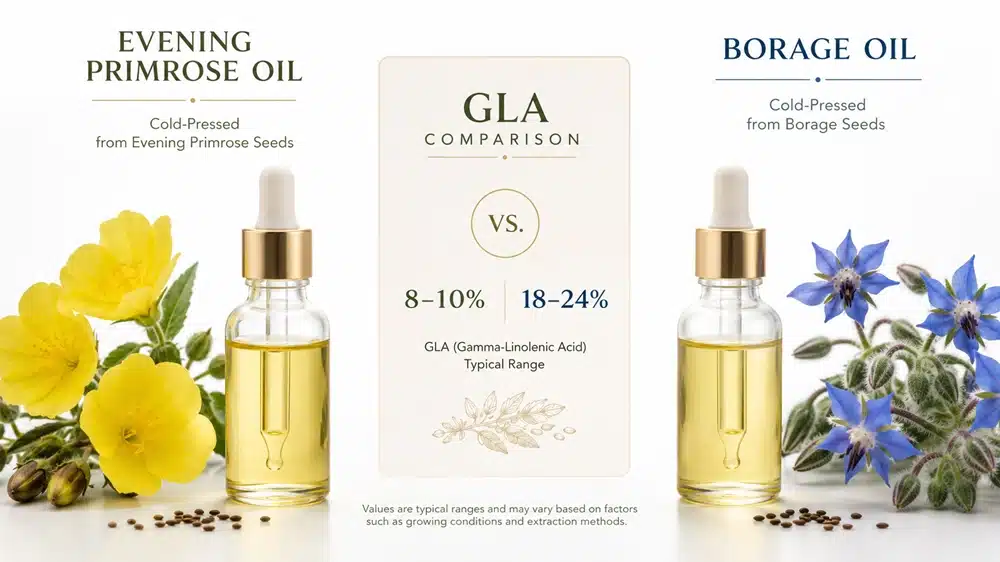
Quick verdict: Borage oil usually delivers more gamma-linolenic acid (GLA) per capsule because borage seed oil commonly contains about 18-27% GLA, while evening primrose oil is typically lower in GLA. Prímula da noite oil is often chosen for gentle daily skin and women’s wellness formulas, while borage oil is preferred when a higher-GLA, more concentrated softgel formula is required. For borage oil, buyers should always verify PA-free status and oxidation-control testing.
Evening Primrose Oil vs Borage Oil at a Glance
| Comparison point | Óleo de prímula da noite | Óleo de borragem |
|---|---|---|
| Origem botânica | Seeds of Oenothera biennis | Seeds of Borago officinalis |
| Main active fatty acid | Ácido gama-linolénico (GLA), um ácido gordo ómega-6 | Gamma-linolenic acid (GLA), usually at a higher level |
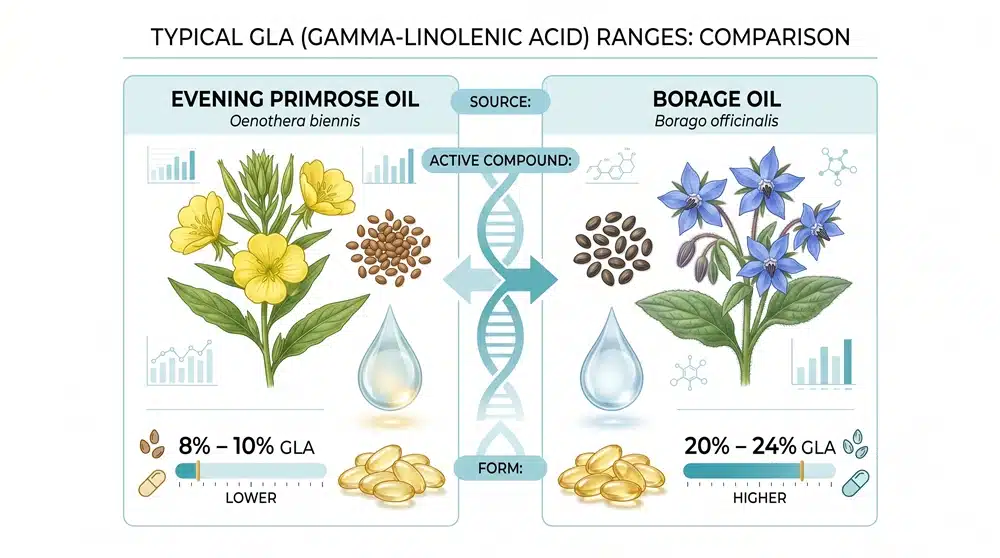
| Typical GLA range | Commonly around 7-14% of total fatty acids | Commonly around 18-27% of total fatty acids |
| Best-fit formula positioning | Gentle daily skin, beauty-from-within and women’s wellness formulas | High-GLA skin, joint comfort and premium beauty oil softgel formulas |
| Common dosage format | 500 mg or 1000 mg softgels; topical oil blends and creams | 500 mg or 1000 mg softgels; higher-GLA oil blends |
| Key quality concern | Oxidation control, accurate GLA assay and clean-label carrier system | PA-free verification, oxidation control and accurate GLA assay |
| Buyer takeaway | Choose when brand story focuses on gentle skin hydration and women’s wellness. | Choose when the formula needs more GLA per serving and strong quality documentation. |
Óleo de onagra: O equilibrador hormonal e calmante para a pele
O óleo de onagra é extraído das sementes da planta Oenothera biennis, que é nativa da América do Norte. O óleo é mais notável pelo seu elevado teor de ácido gamalinolénico (GLA), um ácido gordo ómega 6 que desempenha um papel crucial na manutenção da saúde das células da pele e na redução da inflamação. O EPO tem sido utilizado há séculos para apoiar o equilíbrio hormonal, tratar várias doenças de pele e aliviar os sintomas relacionados com a menopausa e a TPM.
Um dos principais benefícios do Óleo de Prímula é a sua propriedade anti-inflamatória. O EPO é normalmente utilizado para aliviar condições como eczema, psoríase e acne. O seu conteúdo em GLA ajuda a reduzir a vermelhidão, a irritação e o inchaço, promovendo uma pele mais suave e saudável. A EPO também melhora a capacidade da pele de reter a humidade, o que é especialmente benéfico para os tipos de pele seca ou sensível. A utilização regular pode resultar numa pele mais suave e pode ajudar a reduzir o aparecimento de rídulas e rugas ao longo do tempo.
Para além dos seus efeitos na saúde da pele, o Óleo de Onagra é especialmente útil para gerir desequilíbrios hormonais. As mulheres que sofrem de TPM ou sintomas da menopausa utilizam frequentemente o EPO para aliviar sintomas como alterações de humor, afrontamentos e erupções cutâneas. O óleo funciona regulando os níveis hormonais e apoiando a produção de prostaglandinas, que ajudam a controlar várias funções corporais.
Óleo de borragem: O óleo anti-inflamatório e cicatrizante
Óleo de borragem é derivado das sementes da planta Borago officinalis, que é conhecida pelas suas flores azuis brilhantes. O óleo de borragem é outra excelente fonte de ácido gamalinolénico (GLA), mas contém uma concentração significativamente mais elevada de GLA em comparação com o óleo de onagra, o que o torna uma das fontes naturais mais ricas deste ácido gordo essencial. O óleo de borragem também contém outros ácidos gordos benéficos, incluindo o ácido linoleico e o ácido oleico, que apoiam a função de barreira da pele e ajudam a manter a humidade.
Devido ao seu elevado teor de GLA, o óleo de borragem é particularmente eficaz na redução da inflamação e na promoção da cura da pele inflamada ou irritada. É amplamente utilizado para tratar eczema, psoríase e dermatite, bem como condições como a rosácea. A capacidade do Óleo de Borragem para melhorar a barreira de hidratação da pele torna-o uma excelente escolha para indivíduos com pele seca ou madura. Pode ajudar a reduzir o aparecimento de linhas finas e rugas, melhorando a elasticidade da pele e a retenção de humidade.
Um dos benefícios mais poderosos do Óleo de Borragem são as suas propriedades curativas. É frequentemente utilizado em produtos de cuidados da pele destinados a tratar feridas, cicatrizes e estrias, uma vez que promove uma regeneração mais rápida da pele. Para além das suas utilizações tópicas, o Óleo de Borragem é por vezes tomado como um suplemento para apoiar a saúde das articulações e a redução da inflamação, especialmente para condições como a artrite reumatoide.
Principais diferenças entre o óleo de onagra e o óleo de borragem
| Dimensão | Óleo de prímula da noite | Óleo de borragem | What this means for brands and consumers |
|---|---|---|---|
| GLA concentration | Usually lower; often used as a gentle GLA source. | Usually higher; borage oil is one of the richest natural sources of GLA. | Borage oil can deliver more GLA in the same capsule size, while EPO may fit a softer women’s wellness positioning. |
| Skin positioning | Often used for dry, sensitive and barrier-support skincare concepts. | Often used for higher-GLA skin comfort and premium beauty oil formulas. | For topical claims, keep language around hydration, barrier support and skin comfort rather than disease treatment. |
| Women’s wellness positioning | Commonly associated with PMS and menopause support, although evidence is mixed. | Less commonly positioned as a hormonal-support oil. | EPO may match women’s wellness branding, but claims should be evidence-based and compliant. |
| Joint comfort positioning | Can be included in general wellness formulas, but it is not usually the strongest GLA option. | Often selected when a high-GLA oil is needed for joint comfort positioning. | Use structure/function language such as “supports joint comfort” rather than disease claims. |
| Safety focus | Generally focused on oxidation, allergens and medication cautions. | Must include PA-free verification because borage plants can contain pyrrolizidine alkaloids. | For B2B purchasing, require a COA confirming PA-free status and fatty acid profile. |
| Manufacturing focus | Protect from heat, light and oxygen; suitable for softgels and topical oils. | Same oxidation controls, plus stronger raw-material qualification for PA control. | Nitrogen flushing, amber packaging and peroxide/anisidine testing help preserve oil quality. |
Evidence and Safety: What Research Actually Shows
Both evening primrose oil and borage oil are valued because they provide gamma-linolenic acid (GLA), but the strength of evidence differs by use case. For consumer education and compliant supplement marketing, it is important to separate “skin comfort and barrier support” from disease-treatment claims.
For eczema, a Cochrane review concluded that oral evening primrose oil and oral borage oil did not show meaningful benefit compared with placebo in the reviewed trials. Therefore, brands should avoid presenting either oil as a treatment for eczema, psoriasis, dermatitis or rheumatoid arthritis. A more compliant approach is to describe these oils as sources of essential fatty acids that may help support normal skin barrier function, skin hydration and general wellness.
Evening primrose oil has also been studied for PMS, menopause symptoms and other health concerns, but NCCIH notes that evidence is insufficient for many of these uses. This does not make EPO irrelevant; it means the article should use careful language such as “traditionally used,” “studied for,” or “may support,” instead of promising symptom relief.
For borage oil, the most important safety point is pyrrolizidine alkaloid (PA) control. Borage leaves and flowers can contain PAs, and high-quality borage seed oil used in dietary supplements should be refined and verified as PA-free. For B2B buyers, the supplier should provide a current COA showing fatty acid profile, GLA percentage, peroxide value, anisidine value, heavy metals, microbiology and PA-free status.
Qual deles deve escolher?
A decisão entre o óleo de onagra e o óleo de borragem depende em grande medida das suas necessidades específicas de saúde e de cuidados da pele.
Se estiver a lidar com uma ligeira irritação da pele, secura ou desequilíbrios hormonais como a TPM ou a menopausa, o Óleo de Onagra pode ser a melhor escolha. As suas propriedades anti-inflamatórias e a capacidade de equilibrar as hormonas fazem dele uma óptima opção para as mulheres com estas preocupações.
Se procura tratar doenças de pele mais graves, como eczema, rosácea ou dermatite, ou se pretende um óleo anti-inflamatório mais potente para doenças como a artrite reumatoide, o óleo de borragem é uma opção mais forte. A sua maior concentração de GLA torna-o especialmente eficaz na cicatrização da pele e na redução da inflamação das articulações.
Ambos os óleos podem ser utilizados em conjunto para uma rotina de cuidados da pele abrangente, com o Óleo de Onagra a oferecer apoio hormonal e benefícios gerais para a pele, enquanto o Óleo de Borragem proporciona um tratamento mais direcionado para a inflamação e regeneração da pele.
From a Softgel Manufacturer’s View: How to Protect GLA Oil Quality
As a manufacturer of oil-based softgel supplements, the key challenge with both evening primrose oil and borage oil is not only choosing the right botanical oil. It is protecting the GLA-rich oil from oxidation during sourcing, encapsulation, drying, packaging and storage.
GLA oils are polyunsaturated and can be sensitive to oxygen, heat and light. For this reason, premium EPO and borage oil softgels should be produced with controlled processing temperatures, oxygen exposure control, nitrogen flushing when appropriate, and packaging that protects the oil from light and air. Antioxidant systems such as mixed tocopherols may also be used depending on the formula and market requirements.
For private label brands, the most important manufacturing documents include the raw material COA, fatty acid profile, GLA assay, peroxide value, anisidine value, heavy metal test, microbiology report, allergen statement and stability data. For borage oil formulas, PA-free documentation should be treated as a non-negotiable specification.
If you are developing a beauty-from-within or joint-comfort softgel formula with evening primrose oil, borage oil or a blended GLA oil system, work with a softgel manufacturer that can review capsule size, fill weight, antioxidant system, shell type, label claims and packaging from the beginning of the project.
Conclusão
Evening primrose oil and borage oil are both valuable sources of GLA, but they are not identical ingredients. Evening primrose oil is a familiar choice for gentle skin and women’s wellness positioning, while borage oil is usually selected when a formula needs a higher GLA concentration in a smaller serving size.
For consumers, the best choice depends on the goal: daily skin hydration and comfort may fit evening primrose oil, while a higher-GLA supplement may point toward borage oil. For brands, the decision should also include quality documentation, PA-free verification for borage oil, oxidation control, softgel stability and compliant label language.
In short: choose evening primrose oil for gentle, familiar wellness positioning; choose borage oil for high-GLA potency; and choose a qualified softgel manufacturer when product stability, documentation and market-ready formulation matter.
FAQ: Evening Primrose Oil vs Borage Oil
Which has more GLA, evening primrose oil or borage oil?
Borage oil usually has more GLA. Borage seed oil is commonly standardized around 18-27% GLA, while evening primrose oil is typically lower.
Is borage oil better than evening primrose oil?
Not always. Borage oil is better when the formula needs more GLA per serving. Evening primrose oil may be better for gentle daily skin and women’s wellness positioning.
Can evening primrose oil and borage oil be used together?
They can be blended in some softgel or topical formulas, but total GLA intake, label claims and target users should be reviewed by a qualified formulator.
O óleo de borragem é seguro?
High-quality borage seed oil should be refined and verified as PA-free. Buyers should ask for a COA confirming fatty acid profile, oxidation values, heavy metals, microbiology and PA-free status.
Can these oils treat eczema or psoriasis?
They should not be marketed as treatments for eczema, psoriasis or any disease. Evidence for oral evening primrose oil and borage oil in eczema is not strong, so compliant content should focus on essential fatty acid support, skin barrier support and general wellness.
Which oil is better for private label softgels?
For a familiar beauty and women’s wellness product, evening primrose oil may be easier to position. For a high-GLA product, borage oil may be more efficient, provided PA-free and oxidation-control specifications are verified.
referência
- NCCIH: Evening Primrose Oil – Usefulness and Safety
- FDA: Alegações relativas à estrutura e função
- EFSA: Risks related to pyrrolizidine alkaloids in food
- USP: Evening Primrose Oil Capsules Monograph Preview

Warren Wan é um especialista experiente com vasta experiência na cadeia de abastecimento de suplementos alimentares, possuindo uma rica experiência prática na investigação, desenvolvimento, controlo de processos e aquisição global de ingredientes essenciais, tais como peptídeos de colagénio, proteína de caldo de ossos e queratina. Como autor desta coluna, dedica-se a ir além do discurso de marketing, transformando a ciência obscura dos ingredientes e as normas de controlo de qualidade da produção numa divulgação científica rigorosa e de fácil compreensão, ajudando os leitores a compreender a verdade por trás dos rótulos e a fazer escolhas mais racionais em matéria de saúde.