Chicken collagen Type II is an animal-derived collagen ingredient commonly sourced from chicken sternum cartilage. The name can refer to very different products: cartilage matrix powder, hydrolyzed Type II peptides, or native/undenatured Type II collagen. These forms are not interchangeable. They use different manufacturing methods, specifications, serving amounts, and evidence, so the exact product identity must be confirmed before comparing benefits or doses.
Consumers should check the source, form, serving amount, other cartilage components, allergens, and product-specific evidence. Supplement brands should define the ingredient by tissue, process, native-structure status, assay methods, composition, contaminants, stability, and permitted claims—not by the phrase “chicken collagen Type II” alone.
What Is Chicken Collagen Type II?
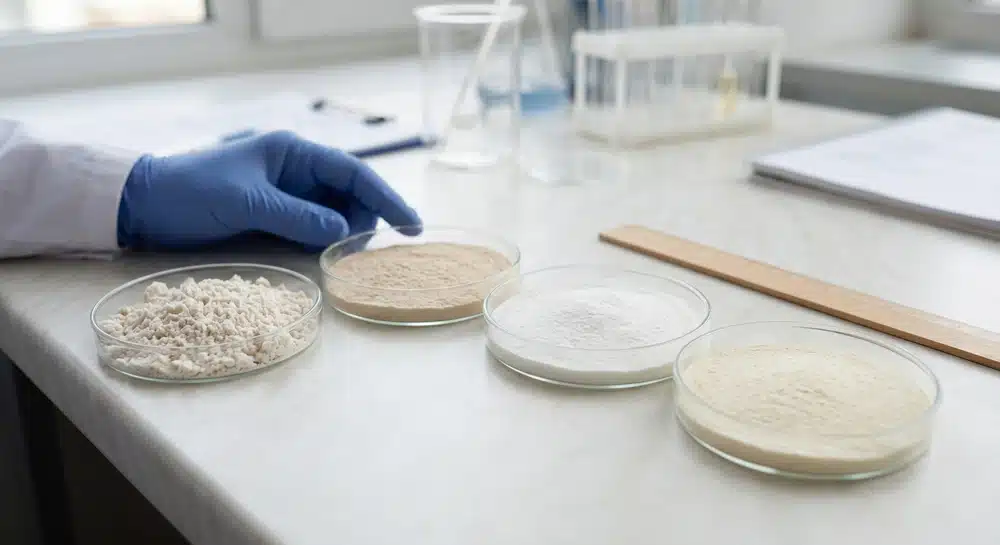
Type II collagen is a fibrillar collagen found primarily in cartilage and the vitreous body of the eye. In articular cartilage, it contributes to a collagen network that interacts with proteoglycans and water to help the tissue tolerate compressive loading.
Commercial chicken-derived Type II ingredients are usually obtained from cartilage-rich tissue, especially the sternum or breastbone region. However, the finished material may be a minimally processed cartilage powder, a hydrolyzed cartilage matrix, a collagen peptide ingredient, or a native/undenatured Type II collagen product.
The ingredient name alone does not reveal:
- how much Type II collagen is present;
- whether the native triple-helical epitopes are retained;
- whether the collagen has been hydrolyzed into peptides;
- how much chondroitin sulfate or hyaluronic acid is present;
- whether glucosamine is measured or only assumed;
- which clinical research, if any, matches the material.
Where Does Chicken Type II Collagen Come From?
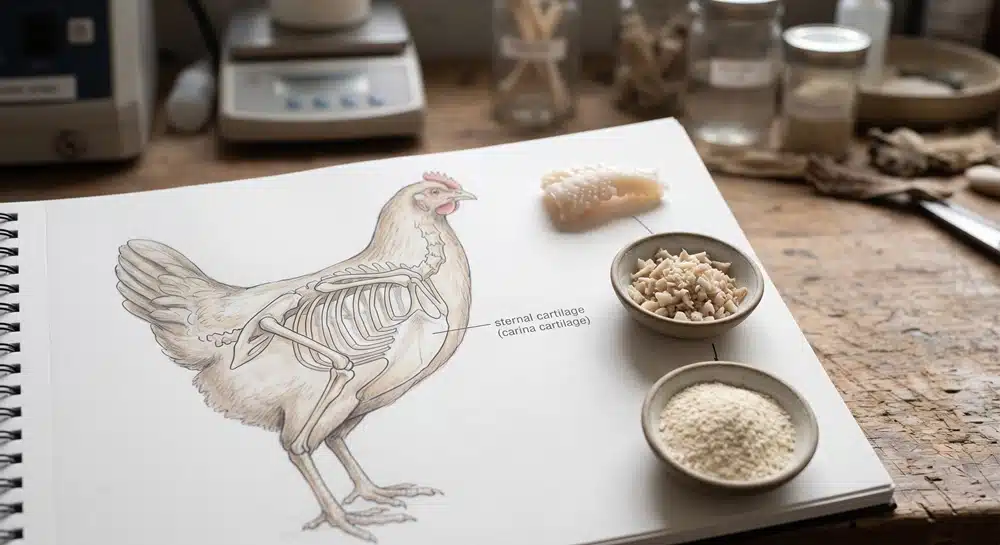
Chicken Sternum Cartilage
The chicken sternum is a common commercial source because it contains cartilage tissue that can be separated and processed. It is used for cartilage matrix powders, hydrolyzed cartilage extracts, and selected native Type II collagen ingredients.
“Chicken breast cartilage” and “chicken sternum cartilage” may be used to describe the cartilage associated with the breastbone, but the supplier should provide the scientific species, anatomical tissue definition, collection procedure, and traceability records.
Chicken Cartilage, Skin, Bone Broth, and Comb Are Not Equivalent
| Source or Product | Likely Collagen Profile | Can It Be Assumed to Be a Type II Ingredient? |
|---|---|---|
| Хрящ грудины курицы | Cartilage-rich tissue with Type II collagen and other matrix components | Potentially, but finished-product identity and content must be tested |
| Other chicken cartilage | May contain Type II collagen, proteoglycans, minerals, and other tissue components | No fixed composition should be assumed |
| Chicken skin | Contains collagen, but skin collagen is not the same as a standardized sternum Type II ingredient | Нет |
| Куриный бульон на костях | A cooked extract containing variable proteins, peptides, amino acids, minerals, and other components | No, unless the product is specifically characterized |
| Chicken comb extract | Often positioned as a source of hyaluronic acid rather than standardized Type II collagen | Нет |
Brands sourcing a documented chicken sternum cartilage matrix can review our bulk Chicken Sternum Collagen Type II ingredient page.
Four Products Commonly Called Chicken Collagen Type II
| Категория товара | Processing and Structure | Common Specification Focus | Typical Use Pattern |
|---|---|---|---|
| Chicken sternum cartilage powder or matrix | Dried or processed cartilage retaining a mixture of proteins and matrix components | Protein/collagen, chondroitin sulfate, hyaluronic acid, moisture, ash, microbiology, contaminants | Hundreds of milligrams to gram-level servings, depending on the exact product |
| Hydrolyzed chicken cartilage matrix | Cartilage proteins and other components partially broken down by enzymes or another hydrolysis process | Molecular-weight distribution, protein, peptides, chondroitin, HA, residuals, solubility | Product-specific; some studied proprietary ingredients use gram-level doses |
| Гидролизованный куриный коллаген Type II peptides | Collagen peptide material in which peptide bonds have been cleaved | Protein, hydroxyproline, amino-acid profile, peptide molecular weight, source, contaminants | Usually higher than native Type II ingredient doses |
| Native or undenatured Type II collagen | Processed to retain defined native conformational epitopes rather than primarily producing peptides | Native/undenatured Type II assay, total collagen, epitope retention, identity, stability | Low-milligram ingredient doses in product-specific studies |
These categories should not share one generic dose, mechanism, or clinical claim.
Hydrolyzed, Denatured, Native, Undenatured, and UC-II®
Hydrolyzed Is Not Exactly the Same as Denatured
Гидролиз breaks peptide bonds and produces smaller peptides. Denaturation changes the protein’s higher-order structure without necessarily cutting the peptide chain. Hydrolysis usually removes the intact native triple-helical structure, but a product should be described by its actual process and tested characteristics rather than using the terms as automatic synonyms.
Native and Undenatured Type II Collagen
Native or undenatured Type II collagen products are manufactured to retain selected conformational epitopes. A proposed mechanism involves antigen sampling in gut-associated lymphoid tissue and oral tolerance. This mechanism is supported primarily by preclinical and ingredient-specific research and should not be described as a guaranteed immune “switch” that stops cartilage destruction.
UC-II® Is a Branded Ingredient
UC-II® is a trademarked, branded undenatured Type II collagen ingredient derived from chicken sternum cartilage. It is not a generic synonym for all native Type II collagen.
Published studies have used 40 mg per day of the UC-II® ingredient. In one healthy-volunteer study, 40 mg of material provided approximately 10.4 mg of native Type II collagen. Another study described a 40 mg ingredient containing at least 3% undenatured Type II collagen. Therefore, a label should not imply that every 40 mg product contains 40 mg of active native collagen.
| Label Term | What It Should Mean | Evidence Needed |
|---|---|---|
| Hydrolyzed chicken collagen | Chicken-derived collagen with cleaved peptide bonds | Process description, molecular-weight distribution, protein and peptide specifications |
| Chicken cartilage matrix | A multi-component cartilage-derived ingredient | Batch COA for protein/collagen and claimed matrix components |
| Native or undenatured Type II collagen | Retention of defined native structural epitopes | Validated native Type II or epitope-retention assay and stability |
| UC-II® | The authorized Lonza branded ingredient | Trademark authorization, branded specification, supply-chain and label compliance |
For a deeper manufacturing and mechanism comparison, see our undenatured vs hydrolyzed Type II collagen guide.
Chicken Collagen Type II vs Types I and III
| Фактор | Chicken Type II Products | Common Type I / III Collagen Peptides |
|---|---|---|
| Common source | Chicken cartilage, especially sternum cartilage | Bovine hide, porcine skin, fish skin/scales, or other connective tissue |
| Natural tissue association | Cartilage-related Type II collagen | Skin, tendon, bone, and other Type I/III-rich tissues |
| Commercial forms | Cartilage matrix, hydrolyzed matrix/peptides, native/undenatured Type II | Usually hydrolyzed collagen peptides or gelatin |
| Serving amount | Highly product-specific, from low milligrams to grams | Often gram-level servings in studies and products |
| Evidence transfer | Research on one collagen type, source, peptide profile, or branded ingredient should not automatically be applied to another. | |
| Что лучше? | The choice depends on the product objective, exact ingredient evidence, dose, dosage form, label claims, and consumer needs. Collagen type alone does not guarantee a result. | |
Does Chicken Cartilage Contain Chondroitin, Glucosamine, and Hyaluronic Acid?
Chicken cartilage naturally contains a complex extracellular matrix. A commercial cartilage ingredient may contain collagen protein, chondroitin sulfate, hyaluronic acid, minerals, and other components. However, the amount depends on the tissue, cleaning, extraction, hydrolysis, filtration, concentration, drying, and use of carriers.
The correct answer is batch-specific:
- Type II collagen content should be measured with a suitable identity or quantitative method.
- Total protein or hydroxyproline does not prove native Type II content.
- Chondroitin sulfate should be tested with a defined assay and reported on a clear basis.
- Hyaluronic acid should be measured rather than assumed.
- Glucosamine may be part of cartilage-related molecules, but a free-glucosamine quantity should not be claimed without an appropriate method.
- Percentages should be reconciled with moisture, ash, carriers, and total mass balance.
Brands should avoid saying that all chicken sternum products naturally provide a fixed “human-cartilage ratio.”

What Does the Clinical Evidence Show?
Clinical research exists for selected undenatured Type II and hydrolyzed chicken cartilage products. The results cannot be applied to every chicken collagen Type II ingredient.
| Studied Product | Population and Duration | Study Amount | What the Study Can Support |
|---|---|---|---|
| UC-II® undenatured Type II collagen | Adults with knee osteoarthritis, 180 days | 40 mg/day branded ingredient | Product-specific changes in WOMAC and related outcomes under the trial conditions |
| UC-II® undenatured Type II collagen | Healthy adults with exercise-induced knee discomfort, 120 days | 40 mg/day, providing about 10.4 mg native Type II collagen in the tested lot | Product-specific knee extension and exercise-discomfort findings |
| UC-II® undenatured Type II collagen | Healthy adults with activity-related knee discomfort, 24 weeks | 40 mg/day ingredient with a defined undenatured Type II specification | Product-specific knee-flexibility findings |
| AVC-H2 hydrolyzed chicken collagen Type II | Otherwise healthy adults with joint-related discomfort, 8 weeks | 2.5 g/day proprietary hydrolyzed ingredient | Findings for the exact hydrolyzed ingredient and population |
Important Evidence Limitations
- Several studies are industry-funded or involve proprietary ingredients.
- Product composition, native collagen content, molecular weight, and accompanying matrix components differ.
- Healthy adults with activity-related discomfort are not the same as people with diagnosed osteoarthritis.
- Statistically significant differences do not mean every consumer will experience a meaningful effect.
- A trial on UC-II® does not substantiate a generic chicken cartilage powder.
- A 2.5 g hydrolyzed product trial does not substantiate a 40 mg native product or another hydrolysate.
- Studies on bovine, porcine, marine, or generic collagen hydrolysates cannot automatically validate chicken Type II claims.
For consumer education, it is reasonable to say that selected products have been studied for joint comfort, function, or flexibility. It is not appropriate to claim that chicken collagen Type II treats arthritis, regenerates cartilage, prevents degeneration, or replaces medical care.
Возможные преимущества: утверждения против доказательств
| Распространенное утверждение | Оценка доказательств | Ответственная формулировка |
|---|---|---|
| Supports joint comfort and mobility | Some product-specific human studies report improvements | May support joint comfort or mobility when the exact product and claim are substantiated |
| Rebuilds or regenerates cartilage | Not established as a clinical outcome for generic supplements | Не использовать |
| Stops cartilage destruction | Overstates a proposed mechanism | Не использовать |
| Outperforms glucosamine and chondroitin | One branded study reported differences under specific conditions | Describe the trial and comparator accurately; do not generalize |
| Prevents exercise-related joint damage | Healthy-adult trials assessed function and discomfort, not prevention of structural damage | Do not use structural-prevention language |
| Provides chondroitin and HA | Possible for cartilage matrix ingredients | State only the batch-tested quantities |
| Is more bioavailable than bovine or marine collagen | No universal source-level conclusion | Compare only product-specific pharmacokinetic or clinical evidence |
| Is the best collagen for joints | Depends on form, evidence, dose, and goal | One option used in joint-health formulations |
Why 40 mg and 2.5 g Are Not Interchangeable
| Label Amount | Possible Product Type | What Must Be Confirmed |
|---|---|---|
| 40 mg | A specific undenatured Type II ingredient such as a clinically studied branded material | Brand identity, native Type II specification, ingredient dose, study match, trademark rights |
| Hundreds of milligrams | Cartilage matrix powder or blend | Actual collagen, chondroitin, HA, carriers, and evidence at that serving |
| 2.5 g | A studied proprietary hydrolyzed chicken Type II ingredient in one trial | Exact ingredient, peptide/matrix composition, study population and duration |
| 5-10 g | Common range for some general collagen hydrolysate products and studies | Source, collagen type, peptide profile, clinical evidence, serving practicality |
A lower number is not automatically more potent, and a higher number is not automatically more effective. The form, structure, composition, and matched evidence determine how the amount should be interpreted.
Combination Formulation Considerations
Chicken collagen Type II is often combined with vitamin C, glucosamine, chondroitin, MSM, hyaluronic acid, curcumin, boswellia, or minerals. A combination is not automatically synergistic.
| Ингредиент | Formulation Rationale | What Must Be Verified |
|---|---|---|
| Витамин C | Vitamin C is required for normal endogenous collagen synthesis | Whether the target user needs supplemental vitamin C, dose, stability, and permitted claim |
| Глюкозамин | Common joint-health ingredient with a separate evidence base | Salt form, source, dose, warfarin and glucose considerations, formula evidence |
| Хондроитин сульфат | May already be present in a cartilage matrix or added separately | Total contribution, source, assay, label quantity, duplication, warfarin caution |
| Гиалуроновая кислота | May be part of a matrix ingredient or an added active | Source, molecular weight, assay, total amount, stability |
| MSM | Frequently used in joint formulas | Identity, purity, dose, safety, and evidence for the exact combination |
| Куркумин или босвелия | Botanical ingredients used in joint-positioned products | Extract standardization, dose, interactions, stability, and claim substantiation |
Do not claim that MSM transports collagen into cartilage cells, that curcumin provides immediate pain relief, or that a stack repairs cartilage unless the exact finished formula has adequate evidence.
Chicken Collagen Type II Side Effects and Safety
Safety depends on the exact ingredient, dose, source, other formula ingredients, contaminants, and individual health status. Most published trials report that the studied products were generally well tolerated, but that does not prove every chicken cartilage supplement is safe for every person.
Poultry Allergy
People with a known chicken-meat or poultry-protein allergy should avoid chicken-derived collagen unless an allergist has evaluated the exact product. Egg allergy is a separate allergy and should not automatically be treated as proof of chicken-cartilage allergy, although a person with multiple poultry-related allergies should seek professional advice.
Digestive Reactions
Possible reactions may include nausea, fullness, unpleasant taste, heartburn, diarrhea, constipation, or other gastrointestinal discomfort. Frequency and severity vary by product and formula.
Combination Ingredients and Medicines
A cartilage matrix may contain chondroitin, and finished formulas may add glucosamine, curcumin, boswellia, or other ingredients. People using warfarin, anticoagulants, antiplatelet medicines, diabetes medicines, or multiple prescriptions should review the complete formula with a healthcare professional.
Pregnancy, Breastfeeding, and Children
There is not enough product-specific safety information to make a general recommendation for pregnancy, breastfeeding, or children. Use should be discussed with an appropriate healthcare professional.
Source and Contaminant Controls
Animal-derived ingredients require documented species identity, anatomical source, food-safety controls, veterinary and traceability records, microbial limits, heavy-metal testing, processing validation, and storage controls.
“Cage-free,” “humanely raised,” “hormone-free,” or “antibiotic-free” marketing does not replace these quality requirements. Each claim must also be separately documented.
How Consumers Should Read a Chicken Collagen Type II Label
- Identify the form. Is it cartilage matrix, hydrolyzed collagen, hydrolyzed cartilage, or undenatured/native Type II?
- Check the source. Look for chicken sternum cartilage or another clearly declared tissue.
- Check whether UC-II® is actually used. The trademark should not appear on an unrelated generic ingredient.
- Read the serving amount carefully. A 40 mg native ingredient and a 2.5 g hydrolyzed ingredient are not equivalent.
- Look for measured actives. Type II collagen, chondroitin, and HA should not be assumed from a general cartilage name.
- Review the complete formula. Glucosamine, chondroitin, botanicals, capsule materials, and allergens change safety and vegan/vegetarian suitability.
- Не верьте обещаниям об излечении от болезней. Products should not claim to treat arthritis, regenerate cartilage, reverse degeneration, or prevent injury.
- Look for meaningful quality information. A certification logo is useful only if its scope, tested product, lot, and standards are clear.
How Supplement Brands Should Specify the Ingredient
| Область спецификации | Required Questions or Documents |
|---|---|
| Идентичность | Scientific species, anatomical tissue, product category, chemical/biological identity, validated tests |
| Native status | Validated native or undenatured Type II assay, epitope-retention method, limit and stability |
| Hydrolyzed status | Hydrolysis process, enzyme or processing conditions, molecular-weight distribution, degree of hydrolysis |
| Состав | Total protein, collagen or hydroxyproline, Type II identity/content, chondroitin, HA, moisture, ash and carrier |
| Физические свойства | Appearance, odor, particle size, density, flowability, solubility or dispersibility |
| Примеси | Lead, arsenic, cadmium, mercury, microbiology, pathogens, processing residues and risk-based tests |
| Источник и прослеживаемость | Country, facility, tissue collection, veterinary controls, lot traceability, change control |
| Аллергены | Poultry source statement, cross-contact controls, other formula allergens, label review |
| Доказательства | Studies using the exact product, dose, population, duration and endpoints |
| Коммерческий | MOQ, sample, lead time, package, shelf life, quality agreement, complaint and recall responsibilities |
Brands can review our joint health ingredient portfolio и усовершенствовать процесс контроля качества.
Dosage Form and Formulation Considerations
| Форма дозировки | Best-Fit Product Types | Key Challenges |
|---|---|---|
| Капсулы | Low-dose native Type II; concentrated matrix or hydrolysate where fill volume permits | Bulk density, serving count, flow, odor, capsule source, dose accuracy |
| Планшеты | Matrix powders and combinations | Compression, tablet size, excipients, disintegration, active uniformity |
| Powders and sachets | Gram-dose hydrolyzed chicken collagen or blends | Taste, odor, dispersibility, serving volume, moisture, packaging |
| Жевательные резинки | Only when dose and stability are practical | High serving requirement, sensory profile, heat/moisture exposure, content uniformity |
| Combination capsules | Native Type II with complementary low-dose ingredients | Evidence, duplication of chondroitin/HA, interactions, proprietary blend transparency |
For finished products, review our joint health supplement manufacturing services, производство капсул, производство порошка, и возможности по разработке индивидуальных рецептур.
Вопросы, касающиеся маркировки и заявлений о свойствах в США
Dietary supplements are not approved by FDA before marketing. The company marketing the product is responsible for ingredient legality, safety, manufacturing controls, labeling, and truthful claims.
Для товаров из США:
- do not state or imply that a chicken collagen supplement treats osteoarthritis, rheumatoid arthritis, cartilage degeneration, injury, or pain;
- structure/function claims must be truthful, not misleading, substantiated, notified as applicable, and accompanied by the required disclaimer;
- do not use the UC-II® name without the authorized branded ingredient and trademark permissions;
- do not call a product “native” or “undenatured” without a suitable specification and test method;
- do not describe a generic cartilage matrix as clinically proven based on another proprietary ingredient;
- GRAS conclusions, if relevant, are specific to the material, intended food uses, levels, and conditions and do not mean FDA approval;
- manufacturing, packaging, labeling, and holding must comply with applicable 21 CFR Part 111 requirements.
FDA has previously challenged disease claims for products marketed with hydrolyzed collagen Type II derived from chicken sternal cartilage. Claim review should include website copy, product names, images, testimonials, FAQs, ads, and retailer listings.
Вопросы по запросу предложений от поставщиков
- What is the exact product category: cartilage matrix, hydrolyzed matrix, collagen peptides, or native Type II?
- What is the chicken species and anatomical tissue source?
- Is the material derived specifically from sternum cartilage?
- What source and veterinary traceability documents are available?
- How is species and tissue identity verified?
- What processing steps are used, including temperature, pH, enzymes, extraction, filtration, and drying?
- If hydrolyzed, what are the degree of hydrolysis and molecular-weight distribution?
- If native/undenatured, which validated assay demonstrates retained Type II epitopes?
- Is UC-II® or another branded material used, and are trademark rights included?
- What are the total protein, collagen/hydroxyproline, Type II collagen, chondroitin, HA, moisture, ash, and carrier specifications?
- Is glucosamine measured, and in what chemical form?
- How are assay results calculated and reconciled to total mass?
- What microbiological and pathogen tests are performed?
- What heavy-metal and process-residual limits apply?
- What allergen and poultry-source statements are available?
- What stability data support the native structure or peptide profile through shelf life?
- Which clinical studies use this exact material and dose?
- Which claims does the supplier substantiate, and in which markets?
- What dosage forms and serving sizes have been validated?
- What are the MOQ, sample, lead time, packaging, change-control, complaint, and recall terms?
To request a sample, COA, specification, MOQ, or formulation review, contact Gensei with the intended product form, serving amount, target market, dosage form, quantity, and claim requirements.
Часто задаваемые вопросы
What is chicken collagen Type II?
Chicken collagen Type II is a category of animal-derived ingredients commonly sourced from chicken cartilage, especially sternum cartilage. Products may be cartilage matrix powders, hydrolyzed peptides, or native/undenatured Type II collagen, and these forms are not interchangeable.
Is Type II collagen sourced from chicken sternum cartilage?
Chicken sternum cartilage is a common commercial source. The supplier should still verify the species, anatomical tissue, process, Type II identity, composition, contaminants, and traceability.
Does chicken cartilage contain Type II collagen?
Cartilage tissue contains Type II collagen, but the quantity and structural condition in a finished powder depend on the tissue and processing. A product claim should be supported by an appropriate test rather than assumed from the source name.
What is the difference between chicken cartilage powder and undenatured Type II collagen?
Chicken cartilage powder is a multi-component tissue-derived material. Undenatured Type II collagen is processed and tested to retain selected native conformational epitopes. Total protein or cartilage source alone does not prove undenatured status.
Is hydrolyzed chicken collagen the same as undenatured Type II collagen?
No. Hydrolysis breaks collagen into smaller peptides. Undenatured Type II products are designed to retain native structural epitopes. They use different specifications, serving amounts, and research.
Is UC-II® the same as all chicken collagen Type II?
No. UC-II® is a specific branded undenatured Type II collagen ingredient. Generic chicken cartilage, hydrolyzed collagen, and other native Type II ingredients should not use the UC-II® name or research without authorization and product matching.
Why do some products use 40 mg while others use grams?
Low-milligram amounts are associated with specific native/undenatured ingredients. Gram-level amounts are used for hydrolyzed collagen or cartilage matrix products. The amount cannot be compared without knowing the form, specification, and matched study.
Does 40 mg of UC-II® mean 40 mg of pure native Type II collagen?
Not necessarily. Published studies describe 40 mg of the branded ingredient, with the tested lot or specification providing a smaller amount or percentage of native Type II collagen. Check the exact ingredient specification.
Does chicken cartilage contain chondroitin and hyaluronic acid?
It may, but finished-product quantities vary. Chondroitin and hyaluronic acid should be measured and listed on the batch COA if they are used in formulation or marketing claims.
Does chicken cartilage naturally contain glucosamine?
Cartilage contains glycosaminoglycan-related structures, but a free-glucosamine amount should not be claimed without a suitable analytical method and clear chemical definition.
What are the benefits of chicken collagen Type II?
Selected branded native and hydrolyzed chicken Type II products have been studied for joint comfort, function, or flexibility. Evidence is product-specific and does not prove that every chicken cartilage supplement repairs cartilage or treats arthritis.
Is chicken collagen Type II safe?
The products used in several trials were generally well tolerated, but safety depends on the exact ingredient and user. People with poultry allergy, pregnancy or breastfeeding, medical conditions, or relevant medicines should seek professional advice.
Can people with egg allergy take chicken collagen Type II?
Egg allergy and chicken-meat allergy are different. An egg allergy does not automatically predict a reaction to chicken cartilage, but people with severe or multiple poultry-related allergies should consult an allergist and verify the exact product.
Is chicken skin a good source of Type II collagen?
Chicken skin contains collagen, but it is not equivalent to a standardized chicken sternum Type II ingredient. Do not use chicken-skin content to infer the specification or dose of a joint supplement.
How should brands verify a chicken Type II collagen powder?
Verify product category, species and tissue, process, native or hydrolyzed status, Type II identity, protein/collagen, chondroitin, HA, molecular weight or epitope retention, contaminants, allergens, stability, COA, evidence, and regulatory status.
Ссылки
- Управление по контролю за продуктами и лекарствами США. Вопросы и ответы о пищевых добавках.
- Управление по контролю за продуктами и лекарствами США. Заявления о связи «структура-функция».
- Федеральная торговая комиссия. Руководство по соблюдению требований к товарам для здоровья.
- U.S. Food and Drug Administration. Warning Letter to Applied Health Solutions, Inc.
- Lugo JP, et al. Efficacy and Tolerability of an Undenatured Type II Collagen Supplement in Knee Osteoarthritis.
- Lugo JP, et al. Undenatured Type II Collagen for Joint Support in Healthy Volunteers.
- Schön C, et al. UC-II® Undenatured Type II Collagen for Knee Joint Flexibility.
- Crowley DC, et al. Safety and Efficacy of Undenatured Type II Collagen in Knee Osteoarthritis.
- Mohammed A, et al. Hydrolyzed Chicken Collagen Type II in Adults With Joint Discomfort.
- ClinicalTrials.gov. Hydrolyzed Chicken Collagen Type II in Joint Discomfort, NCT04955353.
- Martínez-Puig D, et al. Collagen Supplementation for Joint Health: Mechanisms and Clinical Evidence.
- U.S. Food and Drug Administration. Generally Recognized as Safe (GRAS).
- Lonza. Intellectual Property and UC-II® Trademark Information.

Уоррен Ван — опытный специалист с обширным стажем работы в сфере цепочки поставок пищевых добавок, обладающий богатым практическим опытом в области исследований, разработки, контроля производственных процессов и глобального поиска поставщиков ключевых ингредиентов, таких как коллагеновые пептиды, белок костного бульона и кератин. Как автор этой рубрики, он стремится развенчать маркетинговую мистификацию, преобразуя малоизвестные научные факты об ингредиентах и стандарты контроля качества производства в доступные и достоверные научно-популярные материалы, помогая читателям понять правду, скрытую за этикетками, и делать более рациональный выбор в вопросах здоровья.