
Before comparing names, request the actual specification and batch documents for the material. Buyers reviewing bulk Vitamin E powder and beadlet specifications should confirm what “50%,” “CWS,” “beadlet” and “powder” mean for the supplier’s exact product.
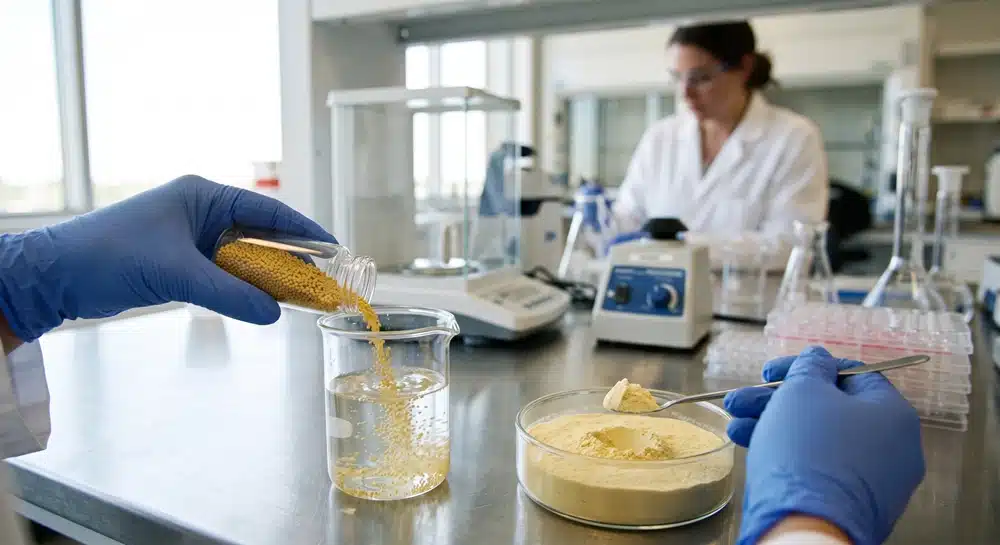
What Does Vitamin E 50% CWS Mean?
“50%” Refers to Potency, Not Daily Value
In a dry Vitamin E ingredient, “50%” commonly refers to a minimum concentration of a named active component, such as all-rac-alpha-tocopheryl acetate or RRR-alpha-tocopheryl acetate, in a carrier matrix. It does not mean that one gram provides 50% of the Daily Value, and it does not identify whether the Vitamin E is natural-source or synthetic.
Always confirm the exact active identity. Tocopherol and tocopheryl acetate are different chemical forms, and natural-source and synthetic alpha-tocopherol use different U.S. label conversions. Brands considering premium or source-specific positioning should separately review natural Vitamin E forms.
CWS Usually Means Cold-Water Dispersible
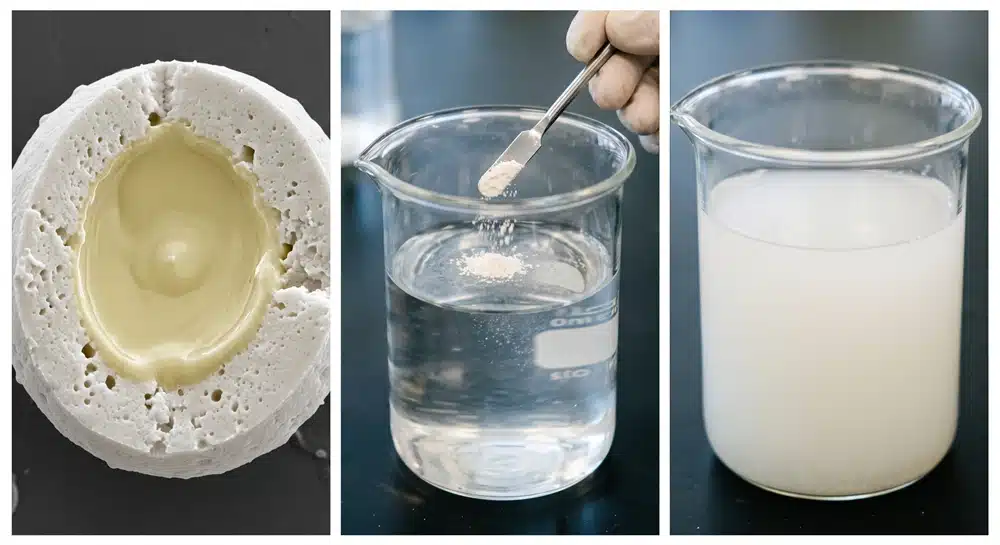
Vitamin E is a fat-soluble vitamin. A CWS dry form uses an encapsulating or emulsifying carrier system to help the ingredient disperse in cold water. The material may form a cloudy dispersion or emulsion rather than a clear molecular solution. For technical accuracy, “cold-water dispersible” is usually more appropriate than claiming that Vitamin E itself has become water-soluble.
When a beverage or powder project requires a particular appearance, request a defined dispersibility test that specifies water temperature, ingredient concentration, mixing method, mixing time, turbidity, foam, sedimentation and holding time.
Vitamin E 50% CWS Beadlet vs Powder: Key Differences
| Comparison factor | Beadlet or granular grade | Fine powder grade | Neler kontrol edilmeli |
|---|---|---|---|
| Industry meaning | Usually a larger microencapsulated particle or granule | Usually a finer free-flowing dry material | Supplier definition, manufacturing process and particle-size distribution |
| Active component | May contain tocopheryl acetate or another specified Vitamin E form | May contain the same or a different Vitamin E form | Exact chemical identity, source and assay basis |
| Carrier matrix | May use starch, modified starch, gelatin, sugars, gums or other wall materials | May use starch, maltodextrin, gums, silica or other processing aids | Full composition, allergens, animal origin and label declaration |
| Parçacık boyutu | Generally larger and potentially less dusty | Generally finer, with greater surface area | Mesh distribution, D10/D50/D90 or supplier sieve specification |
| Flow and handling | May provide better flow in some systems | May blend more readily but can create dust or segregation risk | Bulk density, tapped density, flow test and production trial |
| Soğuk suda performans | Can disperse if the coating and particle design are suitable | Can disperse rapidly if wetting and agglomeration are controlled | Defined dispersibility, turbidity and sedimentation data |
| Dry-blend uniformity | Larger particles may segregate from fine premix ingredients | Fine particles may match some premixes but can agglomerate | Particle-size matching and blend-uniformity study |
| Tablet sıkıştırma | Granular structure may support handling, but pressure can damage some coatings | May require granulation or flow aids depending on compressibility | Compression trial, potency retention, hardness and dissolution |
| Oxidative stability | Potentially protected by the carrier matrix | Can also be highly stable when properly encapsulated | Actual shelf-life data, peroxide value, oxygen/light barrier and packaging |
| Best use | Supplier-specific; often considered for premixes, tablets or capsules | Supplier-specific; often considered for powders and beverages | Finished-product testing rather than category assumptions |
Key point: A beadlet is still a dry particulate material. Some suppliers use “beadlet,” “granule,” “microencapsulated powder” and “CWS powder” differently. Do not approve a material based only on the sales name.
Why the Product Name Alone Is Not Enough
Two materials labeled Vitamin E 50% CWS can behave differently because of:
- natural-source versus synthetic Vitamin E;
- tocopherol versus tocopheryl acetate;
- wall material and emulsifier system;
- gelatin-containing versus gelatin-free composition;
- particle size and bulk density;
- surface oil and encapsulation efficiency;
- flow agent and anticaking system;
- water activity and residual moisture;
- stability protection and packaging;
- assay method and potency expression.
A complete technical review should compare the specification sheet, representative COA, full composition statement, manufacturing flow description, application data and storage conditions.
Which Form Is Better for Each Application?
Dry Premixes, Sachets and Stick Packs
Select the grade that matches the particle size and bulk density of the surrounding blend. A very large beadlet can segregate from fine vitamins and minerals, while an ultrafine powder can create dust, electrostatic behavior or agglomeration. Conduct blend-uniformity and transport-simulation tests before commercial production.
Instant Beverages and Nutrition Powders
Prioritize validated wetting, dispersion, turbidity and sedimentation performance. A ince toz is not automatically more dispersible, and a beadlet is not automatically more stable in the prepared drink. Brands developing drink mixes should combine ingredient selection with toz takvi̇ye üreti̇mi̇ trials covering mixability, flavor, appearance and packaging.
Tablets and Hard Capsules
For tablets, evaluate compression tolerance, potency retention, tablet hardness, friability and dissolution. For hard capsules, compare flowability, fill-weight consistency, capsule size and segregation risk. Larger granules may improve handling in one formula but reduce uniformity in another.
Sakızlar
Use only a grade tested for the gummy’s processing temperature, pH, water activity and shelf life. Confirm the addition point and potency overage. A CWS designation alone does not prove that the Vitamin E will remain evenly distributed or retain potency during heating and storage.
Softgels and Oil-Based Liquids
Oil-compatible Vitamin E is often a more direct fit for conventional softgels and oil-based drops than a dry CWS powder. A dry beadlet should not be selected for softgels without a specific formulation and suspension study.
For custom capsules, tablets, gummies, powders or liquids, a fason vi̇tami̇n üreti̇mi̇ review can help match the active form, carrier and potency with the finished dosage form.

How to Calculate Ingredient Quantity from 50% Potency
Ingredient calculations must use the active form and the label convention required in the destination market. The following is an illustrative U.S. example, not a universal formula.
Assume a specification contains a minimum of 50% synthetic all-rac-alpha-tocopheryl acetate. A commonly used U.S. conversion is:
- 1 mg synthetic alpha-tocopheryl acetate = approximately 0.45 mg Vitamin E for label purposes;
- 1 g of a 50% ingredient contains at least 500 mg alpha-tocopheryl acetate;
- 500 mg × 0.45 = approximately 225 mg Vitamin E label value per gram of ingredient.
To formulate a nominal 15 mg Vitamin E serving:
15 mg ÷ 0.45 ÷ 0.50 = approximately 66.7 mg of the 50% ingredient
This calculation must be adjusted for the exact source form, actual batch assay, manufacturing loss, approved overage, serving-size tolerance and local labeling rules. Do not calculate from the product name alone.
Specifications B2B Buyers Should Check
| Specification area | Questions to ask |
|---|---|
| Kimlik | What is the exact Vitamin E form: all-rac-alpha-tocopheryl acetate, RRR-alpha-tocopheryl acetate, tocopherol or another form? |
| Potens | Is potency expressed as active ester, alpha-tocopherol equivalent, IU/g or mg Vitamin E/g? |
| Analiz yöntemi | Which HPLC or compendial method is used, and what are the release limits? |
| Taşıyıcı sistem | What are the wall materials, emulsifiers, sugars, starches, flow agents and antioxidants? |
| Source and suitability | Is the product natural or synthetic, vegetarian, vegan, Halal, Kosher and non-GMO as required? |
| Animal-origin risk | Does the product contain gelatin or another animal-derived processing material, and are BSE/TSE documents available? |
| Fiziksel özellikler | What are the particle-size distribution, bulk density, tapped density, flow and appearance? |
| Dağılma özelliği | What test temperature, concentration, mixing time, turbidity and sedimentation limits are used? |
| Nem | What are the loss-on-drying and water-activity limits? |
| Oksidasyon | Are peroxide value, surface oil or other oxidation-related parameters controlled? |
| Kirleticiler | What are the heavy-metal, solvent, pesticide and other relevant contaminant limits? |
| Mikrobiyoloji | What limits apply for total count, yeast and mold, Enterobacteriaceae and pathogens? |
| Paketleme | Does the package protect against oxygen, moisture, heat and light? |
| Raf ömrü | Is shelf life supported by real-time or accelerated stability data in the offered packaging? |
| Change control | Will the supplier notify buyers of carrier, site, process, method or specification changes? |
Supplier qualification should be connected to a documented takvi̇ye kali̇te kontrolü program rather than relying only on a marketing specification.
Formulation, Stability and Packaging Tests
Raw-material compliance does not prove finished-product performance. A brand should establish tests appropriate to the dosage form.
| Ürün biçimi | Recommended validation |
|---|---|
| Premix or powder | Blend uniformity, segregation, flow, dust, moisture uptake, mixability and potency |
| Instant beverage | Wetting, dispersibility, turbidity, sedimentation, foam, flavor and hold-time stability |
| Tablet | Compression loss, hardness, friability, disintegration, dissolution and potency retention |
| Sert kapsül | Flow, fill-weight variation, capsule compatibility, potency and dissolution |
| Sakızlı | Heat and pH exposure, content uniformity, water activity, texture, potency and shelf life |
| Finished package | Real-time and accelerated stability, oxygen/moisture protection, light exposure and shipping simulation |
Because Vitamin E ingredients are sensitive to the combined effects of oxygen, light, heat and moisture, packaging selection should be part of the stability plan rather than a final cosmetic decision.
Labeling and Claims Considerations
- Declare Vitamin E in the units required by the destination market; U.S. Supplement Facts generally use mg.
- Confirm whether the label amount is based on natural or synthetic alpha-tocopherol conversion.
- List carrier and other ingredients as required; “50% CWS” does not replace the full ingredient declaration.
- Do not claim “water-soluble Vitamin E” without clarifying that the dry form is designed for water dispersion.
- Do not claim superior absorption or bioavailability solely because the product is CWS.
- Do not describe a dietary supplement or ingredient as FDA approved.
- Health and structure/function claims must be truthful, not misleading and supported by evidence relevant to the finished product.
How to Choose a Vitamin E 50% CWS Supplier
- Define the dosage form, target Vitamin E label amount and market.
- Specify the active form and natural or synthetic source requirement.
- Request the complete carrier and processing-aid composition.
- Compare potency expression and assay method across suppliers.
- Review particle size, density, flow and dispersibility data.
- Confirm allergen, vegan, Halal, Kosher, GMO and animal-origin documents.
- Review representative COA, specification, SDS, TDS and stability data.
- Run a pilot in the actual formula and packaging.
- Test finished-product potency, uniformity and shelf life.
- Include change-control and complaint procedures in the supply agreement.
Sıkça Sorulan Sorular
Is Vitamin E 50% CWS actually water-soluble?
Vitamin E remains fat-soluble. A CWS dry ingredient uses a carrier system that helps the Vitamin E disperse in cold water. It may form an emulsion or cloudy dispersion rather than a clear true solution.
What does 50% mean in Vitamin E 50% CWS?
It usually means that at least 50% of the ingredient is a specified Vitamin E active, often a tocopheryl acetate form. Confirm the exact chemical identity and assay basis on the specification.
Is a beadlet always more stable than a powder?
No. Stability depends on the active form, carrier matrix, encapsulation efficiency, surface oil, moisture, oxygen exposure, packaging and storage. Compare actual stability data.
Does a fine powder disperse faster than a beadlet?
Not necessarily. Fine particles can wet quickly but may float, clump or foam. A beadlet may disperse well if designed for that use. Require a defined application test.
Can Vitamin E 50% CWS be used in hard capsules?
Yes, selected grades may be suitable for hard capsules, but flow, bulk density, fill-weight variation and dissolution should be verified.
Can Vitamin E 50% CWS beadlets be used in softgels?
Dry beadlets are not the default choice for conventional oil-filled softgels. An oil-compatible Vitamin E form is often more practical unless a specific suspension system has been validated.
Can the same CWS grade be used in beverages and tablets?
Possibly, but the performance requirements differ. Beverages emphasize wetting and sedimentation, while tablets emphasize flow, compression tolerance, disintegration and potency retention.
What documents should a buyer request?
Request a specification, representative COA, SDS, TDS, full composition statement, allergen and GMO statements, source documents, Halal/Kosher documents if needed, stability data, packaging details and change-control policy.
Sonuç
The best Vitamin E 50% CWS form cannot be selected from the words “beadlet” or “powder” alone. Compare the exact active form, carrier system, potency, particle size, dispersibility, stability and finished-product performance. A qualified supplier should provide transparent specifications and support a pilot and testing plan for the intended dosage form.
Technical note: This guide is intended for B2B ingredient sourcing and formulation planning. Final ingredient identity, dosage, label conversion, claims, warnings and regulatory suitability must be reviewed for the actual product and destination market.
Referanslar
- dsm-firmenich Health, Nutrition & Care Product Brochure 2026
- NIH Office of Dietary Supplements: Vitamin E Fact Sheet for Health Professionals
- FDA: Besin Takviyeleri İçin Güncel İyi Üretim Uygulamaları Uyum Kılavuzu
- FDA: Besin Takviyeleriyle İlgili Sorular ve Cevaplar
- Encapsulation of Vitamin E: Effect of Wall Material on Retention and Stability

Warren Wan, besin takviyesi tedarik zincirinde kapsamlı deneyime sahip deneyimli bir uzmandır ve kolajen peptidleri, kemik suyu proteini ve keratin gibi temel bileşenlerin araştırma, geliştirme, süreç kontrolü ve küresel tedarik alanlarında zengin pratik deneyime sahiptir. Bu köşenin yazarı olarak, pazarlama söylemlerinin ötesine geçmeye, anlaşılması zor bileşen bilimini ve üretim kalite kontrol standartlarını kolay anlaşılır, somut bilimsel bilgilere dönüştürmeye kendini adamıştır. Böylece okuyucuların etiketlerin ardındaki gerçeği anlamalarına ve sağlık konusunda daha rasyonel seçimler yapmalarına yardımcı olmaktadır.


