
This guide is for consumers comparing labels and for supplement brands, formulators and procurement teams selecting an ingredient. The choice depends on the intended nutritional use, dose, dosage form, quality specification, safety review and destination-market rules. Medical uses of acetylcysteine should not be presented as ordinary supplement benefits.
Brands can begin with GENSEI’s مركز مكونات الأحماض الأمينية السائبة and use the quality and RFP sections below to evaluate a supplier.
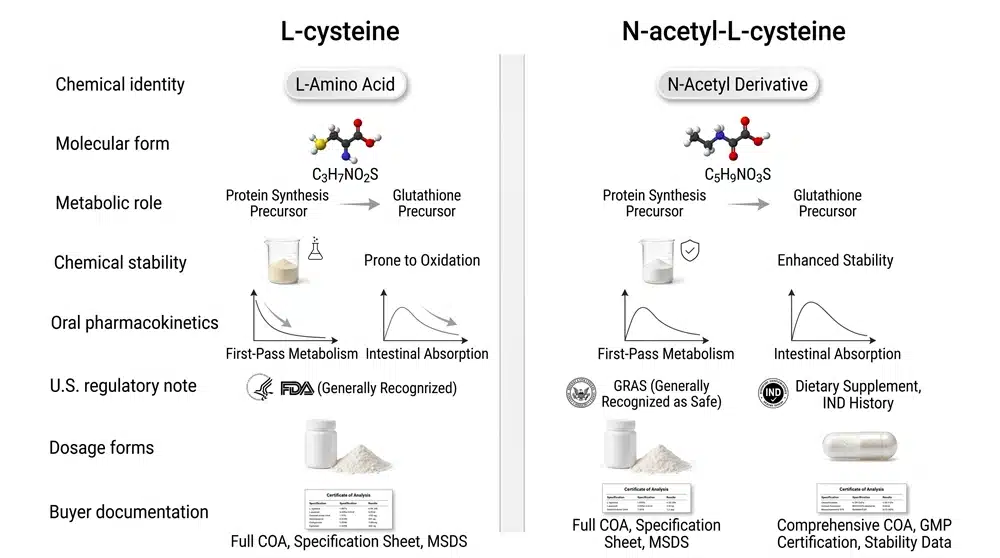
L-Cysteine vs NAC at a Glance
| العامل | ل-سيستين | إن-أسيتيل-إل-سيستين (N-Acetyl-L-Cysteine) |
|---|---|---|
| ما هو | A sulfur-containing amino acid | An acetylated derivative of L-cysteine |
| Metabolic role | Used directly in proteins and sulfur-amino-acid pathways | Deacetylated and used as a cysteine source in glutathione-related pathways |
| الأشكال الشائعة للمكونات | L-cysteine, L-cysteine HCl anhydrous or monohydrate | N-acetyl-L-cysteine / acetylcysteine |
| المناولة | Reactive thiol; can oxidize to cystine and may have sulfur odor | Often easier to handle than free cysteine, but still requires moisture, odor and impurity control |
| Oral pharmacokinetics | Handled through amino-acid transport and metabolism; product performance depends on the form and formula | Undergoes extensive first-pass metabolism and has low systemic oral bioavailability |
| U.S. regulatory note | Subject to applicable food, supplement and ingredient requirements | FDA currently lists a final enforcement-discretion policy for certain otherwise-lawful NAC products labeled as dietary supplements |
| السؤال الرئيسي للمشتري | Which molecular form, assay basis and stability specification are required? | Does the material, finished product and claim strategy fit the current market-specific regulatory framework? |
What Is L-Cysteine?
L-cysteine is a conditionally essential amino acid containing a reactive thiol group. It contributes to protein structure, sulfur metabolism and glutathione synthesis. Under normal conditions, the body can produce cysteine from methionine, but nutritional status, life stage and medical conditions can affect requirements.
Commercial materials may be supplied as free L-cysteine, L-cysteine hydrochloride anhydrous or L-cysteine hydrochloride monohydrate. These forms differ in molecular weight, chloride content, water content and assay basis. Buyers should not compare equal ingredient weights without calculating the active L-cysteine equivalent. Review the L-cysteine hydrochloride specification page for form and document considerations.
ما هو N-أسيتيل-L-سيستين؟
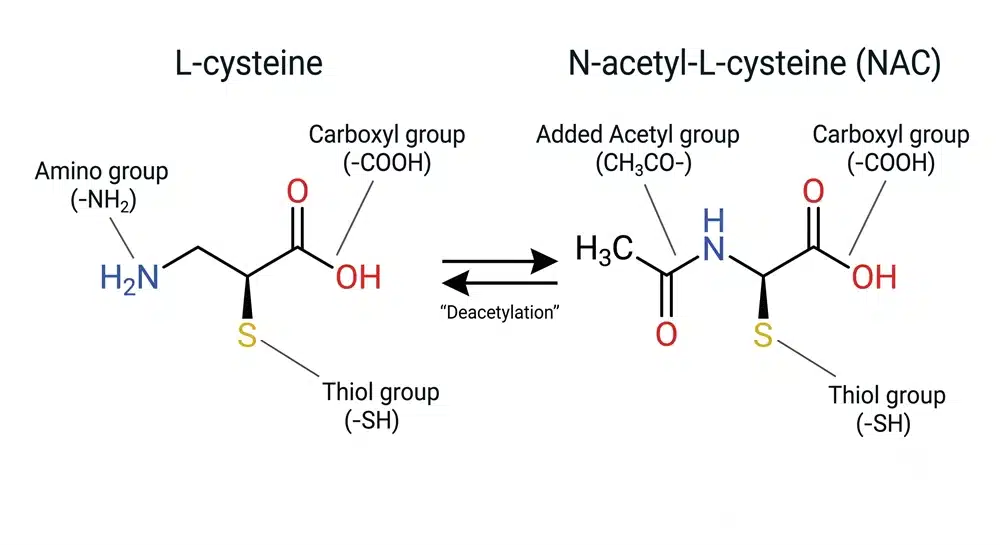
N-acetyl-L-cysteine, commonly abbreviated NAC, is L-cysteine with an acetyl group attached to the nitrogen atom. After administration, NAC can be deacetylated and contribute cysteine to metabolic pathways, including glutathione synthesis.
NAC is also an approved drug ingredient for specific medical uses. That history creates a special U.S. dietary-supplement issue. FDA’s current directory and final guidance describe an enforcement-discretion policy for certain products that would otherwise be lawfully marketed dietary supplements. This is not the same as FDA approval of NAC supplements. Brands sourcing the ingredient can review the N-acetyl-L-cysteine powder specification page.
Is L-Cysteine the Same as NAC?
No. NAC is derived from L-cysteine but is a distinct chemical compound with its own CAS number, molecular weight, assay and impurity profile. The names should not be used interchangeably on a formulation sheet, COA or finished-product label.
N-acetylcysteine, acetylcysteine, N-acetyl-L-cysteine and NAC commonly refer to the same L-form compound in supplement and pharmaceutical contexts, but procurement teams should still verify the exact stereochemistry, chemical name, grade and analytical method.
Chemical Structure and Functional Differences
ل-سيستين
L-cysteine contains a free amino group, carboxyl group and thiol group. The thiol can form disulfide bonds that contribute to protein structure. The same reactivity can also increase oxidation risk during raw-material storage and finished-product processing.
NAC
NAC contains an acetylated amino group. Acetylation changes chemical handling and metabolic processing, but it does not prove that NAC is universally absorbed better than free L-cysteine. Chemical stability, gastrointestinal absorption, first-pass metabolism, systemic exposure and pathway support are different concepts.
Glutathione Support: Which Is Better?
Both ingredients can contribute cysteine to glutathione-related metabolism. L-cysteine is the amino acid used directly in glutathione synthesis. NAC is more commonly studied and marketed as a cysteine precursor, but its practical effect depends on dose, route, nutritional status, formula and the population studied.
A supplement may describe support for normal glutathione production or antioxidant pathways only when the finished formula and claim are properly substantiated. Avoid claims such as “detoxes the liver,” “removes toxins,” “treats oxidative stress” or “prevents disease.”
الامتصاص والتوافر البيولوجي
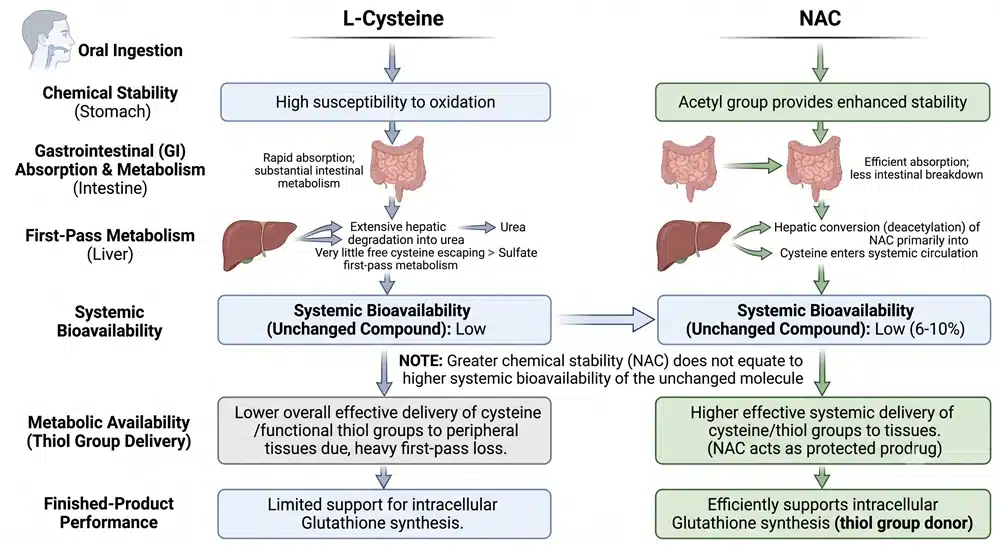
The current page states that NAC has superior bioavailability. That conclusion is not accurate as a universal comparison. Oral NAC undergoes extensive first-pass metabolism, and pharmacokinetic research reports low systemic oral bioavailability. Greater chemical stability does not automatically mean greater unchanged-drug exposure in blood or tissues.
| Concept | ماذا يعني ذلك | Why It Should Not Be Confused |
|---|---|---|
| Chemical stability | Resistance to oxidation or degradation during storage and processing | Does not directly measure absorption or clinical effect |
| الامتصاص | Movement from the gastrointestinal tract into the body | Does not account for extensive metabolism after absorption |
| Systemic bioavailability | Fraction reaching systemic circulation in the measured form | Low unchanged NAC exposure does not mean no metabolic contribution |
| Metabolic availability | Ability to contribute cysteine or downstream metabolites | Depends on pathway, dose and endpoint rather than one generic percentage |
| Finished-product performance | Release, stability and outcome for a specific formula | Cannot be predicted solely from the ingredient name |
The accurate consumer conclusion is that NAC is not automatically “better absorbed” in every comparison. A formula-level decision should consider the exact ingredient form, dose, route, excipients, stability and intended endpoint.
Which One Should Consumers Choose?
| الاستخدام المقصود | Possible Starting Point | قيود مهمة |
|---|---|---|
| General amino acid or protein formula | L-cysteine or an appropriate L-cysteine salt | Confirm active-equivalent dose and total sulfur amino acid intake |
| Formula positioned around cysteine availability or glutathione pathways | NAC may be considered where legally appropriate | Do not imply treatment, detoxification or guaranteed glutathione increase |
| Medical treatment or acetaminophen overdose | Clinical acetylcysteine protocol | This is a medical use and not a self-directed supplement application |
| High-dose or multi-product use | Professional review | Combining NAC and cysteine may duplicate exposure without proving greater benefit |
Safety, Side Effects and Interactions
Oral L-cysteine and NAC can cause gastrointestinal effects such as nausea, abdominal discomfort, vomiting or diarrhea. NAC can have a strong sulfur-like odor that may be normal for the material, but changes in odor, color, moisture or caking should be assessed against the specification and stability data.
People who are pregnant or breastfeeding, have a medical condition, use prescription medicines, have asthma or ulcer-related concerns, or are preparing for surgery should seek qualified professional advice. Brands should not copy contraindications, warnings or dose instructions from prescription acetylcysteine products without medical and regulatory review.
U.S. Regulatory Considerations for NAC
FDA has concluded that NAC was approved as a drug before it was marketed as a dietary supplement or food and therefore is excluded from the statutory dietary-supplement definition. FDA nevertheless maintains a final guidance explaining its intent to exercise enforcement discretion for certain NAC products labeled as dietary supplements that would otherwise be lawfully marketed and are not otherwise in violation of the FD&C Act.
This policy does not mean that NAC supplements are FDA approved, and it does not protect adulterated, misbranded or drug-claim products. Brands should review the latest FDA ingredient directory and guidance before launch, import, label revision or major distribution decisions.
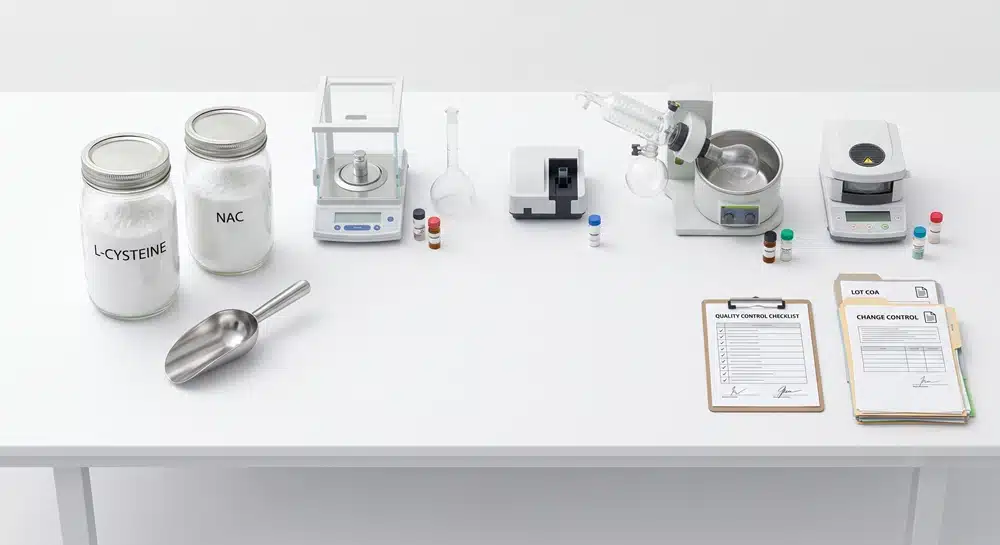
L-Cysteine and NAC Quality Specification Checklist
| المواصفات | ما الذي يجب التحقق منه | ما أهمية ذلك |
|---|---|---|
| الهوية | Chemical name, stereochemistry, CAS number and validated identity method | Prevents confusion among cysteine, cystine, NAC and salt forms |
| Molecular form | Free base, hydrochloride, anhydrous, monohydrate or acetylated derivative | Changes molecular weight and active-equivalent calculations |
| التحليل | Percentage, dry or as-is basis and test method | Supports correct formula and label calculations |
| المواد ذات الصلة | Cystine, degradation products and process impurities | تُظهر درجة نقاء تتجاوز نتائج الاختبار الأولي |
| المذيبات المتبقية | Process-specific panel and batch limits | يؤكد أن مخلفات التصنيع تخضع للرقابة |
| الشوائب العنصرية | الرصاص والزرنيخ والكادميوم والكادميوم والزئبق | يدعم مراجعة المخاطر المتعلقة بالمواد الخام والمنتجات النهائية |
| علم الأحياء الدقيقة | العدد الإجمالي والكائنات المحددة | يساعد على إطلاق المكونات |
| Moisture and physical properties | Water content, particle size, bulk density, flowability, color and odor | Affects stability, filling, compression and sensory quality |
| الأصل والعملية | Production process, country of origin, allergen and GMO statements | يدعم الادعاءات المتعلقة بالتوريد والتسويق |
| الاستقرار والتحكم في التغيير | Retest date, storage, package, finished-product data and supplier-change notification | Protects potency and impurity limits through shelf life |
اعتبارات تتعلق بتركيب المنتجات بالنسبة لعلامات المكملات الغذائية
الكبسولات
Capsules are common for both ingredients. Formulators should evaluate dose, fill volume, sulfur odor, moisture, flowability, shell compatibility and blend uniformity. GENSEI supports تصنيع المكملات الغذائية بالكبسولات for amino acid and NAC projects.
الأجهزة اللوحية
Tablet development requires compression, disintegration, taste, odor and stability evaluation. High active loading may require suitable binders, lubricants, glidants and moisture-protective packaging.
المساحيق
Powder formulas must address sulfur odor, taste masking, hygroscopicity, segregation and compatibility with flavors and other active ingredients. Sachet and scoop accuracy should be validated at the finished-product level.
الصيغ المركبة
Glycine, selenium, vitamins or other antioxidant-pathway ingredients may appear in combination formulas. The presence of multiple ingredients does not automatically validate a stronger claim. Review total dose, ingredient overlap, stability, target population and substantiation for the exact finished product.
RFP Questions for an L-Cysteine or NAC Supplier
- What exact chemical form, stereochemistry and assay basis are supplied?
- Is L-cysteine supplied as free form, HCl anhydrous or HCl monohydrate?
- What manufacturing process and country of origin apply?
- Which identity, assay and related-substance methods are used?
- هل يمكنك تقديم ثلاث شهادات منشأ حديثة خاصة بكل دفعة على حدة؟
- Which oxidation products, residual solvents, elemental impurities and microbiological tests are controlled?
- What are the particle size, bulk density, flowability, odor and moisture specifications?
- What package, storage conditions and retest period are recommended?
- What are the MOQ, sample quantity, lead time and change-control terms?
- هل يمكنكم تقديم الدعم لتطوير منتجات تجريبية على شكل كبسولات أو أقراص أو مسحوق؟
- How do you verify finished-product potency and stability?
- For U.S. NAC projects, what regulatory and claim-review support is available?
أين يندرج «جينسي»
GENSEI supports amino acid ingredient sourcing, specification matching, dosage-form feasibility, packaging and quality-document review for supplement projects.
يمكن للعلامات التجارية أن request an L-cysteine or NAC sample, COA and formulation quotation with the required chemical form, assay, dose, dosage format, destination market, order quantity and launch timeline.
الأسئلة الشائعة
Is L-cysteine the same as NAC?
No. L-cysteine is an amino acid. NAC is an acetylated derivative that can be converted to cysteine after administration.
Is N-acetylcysteine the same as N-acetyl-L-cysteine?
They commonly refer to the same compound, but specifications should confirm the L-form, CAS number, assay and identity method.
Does NAC have better bioavailability than L-cysteine?
That claim is too broad. NAC may have handling advantages, but oral NAC undergoes extensive first-pass metabolism and has low systemic bioavailability. The relevant comparison depends on the intended metabolic endpoint and finished formula.
Which is better for glutathione support?
Both can contribute cysteine to glutathione-related pathways. NAC is more commonly studied for this purpose, but the appropriate choice depends on dose, formula, evidence, safety and regulatory context.
Can L-cysteine and NAC be taken together?
Combining them can duplicate cysteine exposure and is not automatically more effective. Consumers should follow the label and obtain professional advice when combining supplements or medicines.
Is NAC legal in U.S. dietary supplements?
FDA currently maintains an enforcement-discretion policy for certain otherwise-lawful NAC products labeled as dietary supplements. This is not FDA approval and can be revised or withdrawn.
الوجبات الجاهزة النهائية
L-cysteine and NAC are related but distinct ingredients. L-cysteine is the amino acid itself; NAC is an acetylated derivative used as a cysteine source. A responsible comparison should separate chemical stability from systemic bioavailability, distinguish drug uses from supplement positioning, avoid disease claims and evaluate molecular form, assay, impurities, dosage-form performance and current market-specific regulations.
المراجع
- FDA: Policy Regarding N-Acetyl-L-Cysteine
- FDA: Information on Select Dietary Supplement Ingredients and Other Substances
- إدارة الغذاء والدواء الأمريكية (FDA): الادعاءات الواردة على ملصقات الأغذية التقليدية والمكملات الغذائية
- لجنة التجارة الفيدرالية (FTC): إرشادات الامتثال الخاصة بالمنتجات الصحية
- 21 CFR الجزء 111: الممارسات التصنيعية الجيدة الحالية للمكملات الغذائية
- Clinical Pharmacokinetics of N-Acetylcysteine
- N-Acetylcysteine: Impacts on Human Health
- Effects of the Usage of L-Cysteine on Human Health

وارن وان خبير متمرس يتمتع بخبرة واسعة في سلسلة توريد المكملات الغذائية، ولديه خبرة عملية غنية في مجالات البحث والتطوير ومراقبة العمليات والتوريد العالمي للمكونات الأساسية مثل ببتيدات الكولاجين وبروتين مرق العظام والكيراتين. وبصفته كاتب هذه الزاوية، يكرس جهوده لتجريد الموضوعات من غلافها التسويقي، وتحويل العلوم الغامضة المتعلقة بالمكونات ومعايير مراقبة جودة الإنتاج إلى معلومات علمية متعمقة وسهلة الفهم، مما يساعد القراء على فهم الحقيقة الكامنة وراء الملصقات واتخاذ خيارات صحية أكثر عقلانية.


