
Dieser Leitfaden richtet sich an Verbraucher, die Inhaltsangaben vergleichen, sowie an Hersteller von Nahrungsergänzungsmitteln, Produktentwickler und Einkaufsteams, die einen Inhaltsstoff auswählen. Die Wahl hängt vom beabsichtigten ernährungsphysiologischen Verwendungszweck, der Dosierung, der Darreichungsform, den Qualitätsanforderungen, der Sicherheitsprüfung und den Vorschriften des Zielmarktes ab. Medizinische Anwendungsgebiete von Acetylcystein sollten nicht als gewöhnliche Vorteile eines Nahrungsergänzungsmittels dargestellt werden.
Marken können mit GENSEI beginnen Zentrum für Aminosäure-Rohstoffe in Großmengen und nutzen Sie die folgenden Abschnitte zu Qualität und Ausschreibung, um einen Anbieter zu bewerten.
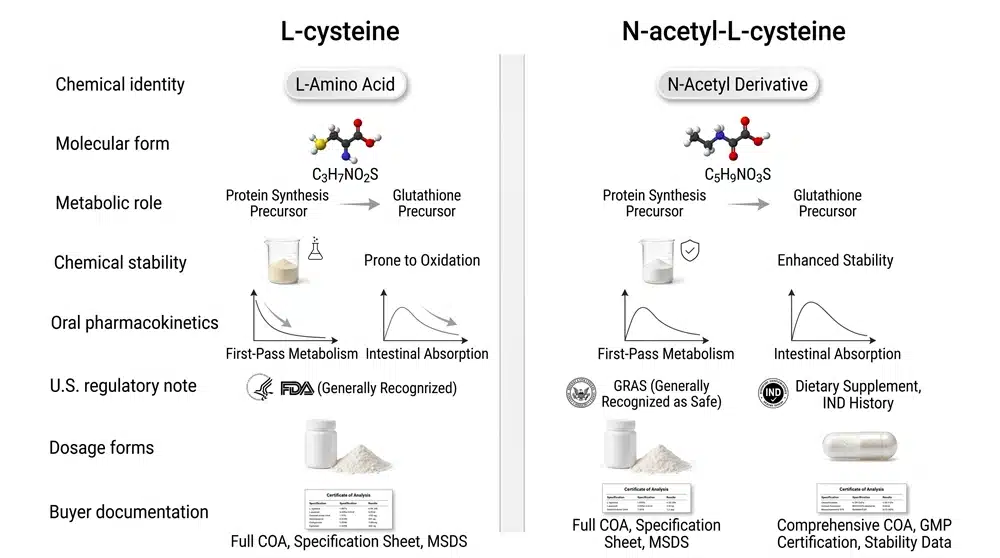
L-Cystein vs. NAC auf einen Blick
| Faktor | L-Cystein | N-Acetyl-L-Cystein (NAC) |
|---|---|---|
| Was es ist | Eine schwefelhaltige Aminosäure | Ein acetyliertes Derivat von L-Cystein |
| Rolle im Stoffwechsel | Wird direkt in Proteinen und im Stoffwechsel der schwefelhaltigen Aminosäuren verwendet | Es wird deacetyliert und als Cysteinquelle in Glutathion-bezogenen Stoffwechselwegen genutzt |
| Gängige Darreichungsformen von Inhaltsstoffen | L-Cystein, L-Cystein-HCl, wasserfrei oder als Monohydrat | N-Acetyl-L-Cystein / Acetylcystein |
| Handhabung | Reaktives Thiol; kann zu Cystin oxidieren und unter Umständen einen Schwefelgeruch aufweisen | Oft einfacher zu handhaben als freies Cystein, erfordert jedoch nach wie vor eine Kontrolle von Feuchtigkeit, Geruch und Verunreinigungen |
| Orale Pharmakokinetik | Wird über den Aminosäuretransport und -stoffwechsel verwertet; die Wirksamkeit des Produkts hängt von der Form und der Zusammensetzung ab | Wird in großem Umfang einem First-Pass-Metabolismus unterzogen und weist eine geringe systemische orale Bioverfügbarkeit auf |
| Hinweis zu den US-amerikanischen Vorschriften | Vorbehaltlich der geltenden Vorschriften für Lebensmittel, Nahrungsergänzungsmittel und Zutaten | Die FDA hat derzeit eine endgültige Richtlinie zur Ermessensausübung bei der Durchsetzung für bestimmte, ansonsten rechtmäßige NAC-Produkte veröffentlicht, die als Nahrungsergänzungsmittel gekennzeichnet sind. |
| Wichtigste Frage des Käufers | Welche Molekülform, welche Assay-Grundlage und welche Stabilitätsspezifikation sind erforderlich? | Entsprechen das Material, das Endprodukt und die Werbestrategie den aktuellen marktspezifischen rechtlichen Rahmenbedingungen? |
Was ist L-Cystein?
L-Cystein ist eine bedingt essentielle Aminosäure, die eine reaktive Thiolgruppe enthält. Es trägt zur Proteinstruktur, zum Schwefelstoffwechsel und zur Glutathion-Synthese bei. Unter normalen Umständen kann der Körper Cystein aus Methionin bilden, doch der Ernährungszustand, die Lebensphase und bestimmte Erkrankungen können den Bedarf beeinflussen.
Handelsübliche Produkte können als freies L-Cystein, wasserfreies L-Cystein-Hydrochlorid oder L-Cystein-Hydrochlorid-Monohydrat geliefert werden. Diese Formen unterscheiden sich hinsichtlich Molekulargewicht, Chloridgehalt, Wassergehalt und Gehaltsbasis. Käufer sollten gleiche Inhaltsstoffgewichte nicht vergleichen, ohne das Äquivalent an aktivem L-Cystein zu berechnen. Lesen Sie die Seite mit den Spezifikationen für L-Cystein-Hydrochlorid aus formalen und dokumentarischen Gründen.
Was ist N-Acetyl-L-Cystein?
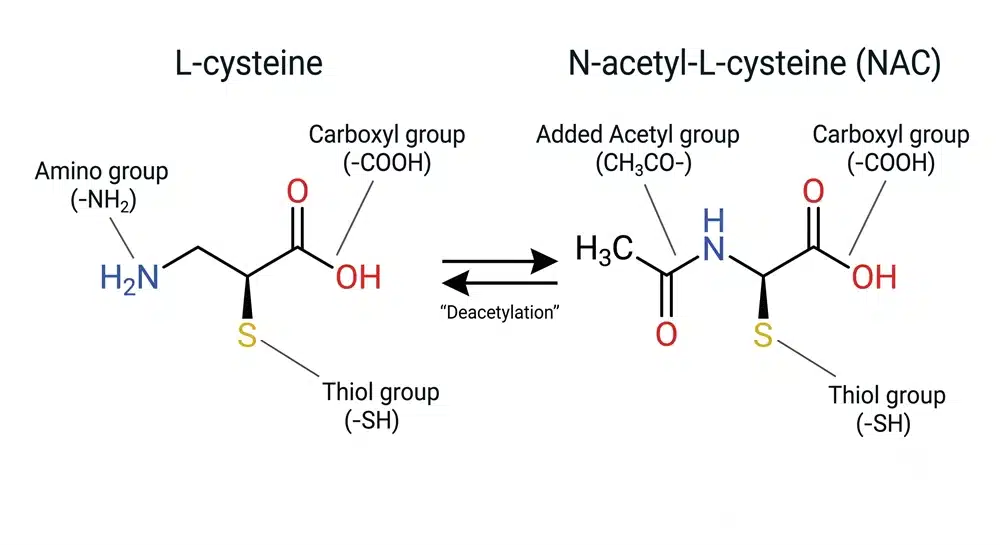
N-Acetyl-L-Cystein, üblicherweise mit NAC abgekürzt, ist L-Cystein, an dessen Stickstoffatom eine Acetylgruppe gebunden ist. Nach der Verabreichung kann NAC deacetyliert werden und Cystein für Stoffwechselwege, darunter die Glutathion-Synthese, bereitstellen.
NAC ist zudem ein zugelassener Arzneimittelwirkstoff für bestimmte medizinische Anwendungen. Diese Vorgeschichte führt in den USA zu einer besonderen Problematik im Bereich der Nahrungsergänzungsmittel. Das aktuelle Verzeichnis und die endgültigen Leitlinien der FDA beschreiben eine Politik der Ermessensausübung bei der Durchsetzung für bestimmte Produkte, bei denen es sich ansonsten um rechtmäßig vermarktete Nahrungsergänzungsmittel handeln würde. Dies ist nicht gleichbedeutend mit einer Zulassung von NAC-Präparaten durch die FDA. Marken, die diesen Wirkstoff beziehen, können die Seite mit den Spezifikationen für N-Acetyl-L-Cystein-Pulver.
Ist L-Cystein dasselbe wie NAC?
Nein. NAC wird zwar aus L-Cystein gewonnen, ist jedoch eine eigenständige chemische Verbindung mit eigener CAS-Nummer, eigenem Molekulargewicht, eigenem Gehalt und eigenem Verunreinigungsprofil. Die Bezeichnungen sollten in einem Rezepturblatt, einem Qualitätszertifikat (COA) oder auf dem Etikett des Endprodukts nicht synonym verwendet werden.
N-Acetylcystein, Acetylcystein, N-Acetyl-L-Cystein und NAC bezeichnen im Bereich der Nahrungsergänzungsmittel und Arzneimittel in der Regel dieselbe Verbindung in L-Form; Beschaffungsteams sollten jedoch dennoch die genaue Stereochemie, die chemische Bezeichnung, die Reinheitsklasse und die Analysemethode überprüfen.
Chemische Struktur und funktionelle Unterschiede
L-Cystein
L-Cystein enthält eine freie Aminogruppe, eine Carboxylgruppe und eine Thiolgruppe. Das Thiol kann Disulfidbrücken bilden, die zur Proteinstruktur beitragen. Diese Reaktivität kann jedoch auch das Oxidationsrisiko während der Lagerung der Rohstoffe und der Verarbeitung der Endprodukte erhöhen.
NAC
NAC enthält eine acetylierte Aminogruppe. Die Acetylierung verändert die chemische Handhabung und den Stoffwechsel, beweist jedoch nicht, dass NAC grundsätzlich besser resorbiert wird als freies L-Cystein. Chemische Stabilität, gastrointestinale Resorption, First-Pass-Metabolismus, systemische Exposition und Unterstützung der Stoffwechselwege sind unterschiedliche Konzepte.
Glutathion-Ergänzung: Was ist besser?
Beide Inhaltsstoffe können Cystein für den Glutathion-Stoffwechsel bereitstellen. L-Cystein ist die Aminosäure, die direkt bei der Glutathion-Synthese verwendet wird. NAC wird häufiger als Cystein-Vorläufer untersucht und vermarktet, doch seine tatsächliche Wirkung hängt von der Dosierung, dem Verabreichungsweg, dem Ernährungszustand, der Zusammensetzung sowie der untersuchten Population ab.
Ein Nahrungsergänzungsmittel darf eine Unterstützung der normalen Glutathionproduktion oder der antioxidativen Stoffwechselwege nur dann beschreiben, wenn die endgültige Rezeptur und die Angabe ordnungsgemäß belegt sind. Vermeiden Sie Angaben wie “entgiftet die Leber”, “beseitigt Giftstoffe”, “bekämpft oxidativen Stress” oder “beugt Krankheiten vor”.”
Absorption und Bioverfügbarkeit
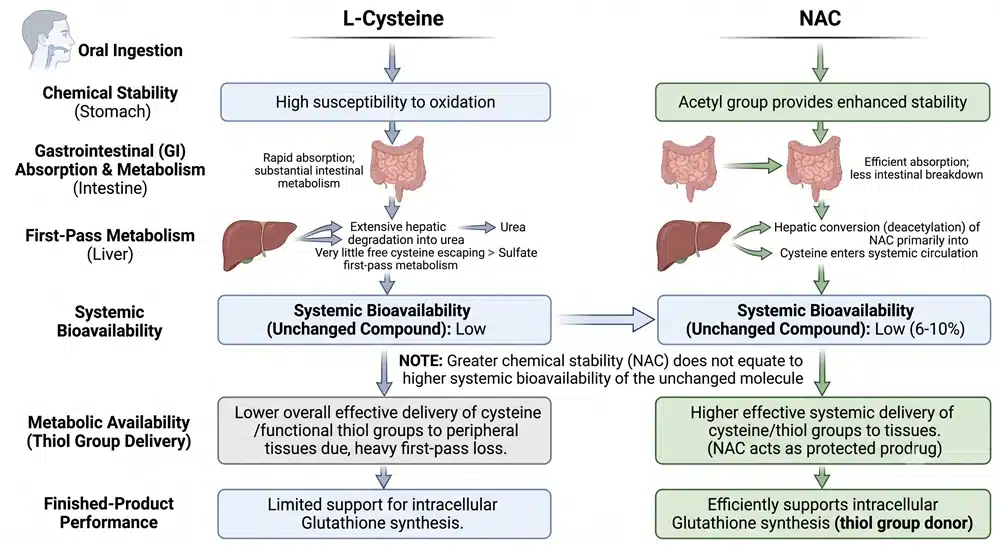
Auf der aktuellen Seite wird angegeben, dass NAC eine überlegene Bioverfügbarkeit aufweise. Diese Schlussfolgerung ist als allgemeingültiger Vergleich nicht zutreffend. Oral verabreichtes NAC unterliegt einem umfangreichen First-Pass-Metabolismus, und pharmakokinetische Untersuchungen belegen eine geringe systemische Bioverfügbarkeit bei oraler Einnahme. Eine höhere chemische Stabilität bedeutet nicht automatisch eine höhere Konzentration des unveränderten Wirkstoffs im Blut oder im Gewebe.
| Konzept | Was das bedeutet | Warum man es nicht verwechseln sollte |
|---|---|---|
| Chemische Stabilität | Beständigkeit gegen Oxidation oder Zersetzung während der Lagerung und Verarbeitung | Misst weder die Absorption noch die klinische Wirkung direkt |
| Absorption | Transport aus dem Magen-Darm-Trakt in den Körper | Berücksichtigt nicht den umfangreichen Stoffwechsel nach der Resorption |
| Systemische Bioverfügbarkeit | Anteil, der in der gemessenen Form in den systemischen Kreislauf gelangt | Ein unverändert niedriger NAC-Spiegel bedeutet nicht, dass kein metabolischer Beitrag vorliegt |
| Metabolische Verfügbarkeit | Fähigkeit, Cystein oder dessen nachgelagerte Metaboliten bereitzustellen | Das hängt eher vom Wirkmechanismus, der Dosis und dem Endpunkt ab als von einem pauschalen Prozentsatz. |
| Leistung des Endprodukts | Freisetzung, Stabilität und Ergebnis für eine bestimmte Rezeptur | Lässt sich nicht allein anhand der Bezeichnung des Inhaltsstoffs vorhersagen |
Die zutreffende Schlussfolgerung für den Verbraucher lautet, dass NAC nicht automatisch in jedem Vergleich “besser resorbiert” wird. Bei einer Entscheidung auf Formulierungsebene sollten die genaue Form des Inhaltsstoffs, die Dosierung, der Verabreichungsweg, die Hilfsstoffe, die Stabilität und der angestrebte Endpunkt berücksichtigt werden.
Für welches Produkt sollten sich Verbraucher entscheiden?
| Verwendungszweck | Möglicher Ausgangspunkt | Wichtiger Hinweis |
|---|---|---|
| Allgemeine Aminosäure- oder Proteinformel | L-Cystein oder ein geeignetes L-Cystein-Salz | Bestimmung der aktiven Äquivalentdosis und der Gesamtzufuhr an schwefelhaltigen Aminosäuren |
| Formel, die sich auf die Verfügbarkeit von Cystein oder die Glutathion-Stoffwechselwege bezieht | NAC kann in Betracht gezogen werden, sofern dies rechtlich zulässig ist | Es darf nicht der Eindruck erweckt werden, dass eine Behandlung, Entgiftung oder eine garantierte Erhöhung des Glutathion-Spiegels stattfindet. |
| Medizinische Behandlung oder Überdosierung von Paracetamol | Klinisches Acetylcystein-Protokoll | Hierbei handelt es sich um eine medizinische Anwendung und nicht um die eigenmächtige Einnahme eines Nahrungsergänzungsmittels. |
| Anwendung in hoher Dosierung oder mit mehreren Produkten | Fachliche Begutachtung | Die Kombination von NAC und Cystein könnte zu einer doppelten Einnahme führen, ohne dass dadurch ein größerer Nutzen nachgewiesen wäre. |
Sicherheit, Nebenwirkungen und Wechselwirkungen
Oral eingenommenes L-Cystein und NAC können gastrointestinale Nebenwirkungen wie Übelkeit, Bauchbeschwerden, Erbrechen oder Durchfall verursachen. NAC kann einen starken schwefelartigen Geruch aufweisen, der für den Stoff zwar normal sein mag; Veränderungen hinsichtlich Geruch, Farbe, Feuchtigkeit oder Verklumpung sollten jedoch anhand der Spezifikationen und Stabilitätsdaten überprüft werden.
Schwangere oder stillende Frauen, Personen mit Vorerkrankungen, Personen, die verschreibungspflichtige Medikamente einnehmen, an Asthma oder Magengeschwüren leiden oder sich auf eine Operation vorbereiten, sollten qualifizierten medizinischen Rat einholen. Hersteller sollten Kontraindikationen, Warnhinweise oder Dosierungsanweisungen von verschreibungspflichtigen Acetylcystein-Produkten nicht ohne medizinische und behördliche Überprüfung übernehmen.
Regulatorische Aspekte in den USA im Zusammenhang mit NAC
Die FDA ist zu dem Schluss gekommen, dass NAC als Arzneimittel zugelassen wurde, bevor es als Nahrungsergänzungsmittel oder Lebensmittel in Verkehr gebracht wurde, und daher nicht unter die gesetzliche Definition eines Nahrungsergänzungsmittels fällt. Die FDA hält dennoch an einer endgültigen Leitlinie fest, in der sie ihre Absicht darlegt, bei bestimmten NAC-Produkten, die als Nahrungsergänzungsmittel gekennzeichnet sind und ansonsten rechtmäßig vermarktet würden sowie nicht gegen den FD&C Act verstoßen, Ermessensspielraum bei der Durchsetzung auszuüben.
Diese Richtlinie bedeutet nicht, dass NAC-Nahrungsergänzungsmittel von der FDA zugelassen sind, und sie bietet keinen Schutz für verfälschte, falsch gekennzeichnete oder Produkte mit arzneimittelbezogenen Angaben. Marken sollten vor der Markteinführung, dem Import, einer Etikettenänderung oder wichtigen Vertriebsentscheidungen das aktuelle Inhaltsstoffverzeichnis und die Leitlinien der FDA prüfen.
Checkliste für die Qualitätsspezifikation von L-Cystein und NAC
| Spezifikation | Was ist zu überprüfen? | Warum es wichtig ist |
|---|---|---|
| Identität | Chemische Bezeichnung, Stereochemie, CAS-Nummer und validierte Identifizierungsmethode | Verhindert Verwechslungen zwischen Cystein, Cystin, NAC und Salzformen |
| Molekulare Form | Freie Base, Hydrochlorid, wasserfrei, Monohydrat oder acetyliertes Derivat | Änderungen bei der Berechnung des Molekulargewichts und der Wirkstoffäquivalente |
| Assay | Prozentangabe, Trockenbasis oder Ist-Zustand sowie Prüfverfahren | Unterstützt korrekte Formeln und Etikettenberechnungen |
| Verwandte Stoffe | Cystin, Abbauprodukte und Prozessverunreinigungen | Zeigt eine Reinheit, die über die Ergebnisse der Standardanalyse hinausgeht |
| Rückstände von Lösungsmitteln | Prozessspezifische Panel- und Chargengrenzwerte | Bestätigt, dass Produktionsrückstände unter Kontrolle sind |
| Elementare Verunreinigungen | Blei, Arsen, Kadmium und Quecksilber | Unterstützt die Risikoprüfung von Rohstoffen und Fertigprodukten |
| Mikrobiologie | Gesamtzahlen und bestimmte Organismen | Unterstützt die Freisetzung der Inhaltsstoffe |
| Feuchtigkeit und physikalische Eigenschaften | Wassergehalt, Korngröße, Schüttdichte, Fließfähigkeit, Farbe und Geruch | Beeinflusst die Stabilität, die Füllung, die Kompression und die sensorische Qualität |
| Herkunft und Herstellungsprozess | Angaben zu Herstellungsverfahren, Herkunftsland, Allergenen und GVO | Unterstützt Angaben zur Herkunft und zum Marketing |
| Stabilität und Änderungskontrolle | Termin für die erneute Prüfung, Lagerung, Verpackung, Daten zum Fertigprodukt und Benachrichtigung über Lieferantenwechsel | Gewährleistet die Einhaltung der Wirkstoffkonzentration und der Grenzwerte für Verunreinigungen über die gesamte Haltbarkeitsdauer hinweg |
Überlegungen zur Produktformulierung für Hersteller von Nahrungsergänzungsmitteln
Kapseln
Beide Inhaltsstoffe werden üblicherweise in Kapselform verabreicht. Produktentwickler sollten die Dosierung, das Füllvolumen, den Schwefelgeruch, die Feuchtigkeit, die Fließfähigkeit, die Kompatibilität mit der Kapselhülle und die Gleichmäßigkeit der Mischung bewerten. GENSEI unterstützt Herstellung von Nahrungsergänzungsmitteln in Kapselform für Aminosäure- und NAC-Projekte.
Tabletten
Bei der Entwicklung von Tabletten sind Untersuchungen zur Kompression, Zerfall, Geschmack, Geruch und Stabilität erforderlich. Bei einem hohen Wirkstoffgehalt können geeignete Bindemittel, Gleitmittel und feuchtigkeitsschützende Verpackungen erforderlich sein.
Pulver
Bei Pulverformulierungen müssen Aspekte wie Schwefelgeruch, Geschmacksmaskierung, Hygroskopizität, Entmischung sowie die Verträglichkeit mit Aromen und anderen Wirkstoffen berücksichtigt werden. Die Dosiergenauigkeit von Beuteln und Messlöffeln sollte auf der Ebene des Endprodukts validiert werden.
Kombinationsformeln
Glycin, Selen, Vitamine oder andere Inhaltsstoffe, die in antioxidativen Stoffwechselwegen eine Rolle spielen, können in Kombinationspräparaten enthalten sein. Das Vorhandensein mehrerer Inhaltsstoffe rechtfertigt nicht automatisch eine stärkere Wirkungsbehauptung. Prüfen Sie die Gesamtdosis, Überschneidungen bei den Inhaltsstoffen, die Stabilität, die Zielgruppe und die Beleglage für das jeweilige Endprodukt.
Fragen zur Ausschreibung für einen Lieferanten von L-Cystein oder NAC
- Welche chemische Form, Stereochemie und Assay-Grundlage werden genau angegeben?
- Wird L-Cystein in freier Form, als wasserfreies HCl oder als HCl-Monohydrat angeboten?
- Welches Herstellungsverfahren und welches Herkunftsland gelten?
- Welche Methoden zur Identifizierung, Analyse und Bestimmung von verwandten Substanzen werden verwendet?
- Könnten Sie uns bitte drei aktuelle, chargenspezifische Echtheitszertifikate vorlegen?
- Welche Oxidationsprodukte, Lösungsmittelrückstände, elementaren Verunreinigungen und mikrobiologischen Prüfungen werden kontrolliert?
- Wie lauten die Spezifikationen hinsichtlich Partikelgröße, Schüttdichte, Fließfähigkeit, Geruch und Feuchtigkeitsgehalt?
- Welche Verpackung, welche Lagerbedingungen und welche Nachprüfungsfrist werden empfohlen?
- Wie lauten die Mindestbestellmenge, die Mustermenge, die Lieferzeit und die Bedingungen für Änderungskontrollen?
- Können Sie die Pilotentwicklung von Kapseln, Tabletten oder Pulver unterstützen?
- Wie überprüfen Sie die Wirksamkeit und Stabilität des Endprodukts?
- Welche Unterstützung in Bezug auf regulatorische Fragen und die Prüfung von Ansprüchen gibt es für NAC-Projekte in den USA?
Wo GENSEI zum Einsatz kommt
GENSEI unterstützt bei der Beschaffung von Aminosäure-Inhaltsstoffen, der Abstimmung der Spezifikationen, der Prüfung der Machbarkeit der Darreichungsform sowie der Überprüfung der Verpackungs- und Qualitätsunterlagen für Projekte im Bereich Nahrungsergänzungsmittel.
Marken können Fordern Sie ein Muster von L-Cystein oder NAC, ein Analysezertifikat (COA) und ein Angebot für die Rezeptur an mit den erforderlichen Angaben zu chemischer Form, Wirkstoffgehalt, Dosierung, Darreichungsform, Zielmarkt, Bestellmenge und Zeitplan für die Markteinführung.
Häufig gestellte Fragen
Ist L-Cystein dasselbe wie NAC?
Nein. L-Cystein ist eine Aminosäure. NAC ist ein acetyliertes Derivat, das nach der Einnahme in Cystein umgewandelt werden kann.
Ist N-Acetylcystein dasselbe wie N-Acetyl-L-Cystein?
Sie beziehen sich in der Regel auf dieselbe Verbindung, doch sollten die Spezifikationen die L-Form, die CAS-Nummer, den Gehalt und das Identifizierungsverfahren bestätigen.
Weist NAC eine bessere Bioverfügbarkeit auf als L-Cystein?
Diese Behauptung ist zu pauschal. NAC mag zwar Vorteile bei der Handhabung bieten, doch oral eingenommenes NAC unterliegt einem umfangreichen First-Pass-Metabolismus und weist eine geringe systemische Bioverfügbarkeit auf. Der relevante Vergleich hängt vom angestrebten metabolischen Endpunkt und der fertigen Rezeptur ab.
Was eignet sich besser zur Unterstützung des Glutathion-Haushalts?
Beide können Cystein für Glutathion-bezogene Stoffwechselwege bereitstellen. NAC wird zu diesem Zweck häufiger untersucht, doch die richtige Wahl hängt von der Dosierung, der Zusammensetzung, den wissenschaftlichen Erkenntnissen, der Sicherheit und den rechtlichen Rahmenbedingungen ab.
Können L-Cystein und NAC zusammen eingenommen werden?
Eine Kombination dieser Mittel kann zu einer doppelten Cystein-Zufuhr führen und ist nicht automatisch wirksamer. Verbraucher sollten sich an die Angaben auf dem Etikett halten und bei der Kombination von Nahrungsergänzungsmitteln oder Medikamenten fachkundigen Rat einholen.
Ist NAC in Nahrungsergänzungsmitteln in den USA zugelassen?
Die FDA wendet derzeit bei bestimmten, ansonsten rechtmäßigen NAC-Produkten, die als Nahrungsergänzungsmittel gekennzeichnet sind, eine Politik der Ermessensausübung bei der Durchsetzung an. Dies stellt keine Zulassung durch die FDA dar und kann geändert oder widerrufen werden.
Letzte Erkenntnis
L-Cystein und NAC sind verwandte, aber unterschiedliche Inhaltsstoffe. L-Cystein ist die Aminosäure selbst; NAC ist ein acetyliertes Derivat, das als Cysteinquelle verwendet wird. Ein fundierter Vergleich sollte die chemische Stabilität von der systemischen Bioverfügbarkeit trennen, die Verwendung als Arzneimittel von der Positionierung als Nahrungsergänzungsmittel unterscheiden, Angaben zu Krankheiten vermeiden und die molekulare Form, den Gehalt, Verunreinigungen, die Leistungsfähigkeit der Darreichungsform sowie aktuelle marktspezifische Vorschriften bewerten.
Referenzen
- FDA: Leitlinie zu N-Acetyl-L-Cystein
- FDA: Informationen zu ausgewählten Inhaltsstoffen von Nahrungsergänzungsmitteln und anderen Substanzen
- FDA: Angaben auf Etiketten für herkömmliche Lebensmittel und Nahrungsergänzungsmittel
- FTC: Leitfaden zur Einhaltung der Vorschriften für Gesundheitsprodukte
- 21 CFR Teil 111: Aktuelle gute Herstellungspraxis für Nahrungsergänzungsmittel
- Klinische Pharmakokinetik von N-Acetylcystein
- N-Acetylcystein: Auswirkungen auf die menschliche Gesundheit
- Auswirkungen der Einnahme von L-Cystein auf die menschliche Gesundheit

Warren Wan ist ein versierter Experte mit umfassender Erfahrung in der Lieferkette für Nahrungsergänzungsmittel und verfügt über fundierte praktische Kenntnisse in den Bereichen Forschung, Entwicklung, Prozesskontrolle und weltweite Beschaffung von Kerninhaltsstoffen wie Kollagenpeptiden, Knochenbrüheprotein und Keratin. Als Autor dieser Kolumne hat er es sich zur Aufgabe gemacht, den Marketing-Hype zu durchschauen und komplexe wissenschaftliche Erkenntnisse über Inhaltsstoffe sowie Standards der Produktionsqualitätskontrolle in leicht verständliche, fundierte Wissenschaftspopularisierung zu verwandeln, um den Lesern zu helfen, die Wahrheit hinter den Etiketten zu erkennen und rationalere Gesundheitsentscheidungen zu treffen.


