
This guide is for consumers comparing labels and for supplement brands, formulators and procurement teams selecting an ingredient. The choice depends on the intended nutritional use, dose, dosage form, quality specification, safety review and destination-market rules. Medical uses of acetylcysteine should not be presented as ordinary supplement benefits.
Brands can begin with GENSEI’s bulk amino acid ingredients hub and use the quality and RFP sections below to evaluate a supplier.
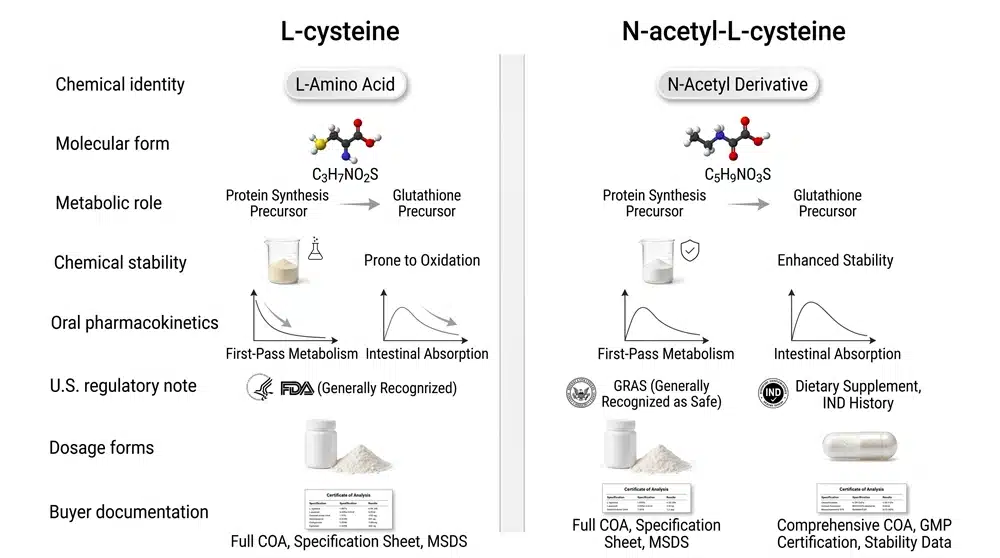
L-Cysteine vs NAC at a Glance
| Yếu tố | L-cysteine | N-Acetyl-L-cysteine (NAC) |
|---|---|---|
| Đó là gì | A sulfur-containing amino acid | An acetylated derivative of L-cysteine |
| Metabolic role | Used directly in proteins and sulfur-amino-acid pathways | Deacetylated and used as a cysteine source in glutathione-related pathways |
| Common ingredient forms | L-cysteine, L-cysteine HCl anhydrous or monohydrate | N-acetyl-L-cysteine / acetylcysteine |
| Xử lý | Reactive thiol; can oxidize to cystine and may have sulfur odor | Often easier to handle than free cysteine, but still requires moisture, odor and impurity control |
| Oral pharmacokinetics | Handled through amino-acid transport and metabolism; product performance depends on the form and formula | Undergoes extensive first-pass metabolism and has low systemic oral bioavailability |
| U.S. regulatory note | Subject to applicable food, supplement and ingredient requirements | FDA currently lists a final enforcement-discretion policy for certain otherwise-lawful NAC products labeled as dietary supplements |
| Primary buyer question | Which molecular form, assay basis and stability specification are required? | Does the material, finished product and claim strategy fit the current market-specific regulatory framework? |
What Is L-Cysteine?
L-cysteine is a conditionally essential amino acid containing a reactive thiol group. It contributes to protein structure, sulfur metabolism and glutathione synthesis. Under normal conditions, the body can produce cysteine from methionine, but nutritional status, life stage and medical conditions can affect requirements.
Commercial materials may be supplied as free L-cysteine, L-cysteine hydrochloride anhydrous or L-cysteine hydrochloride monohydrate. These forms differ in molecular weight, chloride content, water content and assay basis. Buyers should not compare equal ingredient weights without calculating the active L-cysteine equivalent. Review the L-cysteine hydrochloride specification page for form and document considerations.
What Is N-Acetyl-L-Cysteine?
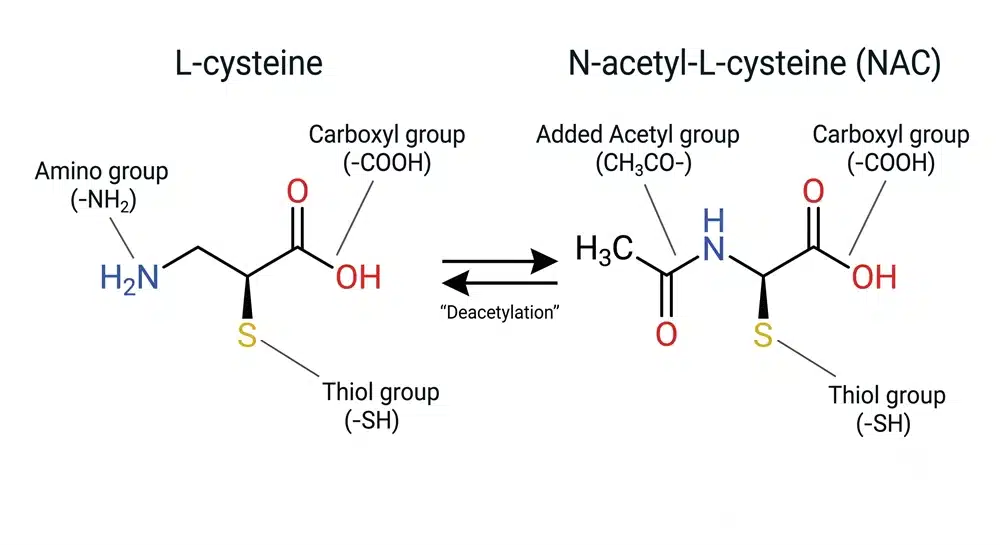
N-acetyl-L-cysteine, commonly abbreviated NAC, is L-cysteine with an acetyl group attached to the nitrogen atom. After administration, NAC can be deacetylated and contribute cysteine to metabolic pathways, including glutathione synthesis.
NAC is also an approved drug ingredient for specific medical uses. That history creates a special U.S. dietary-supplement issue. FDA’s current directory and final guidance describe an enforcement-discretion policy for certain products that would otherwise be lawfully marketed dietary supplements. This is not the same as FDA approval of NAC supplements. Brands sourcing the ingredient can review the N-acetyl-L-cysteine powder specification page.
Is L-Cysteine the Same as NAC?
No. NAC is derived from L-cysteine but is a distinct chemical compound with its own CAS number, molecular weight, assay and impurity profile. The names should not be used interchangeably on a formulation sheet, COA or finished-product label.
N-acetylcysteine, acetylcysteine, N-acetyl-L-cysteine and NAC commonly refer to the same L-form compound in supplement and pharmaceutical contexts, but procurement teams should still verify the exact stereochemistry, chemical name, grade and analytical method.
Chemical Structure and Functional Differences
L-cysteine
L-cysteine contains a free amino group, carboxyl group and thiol group. The thiol can form disulfide bonds that contribute to protein structure. The same reactivity can also increase oxidation risk during raw-material storage and finished-product processing.
NAC
NAC contains an acetylated amino group. Acetylation changes chemical handling and metabolic processing, but it does not prove that NAC is universally absorbed better than free L-cysteine. Chemical stability, gastrointestinal absorption, first-pass metabolism, systemic exposure and pathway support are different concepts.
Glutathione Support: Which Is Better?
Both ingredients can contribute cysteine to glutathione-related metabolism. L-cysteine is the amino acid used directly in glutathione synthesis. NAC is more commonly studied and marketed as a cysteine precursor, but its practical effect depends on dose, route, nutritional status, formula and the population studied.
A supplement may describe support for normal glutathione production or antioxidant pathways only when the finished formula and claim are properly substantiated. Avoid claims such as “detoxes the liver,” “removes toxins,” “treats oxidative stress” or “prevents disease.”
Sự hấp thu và sinh khả dụng
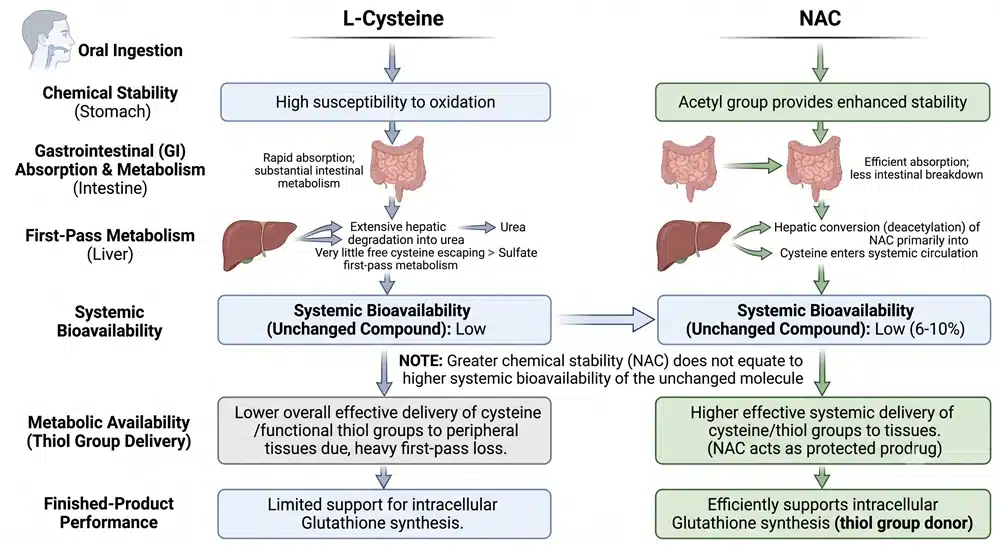
The current page states that NAC has superior bioavailability. That conclusion is not accurate as a universal comparison. Oral NAC undergoes extensive first-pass metabolism, and pharmacokinetic research reports low systemic oral bioavailability. Greater chemical stability does not automatically mean greater unchanged-drug exposure in blood or tissues.
| Concept | Ý nghĩa của điều đó là gì | Why It Should Not Be Confused |
|---|---|---|
| Chemical stability | Resistance to oxidation or degradation during storage and processing | Does not directly measure absorption or clinical effect |
| Hấp thụ | Movement from the gastrointestinal tract into the body | Does not account for extensive metabolism after absorption |
| Systemic bioavailability | Fraction reaching systemic circulation in the measured form | Low unchanged NAC exposure does not mean no metabolic contribution |
| Metabolic availability | Ability to contribute cysteine or downstream metabolites | Depends on pathway, dose and endpoint rather than one generic percentage |
| Finished-product performance | Release, stability and outcome for a specific formula | Cannot be predicted solely from the ingredient name |
The accurate consumer conclusion is that NAC is not automatically “better absorbed” in every comparison. A formula-level decision should consider the exact ingredient form, dose, route, excipients, stability and intended endpoint.
Which One Should Consumers Choose?
| Mục đích sử dụng | Possible Starting Point | Important Limitation |
|---|---|---|
| General amino acid or protein formula | L-cysteine or an appropriate L-cysteine salt | Confirm active-equivalent dose and total sulfur amino acid intake |
| Formula positioned around cysteine availability or glutathione pathways | NAC may be considered where legally appropriate | Do not imply treatment, detoxification or guaranteed glutathione increase |
| Medical treatment or acetaminophen overdose | Clinical acetylcysteine protocol | This is a medical use and not a self-directed supplement application |
| High-dose or multi-product use | Professional review | Combining NAC and cysteine may duplicate exposure without proving greater benefit |
An toàn, tác dụng phụ và tương tác
Oral L-cysteine and NAC can cause gastrointestinal effects such as nausea, abdominal discomfort, vomiting or diarrhea. NAC can have a strong sulfur-like odor that may be normal for the material, but changes in odor, color, moisture or caking should be assessed against the specification and stability data.
People who are pregnant or breastfeeding, have a medical condition, use prescription medicines, have asthma or ulcer-related concerns, or are preparing for surgery should seek qualified professional advice. Brands should not copy contraindications, warnings or dose instructions from prescription acetylcysteine products without medical and regulatory review.
U.S. Regulatory Considerations for NAC
FDA has concluded that NAC was approved as a drug before it was marketed as a dietary supplement or food and therefore is excluded from the statutory dietary-supplement definition. FDA nevertheless maintains a final guidance explaining its intent to exercise enforcement discretion for certain NAC products labeled as dietary supplements that would otherwise be lawfully marketed and are not otherwise in violation of the FD&C Act.
This policy does not mean that NAC supplements are FDA approved, and it does not protect adulterated, misbranded or drug-claim products. Brands should review the latest FDA ingredient directory and guidance before launch, import, label revision or major distribution decisions.
L-Cysteine and NAC Quality Specification Checklist
| Thông số kỹ thuật | Những điều cần kiểm tra | Tại sao điều này lại quan trọng |
|---|---|---|
| Bản sắc | Chemical name, stereochemistry, CAS number and validated identity method | Prevents confusion among cysteine, cystine, NAC and salt forms |
| Molecular form | Free base, hydrochloride, anhydrous, monohydrate or acetylated derivative | Changes molecular weight and active-equivalent calculations |
| Phương pháp định lượng | Percentage, dry or as-is basis and test method | Supports correct formula and label calculations |
| Các chất có liên quan | Cystine, degradation products and process impurities | Shows purity beyond a headline assay |
| Chất dung môi còn lại | Process-specific panel and batch limits | Confirms manufacturing residues are controlled |
| Elemental impurities | Chì, asen, cadmium và thủy ngân | Supports raw-material and finished-product risk review |
| Vi sinh học | Total counts and specified organisms | Supports ingredient release |
| Moisture and physical properties | Water content, particle size, bulk density, flowability, color and odor | Affects stability, filling, compression and sensory quality |
| Origin and process | Production process, country of origin, allergen and GMO statements | Supports sourcing and marketing claims |
| Stability and change control | Retest date, storage, package, finished-product data and supplier-change notification | Protects potency and impurity limits through shelf life |
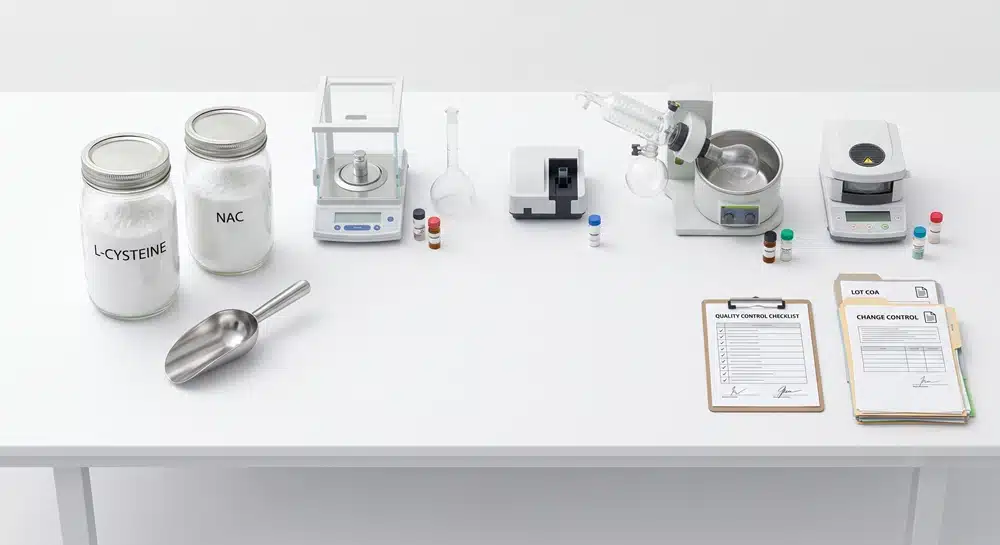
Các yếu tố cần cân nhắc trong việc xây dựng công thức cho các thương hiệu thực phẩm bổ sung
Viên nang
Capsules are common for both ingredients. Formulators should evaluate dose, fill volume, sulfur odor, moisture, flowability, shell compatibility and blend uniformity. GENSEI supports Sản xuất thực phẩm bổ sung dạng viên nang for amino acid and NAC projects.
Máy tính bảng
Tablet development requires compression, disintegration, taste, odor and stability evaluation. High active loading may require suitable binders, lubricants, glidants and moisture-protective packaging.
Bột
Powder formulas must address sulfur odor, taste masking, hygroscopicity, segregation and compatibility with flavors and other active ingredients. Sachet and scoop accuracy should be validated at the finished-product level.
Công thức kết hợp
Glycine, selenium, vitamins or other antioxidant-pathway ingredients may appear in combination formulas. The presence of multiple ingredients does not automatically validate a stronger claim. Review total dose, ingredient overlap, stability, target population and substantiation for the exact finished product.
RFP Questions for an L-Cysteine or NAC Supplier
- What exact chemical form, stereochemistry and assay basis are supplied?
- Is L-cysteine supplied as free form, HCl anhydrous or HCl monohydrate?
- What manufacturing process and country of origin apply?
- Các phương pháp xác định, định lượng và phân tích các chất liên quan nào được sử dụng?
- Quý vị có thể cung cấp ba giấy chứng nhận xuất xứ (COA) gần đây dành riêng cho từng lô hàng được không?
- Which oxidation products, residual solvents, elemental impurities and microbiological tests are controlled?
- What are the particle size, bulk density, flowability, odor and moisture specifications?
- What package, storage conditions and retest period are recommended?
- Số lượng đặt hàng tối thiểu (MOQ), số lượng mẫu, thời gian giao hàng và các điều khoản kiểm soát thay đổi là gì?
- Can you support capsule, tablet or powder pilot development?
- How do you verify finished-product potency and stability?
- For U.S. NAC projects, what regulatory and claim-review support is available?
Vị trí của GENSEI
GENSEI supports amino acid ingredient sourcing, specification matching, dosage-form feasibility, packaging and quality-document review for supplement projects.
Các thương hiệu có thể request an L-cysteine or NAC sample, COA and formulation quotation with the required chemical form, assay, dose, dosage format, destination market, order quantity and launch timeline.
Câu hỏi thường gặp
Is L-cysteine the same as NAC?
No. L-cysteine is an amino acid. NAC is an acetylated derivative that can be converted to cysteine after administration.
Is N-acetylcysteine the same as N-acetyl-L-cysteine?
They commonly refer to the same compound, but specifications should confirm the L-form, CAS number, assay and identity method.
Does NAC have better bioavailability than L-cysteine?
That claim is too broad. NAC may have handling advantages, but oral NAC undergoes extensive first-pass metabolism and has low systemic bioavailability. The relevant comparison depends on the intended metabolic endpoint and finished formula.
Which is better for glutathione support?
Both can contribute cysteine to glutathione-related pathways. NAC is more commonly studied for this purpose, but the appropriate choice depends on dose, formula, evidence, safety and regulatory context.
Can L-cysteine and NAC be taken together?
Combining them can duplicate cysteine exposure and is not automatically more effective. Consumers should follow the label and obtain professional advice when combining supplements or medicines.
Is NAC legal in U.S. dietary supplements?
FDA currently maintains an enforcement-discretion policy for certain otherwise-lawful NAC products labeled as dietary supplements. This is not FDA approval and can be revised or withdrawn.
Điểm chính cần ghi nhớ
L-cysteine and NAC are related but distinct ingredients. L-cysteine is the amino acid itself; NAC is an acetylated derivative used as a cysteine source. A responsible comparison should separate chemical stability from systemic bioavailability, distinguish drug uses from supplement positioning, avoid disease claims and evaluate molecular form, assay, impurities, dosage-form performance and current market-specific regulations.
Tài liệu tham khảo
- FDA: Policy Regarding N-Acetyl-L-Cysteine
- FDA: Information on Select Dietary Supplement Ingredients and Other Substances
- FDA: Label Claims for Conventional Foods and Dietary Supplements
- FTC: Hướng dẫn tuân thủ đối với các sản phẩm chăm sóc sức khỏe
- 21 CFR Phần 111: Thực hành sản xuất tốt hiện hành đối với thực phẩm bổ sung
- Clinical Pharmacokinetics of N-Acetylcysteine
- N-Acetylcysteine: Impacts on Human Health
- Effects of the Usage of L-Cysteine on Human Health

Warren Wan là một chuyên gia dày dạn với kinh nghiệm phong phú trong chuỗi cung ứng thực phẩm bổ sung, sở hữu kinh nghiệm thực tiễn sâu rộng trong nghiên cứu, phát triển, kiểm soát quy trình và tìm nguồn cung ứng toàn cầu các thành phần cốt lõi như peptit collagen, protein từ nước hầm xương và keratin. Với tư cách là tác giả của chuyên mục này, ông cam kết loại bỏ những lớp bao bọc tiếp thị, biến những kiến thức khoa học phức tạp về thành phần và các tiêu chuẩn kiểm soát chất lượng sản xuất thành những nội dung phổ biến khoa học dễ hiểu nhưng sâu sắc, giúp độc giả hiểu rõ sự thật đằng sau các nhãn mác và đưa ra những lựa chọn sức khỏe hợp lý hơn.


