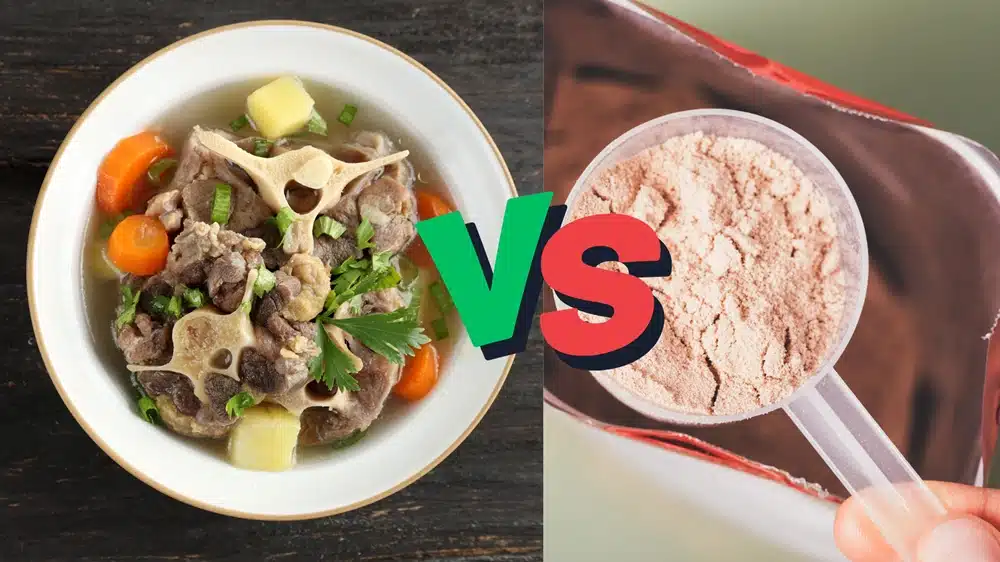
Neither source is universally “better.” The right choice depends on the desired serving size, delivery format, allergen profile, evidence base, target claim, sensory requirements, and supplier documentation. This guide compares the two ingredients for consumers, supplement brands, and formulators without treating different study doses as equivalent.
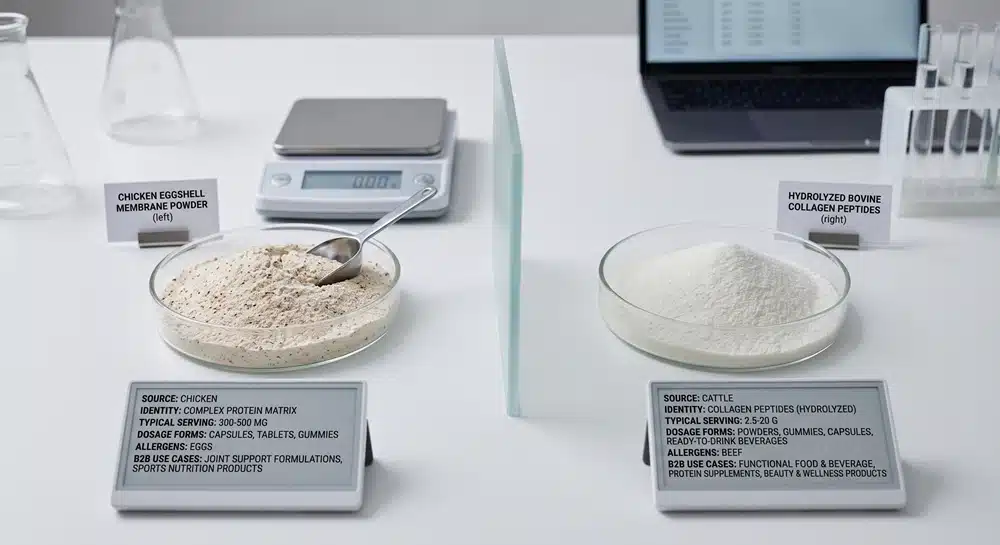
Eggshell Membrane vs Bovine Collagen at a Glance
| Fattore di confronto | Membrana del guscio d'uovo | Peptidi di collagene bovino |
|---|---|---|
| Fonte | Membrane between the chicken eggshell and egg white | Usually bovine hide or bone, depending on the ingredient |
| Identificazione degli ingredienti | A multi-component membrane material; may be whole, processed, hydrolyzed, or sold as egg membrane collagen peptides | Usually enzymatically hydrolyzed collagen protein peptides |
| Typical commercial positioning | Joint comfort, mobility, connective-tissue, skin, or healthy-aging formulas | Skin, joint, beauty, sports nutrition, healthy-aging, and general collagen formulas |
| Common studied serving range | Some human studies used approximately 450-500 mg/day of specific branded preparations | Clinical studies use different products and endpoints; several grams per day are common |
| Apporto proteico | Usually too small to serve as a meaningful daily protein source at typical capsule doses | Can provide several grams of protein or collagen peptides per serving |
| Formati più adatti | Capsules, tablets, gummies, small-dose powders, and combination formulas | Powders, stick packs, beverages, capsules, tablets, gummies, and protein blends |
| Major allergen issue | Egg-derived; allergen review and labeling are essential | Not one of the nine major U.S. food allergens, but source and cross-contact still require review |
| Dietary fit | Animal-derived and not vegan; suitability for ovo-vegetarian positioning must be validated for the target market | Animal-derived and unsuitable for vegan or beef-avoiding consumers |
| Key buying question | What exactly is standardized or measured in the supplied batch? | What are the source, protein result, molecular-weight specification, and traceability documents? |
What Is Eggshell Membrane?
Eggshell membrane is the thin fibrous layer between the mineral shell and the egg white. It contains a network of structural proteins and other naturally occurring compounds, but the composition of a commercial ingredient depends on the raw material, separation method, hydrolysis process, carriers, and analytical methods used by the supplier.
The terms membrana naturale del guscio d'uovo, eggshell membrane powder, membrana di guscio d'uovo idrolizzato, fermented eggshell membrane, e egg membrane collagen peptides should not automatically be treated as synonyms. A buyer should confirm the exact ingredient identity and process in the specification, technical data sheet, and batch certificate of analysis.
Does Eggshell Membrane Contain Collagen?
Yes, eggshell membrane contains collagen-related structural proteins, but an eggshell membrane ingredient is not necessarily equivalent to a purified collagen peptide powder. Exact collagen content and collagen-type statements should be supported by product-specific testing or validated source documentation. A generic statement about the membrane cannot replace batch-level evidence.
Natural, Hydrolyzed, and Fermented Eggshell Membrane
- Natural or minimally processed membrane: Retains a broader membrane matrix but may have different dispersibility and digestibility characteristics.
- Hydrolyzed membrane: Uses enzymatic or other controlled processing to reduce protein size and improve handling or solubility. Molecular-weight claims require a defined test method.
- Fermented membrane: Uses a fermentation-related process. “Fermented” is a process description, not proof of superior absorption or efficacy.
For a commercially documented ingredient, review the bulk eggshell membrane collagen specification page and request the current batch documents rather than relying only on category-level marketing language.
What Is Bovine Collagen?
Bovine collagen is obtained from cattle-derived tissues, commonly hide or bone. Most dietary-supplement products use hydrolyzed bovine collagen peptides, meaning the larger collagen proteins have been broken into smaller peptides. Commercial bovine collagen is typically positioned as a Type I and Type III source, but the exact type ratio may not be measured on a routine certificate of analysis.
Compared with eggshell membrane, bovine collagen peptides are usually supplied and consumed in much larger quantities. This makes them more practical for powders, stick packs, beverages, and formulas designed to deliver several grams of collagen peptides per serving.
Brands evaluating a raw material should review the bovine collagen Type I and III sourcing page and confirm whether the ingredient comes from hide or bone, how it is hydrolyzed, and which identity and traceability documents are available.
Key Differences Between Eggshell Membrane and Bovine Collagen
1. They Are Different Ingredient Categories
The biggest mistake is comparing the two only by the word “collagen.” Eggshell membrane is a matrix ingredient that may include collagen, elastin-related proteins, glycosaminoglycans, and other components. Hydrolyzed bovine collagen is primarily a collagen peptide protein ingredient. The products therefore differ in composition, serving size, formulation behavior, and evidence.
2. Serving Sizes Are Not Gram-for-Gram Equivalent
Several eggshell membrane trials studied specific preparations at approximately 450-500 mg per day. Studies of hydrolyzed collagen use a much wider range, commonly several grams per day depending on the product and endpoint. These numbers do not demonstrate that 500 mg of eggshell membrane is equivalent to 5 or 10 grams of bovine collagen. They describe different ingredients studied for different outcomes.
3. The Evidence Base Is Product- and Outcome-Specific
Eggshell membrane has been studied mainly in joint-comfort, exercise-recovery, skin, and hair contexts. Hydrolyzed collagen peptides have a larger and more varied body of research across skin and joint outcomes. However, studies differ in source, peptide profile, dose, duration, population, and funding. Evidence for one branded ingredient should not automatically be transferred to every generic raw material.
4. Delivery Format Changes the Best Choice
Eggshell membrane can fit into one or two capsules because the studied preparations are generally used at lower serving weights. Bovine collagen works well in powder systems because consumers can take several grams in a drink, food, or stick pack. Capsules are possible, but a high gram-level serving may require many capsules.
5. Allergy and Dietary Positioning Are Different
Eggshell membrane is egg-derived and should be evaluated under egg-allergen requirements. It is not vegan. Bovine collagen is also animal-derived and may not fit consumers who avoid beef for dietary, religious, ethical, or personal reasons. Halal, kosher, grass-fed, pasture-raised, and similar positioning requires specific documentation; the source name alone is not enough.
Evidence: What Human Studies Can and Cannot Tell Us
| Ingrediente | Example evidence | What it may support | Important limitation |
|---|---|---|---|
| Natural eggshell membrane | A randomized trial studied 500 mg/day for joint pain and stiffness | Potential support for joint comfort in the studied population | Results apply to the tested preparation and do not prove superiority over bovine collagen |
| Natural eggshell membrane | An exercise study reported changes in exercise-associated joint discomfort and stiffness | Potential use in active-lifestyle joint formulas | Not a treatment claim and not evidence for ligament healing or cartilage regeneration |
| Hydrolyzed eggshell membrane | A 12-week trial used 450 mg/day and evaluated skin and hair appearance | Potential beauty-from-within positioning for a specific ingredient | Cannot be generalized to all eggshell membrane powders |
| Peptidi di collagene idrolizzati | Systematic reviews include multiple trials evaluating skin hydration, elasticity, and related outcomes | Potential skin-support positioning | Products, doses, peptide profiles, and study quality vary |
| Peptidi di collagene idrolizzati | Reviews and trials evaluate joint comfort and activity-related outcomes | Potential joint-support positioning | Does not establish that bovine collagen repairs injuries or replaces complete dietary protein |
Evidence rule for brands: Match claims to the exact ingredient, serving amount, study population, duration, and measured endpoint. Avoid converting a study result into broader promises such as “repairs the ACL,” “prevents cartilage breakdown,” “heals the gut,” or “works in five days for everyone.”
Qual è la soluzione migliore per i consumatori?
Choose Eggshell Membrane When:
- You prefer a low-volume capsule or tablet instead of a large scoop of powder.
- Your primary goal is a joint-focused or connective-tissue supplement.
- You are not allergic to egg and the product clearly identifies the egg-derived ingredient.
- The label names a studied preparation or the manufacturer provides credible quality documentation.
Choose Bovine Collagen Peptides When:
- You want several grams of collagen peptides in a daily powder or beverage.
- You want a meaningful collagen-protein contribution rather than a small-dose matrix ingredient.
- You prefer a neutral-tasting powder that can be mixed into coffee, smoothies, or foods.
- You are comfortable with a cattle-derived ingredient and have reviewed the source and testing information.
Si possono prendere entrambi?
Some products combine eggshell membrane with bovine or other collagen sources. A combined formula may be reasonable when the serving size, allergen disclosure, and intended use are clear, but there is limited evidence that taking both is automatically better than taking one well-chosen ingredient. Avoid duplicate ingredients across multiple supplements and consult a qualified healthcare professional when you have allergies, medical conditions, take medications, or are pregnant or breastfeeding.
Which Is Better for Supplement Brands and Formulators?
| Idea di prodotto | Better starting option | Perché |
|---|---|---|
| One-capsule joint formula | Membrana del guscio d'uovo | Lower serving weight can fit capsule and tablet formats |
| 10-20 g beauty or sports powder | Peptidi di collagene bovino | Supports a gram-level collagen serving and meaningful protein declaration |
| Multi-ingredient joint gummy | Eggshell membrane or a combination | Lower dose may reduce active-load pressure, but taste and stability must be tested |
| Unflavored stick pack | Peptidi di collagene bovino | Suitable for higher serving weights and beverage dispersion |
| Premium multi-source collagen | Combinazione | Can differentiate the formula, provided each source has a clear role and non-misleading dose |
| Egg-free formula | Peptidi di collagene bovino | Avoids an intentionally added egg-derived ingredient |
For finished-product development, the ingredient decision should be made together with delivery-format requirements. Gensei supports formulazione personalizzata degli integratori, produzione di capsule, e produzione di integratori in polvere.
Specifiche di qualità da verificare prima dell'acquisto
For Eggshell Membrane
- Exact ingredient name: whole membrane, hydrolyzed membrane, collagen peptides, or a branded preparation
- Chicken source and egg-allergen statement
- Separation, hydrolysis, fermentation, and drying process
- Protein method and result
- Any claimed glycosaminoglycan, hyaluronic-acid, collagen, or collagen-type values, including test methods
- Molecular-weight distribution when a low-molecular-weight claim is used
- Residual processing enzymes, carriers, flow agents, and other excipients
- Moisture, ash, microbiology, heavy metals, and relevant contaminants
- Stability and sensory data for the intended dosage form
For Bovine Collagen Peptides
- Hide or bone origin and country/source traceability
- Bovine health, veterinary, BSE/TSE, halal, kosher, or grass-fed documents when required
- Protein result and analytical method
- Molecular-weight specification and method
- Solubility, bulk density, particle size, color, odor, and taste
- Moisture, ash, microbiology, heavy metals, and relevant contaminants
- Type I/III substantiation and whether the claim is source-based or analytically measured
- Packaging, storage, shelf life, MOQ, lead time, and change-control process
Request a current, batch-specific certificate of analysis and compare it with the product specification. A supplier’s marketing page is not a substitute for qualification documents. Review Gensei’s processo di controllo della qualità degli integratori and the broader bulk collagen peptide ingredient portfolio.
Supplier Questions for a Technical RFP
- What is the exact raw-material identity and animal tissue source?
- Is the ingredient whole, hydrolyzed, fermented, enzymatically treated, or blended with carriers?
- Which values are routinely reported on every batch COA?
- Which health or composition claims are supported by the exact commercial ingredient?
- Can you provide allergen, traceability, GMP, specification, SDS, stability, and test-method documents?
- What serving amount has been used in finished-product prototypes?
- How does the ingredient perform in capsules, tablets, gummies, powders, and beverages?
- What are the MOQ, sample size, lead time, packaging, and change-notification terms?
- Can you support target-market claim review and label documentation?
Sustainability: Avoid Unsupported Shortcuts
Eggshell membrane and bovine hides can both be recovered from existing food-industry streams. This may support an upcycling narrative, but it does not prove that one finished ingredient has a lower environmental footprint. Processing energy, water, yield, transportation, dosage, packaging, and allocation methods all affect the result. Use supplier-specific life-cycle data before making quantified sustainability claims.
Considerazioni relative alla sicurezza e all'etichettatura
- Egg allergy: Eggshell membrane is egg-derived. Products must be assessed for applicable allergen labeling and cross-contact controls.
- Gravidanza e allattamento: Product-specific safety data may be limited. The 2025 EFSA opinion evaluated a particular egg membrane collagen peptide ingredient for adults while excluding pregnant and lactating women from the proposed supplement use.
- Condizioni mediche e farmaci: Consumers should discuss new supplements with a qualified healthcare professional when relevant.
- Richieste: Use “supports joint comfort,” “supports mobility,” or similarly qualified structure/function language only when substantiated. Do not claim to diagnose, treat, cure, or prevent disease or injury.
- Third-party testing: Brands should verify identity, purity, contaminants, and label accuracy through appropriate supplier and finished-product controls.
Domande frequenti
Is eggshell membrane the same as collagen peptides?
No. Eggshell membrane is a multi-component egg-derived matrix. Some products are hydrolyzed into egg membrane collagen peptides, but ingredient identity and composition vary. Standard bovine collagen peptides are usually a more concentrated collagen-protein ingredient.
What types of collagen are in eggshell membrane?
Eggshell membrane is often marketed as containing several collagen types, including Types I, V, and X. Exact type claims should be supported by the commercial ingredient’s technical documentation rather than assumed from general literature.
Is eggshell membrane collagen vegetarian?
It is animal-derived and not vegan. Some ovo-vegetarians may accept egg-derived ingredients, but “vegetarian” positioning depends on consumer expectations, certification, and target-market rules. Clear egg-source disclosure is safer than a broad vegetarian claim.
What are the side effects of eggshell membrane collagen?
Human studies of specific preparations generally reported good tolerability, but egg allergy is the most important concern. Product-specific excipients and processing aids can also matter. Stop use and seek medical advice if an allergic reaction or other adverse effect occurs.
Is eggshell membrane as effective as bovine collagen?
There is no universal answer because they are different ingredients studied at different doses and for different endpoints. Eggshell membrane may fit low-dose joint-focused products, while bovine collagen is better suited to gram-level collagen peptide formulas. Direct head-to-head evidence is limited.
Is fermented eggshell membrane better than natural eggshell membrane?
Not automatically. Fermentation changes the process and may affect handling or peptide characteristics, but superiority requires comparative data on the exact ingredients. Review molecular-weight, composition, stability, and human evidence rather than relying on the word “fermented.”
Which option is usually more economical?
Compare cost per substantiated daily serving, not price per kilogram alone. Eggshell membrane may cost more per kilogram but use a smaller serving. Bovine collagen may be less expensive per kilogram but require several grams. Finished-product cost also depends on dosage form, packaging, flavoring, testing, and MOQ.
Raccomandazione finale
Choose eggshell membrane for a documented, low-dose, joint-focused ingredient that fits capsules or combination formulas. Choose bovine collagen peptides when the product needs a gram-level collagen serving, a meaningful protein contribution, or a versatile powder format. Consider a combination only when each ingredient has a clear role, the doses are transparent, and the claims are supported.
I marchi di integratori possono contattare Gensei to request current COAs, specifications, samples, MOQ information, and formulation support for eggshell membrane and bovine collagen ingredients.
Riferimenti
- Eggshell membrane in the treatment of pain and stiffness from osteoarthritis of the knee: a randomized, multicenter, double-blind, placebo-controlled clinical study
- Beneficial effects of natural eggshell membrane versus placebo in exercise-induced joint pain, stiffness, and cartilage turnover
- A randomized double-blind placebo-controlled clinical trial evaluating hydrolyzed eggshell membrane for skin and hair
- EFSA safety opinion on egg membrane collagen peptides as a novel food
- Integrazione orale di collagene: Una revisione sistematica delle applicazioni dermatologiche
- Effects of hydrolyzed collagen supplementation on skin aging: a systematic review and meta-analysis
- Collagen Supplementation for Joint Health: The Link between Composition and Scientific Knowledge
- U.S. FDA overview of major food-allergen labeling requirements

Warren Wan è un esperto di grande esperienza nel settore della filiera degli integratori alimentari, con una vasta esperienza pratica nella ricerca, nello sviluppo, nel controllo dei processi e nell’approvvigionamento globale di ingredienti fondamentali quali i peptidi di collagene, le proteine del brodo d’ossa e la cheratina. In qualità di autore di questa rubrica, si impegna a smascherare le strategie di marketing, trasformando la complessa scienza degli ingredienti e gli standard di controllo della qualità della produzione in una divulgazione scientifica approfondita e di facile comprensione, aiutando i lettori a comprendere la verità che si cela dietro le etichette e a compiere scelte più razionali in materia di salute.