
Softgels are one-piece, sealed capsules commonly used for oils, liquid nutrients and suspended ingredients. For a broader introduction to the dosage form, see our Guida agli integratori in capsule molli.

Are Most Softgel Capsules Vegetarian?
No. A conventional softgel shell is usually made from gelatin, water and a plasticizer such as glycerin or sorbitol. Gelatin is produced from animal collagen, commonly from bovine, porcine or fish sources. A softgel made with any of these gelatin sources is not vegetarian or vegan.
However, the word softgel describes the dosage form, not a required ingredient. Manufacturers can produce animal-free softgel shells with systems based on modified starches, carrageenan and other plant-derived or fermentation-derived materials. The exact composition varies by supplier and formula, so the label and technical documentation matter more than the capsule’s appearance.
What Are Traditional Softgel Shells Made Of?
Traditional softgel shells generally contain three core components:
- Gelatina: the film-forming protein that gives the shell strength and elasticity.
- Acqua: used during preparation and processing of the gel mass.
- Plasticizer: commonly glycerin, sorbitol or a related polyol, used to keep the shell flexible rather than brittle.
Colorants, opacifiers, flavors, preservatives or other processing ingredients may also be present. The shell formula must be compatible with the liquid or semisolid fill throughout encapsulation, drying and shelf life. Our guide to what supplement capsules are made of explains how softgels differ from two-piece hard capsules.
Why Gelatin Makes a Softgel Non-Vegetarian
Gelatin is obtained through partial hydrolysis of collagen from animal tissues. Bovine gelatin comes from cattle, porcine gelatin comes from pigs, and fish gelatin comes from fish. Fish gelatin may fit certain religious or sourcing preferences, but it is still animal-derived and is not vegetarian or vegan.
Does Glycerin Determine Whether a Softgel Is Vegetarian?
Not by itself. Glycerin can be produced from plant, animal or synthetic sources. A label that lists only “glycerin” may not disclose the source. “Vegetable glycerin” is a stronger indicator of plant origin, but an animal-free plasticizer does not make the full product vegetarian if the shell contains gelatin or the fill contains fish oil, animal-derived vitamin D3 or another animal ingredient.
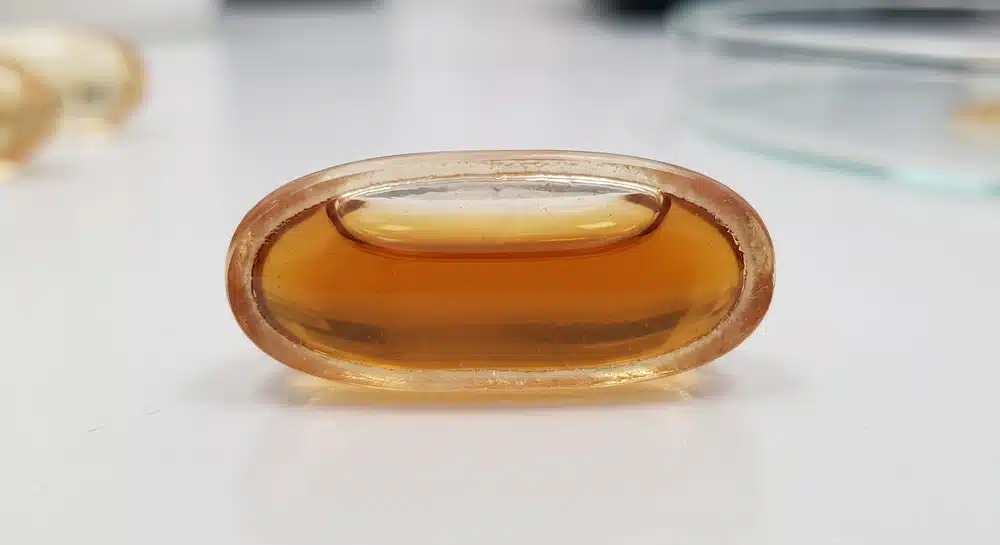
What Are Vegetarian and Vegan Softgels Made Of?
Plant-based softgel shells are often formulated with modified starches, carrageenan and plant-sourced plasticizers. Depending on the technology, manufacturers may use tapioca, corn, potato or other starch sources combined with gelling agents and water.
Distituzione importante: HPMC and pullulan are widely used for two-piece vegetarian hard capsules. They should not automatically be described as the standard materials for one-piece softgels. A brand should confirm the actual dosage form and shell technology with its capsule or softgel supplier.
Modified-Starch Softgels
Modified starch can provide the film structure needed for an animal-free softgel. It may be combined with carrageenan, gums or other functional ingredients to achieve elasticity, sealing and drying performance. The source and modification method should be documented when a brand plans to make vegan, non-GMO, allergen or religious-compliance claims.
Carrageenan-Based Softgels
Carrageenan is a seaweed-derived polysaccharide that can support gel formation in plant-based shell systems. It is usually part of a multi-ingredient shell rather than the only structural material. Performance depends on the complete formulation, processing conditions, fill compatibility and packaging system.
Gelatin vs Vegetarian Softgels: Key Differences
| Fattore | Traditional Gelatin Softgel | Vegetarian or Vegan Softgel | Cosa verificare |
|---|---|---|---|
| Primary shell base | Animal-derived gelatin | Often modified starch plus carrageenan or another non-animal system | Raw-material identity and supplier specification |
| Vegetarian suitability | No | Potentially, if the entire shell and fill are animal-free | Shell, plasticizer, active ingredients and processing aids |
| Adatto ai vegani | No | Possible, but must meet the chosen vegan standard | Certification scope and animal-testing or cross-contact policies where relevant |
| Manufacturing maturity | Long-established and widely available | Requires supplier-specific formulation and processing expertise | Pilot runs, seam quality, drying and scale-up data |
| Fill compatibility | Product-specific; some fills can promote migration or cross-linking | Product-specific; starch and carrageenan systems also have compatibility limits | Accelerated and real-time stability data |
| Religious claims | Depend on animal source and certification | Not automatic | Valid Halal or Kosher certification for the full product |
| Non-GMO claim | Not determined by gelatin alone | Not automatic for plant-derived starch | Identity-preserved sourcing and claim documentation |
| Cost and MOQ | Often more standardized | May require specialized materials and larger validation effort | Project-specific quote, MOQ and lead time |
How to Tell Whether a Softgel Is Vegetarian
1. Read the “Other Ingredients” List
In the United States, capsule-shell ingredients and other non-dietary ingredients are generally declared in the ingredient list. Look for terms such as gelatin, bovine gelatin, porcine gelatin or fish gelatin. These indicate an animal-derived shell.
Possible plant-based indicators include modified food starch, tapioca starch, carrageenan, vegetable glycerin and purified water. These terms are helpful, but they do not by themselves verify the source of every ingredient or the status of the fill.
2. Check the Active Fill, Not Only the Shell
A plant-based shell can contain a non-vegetarian fill. Common examples include fish oil, krill oil, gelatin-based carriers and some animal-derived nutrient sources. Conversely, an algal oil or plant oil may be placed in a gelatin shell. The dietary status depends on the complete finished product.
3. Do Not Rely on Capsule Color or Transparency
Clear, amber, opaque and colored softgels can all be made with either animal-derived or non-animal shell systems. Appearance is not a reliable way to identify vegetarian status.
4. Review Certification Scope
A vegan, vegetarian, Halal or Kosher logo should be checked for the certifying body and the exact product covered. A supplier certificate for one shell ingredient is not the same as finished-product certification.
5. Ask the Brand or Manufacturer for Source Documentation
When the label is unclear, ask for the shell composition, glycerin source, fill-ingredient sources and relevant certifications. For strict dietary, ethical or religious requirements, documented verification is more reliable than marketing language.

Vegetarian vs Vegan Softgels: Are They the Same?
Not always. “Vegetarian” and “vegan” can be used differently by brands and certification programs. A vegetarian claim may permit ingredients that a vegan standard does not. Brands should define the intended claim before formulation and confirm the requirements of the selected certifier and target market.
Halal, Kosher and non-GMO claims are separate from vegetarian or vegan status. A plant-based softgel is not automatically certified for any of these claims.
Are Vegetarian Softgels Better Than Gelatin Softgels?
Neither shell type is universally better. The correct choice depends on the target consumer, fill chemistry, stability requirements, certification strategy, production scale, cost and packaging conditions.
- Choose gelatin softgels when the brand does not need a vegetarian claim and the shell performs well with the intended fill and stability profile.
- Choose vegetarian or vegan softgels when animal-free positioning is essential and the selected shell has been validated with the actual fill, packaging and storage conditions.
For a dosage-form comparison beyond dietary status, review softgels vs hard capsules.
What Supplement Brands Should Verify Before Using Vegan Softgels
A brand should treat “vegan softgel” as a documented product specification, not only a marketing phrase. Before approving a formula, request the following:
- Complete shell formula: structural polymer, plasticizer, water, colors, opacifiers and processing aids.
- Source declarations: plant, fermentation, mineral, synthetic or animal origin for each relevant component.
- Fill compatibility data: evidence that the oil, suspension or semisolid fill will not weaken the seam, migrate into the shell or change disintegration performance.
- Finished-product stability: appearance, leakage, moisture, assay, oxidation markers where relevant, disintegration or dissolution and package compatibility.
- Documenti di qualità: specifications, COAs, allergen statements, contaminant testing and manufacturing controls.
- Claim substantiation: documentation supporting vegan, vegetarian, non-GMO, Halal, Kosher or other label claims.
- Commercial requirements: MOQ, pilot-batch options, lead time, tooling, colors, shapes, packaging and change-control procedures.
Brands developing oil-based or liquid-filled supplements can review the processo di produzione delle capsule molli prima di richiedere un preventivo.
Consumer and Brand Decision Guide
| Your Situation | Recommended Action |
|---|---|
| You avoid all animal-derived ingredients | Choose a product with a clearly animal-free shell and fill, supported by a vegan claim or documentation. |
| The label lists gelatin | Treat the product as non-vegetarian unless a qualified dietary authority defines your personal practice differently. |
| The label lists vegetable glycerin but does not identify the shell polymer | Ask the brand whether the structural shell material contains gelatin. |
| You need Halal or Kosher compliance | Look for current finished-product certification; do not infer compliance from “vegetarian.” |
| You are formulating a vegan supplement | Lock the claim standard first, then select shell and fill materials and validate the finished dosage form. |
| You need an OEM partner | Compare shell technologies, pilot capability, testing, MOQ and documentation with a qualified produttore di capsule softgel. |
Domande frequenti
Are soft gelatin capsules veg or non-veg?
Soft gelatin capsules are non-vegetarian because gelatin is derived from animal collagen. The source may be bovine, porcine or fish.
Are all softgel capsules made with gelatin?
No. Gelatin is the traditional shell material, but animal-free softgels can use modified starch, carrageenan and other non-animal shell systems.
Are vegan softgels the same as vegetarian capsules?
No. “Vegetarian capsules” often refers to two-piece hard capsules made with HPMC or pullulan. Vegan softgels are one-piece, flexible capsules made with a different shell and encapsulation process.
Is fish gelatin vegetarian?
No. Fish gelatin is animal-derived and is not suitable for vegetarian or vegan products.
Does vegetable glycerin make a softgel vegan?
No. Vegetable glycerin confirms only the likely source of one component. The shell polymer, active fill, carriers, colors and processing aids must also be animal-free.
Can omega-3 softgels be vegan?
Yes, when the omega-3 is sourced from algae or another acceptable non-animal source and the shell and all supporting ingredients meet the chosen vegan standard.
Are vegetarian softgels automatically Halal or Kosher?
No. Vegetarian composition may simplify sourcing, but Halal and Kosher are separate certification systems with their own ingredient and manufacturing requirements.
Is cellulose gel vegetarian?
Cellulose-derived HPMC is generally used as a vegetarian material for hard capsules. The phrase “cellulose gel” alone may not identify the full dosage-form composition, so verify the complete ingredient list and product type.
Conclusione
Most traditional capsule softgel are not vegetarian because they use animal-derived gelatin. Animal-free softgels are available, but a reliable decision requires checking the complete shell, plasticizer, fill ingredients and certification scope. Consumers should read the “Other Ingredients” list and contact the brand when sources are unclear. Supplement companies should define the intended claim first and validate the shell technology with the actual formula, packaging and target market.
Riferimenti
- U.S. FDA: Questions and Answers on Dietary Supplements
- U.S. FDA: Dietary Supplement Labeling Guide, Ingredient Labeling
- U.S. FTC: Health Products Compliance Guidance
- Formulazione di shell in capsule di gelatina morbida: progettazione e caratterizzazione
- Enzymes in the Dissolution Testing of Gelatin Capsules
- Are Your Capsules Vegetarian or Nonvegetarian?

Warren Wan è un esperto di grande esperienza nel settore della filiera degli integratori alimentari, con una vasta esperienza pratica nella ricerca, nello sviluppo, nel controllo dei processi e nell’approvvigionamento globale di ingredienti fondamentali quali i peptidi di collagene, le proteine del brodo d’ossa e la cheratina. In qualità di autore di questa rubrica, si impegna a smascherare le strategie di marketing, trasformando la complessa scienza degli ingredienti e gli standard di controllo della qualità della produzione in una divulgazione scientifica approfondita e di facile comprensione, aiutando i lettori a comprendere la verità che si cela dietro le etichette e a compiere scelte più razionali in materia di salute.


