
This guide is for consumers comparing supplement formats and for supplement brands, formulators and procurement teams choosing a dosage form. Softgels usually fit oil-based formulas; hard capsules usually fit dry blends. Products with modified-release, enteric or special handling instructions require label-specific or professional guidance.
Brands that need a formula-specific recommendation should begin with a feasibility review from a produttore di integratori con formula personalizzata rather than choosing a format only from general marketing claims.
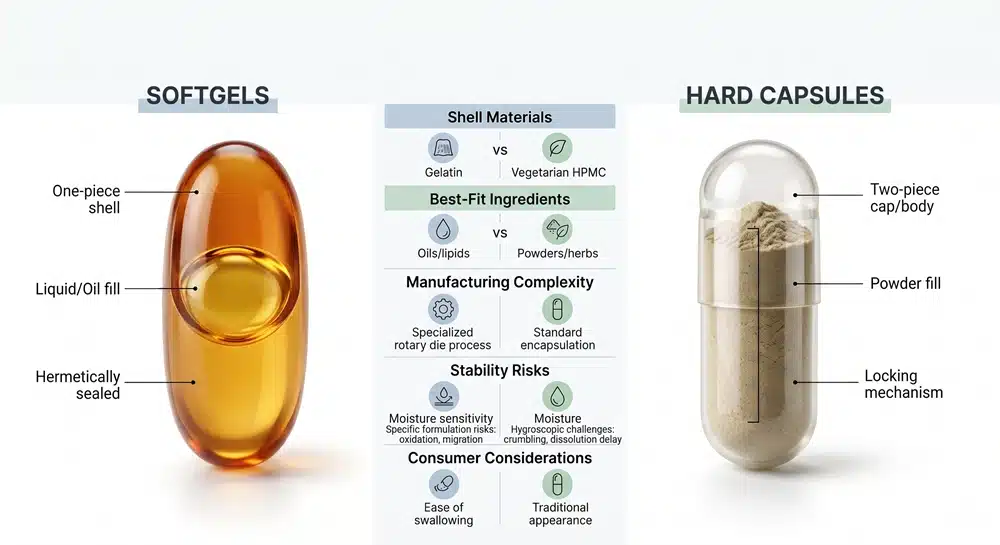
Softgels vs Capsules at a Glance
| Fattore | Capsule molli | Capsule rigide |
|---|---|---|
| Struttura | One-piece, flexible and sealed shell | Scocca in due pezzi (calotta e corpo) |
| Riempimento tipico | Oils, non-aqueous liquids, solutions, suspensions or semi-solids | Powders, granules, pellets, mini-tablets and selected compatible liquid fills |
| Common shell materials | Gelatin or selected plant-based softgel systems | Gelatin, HPMC or pullulan |
| Best-known use cases | Olio di pesce, vitamina D, vitamin E, CoQ10 and other oil-compatible formulas | Herbal blends, probiotics, minerals, amino acids and multi-ingredient powders |
| Assorbimento | May help when an ingredient is appropriately dissolved or dispersed in a suitable vehicle | Can perform well when the ingredient, particle size, excipients and disintegration are properly designed |
| Opening the dosage form | Not intended to be opened, cut or chewed | Some immediate-release capsules may be opened only when the label or a healthcare professional confirms this is appropriate |
| Complessità produttiva | Requires fill-shell compatibility, encapsulation, drying and leak control | Usually more flexible for dry blends and smaller development runs |
| Primary quality risks | Leakage, cross-linking, fill migration, oxidation, shell deformation and moisture imbalance | Weight variation, segregation, poor flow, shell brittleness, delayed disintegration and moisture sensitivity |
Che cos’è una capsula molle?
A softgel is a one-piece capsule in which the shell is formed, filled and sealed during the same manufacturing operation. The fill is commonly an oil, a non-aqueous solution, a suspension or a semi-solid system. Softgels are often selected for lipophilic ingredients, odor masking and sealed liquid delivery.
A softgel is a type of capsule, but it is not the same as a standard two-piece hard capsule. Its shell, filling process, equipment, drying process and quality tests are different. Brands can review produzione di capsule softgel when evaluating liquid-fill feasibility.
What Is a Hard Capsule?
A hard capsule normally consists of a body and cap that are manufactured separately and joined after filling. Most supplement hard capsules contain powders, granules, pellets or beadlets. Depending on the shell, fill and equipment, selected non-aqueous liquids or semi-solids may also be suitable.
Hard capsules are commonly chosen when a formula needs multiple powdered ingredients, flexible shell options, faster formulation changes or lower development complexity. Review produzione di integratori in capsule for shell, size and filling options.
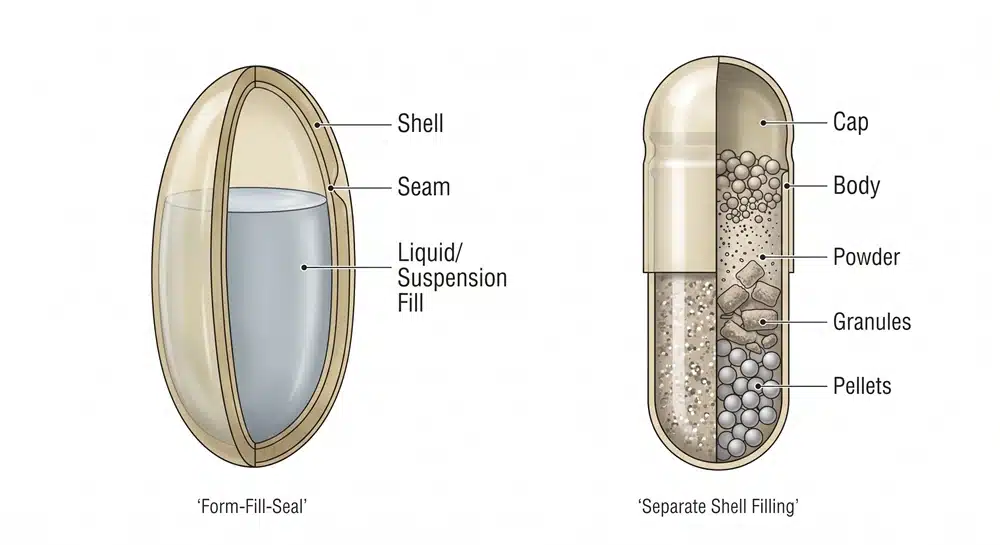
Softgel vs Capsule: The Key Differences
1. Fill Type and Formula Compatibility
The first decision should be based on the physical form and chemistry of the formula. Oil-based and fat-soluble ingredients may fit naturally into a softgel system. Dry botanical, mineral, amino acid and probiotic blends usually fit a hard capsule more easily.
The category is not absolute. A poorly designed oil suspension can fail in a softgel, while a properly engineered powder can disperse and release efficiently from a hard capsule. Formulators should evaluate solubility, particle size, dose, water activity, viscosity, oxidation risk and shell compatibility.
2. Shell Composition
Traditional softgels commonly use gelatin with plasticizers such as glycerin or sorbitol. Plant-based softgel systems are available, but their processing windows, cost and stability requirements differ. Hard capsules are commonly available in gelatin, hydroxypropyl methylcellulose (HPMC) and pullulan.
“Vegetarian” and “vegan” claims require verification of the complete shell system, processing aids, colors and fill ingredients. Brands should request shell specifications, source declarations and certification scope rather than relying on appearance or a generic “veggie” statement.
3. Absorption and Bioavailability
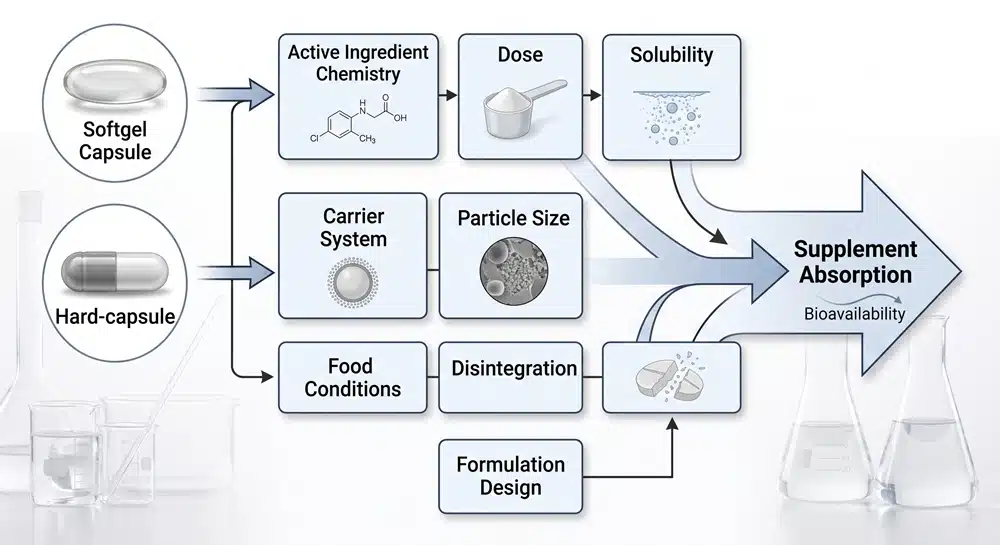
Softgels are not automatically more bioavailable than hard capsules. A dosage form can influence release, but absorption depends on the active ingredient, chemical form, dose, vehicle, particle size, excipients, food conditions and study design.
A softgel may be advantageous when a poorly water-soluble ingredient is dissolved or dispersed in an appropriate lipid vehicle. A hard capsule may perform equally well when it contains a readily soluble ingredient or a well-engineered powder. Research on one ingredient or finished product should not be generalized to all softgels.
4. Stability and Shelf Life
Softgel stability depends on both the fill and shell. Oxygen-sensitive oils may benefit from a sealed dosage form, but the finished product still requires appropriate antioxidant strategy, headspace control, packaging and storage. Softgel shells can be affected by heat, humidity, cross-linking and fill-shell interactions.
Hard capsules can also be moisture-sensitive. Gelatin shells may become brittle under very dry conditions, while hygroscopic fills can transfer moisture to or from the shell. HPMC can be useful for selected moisture-sensitive formulas, but the decision must be confirmed through finished-product stability testing.
5. Swallowing and Consumer Experience
Many consumers find smooth softgels easy to swallow when the shape and size are appropriate. Hard capsules can also be easy to swallow and may be lighter. Ease of swallowing should not be assumed from the dosage-form name alone.
Brands should evaluate capsule dimensions, shape, fill weight, serving count and target population. Large oil doses can require large softgels or multiple units, while high-volume powders can require large hard capsules or several capsules per serving.
6. Cost, MOQ and Lead Time
Softgel development normally requires specialized equipment, a compatible fill, shell formulation, tooling, drying and leak testing. This can increase development time, MOQ and cost. Hard capsules are often more flexible for dry formulas and pilot runs, although difficult-flowing or high-dose powders can also require substantial development.
Manufacturers should quote the complete project: formula development, shell material, tooling, testing, packaging, minimum batch size, stability work and change-control requirements—not only unit price.
Are Softgels Better Than Capsules?
Softgels are usually the stronger starting option for compatible oil-based formulas, selected fat-soluble ingredients, odor masking and sealed liquid delivery. Hard capsules are usually the stronger starting option for dry multi-ingredient blends, probiotics, herbs, minerals and projects requiring broad shell or batch-size flexibility.
- Choose a softgel when the active can be stably dissolved or suspended in a compatible oil or non-aqueous vehicle.
- Choose a hard capsule when the active is a stable powder, granule or pellet and the required dose fits an acceptable capsule size and serving count.
- Run comparative development when absorption, stability or consumer preference is commercially important and cannot be predicted from ingredient data alone.
CoQ10 Softgel vs Capsule
CoQ10 is a useful example because its performance depends strongly on formulation. An oil-based softgel can be appropriate when CoQ10 is dissolved or maintained in a suitable dispersion. A hard capsule may use powder engineering, crystal control or another delivery technology.
For a meaningful comparison, check whether the products contain ubiquinone or ubiquinol, the carrier system, serving size, storage conditions and human bioavailability evidence for the exact marketed formula. Do not use CoQ10 research to make a universal claim about every softgel.
Can You Open or Chew Softgels and Capsules?
Softgels are designed to be swallowed whole. Cutting, chewing or opening them can release an unpleasant or unstable liquid, create dosing errors and damage a formulation designed to remain sealed.
Some immediate-release hard capsules can be opened, but not all should be. Do not open delayed-release, enteric-coated, modified-release or irritation-sensitive products unless the label or a qualified healthcare professional specifically confirms that it is appropriate.
Softgel and Capsule Formulation Matrix for Brands
| Scenario della Formula | Likely Starting Format | Domande sullo sviluppo |
|---|---|---|
| Fish oil or botanical oil | Capsula molle | Oxidation limits, fill viscosity, antioxidant system, shell compatibility and odor control |
| Vitamin D or vitamin E in oil | Softgel or compatible liquid-filled capsule | Potency uniformity, carrier oil, overage, light protection and stability |
| CoQ10 | Softgel or engineered hard capsule | Solubility, crystal control, active form, carrier and matching bioavailability evidence |
| Herbal powder blend | Capsula rigida | Bulk density, flow, particle size, dose fit and capsule size |
| Probiotic blend | Capsula rigida | Moisture, oxygen, shell choice, end-of-shelf-life count and packaging |
| Mineral formula | Hard capsule or tablet | Elemental dose, fill volume, excipients and serving count |
| Mixed oil and powder actives | Feasibility study required | Suspension stability, settling, dose uniformity, shell interaction and alternative formats |
Specifiche di qualità da verificare
Softgel Quality Checks
- Fill identity, potency and homogeneity
- Shell composition, origin and plasticizer system
- Seam integrity, leakage and visual defects
- Fill weight and dosage-unit uniformity
- Disintegration or dissolution, where appropriate
- Moisture balance and gelatin cross-linking risk
- Oxidation markers for oil formulas
- Microbiology, heavy metals and product-specific contaminants
- Accelerated and real-time stability in the final package
Hard Capsule Quality Checks
- Raw-material identity and potency
- Blend uniformity and segregation risk
- Flowability, bulk density and fill-weight variation
- Capsule size, shell type and closure integrity
- Disintegration or dissolution, where appropriate
- Moisture compatibility between fill and shell
- Microbiology, heavy metals and product-specific contaminants
- Finished-product potency through shelf life
A documented processo di controllo della qualità degli integratori should connect raw-material review, in-process controls, finished-product testing and batch records.
RFP Questions to Ask a Softgel or Capsule Manufacturer
- Which format do you recommend for this formula, and what compatibility data supports the recommendation?
- What shell materials, sizes, shapes and colors are available?
- Can you manufacture gelatin, vegetarian or vegan options, and how are those claims documented?
- What are the minimum pilot quantity, commercial MOQ and expected lead time?
- Which formulation, tooling and stability fees are separate from the unit price?
- How do you test fill weight, potency, uniformity, disintegration, leakage and microbial quality?
- How are oxidation-sensitive oils protected during processing and packaging?
- What packaging is recommended for heat, humidity, light and oxygen control?
- Can you provide master manufacturing records, batch production records and lot-specific COAs?
- How do you review labels and structure/function claims before production?
- What change-control process applies if an ingredient, shell material or supplier changes?
- Can you support both formats if the product line later expands?
Il ruolo di GENSEI
GENSEI supports custom and private label softgels, powder-filled hard capsules, formula evaluation, packaging and project-specific quality testing.
Brands comparing formats can request a softgel or capsule feasibility review and quotation with the ingredient list, target dose, preferred shell, destination market, packaging, order quantity and launch timeline.
Domande frequenti
Is a softgel a capsule?
Yes. A softgel is a one-piece, sealed type of capsule. A standard hard capsule is normally a two-piece shell.
What is the difference between softgels and capsules?
Softgels usually hold oils, liquids or suspensions in a flexible sealed shell. Hard capsules usually hold powders, granules or pellets in a two-piece shell.
Do softgels absorb faster than capsules?
Not always. A softgel may improve release when an ingredient is properly dissolved or dispersed, but absorption depends on the exact active, vehicle, dose, excipients and study conditions.
Are softgels easier to swallow?
Many people find their smooth shape easy to swallow, but size and shape matter. A small hard capsule may be easier than a large softgel for some users.
Are softgels vegetarian?
Traditional softgels commonly use animal-derived gelatin. Plant-based softgel systems exist, but consumers and brands should verify the complete shell specification and claim documentation.
Can softgels be opened or chewed?
They are intended to be swallowed whole. Opening or chewing can cause dose loss, unpleasant taste and stability problems.
Which is cheaper to manufacture?
Hard capsules are often less complex for dry formulas and smaller runs. Softgel costs depend on fill development, shell system, tooling, drying, testing, MOQ and packaging.
Conclusione
The softgel-versus-capsule decision should not be reduced to “faster absorption” or “easier swallowing.” Softgels are engineered for compatible liquids, oils, suspensions and semi-solids; hard capsules offer broad flexibility for dry ingredients and multi-ingredient blends. The right choice is the format that delivers the target dose, remains stable in the final package, meets consumer and dietary requirements, can be manufactured consistently and is supported by appropriate quality testing.
Riferimenti
- FDA: Domande e risposte sugli integratori alimentari
- 21 CFR Parte 111: Buone pratiche di fabbricazione (GMP) per gli integratori alimentari
- FTC: Linee guida sulla conformità dei prodotti per la salute
- Challenges of Dissolution Methods Development for Soft Gelatin Capsules
- Cross-Linking of Gelatin Capsules and Its Relevance to Dissolution and Bioavailability
- Absorption of Folic Acid from a Softgel Capsule Compared with a Tablet
- Bioavailability of Coenzyme Q10: An Overview of the Absorption Process and Subsequent Metabolism

Warren Wan è un esperto di grande esperienza nel settore della filiera degli integratori alimentari, con una vasta esperienza pratica nella ricerca, nello sviluppo, nel controllo dei processi e nell’approvvigionamento globale di ingredienti fondamentali quali i peptidi di collagene, le proteine del brodo d’ossa e la cheratina. In qualità di autore di questa rubrica, si impegna a smascherare le strategie di marketing, trasformando la complessa scienza degli ingredienti e gli standard di controllo della qualità della produzione in una divulgazione scientifica approfondita e di facile comprensione, aiutando i lettori a comprendere la verità che si cela dietro le etichette e a compiere scelte più razionali in materia di salute.


