For consumers, choose a product that clearly states protein per serving and fits your diet and tolerance. For supplement brands and formulators, compare lot-specific specifications rather than relying on generic claims that one source is “complete,” easier to digest or superior for muscle building.
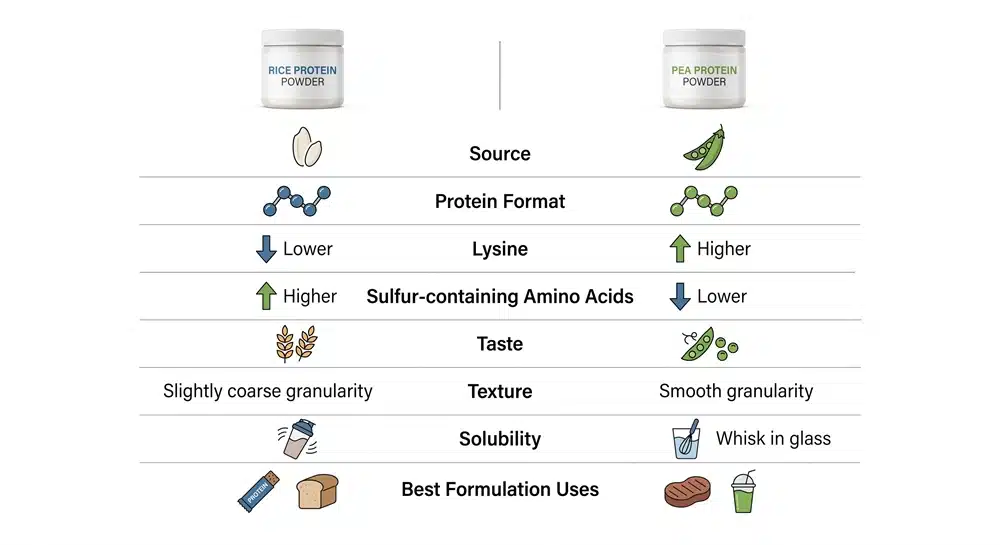
Rice Protein vs Pea Protein at a Glance
| ファクター | ライスプロテイン | ピープロテイン | 製剤上の考慮事項 |
|---|---|---|---|
| 典型的な情報源 | 通常は 玄米タンパク concentrate or isolate | Usually yellow pea protein concentrate or isolate | Confirm species, raw material and processing method |
| Amino-acid pattern | Often relatively lower in lysine | Often relatively lower in methionine and cysteine | A blend may improve balance, but must be calculated from actual assays |
| Protein concentration | Varies by concentrate/isolate and test method | Varies by concentrate/isolate and test method | Use the supplier specification and lot COA |
| 味と食感 | Can be dry, cereal-like or slightly gritty | Can be earthy, beany, bitter or astringent | Flavor masking and particle-size control may be required |
| Functional behavior | Often useful in dry powders, bars and blends | Often contributes viscosity, emulsification and body | Bench testing is required for the final matrix |
| Allergy positioning | Not one of the nine major U.S. allergens | Not one of the nine major U.S. allergens | Do not call either universally allergen-free; assess individual allergy and cross-contact |
| Best starting use | Rice-forward powders, bars or complementary blends | Higher-lysine plant protein powders and textured systems | Select by product goal, not by a universal winner |
ライスプロテインとは何か?
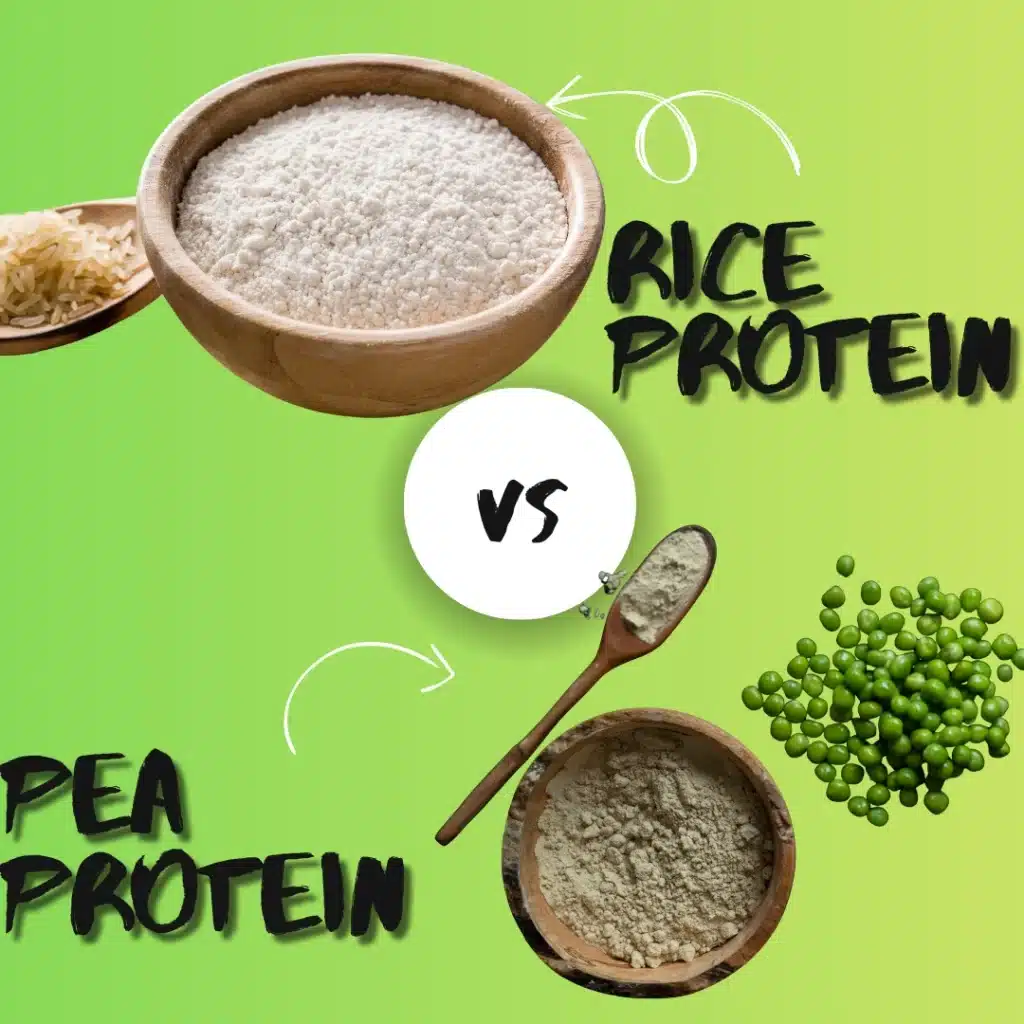
Rice protein is produced by concentrating or isolating protein from rice, commonly brown rice. Commercial materials differ in protein content, particle size, color, flavor, solubility, digestibility and contaminant specifications. A product described only as “rice protein” is not sufficiently defined for formulation or procurement.
Brands evaluating bulk rice protein specifications should request the protein test method, amino-acid profile, heavy-metal limits, microbiological limits, particle size, sensory profile and lot-specific certificate of analysis.
ピー・プロテインとは何か?
Pea protein is generally made from yellow peas and sold as a concentrate or isolate. It is widely used in powders, bars, ready-to-mix products and meat-alternative systems because it can provide high protein content and useful water-binding or emulsifying properties. Its flavor and viscosity can vary substantially by supplier and process.
比較する場合 bulk pea protein specifications, verify the declared protein basis, amino-acid profile, solubility, particle size, flavor, microbiology, pesticide and heavy-metal specifications rather than assuming all pea isolates perform alike.
Amino Acid Profile: “Complete Protein” Needs Context
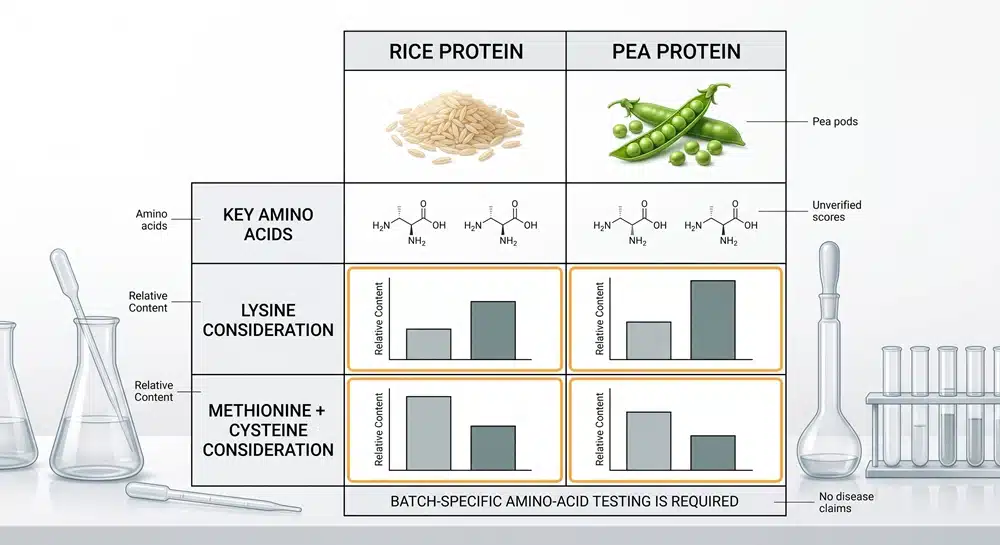
Rice and pea proteins contain all nine indispensable amino acids, but the proportions may not match a reference amino-acid pattern at every serving size. Rice protein is commonly discussed as relatively lysine-limited, while pea protein is often relatively lower in sulfur-containing amino acids such as methionine and cysteine.
The terms “complete” and “incomplete” can oversimplify formulation decisions. A meaningful evaluation should use the amino-acid content per gram of protein, the intended serving size, the relevant reference pattern and suitable digestibility information. The result may differ among suppliers, batches, cultivars and processing methods.
| Evaluation Point | ライスプロテイン | ピープロテイン | What the Formulator Should Do |
|---|---|---|---|
| リジン | Often the first amino acid to review | Often contributes more lysine than rice | Use the actual amino-acid assay, not a generic chart |
| Methionine + cysteine | May complement pea in a blend | Often requires closer review | Calculate contribution at the proposed blend ratio |
| ロイシン | Varies by material and protein concentration | Varies by material and protein concentration | Report the actual amount per serving before making performance claims |
| 総タンパク質 | Depends on assay method and nitrogen factor | Depends on assay method and nitrogen factor | Define method, basis and release specification |
Digestibility and Protein Quality: Avoid Generic Scores
Protein quality cannot be reduced to a single fixed score copied from another supplier or study. PDCAAS uses a protein digestibility correction and truncates scores at 1.0. FAO has recommended DIAAS as a more detailed approach because it considers the digestibility of individual indispensable amino acids at the end of the small intestine.
Published values can help with research, but they do not prove the score of a different commercial ingredient. Processing, antinutritional factors, heat exposure, cultivar, matrix and test method can affect the result. If a brand wants to publish a PDCAAS, DIAAS or “high-quality protein” claim, it should have evidence relevant to the actual ingredient or finished product and the target market.
Does a Pea and Rice Protein Blend Work Better?
A pea–rice blend can improve amino-acid balance, sensory properties or processing behavior, but the blend does not automatically become clinically superior, equivalent to whey or better absorbed than pea protein alone. A 2024 human study found that adding rice protein to pea protein did not increase postprandial aminoacidemia above pea isolate under the tested conditions.
Blend decisions should therefore start with a measurable product objective: amino-acid target, protein declaration, taste, viscosity, solubility, cost, serving size or supply resilience. Claims must match the final formula and should not be transferred from a study that used a different protein source, dose or processing method.
How Supplement Brands Should Set the Blend Ratio
- Obtain recent amino-acid profiles and protein assays for both proposed ingredients.
- Define the target protein grams and serving size of the finished product.
- Calculate indispensable amino acids at candidate ratios using the guaranteed or release values.
- Review digestibility evidence and avoid assigning a score that has not been established for the blend.
- Test taste, aroma, viscosity, foaming, dispersion, sedimentation and mouthfeel in the intended matrix.
- Confirm cost, MOQ, lead time, supply continuity and required certifications.
- Verify the finished product through potency, uniformity, contaminant and stability testing.
There is no universal 70:30, 60:40 or 50:50 ratio. The correct ratio is the one supported by the ingredient data and finished-product requirements.
Which Is Better by Product Goal?
| 製品目標 | おすすめのスタート地点 | 理由 | Validation Needed |
|---|---|---|---|
| Single-source pea protein powder | Pea isolate | Strong market familiarity and useful protein concentration | Flavor, viscosity, solubility and amino-acid declaration |
| Single-source rice protein powder | Rice isolate | Rice-forward positioning and different sensory profile | Grittiness, dispersibility, heavy metals and lysine context |
| Balanced plant-protein powder | Calculated pea–rice blend | Can complement amino-acid and sensory characteristics | Actual blend assay, digestibility evidence and finished-product testing |
| プロテインバー | Bench-test both or a blend | Water binding and texture change during shelf life | Hardening, water activity, flavor and package stability |
| Ready-to-mix beverage | Supplier-specific screening | Dispersion, foam and sedimentation are process-dependent | Mixing protocol, particle size, pH and sensory testing |
| High-protein gummy or novel format | Development study required | Protein can disrupt gel structure and water activity | Pilot trials, texture, microbial controls and stability |
Taste, Texture, Solubility and Mixability
Rice protein is not always smoother, and pea protein is not always grainier. Sensory performance depends on the supplier, protein concentration, particle size, hydrothermal processing, flavor system and finished-product matrix.
- Rice protein: evaluate dryness, cereal notes, grittiness, sediment and color.
- Pea protein: evaluate beany notes, bitterness, astringency, viscosity, foam and sediment.
- Blends: test whether one ingredient masks or amplifies the other ingredient’s sensory profile.
- パッケージング: verify moisture and oxygen protection because sensory quality can change through shelf life.
エビデンスと健康強調表示の境界
Selected studies have evaluated rice protein or pea protein in resistance-training contexts, but the findings are specific to the tested ingredients, doses, diets, participants and exercise programs. The 2013 study frequently cited on this topic compared rice protein isolate with whey—not pea protein with whey. A separate 2015 trial evaluated pea protein against whey and placebo.
These studies do not justify universal statements that pea protein builds more muscle than rice protein, that a pea–rice blend rivals animal protein in every use, or that either ingredient causes weight loss, improves heart health or provides immediate energy. Brands should describe protein content, amino-acid composition and product use accurately, and substantiate any finished-product structure/function claims.
Safety, Allergens and Tolerance
- Rice and peas are not among the nine major allergens that must be declared under U.S. federal law, but individuals can still be allergic to them.
- Do not use “allergen-free” or “hypoallergenic” without a defined basis and cross-contact review.
- Some people may experience bloating, fullness or digestive discomfort from a specific protein, flavor system, sweetener or total serving size.
- Rice-derived ingredients should have risk-based heavy-metal specifications, including arsenic where relevant to the ingredient and market.
- People with kidney disease, protein-restricted diets, significant allergies or complex medical conditions should obtain professional guidance before using concentrated protein supplements.
- Pregnancy, breastfeeding and pediatric products require formula-specific nutritional, safety and regulatory review.
確認すべき品質仕様
| 仕様 | 確認すべき事項 | なぜ重要なのか |
|---|---|---|
| 身元と出所 | Plant species, part, concentrate/isolate status, origin and traceability | Confirms the correct raw material |
| タンパク質含有量 | Assay method, nitrogen conversion factor, dry/as-is basis and lot result | Supports label calculation and supplier comparison |
| アミノ酸組成 | Indispensable amino acids per gram of protein or serving | Supports blend calculation and limits generic “complete protein” claims |
| Digestibility evidence | Study material, method and relevance to the commercial ingredient | Prevents unsupported PDCAAS or DIAAS claims |
| Physical and sensory | Particle size, bulk density, color, odor, taste, solubility and dispersibility | Predicts processing and consumer experience |
| 汚染物質 | Lead, arsenic, cadmium, mercury, pesticides and residual solvents where relevant | Supports risk-based ingredient release |
| 微生物学 | Total counts, yeast/mold and specified organisms | Supports safety and shelf-life control |
| Cross-contact | Allergen statement, facility controls and shared-equipment disclosure | Supports accurate labeling and supplier qualification |
| ドキュメント | Specification, lot COA, TDS, SDS, origin, non-GMO/organic/vegan certificates where claimed | Supports audits and finished-product claims |
| 安定性 | Protein assay, sensory, moisture, microbiology and packaging performance | Confirms quality through the proposed shelf life |
製剤および製造上の考慮事項
A plant-protein project should be qualified in the actual dosage form. GENSEI supports custom protein supplement manufacturing for powders, bars, capsules and other formats where the formula and process are technically feasible.
- Set protein per serving from the target market and product concept, not a generic daily dose.
- Use validated premixing and blend-uniformity controls when proteins are combined with low-dose vitamins, minerals or flavors.
- Evaluate flavor masking, sweetness, sodium, viscosity, foam and sediment before finalizing the label.
- Review packaging for moisture, oxygen and light protection.
- Use pilot and stability batches to confirm protein assay, sensory performance, microbial limits and physical integrity.
- Keep master manufacturing records, batch production records, supplier approvals and change-control documentation.
RFP Questions for Rice or Pea Protein Suppliers
- Is the material a concentrate or isolate, and what plant source and country of origin apply?
- Which protein assay method and nitrogen conversion factor are used?
- Can you provide three recent lot-specific COAs and amino-acid profiles?
- What are the protein, moisture, ash, pH, particle-size and bulk-density specifications?
- What solubility, dispersibility, viscosity, foam and sediment data are available?
- Which heavy metals, including arsenic where relevant, are tested and what limits apply?
- Which microbiological, pesticide and residual-solvent tests are included?
- What allergen and cross-contact controls apply at the exact facility?
- Are PDCAAS, DIAAS or digestibility claims supported by data on this ingredient?
- What are the MOQ, sample quantity, packaging, lead time and supply-continuity plan?
- Can you support pilot production and finished-product stability testing?
- How are muscle, recovery, weight-management, sustainability and “complete protein” claims reviewed?
GENSEIの活用シーン
GENSEI supports rice and pea protein ingredient sourcing, blend development, powder and protein-product manufacturing, packaging and quality review. Brands can GENSEIへのお問い合わせ with the target protein grams, format, flavor, certifications, testing requirements, order quantity and market.
よくある質問
Which is better, rice protein or pea protein?
Neither is universally better. Pea protein often contributes more lysine, while rice protein can complement sulfur-containing amino acids. The right choice depends on the actual specification, serving size, sensory target and dosage format.
ライスプロテインは完全タンパク質か?
Rice protein contains all nine indispensable amino acids, but lysine can be relatively limiting. Whether it meets a reference amino-acid pattern depends on the ingredient, serving size and digestibility evidence.
エンドウ豆のプロテインは完全なプロテインですか?
Pea protein contains all nine indispensable amino acids, but methionine and cysteine are often the amino acids that require closer review. Avoid treating every pea isolate as nutritionally identical.
Does mixing pea and rice protein make a complete protein?
A blend can improve amino-acid balance, but the result should be calculated from the actual ingredient assays. Mixing the names alone does not prove a specific amino-acid score or clinical advantage.
Is pea and rice protein better than pea protein alone?
Not necessarily. A 2024 study did not find higher postprandial aminoacidemia from the tested pea–rice blend than from pea isolate alone. Blends may still be useful for amino-acid balance, sensory design, cost or supply reasons.
Which protein is easier to digest?
Tolerance varies by person and product. Protein processing, serving size, flavor systems, sweeteners and other ingredients can influence digestive comfort. Do not assume rice is always gentler or pea is always harder to digest.
What blend ratio should a supplement brand use?
There is no universal ratio. Brands should calculate ratios from lot-relevant protein and amino-acid data, then validate taste, solubility, processing, contaminants and stability in the finished product.
最終的な収穫
Rice protein and pea protein are useful plant-protein ingredients with different amino-acid, sensory and functional profiles. Pea can contribute lysine; rice can complement sulfur-containing amino acids; and a blend may improve a formula. Responsible selection requires lot-specific assays, relevant digestibility evidence, sensory testing, contaminant controls and finished-product validation—not generic claims that one source or blend is automatically complete, superior or equivalent to whey.
参考文献
- FAO: Dietary Protein Quality Evaluation in Human Nutrition
- NIHサプリメントオフィス運動と運動能力
- Postprandial Aminoacidemia Following Pea, Rice and Pea–Rice Protein Intake
- Amino Acid Composition and Protein Quality of Plant Protein Isolates
- Rice Protein Isolate Compared With Whey Protein After Resistance Exercise
- Pea Protein Compared With Whey Protein During Resistance Training
- FDA: Food Allergies—What You Need to Know
- FDA:構造・機能に関する主張
- FTC:健康関連製品のコンプライアンスに関するガイダンス
- 21 CFR 第111部:栄養補助食品の適正製造規範(cGMP)

ウォーレン・ワン氏は、栄養補助食品のサプライチェーンにおいて豊富な経験を持つベテランの専門家であり、コラーゲンペプチド、骨スープ由来タンパク質、ケラチンといった主要成分の研究、開発、工程管理、およびグローバルな調達において、豊富な実務経験を有しています。 本コラムの執筆者として、彼はマーケティング的な装いを剥ぎ取り、難解な成分科学や製造品質管理基準を、分かりやすい本格的な科学普及記事へと変換することに尽力しています。これにより、読者がラベルの裏にある真実を理解し、より合理的な健康に関する選択を行えるよう支援しています。.